[Photographs; India]Biblio.com
3 242 résultats
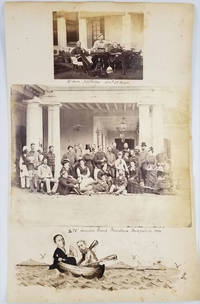
1877réf. 24159Bangalore India 1877. Very good condition. Four large albumen photographs with pen and ink decoration surrounding them of the famed Victorian light cavalry regiment known as the Hussars in India. The albumen photographs on the front are: a portrait of three relaxed officers lounging in uniform on the terrace of a colonial building in India captioned in ink in a period hand "McBurn Capt. Malone and Hon.ble H. G. Gough". The two men at the left wear small round caps; the man at the right sits with one leg flung over the arm of his chair. The second image is a large group portrait of the regiment in civilian dress including wives and Indian servants at the colonnaded facade of an imposing building captioned "XIV Hussars Group Mess House Bangalore 1877". Below this image an unidentified member of the regiment and his wife are portrayed in a charming pen and ink cartoon of the couple in a row boat with a clipped photo of their faces pasted in. On the verso an impressive private residence with British women waiting in a horse drawn carriage at the portico and Indian servants is captioned in period ink "General Macintyre's House Secunderabad". Below is another image of a grand residence with a curved façade on which is painted a sign "The Deanery 1877". It is captioned in period hand "Mr. Dean's house. North Trimulgherry". Both of these large albumen photographs are decorated with hand drawn pen and ink borders. According to an autobiography by Edwin Mole entitled 'A King's Hussar: Being the Military Memoirs for Twenty-five Years of a Troop-sergeant-major of the 14th King's Hussars' the regiment's horses were being newly imported from Australia. The new hardier breed dubbed "Walers" were imported from New South Wales to replace the existing stock from England which was suffering in the harsh climate. Sgt. Mole was sent to Australia as part of a commission to supervise the breeding of the stock of "Walers". The four prints laid down on card stock 11 ½ x 18". 3 of the 4 albumen images 11 ¼ x 9; one image 5 1/2 x 4" unknown
2021réf. AME_9781774078006Delve 2021. UNKNOWN. Hardcover. New/New. _ Delve hardcover
1967réf. 510373Oxford University Press 1967. Leather. NEAR FINE. Large 8vo 10.5x8.1.25' India Paper Smyth-sewn and bound in brown GENUINE COWHIDE leather gilt edges gilt-tooled turn-ins place ribbon thumb indexed dual column with center-column references and footer notes. Large print with generous spacing and wide margins for notes. Owner's name imprinted to front cover pristine otherwise dedication blank entirely clean and sharp with no markings and crisp unused pages. A very uncommon setting. Oxford University Press unknown
2021réf. AME_9781774077566Delve 2021. UNKNOWN. Hardcover. New/New. _ Delve hardcover
1911réf. 21630London: A & C Black. Very Good-. Second Edition. Hardcover. Boards with light rubbing to extremities. Minute tears to spine ends. Former owner's name on front free endpaper. Mild occasional foxing.; Dark red boards with ornate design in blue light red and yellow. Gilt lettering and top edge gilt. 70 color illustrations from watercolors by Major E. Molyneux. Folding map of Kashmir Valley at rear. 20 Shilling Series. Inman 49.; 8vo 8" - 9" tall; xv 283 map 4 pages . 1911. A & C Black hardcover
2020réf. DBS-9781774071793Delve 2020. 1ST. Hardcover. New. Delve hardcover
2020réf. DBS-9781774071793Delve 2020. 1ST. Hardcover. New. Delve hardcover
1888réf. 040755London: Spencer Blackett 1888. xi 388pp 8 bw ills. Or green gilt cloth with title and elephant in gilt. Cloth lightly rubbed at edges front hinge a little tender. A nice clean copy. Originally published in 1881 this undated second edition 1888. Lots of hunting tiger and other military comment social comment and information on the various states. . Second Edition. Hard Cover. Very Good. Illus. by The Author; Burton Miss C.G.M. 8vo. Spencer Blackett Hardcover
réf. BN372350EXPLORING NORTHEAST THE SEVEN PRISTING PEARLS OF INDIA Hardcover Jan 01 2017 NA Hardcover Jan 01 2017 NA Hardcover EXPLORING NORTHEAST THE SEVEN PRISTING PEARLS OF INDIA Hardcover Jan 01 2017 NA Hardcover Jan 01 2017 NA Hardcover EXPLORING NORTHEAST THE SEVEN PRISTING PEARLS OF INDIA Hardcover Jan 01 2017 NA Hardcover Jan 01 2017 NA Hardcover hardcover
réf. 53106757-nnew. unknown
réf. 53106757like new. unknown
1929réf. 151011929. Act No. XIX of 1929 Passed by the Indian Legislature.An Act to Restrain the Solemnisation of Child Marriages 1929 records the enactment of the Child Marriage Restraint Act an early statutory attempt in British India to restrict marriages involving children. Receiving the Governor-General's assent on October 1 1929 and taking effect April 1 1930 the Act defined a "child" as a male under eighteen or a female under fourteen and imposed criminal penalties on adult men contracting child marriages and on persons performing conducting or directing such marriages. The legislation is commonly associated with reformer Harbilas Sarda and became known as the Sarda Act. Act No. XIX of 1929 Passed by the Indian Legislature.An Act to Restrain the Solemnisation of Child Marriages. 1929. Pamphlet. The text specifies the "punishment for male adult below twenty one years of age marrying a child" the "punishment for male adult above twenty one years of age marrying a child" and the punishment for "solemnising a child marriage." Under the original Act a male between eighteen and twenty-one who contracted a child marriage could be fined up to one thousand rupees; a male over twenty-one could receive up to one month of simple imprisonment a fine of up to one thousand rupees or both. Comparable penalties applied to a person who performed conducted or directed a child marriage. The pamphlet preserves the statutory language by which the colonial legislature sought to regulate marriage age through penalties imposed upon adult participants and officiants. The Act preceded later Indian legislation that progressively raised legal marriage ages and strengthened protections against child marriage. Its provisions document an early legislative attempt to intervene directly in the solemnization of marriages involving children and to assign legal responsibility to adult husbands and those conducting such marriages. unknown
1959réf. 164581959. Chand Kailash. An Appeal to Members of Parliament of India and the World at Large 1959 a public petition challenging the legal and social preference for paternal lineage in India and advocating the right of individuals to identify through their mothers. Addressing members of the Indian Parliament and an international audience Chand argued that recognition of maternal descent would advance women's equality while eliminating the stigma attached to children born outside marriage. His appeal followed his efforts to establish through India's courts the right to identify with his mother's lineage rather than his father's challenging prevailing conventions governing family descent legitimacy and the legal standing of mothers. Chand Kailash. An Appeal to Members of Parliament of India and the World at Large. Bombay: Society for the Cause of Mother's Lineage Theosophical Colony 1959. One sheet printed on both sides measuring 10 x 7.75 inches. The handbill presents Chand's arguments for recognizing maternal ancestry as an alternative to patrilineal descent. Central to his proposal was the contention that children should be entitled to their mothers' lineage regardless of their parents' marital status thereby removing distinctions that subjected children born outside marriage to social discrimination. Issued under the auspices of the Society for the Cause of Mother's Lineage the appeal sought support for changes in the treatment of ancestry and legitimacy under Indian law. Published during the first decade following India's independence the appeal addressed questions of family law and women's legal status amid continuing debates over marriage inheritance and social reform. The Hindu Marriage Act of 1955 and the Hindu Succession Act of 1956 had introduced major changes to Hindu personal law although customary preferences for paternal descent remained influential. Chand's 1959 petition advanced a distinct proposal: recognizing maternal lineage as a means of challenging both the subordinate status of women in family relationships and the discrimination faced by children classified as illegitimate. Blue pen check marks on the second page and horizontal folds. In very good condition. unknown
1923réf. 85606Calcutta: Printed at the Photo-Litho. Office Survey of India 1923. Paperback. Very Good. 7 maps 1- 13-61p. Softcover in original wrapper. 34cm. Modest cover staining and wear. Printed at the Photo-Litho. Office, Survey of India paperback
réf. 49447127-nnew. unknown
réf. 49447127like new. unknown
1908réf. 3165Freiburg IM Breisgau: Herdersche Verlagshandlung. Very Good. Hardcover. Extremely light rubbing to outer spine hinges and to top and bottom spine. Else NF; An outstandingly beautiful set. Decorative sandy boards with gilt lettering and pictorial design in color. Marbled edges. Handsome endpapers with green design. Numerous plates from photographs. Index. Both volumes with rear fold-out map in color; 8vo; 456 403 pages . 1908. Herdersche Verlagshandlung hardcover
2021réf. BN70850Knesebeck 2021. 2021. Pasta fantastica: Spektakuläre Nudeln einfach selber machen. Selbstgemachte Pasta wie in Italien Spektakuläre Nudeln einfach selber machen Knesebeck hardcover
2003réf. BN513501Pavilion Books 2003. 2003. Island Life. Inspirational Interiors. Island Life. Inspirational Interiors. Interieur - India Hicks David Flint Wood and Ralph Lauren Pavilion Books unknown
2022réf. x-1032107243Routledge 2022. Hardcover. New. 288 pages. 9.00x6.00x0.82 inches. Routledge hardcover
réf. 23811‘The Hague / November 28th. 1860’. An excellent letter in which a serving Victorian ambassador discusses the nature of diplomacy and gives a vivid assessment of his former superior Sir Hamilton Seymour whom he jokingly characterizes ‘the great Elchee’. See both men’s entries in the Oxford DNB. 7pp 4to. On two bifoliums. In good condition lightly aged and with creases from folding into a packet. Minuted on reverse of last leaf. Addressed to ‘The Honble. George Elliot’ he received his KCB in 1862 and headed ‘Private’. Beginning on the subject of his brother-in-law Henry Lockwood 1825-1882 Napier writes: ‘My dear Elliott Many thanks for your kind letter informing me that Lord John Russell had moved Lockwood from Constantinople to Stockholm. It must be in many respects a great advantage to Lockwood and he will be very grateful to Lord John for the change. I hope that my brother in Law did not incur any blame from being involved in the dissensions of the Constantinople Embassy. I do not know all the circumstances indeed I have heard one side much more than the other. The malignant atmosphere of the place could not have been more strikingly shewn than in a musunderstanding between a most amiable Minister and a very devoted and agreeable subordinate. Such at least was Lumley to Sir Hamilton when I knew him.’ Napier had served as first secretary to Sir Hamilton Seymour in St Petersburg with John Lumley-Savile the future Lord Savile as second secretary. Napier considers Lumley as secretary to the Constantinople ambassador Sir Henry Bulwer is in Napier’s view ‘most in the wrong. Bulwer has a natural fondness for the twilight in business matters and this fanciful partiality for secrecy and winding may have led him to keep some things close from his Secretary’. After a comment on Lords Cowley and Shatford he continues: ‘The great Elchee never gave me a key or shewed me a Dispatch but when I wanted to know anything I would go to his room and talk to him about George Canning or the greek Revolution; or Sophocles or the Emperor Nicholas. Shaking such provocations in the face of that furious genius he would rowse up and open the flood gates of his conversation one thing led on another and at length he had disburdened himself of the past the present and the future. I was young and liked the humour of the thing besides I admired the old man angry so intense so handsome so austere so like Cato outside. And we cannot deny them generous sympathies and great services. Cowley Henry Wellesley 1st Earl Cowley who had been Minister Plenipotentiary was older and more than even on a foot of equality. He could not ever abide him. In fact your Secretary seems the natural enemy of his Chief. Please God I may not find it so if I ever become an Ambassador.’ Over two pages he discusses the ‘most just and wise regulations’ of the Foreign Office and what may happen ‘if your Ambassador is as wild as Nebuchadnezar and your Secretary not as discreet as Daniel’ before continuing: ‘You must have observed that Diplomacy is becoming a caste that we are a sort of Brahmins. Every man has a son in the possession. The diplomatic qualities will become progressive and hereditary. The Children will be wiser than their fathers. I have myself a son who is as smooth as Jacob and who never smiles unless he meets another young augur.’ He jokes: ‘You must be prepared to have an application soon for an unpaid attachéship. My second son is turbulent. I intend him for a naval reformer. I suppose your brother Henry has some of the same.’ This leads to a discussion of Elliot’s wider family the Mintos and the jesting reproach: ‘You are allowing Elcho and The Duke of Argyle to run away with the sympathies of Scotland. This must not be. There will not be a piece of bannock left in the land for a true Whig.’ ‘The Hague / November 28th. 1860’. unknown
réf. 24493‘Treasury. / 8 Dec 1882’. See his entry in the Oxford DNB. 3pp 12mo. Bifolium. In good condition lightly aged with thin neat strip from windowpane mount adhering to edges. Folded twice for postage. Twenty-four hands of text in secretary hand addressed to ‘W. A. Lock Esqre’ and signed in autograph ‘Sir C Trevelyan’. He thanks him for his ‘very interesting Letter’ and hopes he will ‘never think it necessary to make any excuse for writing to me other such’. He has asked ‘Mr. Farr’ for ‘any observations he might have to offer on the early part of it; and his answer is enclosed’ not present. The following paragraph reads possibly with regard to women’s suffrage: ‘What are we to do with our “monstrous Regiment” of Women Is there any remedy short of polygamy’ He turns to the subject of ‘German Immigrants’ on which he has an unusual view: ‘what are we but improved Germans We are Germans disciplined & trained by the Normans and by a long enjoyment of free institutions & of a maritime & Colonial System’. See image. ‘Treasury. / 8 Dec 1882’. unknown
réf. 20044Clarendon Hotel 24 April 1850. Four pages 12mo good condition. "I have just received from Ceylon a formal evaluation of my coffee property. The sums stated ampount to £8471 & as there is upwards of 800 acres of uncleared forest which is valued at £2 peracre the whole amount will be upwards of £10000. I send the paper in hopes it may enable your froiend . to effect a sale. His correspondent from Ceylon has enclosed a report "made by a Mr Simon Keir and Mr. George Hamilton Dundas" Keir Dundas & Co. were the "largest agency house" in Ceylon c.1850s" He continues " The sender of the Report is quoted as saying "I would still strongly advise that you put up the whole place to auction make the time of payment easy and surely you will get this low estimation value". Maddock then discusses the possibilites for the nauture of the sale instalments half shares etc "but I should prefer washing my hands of the troublesome speculator altogether and would only consent to a parnership with any one for the sake of the advantage of placing the management in the hands of one interested in the prosperity of the whole concern. The expenses are now so much reduced that I trust if I am compelled to keep this property and no peculair misfortune happens next season like the deficiency of coolies last year and a visitation of the Bug this year that it will yield a considerable income. The field that suffered most from bug is said now to be showing a prospect of 100 bushels an acre." He asks to be referred to anyone who might help when he arrives in London." Note: Wikipedia describes this period as a golden age of investment and profit etc peaking in 1870. Clarendon Hotel, 24 April 1850. unknown
1826réf. AA1372Edinburgh: Oliver & Boyd 1826. First. Very Good. A very good copy of this scarce study of the origins of English words Rebound in brown cloth with gilt titles on spine Ex-library but other than the gilt accession number at the base of the spine and slight paste residue on the ffep there are no other indications of its library ownership Binding is quite tight and sound There is an ink inscription on a fly leaf from the author's son Major later Major General Thomson dated Montreal 1842 and a vintage newspaper clipping about English word usage is affixed to the same page Text is age darkened There are a few minor pencil and ink annotations throughout and on the rear fly leaf but no other marks or damage to text at all A nice copy of a very uncommon volume there were recently fewer than a dozen copies found on OCLC Major-General Francis Ringler Thomson R E 1794-1863 was the son of the author He joined the Royal Engineers in 1812 and served many assignments in France and across the Empire including Ceylon Gibraltar Canada and Malta A Major in Canada when he inscribed this book in 1842 he continued to rise through the ranks and was eventually promoted to Major General in 1856 Unpaginated but approx 200 pp. Oliver & Boyd unknown