[SURVEY OF INDIA OFFICES].Biblio.com
3 242 résultats
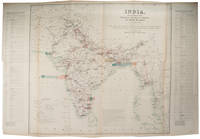
1891réf. 173786London.: Her Majesty's Stationery Office. 1891. Large folding map 64.7 x 71.7cm map size 67.5 x 100cm sheet size with railway gauges highlighted in original colour three small tears without loss along the folds and two longer fold tears strengthened on the verso without loss the left margin of the sheet chipped with some overall toning but a striking map in good condition. Impressive large map from the exhaustive Survey of India with the burgeoning railway network highlighted in attractive detail. A lengthy gazetteer listing "Principal centres of traffic showing goods and passenger traffic separately and combined" is printed either side of the map. . [Her Majesty's Stationery Office]. unknown
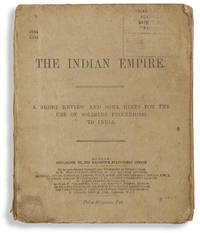
réf. 117119London HMSO 1917. . 24 mo 13 x 11 cm; 7 plates at end folding map in pocket at rear Indian Military Base stamp to upper wrapper; publisher's brown paper wrappers lightly soiled slight wear to extremities spine at some point torn and glued back down a good copy; 130 pp 23 pages ads. The 1917 issue of this handbook issued originally in 1912 to prepare British soldiers for deployment in India. Chapters cover the geography history culture religion languages government climate and with several devoted to the British and Indian armies and fighting classes. The plates depict the military uniforms of the Baluchis Pathans Madrasi Sepoys Tamils Punjabis Sikhs Gurkhas and Rajputs. The 1917 issue appears expanded as it has 130 pages compared to the 1912 and 1913 issues which have 119 pages. This issue is only in 15 libraries worldwide and only in three UK libraries Manchester Oxford Brookes East Anglia and not in BL which only has the 1912 and 1913 issues. London, HMSO, 1917. unknown
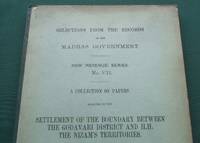
1912réf. 012636Madras: printed by the Superintendent Government Press 1912. 3 volumes. Books measure 33.5x21.cm. Collation v147pp 468pp large folding plan 472pp large folding map. Bound in original publishers cloth backed printed boards. Covers lightly rubbed age darkened title in manuscript on spines library label and sold stamp on top boards. Bindings in good firm condition. Internally occasional library mark/stamp. Pages and plan/map in very good clean condition. Good solid clean volumes. Hardcover. Good Plus. Quarto. printed by the Superintendent Government Press Hardcover
1921réf. 012280Lashkar: Printed at the Alijah Darbar Press 1921. Book measures 33x21.cm. iv 3441pp. Bound in original publishers cloth backed printed boards. Binding lightly rubbed bumped age darkened library label on top baord. Binding in good firm condition. Internally occasional library stamp cancellation stamp. Pages in good clean condition. A good solid copy. . Hardcover. Near Very Good. Quarto. Printed at the Alijah Darbar Press Hardcover
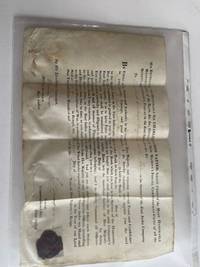
réf. 2687430 July 1850. Vellum Document 40 x 25cms bottom edge sl. crumpled faint water stin lright margin text clear and complete. With Seal. SIGNED by General Sir Charles James Napier Commander-in-Chief in India and J.P. Kennedy John Pitt Kennedy Military Secretary East Indies see Wikipedia entry a productive life. See Image. 30 July 1850. hardcover
réf. 1655331 January 2 May and 3 October 1822. All three from East India House London. The three items in fair condition on lightly aged and worn paper. All three addressed to 'My dear George' and one with valediction from 'your affectionate Father'. The letters are described below in reverse chronological order. ONE: AL. 3 October 1822. 8pp. folio. A long letter on two bifoliums half of which describes an interview between Bosanquet and the new Foreign Secretary and future Prime Minister George Canning in which Bosanquet presses his son's case for preferment within the diplomatic service George was at the time attached to the British Embassy in Paris and would rise to the post of chargé d'affairs at Madrid 1828-1830. Bosanquet begins by stating that he has had the meeting with 'Mr Canning' George Canning 1770-1827 and 'was received with apparent great cordiality. I congratulated him on his late appointment as Foreign Secretary on 13 September & told him that as I considered Lord Londonderry i.e. Castlereagh the previous Foreign Minister who had committed suicide on 12 August 1822 as the real minister of the country he had I considerd sic stept into his shoes & that he had a great & important business to perform but that I might say I felt that he stood in an awful & difficult situation - that the winds would blow very hard in the next year & that if through his means we could weather the storm alluding to his song upon Pit sic being the man who had weathered the storm all the nation would be indebted to him - This seeme'd to please him much'. He tells Canning that 'the country was in the most wretched state that the agriculturalist had lost at least 1/3d I thought half of their capital that considering this capital was at least 3 hundred millions it was a fearful moment'. As the conversation proceeds Canning states that they 'think alike upon this subject'. He drops his 'preliminary discourse' and states to Canning 'many points relative to Turkey'. Canning introduces Bosanquet to Sir Joseph Planta 1787-1847 with whom he intends to 'settle the subject'. Bosanquet tells him that he has 'lost a friend in Lord Londonderry - that he had plac'd you in your present situation & I had hopes he would have protected you in it' and that he hopes Canning will do the same. Canning 'seemed to draw up more than I expected upon this'. He enumerates the 'load of applications & remembrances' he has received stating that they cannot 'all be satisfied'. Bosanquet continues to press his son's case stating that he does not 'ask for a life of idleness' and that he is 'not fitted for such a slave as I knew any inferior retainer of Government was'. As the conversation proceeds Canning discusses one of the Paris attaches - 'I have forgot his name that had been recommended by Sir Charles Stewart sic for Sir Charles Stuart 1779-1845 British Ambassador in Paris and hence George's boss- he was the person I imagine whom you supposed Sr. Charles would have taken to Vienna if he had you there'. The 'conference' with Canning over Bosanquet speaks to Planta whom he finds 'a most Gentlemanly person - he speak sic plain - which I like - He was almost the right hand of Lord Londonderry & will I dare say be so to any person who fills the office of Foreign secretary - he has risen by his merit alone & is very unlike Hamilton i.e. William Richard Hamilton see next letter'. He tells his son he realises that there is nothing to give him 'much pleasure in this long detail' and advises him to 'stay as long as you can be useful at Paris - What will be the result of all Political measures that are going & will go on no person can tell or foresee - I have been trusted and was consulted when it was thought I could be of use & it may be the case again'. He concludes in praise of Castlereagh and with a little domestic news. TWO: ALS. 31 January 1822. 5pp. 4to. With a further page of mathematical calculations. The first part of the letter concerns an untraced pamphlet 'suppos'd to be written by Mr Hamilton William Richard Hamilton 1777-1859 antiquary and diplomat under the immediate superintendence of Lord Londonderry' which he is sending him. Bosanquet is critical of this which he regards as 'evidently the ministers manifesto'. 'Hamilton is I understand certainly to go to Naples as envoy I wish I could hear of your going somewhere.' He continues on the topics of his 'chimney business' and 'an agricultural meeting at Hertford on Fryday sic'. THREE: ALS. 2 May 1822. 4pp. 4to. He is forwarding the answer of 'Thomas' to questions he posed him on the subject the recipient posed to him in a letter. Regarding the economic crisis in England he writes: 'Here we are struggling with difficulties of every kind of which agricultural distress is the most prominent Whether it will lead to any thing like parliamentary reform I dont know - but I should not be at all surpris'd if it were to prepare the way for something & I think our constitution is something like a stocking if a stitch runs & is not stopt immediately there is no saying where the <rip> will end. We know by the example of Dr. Jno <Colpeper> Stocking that a silk stocking may be darn'd into a worsted one or vice versa.' He has just returned from a 'Bank of England meeting where it has been resolv'd that one of their privileges should be given up viz "that no banks shall be established with more than 6 partners" - as far as relates to 60 or 65 miles from London when now the number of partners will be unlimited'. He discusses this with reference to 'the monopoly of the old Lady in Leaden Hall Street i.e. the East India Company'. 31 January, 2 May and 3 October 1822. All three from East India House, London. unknown
réf. 20045Paris 20 March 1817. Four pages 12mo very good condition. His correspondent's letter eventually reached him in Paris where he'd resided since the last August "in coinsequence of my son-in-law the Baron de Montalembert being appointed by the French Government Minister at the Court of Wurtemberg . but political reasons and the difficulty of procuring a suitable house in that small capital have hitherto prevented our joining him." His daughter has to go through a "Municipal marriage" under the Napoleonic Code to establish her children's legitimacy. They plan to return to Stuttgart for a time then return down the Rhine with his grandson to Brussels and then to England. "I shall then make you one of my earliest calls at the British Museum when I trust I shall find you well - illness and the sad state of my daughter's health . prevented my visiting any of my friends except the day that I did underlined twice call on Mr Planta yourself & Mr Combe . In the meantime have the goodness to add my name to the list of your subscribers for 2 copies of your interesting work of sic the ruins of Babylon - I fear I have no way of sending the amount from here - I assure you I am always happy to have the pleasure of seeing or hearing from you - & particularly wished it during the publication of the Oriental Memoirs - but you were tehn generally out of town & I believe not in good health ." Note: Claudius Rich Author of: 'Memoir on the Ruins of Babylon' 'Mines de l'Orient' reprinted London 1815; 'Second memoir on the ruins' London 1818 Paris, 20 March 1817 unknown
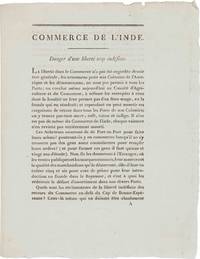
1790réf. 47670Paris: Didot 1790. Brief work cautioning against too much freedom of trade with the East Indies. Three copies in OCLC at the John Carter Brown Library and the national libraries of France and Australia. Quarto on a folded folio sheet. Old fold lines. Minor soiling. Very good. Untrimmed. unknown
1952réf. 052344India: Autograph note: Paper for the International Congress of Sociology Istanbul Session 1952 1952. Soft cover. Very Good. 4to - over 9¾ - 12" tall. Original typed paper by Mukerjee with some autograph corrections in text andsignature. 4to. 30 x 24 cm. In English. 21 p. Type paper with autograph corrections and signature. Signed 'Radhakamal Mukerjee'. Paper for the International Congress of Sociology Istanbul Session. Watermarked 'Glorious Bond' paper made in Sweden. Mukerjee a leading thinker and social scientist of modern India was Professor of Economics and Sociology and Vice-Chancellor of the University of Lucknow. Mukerjee played an important and constructive role in the Indian independence movement. He was a highly original philosopher of history and a discerning interpreter of culture and civilization and a 1962 recipient of the third highest Indian civilian honour of the Padma Bhushan. Mukerjee was the son of a barrister in Baharampur West Bengal a city located some 185 km north of Kolkata. He grew up in a household with a scholarly focus and a library devoted to history literature the law and Sanskrit texts. After attending Krishnanagar College he gained an academic scholarship to Presidency College under the University of Calcutta. He earned his honours degrees in English and History. Mukerjee opened the discourse of the Ashtavakra Gita into English with his posthumous work published in 1971. Mukherjees theory of society sought to explain the values of civilization. In sense Radhakamal was a pioneer of transdisciplinary approach in science. Radhakamal Mukerjee emphasized interdisciplinary disciplinary approach towards the understanding of life. Mukerjee sought to break the barriers between physical sciences and sciences relating to persons aspects. He was a pioneer of Sociology in the 1900s. Wikipedia. [Autograph note: Paper for the International Congress of Sociology, Istanbul Session], 1952 paperback
2020réf. BN561234Taylor & Francis Ltd 2020. 2020. Hardcover. Component-Based Software Engineering Component-Based Software Engineering Umesh Kumar Graphic Era Deemed to be University India Tiwari Santosh Graphic Era Deemed to be University Dehradun India Kumar Taylor & Francis Ltd hardcover
1972réf. ZB394333National Institute of Sciences of India 1972-1995. volumes 3-4; 11; 17-19; 24; 26. 1972-1995 complete volumes partly bound library markings textually clean & tight PRICE IS FOR THE LOT. - If you are reading this this item is actually physically in our stock and ready for shipment once ordered. We are not bookjackers. Buyer is responsible for any additional duties taxes or fees required by recipient's country. Photos available upon request. National Institute of Sciences of India unknown
1914réf. 180951914. Certificate awarded to the Vicereine of India Lady Hardinge of Penshurst upon her visit to the Indraprastha Hindu Girls School in Delhi. 1914. Measures 10" x 16" inches. Text enclosed in ornately decorative box with the school's seal centered at the top reading "The Hindu Girls School Delhi First deserve then desire 1904." The certificate's attractive green script reads in part "To her excellency Lady Hardinge of Penshurst May it please your Excellency It is with feelings of the profoundest joy and gratitude that we to-day welcome Your Excellency to the Indraprastha Hindu Girls School Delhi.Your Excellency's loving interest in the advancement of the women of this land and motherly affection for the children your care for the suffering poor the exemplary fortitude which you have shewn in the time of danger and the heroic devotion to your husband--our ideals of womanhood--have endeared your name to every woman and child in India and we pray you to accept our reverential and warm-hearted welcome to-day." Lady Hardinge of Penshurst Winifred Selina Sturt married her first cousin Henry Sturt a racing magnate and close friend of Edward Prince of Wales. She served as a Woman of the Bedchamber to the Princess of Wales before her husband by then a Baron was named Viceroy of India. The concurrence of monarchical rule and colonialism put aristocratic families with close ties to the royal family put aristocratic Europeans in positions of power worldwide no matter their qualifications. The family moved to India where Lady Hardinge worked to advance women's education. She was instrumental in starting the Lady Hardinge Medical College in Delhi the first medical school exclusively for women in India. She died in November of 1914 just 8 months after receiving this certificate. Signed by the school's President Lady Superintendent and Secretary. Creased along lines where paper was folded. 3 small holes along left side do not affect text. 1" tears along top do not affect text. Tape attached to verso. Very good condition. unknown
2016réf. x-149396416XSpringer Verlag 2016. Hardcover. New. 443 pages. 9.25x6.25x1.00 inches. Springer Verlag hardcover
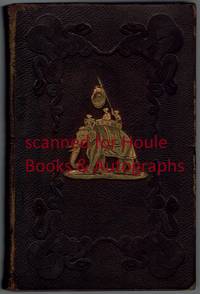
1835réf. 8652First edition. Octavo. Descriptive account by Rev. Hobart Caunter. 22 engravings from original drawings by William Daniell. 263 pages 4 pages of advertisements. Original gilt and blindstamped dark brown morocco spine with gilt stamped design of a palm tree and camel covers with gilt stamped vignette of 3 men riding on an elephant surrounded by blindstamped border of intertwined snakes a.e.g. rubbing to extremities. Very good. No foxing. Binder's ticked of F. Westley. Bookplate of H. Scofield and C.W. Nicolay with Nicolay's ink signature dated 1835. Bull and Churton hardcover
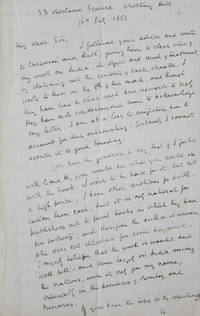
1861réf. 30491033 Norland Square Notting Hill 1861. 4pp. 12mo. Old folds. 4pp. 12mo. Born in Bombay in 1799 Duncan was the illegitimate son of the Governor of Bombay. Duncan's father's wealth enabled him to pursue a literary life and he published regularly from 1825-57. He summarises the work thus: "The object of this book is to enable those who have never studied India to acquire a knowledge of its institutions with the best possible expenditure of time." A book on India would be seemingly inevitable for a writer with his background yet the work described here was seemingly never published. unknown
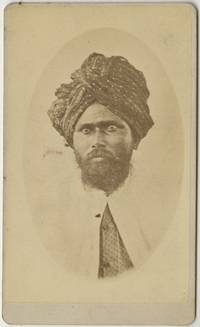
1880réf. List3871Philadelphia Pennsylvania 1880. Carte de visite measuring approximately 2 ½ x 4 inches. Albumen portrait of an Indian man wearing a turban and white garment mounted on photographer's card. Printed verso headed "India Missionary Photographs" advertising copies of "this and other India photographs printed by first-class artists in Philadelphia from negatives taken in India" sold for the benefit of foreign mission work. Addressed in print to Rev. A. D. Rowe York Pennsylvania or Miss Alice Geiger Secretary Woman's Missionary Society Springfield Ohio. Light wear and toning; very good. A carte de visite portrait from a series of India missionary photographs printed in Philadelphia from negatives taken in India and sold to raise money for foreign mission work. The verso offers the photographs in card and cabinet sizes with prices for single copies small groups and lots of one hundred suggesting that the images were intended for circulation among church members missionary supporters and women's missionary societies. American missions in South Asia were less politically dominant than British missionary work there but were active throughout the nineteenth century especially through Congregational Presbyterian Baptist Methodist and women's missionary societies. By the later nineteenth century American mission networks in India supported schools medical work printing itinerant preaching and fundraising efforts at home of which photographic cards like this were one small part. A strong nineteenth-century missionary CDV especially for its printed verso documenting the reproduction pricing and circulation of South Asian photographs through American foreign mission networks this being the first example we have encountered with a South Asian subject. unknown
1911réf. 21538London: A & C Black. Very Good. First Edition. Hardcover. Slight fading to gilt lettering and decoration on spine. Hinges and front board near outer hinge professionally repaired. A handsome copy with a bit of browning to the last few pages and with a new front free endpaper.; Top edge gilt. Turkois boards blindstamped along edges. Gilt lettering to boards and spine and with gilt vignette. One of the most decorative books by A & C Black. 72 tissue guarded watercolors by the British military artist A. C. Lovett. This is the very rare first edition with gilt lettering and spine lettering and top edge gilt. Inman 39.; 8vo 8" - 9" tall; 224 pages . 1911. A & C Black hardcover
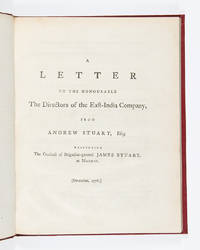
réf. 123245London 1778. . First edition; small 4to 24.5 x 19 cm; modern quarter red morocco gilt rolled red cloth boards spine lettered in gilt all edges speckled red a fine copy; ii 83 vi pp. An important letter appealing to the East India Company in regards to the controversy surrounding the arrest of George Pigot 1719-1777 Governor of Madras in 1776. As soon as Pigot arrived in Madras he was at odds with the the majority of his council members. This resulted in a legal wrangle where Pigot tried to reinstate the lands of the Rajah of Tanjore without approval. He refused to sign documents in several highly strung meetings and was eventually arrested by Brigadier-General James Stuart as ordered of a majority of the council and died in captivity in 1777. This pamphlet was written by James Stuart's brother as a defence of his actions for which he would eventually be pardoned in a court martial in 1780. Pickett 1137. [London], 1778. hardcover
1792réf. 911831792. London. 1792. Dark green cloth gilt type to spine. Sugar report 64 pages followed by six appendices 1789-1790; together with "Thanks to Lord Cornwallis and the Officers Serving in India" and debate 1793 161 pages;"Regulations Proposed to form the By-Laws" 27 pages; "The Debates at the East India House on the 18th of June 1794 on the Consideration of the Report of the Committee of By-Laws and on Mr Twining's Motion . . . " reported by William Woodfall with an Appendix containing letters etc. necessary to elucidate the subject 1794 52 pages; "The Debates at the East India House on Wednesday the 21st of January 1795 on the mode of forming into a by-law Mr Twining's motion . . . which had been carried by Ballot and also on the subject of the Company's Shipping" reported by William Woodfall 1795 134 pages. Corners a little bumped spine and margins of boards sl. damp-mottled edges of boards rubbed. A few marks in blue and red pencil to title-page of Sugar Report. hardcover
1892réf. 1737Calcutta Bombay: Thacker Spink & Co. 1892. 3rd Edition. Hardcover. Used - Very Good. A large book with spine and boards hardly fading though the corners show not excessive wear. Very little yellowing or foxing excellent condition. The illustrations are excellent and protected. Chapters on all large species of Indian wildlife - except for lion and now extinct cheetah - as well as chapters on the logistics of hunts and preservation of skins. Thacker, Spink & Co. hardcover
1930réf. 188517Calcutta: Government of India Central Publication Branch 1930. Fifth iteration of this important collection of treaties and deeds sanads granted to the rulers of the provinces of Agra and Oudh Bengal Bihar and Orissa and the central provinces. These confirmed the princes in their roles in return for allegiance to Britain. Only 665 copies were printed and just 7 are held in UK institutions. Aitchison 1832-1896 went out to India as a civil servant in September 1856 narrowly escaping a massacre at Hissar in 1857 before being stationed at Amritsar. In 1865 he took up administrative work in the Punjab where he was "extremely industrious and thorough in his work. He exercised a marked influence on successive governors-general who trusted him for advice" ODNB. He commenced a compilation entitled A Collection of Treaties Engagements and Sanads Relating to India and Neighbouring Countries in 1862 and eleven volumes were issued by 1892. In 1882 he became governor-general of the Punjab where he advocated for the Indianization of the civil service. Copies of this volume in the UK are held by the British Library Oxford Cambridge King's College London LSE National Library of Scotland and SOAS. Large octavo 257 x 180 mm. Tables in text. Contemporary khaki half cloth spine lettered in gilt low bands ruled in gilt brown cloth boards. Purple ink stamp of the Legal Adviser's Department CRO Downing Street on front free endpaper deaccession stamp on title page. Binding a little scuffed and marked spine toned rear board nicked at fore edge title page loose but holding: a very good copy. hardcover
réf. 24731One item from ‘Allen’s Indian Mail’ 28 March 1887. Three items marked as from the periodical ‘India’ 1902 1903 and 1906. Another ‘Reprinted from “INDIA” August 16 1901.’. Five galley-proofs of articles written during the high-point of the Raj by leading Victorian journalist in India W. Martin Wood editor of the Times of India founder and editor of the Bombay Review. Ephemeral items creased and worn but with text clear and entire. ONE: Headed ‘ALLEN’S INDIAN MAIL / THE LATE MR. EDWARD BROOME C.E. / Mr. M. Martin Wood writes to us as follows: -’. Sixty-two lines in small print follow beginning: ‘Some little time back your “Domestic Occurrences” contained the name of Mr. Edward Broome Civil Engineer as having died at Southport something under 60 years of age. It struck me then that a note of Mr. Broome’s quiet work in India ought to be made’. TWO: Annotated at head by Wood ‘India Sep 16th. 1902’. Sixty-eight lines of small print. Three sections concerning drought ‘in Gujerat and the Deccan’. The first begins: ‘An esteemed correspondent writes: Telegrams from India during the last few weeks have told us very little about the suspension and in certain districts what almost threatens failure of the later monsoon rains.’ The second starts: ‘But this passive creed is nto that of their masters from the West’. The third: ‘Meantime what has become of the Scott-Moncrieff comprehensive Water-Supply and Irrigation Report’ THREE: Headed ‘INDIA’S CHRONIC DEFICIT. / FROM AN ANGLO-INDIAN CORRESPONDENT. Annotated by Wood at head: ‘From India Feb. 13th. 03’. Beginning ‘Those few of our official financiers at Simla or in the palace overlooking St. James’s Park who are at all sensitive to Press criticism must have felt happy when in the last Financial Statement they recorded the line - “the entry under Exchange has become of minor importance.”’ Ninety-three lines of text. FOUR: Headed ‘INDIA’S SEABORNE TRADE: / BALANCED ONLY BY DEADWEIGHTS.’ Annotated at head by Wood: ‘From India Jan 15. 06’. Begins: ‘Only within the last fortnight have come to hand detailed returns of India’s trade with the outside world during the first six months of its current financial year - April 1 to September 30.’ Eighty-one lines in small print. FIVE: Headed ‘Reprinted from “INDIA” August 16 1901. / INDIAN LOANS GUARANTEE. / AN EMERGENT ILLUSTRATION. / BY AN ANGLO-INDIAN.’ Beginning ‘The miscarriage of the proposed Indian sterling loan of £3000000 last month must have recalled attention to the often pressed always postponed demand for a British Treasury guarantee in support of the public debt of India.’ Sixty-five lines of small print. One item from ‘Allen’s Indian Mail’, [28 March 1887]. Three items marked as from the periodical ‘India’, [1902], 1903 unknown
réf. 24732One item from ‘Allen’s Indian Mail’ 28 March 1887. The other ‘Reprinted from “INDIA” August 16 1901.’. Two galley-proofs of articles by leading Victorian journalist in India W. Martin Wood editor of the Times of India founder and editor of the Bombay Review. Ephemeral items creased and worn but with text clear and entire. ONE: Headed ‘ALLEN’S INDIAN MAIL / THE LATE MR. EDWARD BROOME C.E. / Mr. M. Martin Wood writes to us as follows: -’. Sixty-two lines in small print follow beginning: ‘Some little time back your “Domestic Occurrences” contained the name of Mr. Edward Broome Civil Engineer as having died at Southport something under 60 years of age. It struck me then that a note of Mr. Broome’s quiet work in India ought to be made’. TWO: Annotated at head by Wood ‘India Sep 16th. 1902’. Sixty-eight lines of small print. Three sections concerning drought ‘in Gujerat and the Deccan’. The first begins: ‘An esteemed correspondent writes: Telegrams from India during the last few weeks have told us very little about the suspension and in certain districts what almost threatens failure of the later monsoon rains.’ The second starts: ‘But this passive creed is nto that of their masters from the West’. The third: ‘Meantime what has become of the Scott-Moncrieff comprehensive Water-Supply and Irrigation Report’ THREE: Headed ‘INDIA’S CHRONIC DEFICIT. / FROM AN ANGLO-INDIAN CORRESPONDENT. Annotated by Wood at head: ‘From India Feb. 13th. 03’. Beginning ‘Those few of our official financiers at Simla or in the palace overlooking St. James’s Park who are at all sensitive to Press criticism must have felt happy when in the last Financial Statement they recorded the line - “the entry under Exchange has become of minor importance.”’ Ninety-three lines of text. FOUR: Headed ‘INDIA’S SEABORNE TRADE: / BALANCED ONLY BY DEADWEIGHTS.’ Annotated at head by Wood: ‘From India Jan 15. 06’. Begins: ‘Only within the last fortnight have come to hand detailed returns of India’s trade with the outside world during the first six months of its current financial year - April 1 to September 30.’ Eighty-one lines in small print. FIVE: Headed ‘Reprinted from “INDIA” August 16 1901. / INDIAN LOANS GUARANTEE. / AN EMERGENT ILLUSTRATION. / BY AN ANGLO-INDIAN.’ Beginning ‘The miscarriage of the proposed Indian sterling loan of £3000000 last month must have recalled attention to the often pressed always postponed demand for a British Treasury guarantee in support of the public debt of India.’ Sixty-five lines of small print. One item from ‘Allen’s Indian Mail’, [28 March 1887]. The other ‘Reprinted from “INDIA,” August 16, 1901.’ unknown
réf. 25035One letter from 1914 the other nine from 1915. Each on his letterhead 42 Frederick Street Victoria Chambers Edinburgh. In one of the present letters Hay signs himself as ‘Retired Behar Indigo planter’ and the material provides an knowledgeable commentry on the colonial textiles industry at the beginning of the First World War. Some of the material was printed in the Journal of the Royal Society of Arts. The recipient George Kenneth Menzies 1869-1954 was Secretary to the Royal Society of Arts between 1917 and 1935. A total of 21pp 4to. Each bears the stamp of the RSA some with manuscript docketting. Three of the letters appear to be incomplete: those of 4 and 9 January 1915 consists of an unsigned first page only and that of 5 January 1915 is paginated to 7 but lacks p.6. Each of the eight letters with a final page is signed ‘Lewis J. E. Hay.’ The condition of the material is good on lightly aged paper some items with pin holes from the attachment of pages. The first two letters 18 December 1914 and 4 and 9 January 1915 concern ‘Dr. F. Mollvo Perkin’s Lecture’ copies of which Hay requests in order to send them ‘to my friends who are interested in the Indian Indigo industry’. In the second letter he writes: ‘As a Planter I well know that many valuable lectures have been given and discussions have taken place at the Royal Society on Indigo and its Competitors which we planters in India never even heard of though we were vitally interested in the matter!’ He would like to ‘guard against this happening on this occasion’ as there seems to him to be ‘some chance of reviving our Industry provided Dr. F. Molvo Perkin’s most sound advice is taken.’ The incomplete letter of 5 January 1915 six pages of seven is headed ‘Natural Indigo’ and consists of ‘some comments on the generally speaking very accurate description given by the Author of the manufacture of the above dye as practised in Behar’. Topics touched on include ‘the colour of the steeped liquor’ indoxyl ‘the Dutch planters process’ ‘known differences in dyeing strength’ ‘vitamines’ ‘the Chinese method of extracting Indigo’. He ends with a warning of the need to ‘hold the fort against a German monopoly’: ‘our home manufacturers . will assuredly suffer should Germany reach her goal a monopoly of the dye-stuffs of the World’. In another letter of the same date he responds positively to Menzies telegram proposal to ‘publish bulk of your letter in Society of Arts Journal’. Incomplete letter of 9 January 1915 first page only contains comments on ‘Chinese Alkaline Extraction Vat’. A three-page letter of 11 January 1915 is signed ‘Lewis J. E. Hay / Retired Behar Indigo planter.’ It discusses the ‘Alkaline method of Extraction’. In the following four-page letter 14 January 1915 Hay seeks to ‘sum up my conclusions on the existing Behar process and give my suggestions briefly for a possible alternative one’. A two-page letter 18 January 1915 discusses the relative merits of ‘Natural Dye’ and ‘Synthetic’. A postscript reads: ‘It would be helpful if Dr. Perkin Professor Armstrong & other scientists could be induced to give their views for alternative processes. If you thought of publishing my letter of 14th. inst. perhaps Dr. Perkins would very kindly write a note for publication at the same time. / L H.’ The final letter 8 February 1915 concerns a completely different subject being a covering letter for a paper ‘Re Possible Origin of Malignant Diseases’: ‘I don’t know if my Article is suitable for publication but it may prove of interest to investigators engaged in Cancer Research - also the causes of some forms of Insanity.’ One letter from 1914, the other nine from 1915. Each on his letterhead, 42 Frederick Street, Victoria Chambers, Edinburgh. unknown
réf. 2660310 November 1855. Document 39 x 25cm part manuscript part-printed folded good condition. Appointment of Beauchamp Colclough Urquhart as a Lieutenant of Infantry "in the Service of the East India Company on the Bengal Establishment". Signed by Lord Canning Governor-General of India later the first Viceroy; George Anson soon to become Commander in Chief in India; J.P. Grant later to become Lieutenant-Governor of Bengal 1859–1862 and as Governor of Jamaica; B. Peacock "credited with authoring the Indian Penal Code." All four feature in Wikipedia. It is counter-signed by R.J.H. Birch Secretary to the Government of India Military Department. Note: "Beauchamp Colclough Urquhart was born in Waterford Ireland. He was the only son of George Urquhart and Bridget Colclough.He fought with the 85th Regiment of Foot which took part in the burning of the White House and Washington in 1814." Wikitree See Image. 10 November 1855 unknown