GLASENAPP H. VONMareMagnum

12.696 risultati
1937In 8°, br. edit. ill. p.p. 304, 24 tavv. b/n f.t. ed una tav. dei nomi, delle funzioni e delle caratteristiche delle principali divinità . Buona copia con brunitura del tempo e lievi strappi sul dorso. (Libreria, d/8) (La spedizione standard è SEMPRE tracciata con raccomandata - piego di libri, eventuale FATTURA da richiedere all'ordine) (Libreria, d/8)
2004Set in Bombay amid the turbulence of India's surge towards self-rule, Brahma's Dream relates the story of thirteen-year-old Mohini, an unforgettable character whose medical problems and special wisdom set her apart from the world around her.. A joyous and moving novel, astute and reflective, Brahma's Dream explores the Hindu belief that all life is part of a vast continuum, and that momentous political and social changes, birth, suffering, even death, are only as a twinkling in the eye of a god. Book
1972In 8°, t.t. edit. con titoli al dorso e sovracop., pp. (2),920,(4); copia molto buona. (Libreria, d/8) (La spedizione standard è SEMPRE tracciata con raccomandata - piego di libri, eventuale FATTURA da richiedere all'ordine) (Libreria, d/8)
rif. 13798Paris, Neuchatel, Editions Victor Attinger, 1928. 1 volume in-8, reliure indochinoise demi-cuir à bande, couverture imprimée conservée. Quelques soulignures au crayon, sinon bon exemplaire.
1719
1946rif. ABE-176755407328224 PAGES-23,5 CM X 30 CM-L'INDIGNITE NATIONALE MENE A TOUT., 4 PAGES, 5 PHOTOS-FRANCE: DIOGENE AURIOL, 3 PAGES-ONU: LE "BLOC ORIENTAL" SE FEND AVANT D'ETRE CIMENTE, 3 PAGES-ANGLETERRE: L'HOMME MAIGRE ET LA FEMME AUX DIAMANTS, 2 PAGES, 2 PHOTOS-LE PROCES N'AURA PAS LIEU.DES MENTALITES TROUBLES AUX TROUBLES MENTAUX, 4 PAGES, 4 PHOTOS, ANCIENS CRIMINELS-LA RADIO LE POINT DE VUE DES AUDITEURS, 5 PAGES
1961151 pag. con 86 illustrazioni fuori testo; 20 cm. Tela edit. con sovraccoperta. Buono
1961IN-16°, PP. (6) 151 (5), 1 CARTINA IN NERO F.T., 86 TAVV. B.N. F.T., VIII TAVV. COL. F.T., CARTONCINO. EDIT., SOVR. ILL. COL. (LIEVISSIME TRACCE D'USO E DI POLVERE), OTTIMO STATO (F/F), (ALDEBARAN). 1128 A
1957Mm 110x180 Brossura editoriale, 185 pagine, sovraccoperta in acetato con titolo impresso al piatto, buono stato. Spedizione entro 24 ore dalla conferma dell'ordine.
Martello Editore MCMLXI. 16°:pp.151n.+86 tavole fuori testo. Legatura tela editor. con sopracopertina.
1999rif. R200042679DE LA BOUSSOLE. 1999. In-8. Relié. Bon état, Couv. convenable, Dos satisfaisant, Intérieur frais. 151 pages- nombreuses illustrations en couleurs et en noir et blanc dans et hors texte. . . A l'italienne. Classification Dewey : 954-Asie du Sud, Inde
1880In 8° (238x158); pagg. 55 con una carta ripiegata f.t. raffigurante il Mangalore. E' contenuto un bifoglio non rilegato con il resto intitolato "Appello alla carità dei cattolici per l'erezione di un collegio cattolico a Mangalore nelle Indie orientali". Brossura editoriale color carta da zucchero con note editoriali al piatto superiore. Qualche menda alla brossura, soprattutto al dorso.
1880in-8 gr., pp. 56, 1, bross. edit. Con una gr. tav. litogr. ripiegata al fine raff. il vicariato apostolico di Mangalore nelle Indie orientali (Canarà e Malabar). Descrizione della regione, il sultanato di Tippù, la storia della fondazione della missione e del Collegio di San Luigi Gonzaga, rapporti tra i gruppi religiosi. Perfetto esempl. [168]
1994In-16 (cm. 19.40), brossura illustrata, con alette, pp. 136, (6). Traduzione dal sanscrito di Ferdinando Belloni-Filippi. In ottimo stato (nice copy).
1922rif. 1093112Köln, Rheinland-Vlg, 1922. 76 S., 1 Bl. m. 8 Bildtaf. OPpbd.
1963IX, 278 pp.; 22 cm. Tela editoriale con sovrac. Qualche traccia d'uso alla sovraccoperta
rif. 16523Two dated from Cannanore Kannur Kerala India one to December 1913 and the other simply to 1913. Eight witty and attractive caricatures in a sub-Punch style. All eight in good condition on lightly-aged paper. Each in black ink on a separate piece of paper five of them 33.5 x 21.5 cm and three of them 21 x 17 cm. The context of the caricatures is at present obscure but would undoubtedly make itself clear with specialist research. The five largest illustrations are: ONE: Caption: 'Please to remember The twenty-seventh of November The "Bilk-Powder" treason and plot'. Balding European in dress uniform sitting on a powder barrel on which is written: 'Finest high explosives Bilk Powder Mahomed Arif & Co Sole Manufacturers Guaranteed to retain its power even after four years.' Barrel behind with 'ACRE JCS' on it. TWO: Dated in bottom right-hand corner: 'after Marcus Stone II Cannanore Dec 1913'. Same balding individual portrayed as a Regency duellist waiting pensively with pistol in hand at a stile as dapper figure with monocle and cane approaches. Musical phrase at foot with words: 'Somebodys waiting for Somebody. OLD SONG'. THREE: Caption: 'Another musical "hit" in "The Marriage Market" at Daly's "Slippery Jack" sings a pathetic BIlk Ballad accompanied by the full band of the G.C.M.' Same balding individual on stage in cowboy costume with marching band of Indian musicians behind him and monocled figure peeping out from behind curtain. Musical phrase at foot with words: 'My wife will tell the Public of the way that I've been served'. FOUR: Caption: 'Ragtime in Camp Jemadar Amwalla and The Old Atasi Troupe. "Oooohhhh! he's just meant for kings and queens "Dont yer ask us what he means "Topkhanah ke awaz par tumhara dil burra hojata" We just love that Hitchy Koo Hitchy Koo Hitchy Koo'. Balding individual in military fatigues at back of stage doing something akin to a Hitler salute while saying 'Kan Kholo Bloody Monkey' while five portly Indian men four in military unfiform perform music four on instruments and one singing. FIVE: Caption: 'Il Trovatore Act 4 Scene 19 Leonora Alias "Alicemary". from without deplores the fate of her lover and is answered from within the prison by Manrico Manrico "Tho' for one year we sever "Thou wilt remember me. "In the "Madras Times" there thou wilt champion me Alicemary mine! we part but not for ever'. The balding figure in a cell in chains with a view of a woman through barred gothic windows behind him. The three smaller illustrations are: SIX: Dated in bottom right-hand corner 'C. Cannanore 1913'. Musical phrase at foot with words: 'and the truth shall ever come uppermost and justice shall be done OLD SONG'. Regency scene featuring five Western individuals in a tavern including monocled figure and twittish toff outside window stalking with a gun. SEVEN: Caption: 'Serenade "Bilkeuse" by Il Domeni'. Balding individual in Elizabethan dress serenades Indian figure at window: 'Bilk on oh Bilk Sweet Aaaaaaaarif Oh Bilk again once more! Bilk oooonnnn!' Two flowers fall from the window with book titled 'ADJTS CASH ACCT'. EIGHT: Caption: 'Le Reve: the Court is closed to consider the Finding.' Five Western individuals in military dress uniform asleep on a bench while behind them turns a merry-go-round with a number of western and Indian figures on the horses. The word 'J'accuse' in small letters at head as well as '8 Shies at the CO for penny'. Sample scan slight loss through sixe of scanner bed. Two dated from Cannanore [Kannur, Kerala, India], one to December 1913 and the other simply to 1913. unknown
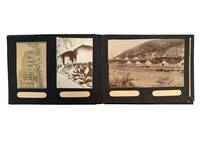
1912rif. 235531912. Missionary education and colonial album depicting India circa 1912 recording Western presence in a British ruled colony through girls' schooling domestic compounds rural labor and major sites of imperial tourism. One of the first images show a group of Indian girls posed with three Western women standing behind them likely a mission school or mission supported classroom during the period when Protestant and Catholic missions made female education one of their central claims to social reform in India. The album also records the wider colonial setting around that work with Western men and women appearing in bungalows on a tennis court and among Indian workers and residents placing missionary possibility inside the everyday social and racial ordering of colonial life. Photo album of 20 silver gelatin photographs each approximately 4 x 3 inches in a 6.5 x 5 inch album India circa 1910s with one image captioned "Holgate 1912." The photos show Indian girls grouped outside a building with three Western women at the rear; children or young laborers crouched in a field; men carrying harvested material along a road; an Indian woman seated at a weaving apparatus; another photo of young Indian girls in seated position in front of grass housing units potentially implying another educational setting; other images show Western figures in colonial settings including a woman holding a tennis racket players on a tennis court with the caption "Holgate 1912" a Western man and children on the veranda of a bungalow a Western woman standing in a brick doorway a Western man with a horse before a house and a large residence set behind a lawn. Architectural and travel views include the Taj Mahal another domed Mughal or Indo Islamic building a street scene with horse drawn vehicles outside commercial buildings a rural village at the base of hills and a settlement or station in a dry mountainous landscape. At the turn of the twentieth century Western women in India came as missionaries teachers medical workers wives of colonial officials tourists and members of expatriate religious and commercial communities. Mission boards used girls' schools orphanages zenana visiting Bible instruction and medical missions to enter spaces that male missionaries could not easily reach while British colonial rule supplied the legal linguistic transport and racial framework that made such work possible and unequal. Light surface wear fading silvering and album wear with some prints unevenly toned. Overall good condition. A compact visual record of Western missionary possibility colonial domestic life Indian labor and tourist seeing in India under the British Raj. unknown
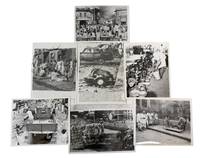
1943rif. 234951943. Indian famine crisis press archive depicting hunger relief work and public unrest from Bengal famine conditions through later food riots in independent India. The Bengal Famine of 1943 killed an estimated three million people and food scarcity remained politically volatile in India for decades afterward. Street demonstrations over grain rationing and hunger drew police deployments in multiple cities turning food access into a public order crisis as well as a humanitarian emergency. Photo archive of 7 silver gelatin press photographs mostly measuring 8" x 10" India 1943-1964. Crowds gather outside food distribution points children sit with metal bowls during feeding mounted police face demonstrators and uniformed officers move through dense street scenes. Press captions identify Calcutta famine conditions food rioters dispersed by police in Kerala fighting and fire in Lucknow and relief activity for famine victims. Typed captions identify "food rioters" being dispersed outside the Travancore state government house in Trivandrum Kerala where police and mounted officers filled the street after looting over food. Another caption describes Lucknow fighting in which "rioters set fire to about a six-block square" with crowds massed near burning buildings and shopfront signs. Calcutta scenes show famine victims clustered around relief vessels and feeding bowls with one caption stating that people had been "reduced to skin and bone" after food shortages. A street-side feeding scene shows children and adults crouched in rows with metal dishes receiving food from a man holding a large bucket.Verso stamps include Acme Newspictures NEA reference markings New York Bureau labels editor crop marks typed captions and publication dates. The group connects famine mortality postwar scarcity and street protest in India across a period when food distribution became a central test of colonial and postcolonial government authority. Press handling wear caption remnants crop marks corner creasing and scattered surface marks; overall in very good condition. A strong press group linking famine relief imagery with the public unrest that followed hunger into India's mid-century political life. unknown
1943rif. 234951943. Indian famine crisis press archive depicting hunger relief work and public unrest from Bengal famine conditions through later food riots in independent India. The Bengal Famine of 1943 killed an estimated three million people and food scarcity remained politically volatile in India for decades afterward. Street demonstrations over grain rationing and hunger drew police deployments in multiple cities turning food access into a public order crisis as well as a humanitarian emergency. Photo archive of 7 silver gelatin press photographs mostly measuring 8" x 10" India 1943-1964. Crowds gather outside food distribution points children sit with metal bowls during feeding mounted police face demonstrators and uniformed officers move through dense street scenes. Press captions identify Calcutta famine conditions food rioters dispersed by police in Kerala fighting and fire in Lucknow and relief activity for famine victims. Typed captions identify "food rioters" being dispersed outside the Travancore state government house in Trivandrum Kerala where police and mounted officers filled the street after looting over food. Another caption describes Lucknow fighting in which "rioters set fire to about a six-block square" with crowds massed near burning buildings and shopfront signs. Calcutta scenes show famine victims clustered around relief vessels and feeding bowls with one caption stating that people had been "reduced to skin and bone" after food shortages. A street-side feeding scene shows children and adults crouched in rows with metal dishes receiving food from a man holding a large bucket.Verso stamps include Acme Newspictures NEA reference markings New York Bureau labels editor crop marks typed captions and publication dates. The group connects famine mortality postwar scarcity and street protest in India across a period when food distribution became a central test of colonial and postcolonial government authority. Press handling wear caption remnants crop marks corner creasing and scattered surface marks; overall in very good condition. A strong press group linking famine relief imagery with the public unrest that followed hunger into India's mid-century political life. unknown books
1912rif. 235531912. Missionary education and colonial album depicting India circa 1912 recording Western presence in a British ruled colony through girls' schooling domestic compounds rural labor and major sites of imperial tourism. One of the first images show a group of Indian girls posed with three Western women standing behind them likely a mission school or mission supported classroom during the period when Protestant and Catholic missions made female education one of their central claims to social reform in India. The album also records the wider colonial setting around that work with Western men and women appearing in bungalows on a tennis court and among Indian workers and residents placing missionary possibility inside the everyday social and racial ordering of colonial life. Photo album of 20 silver gelatin photographs each approximately 4 x 3 inches in a 6.5 x 5 inch album India circa 1910s with one image captioned "Holgate 1912." The photos show Indian girls grouped outside a building with three Western women at the rear; children or young laborers crouched in a field; men carrying harvested material along a road; an Indian woman seated at a weaving apparatus; another photo of young Indian girls in seated position in front of grass housing units potentially implying another educational setting; other images show Western figures in colonial settings including a woman holding a tennis racket players on a tennis court with the caption "Holgate 1912" a Western man and children on the veranda of a bungalow a Western woman standing in a brick doorway a Western man with a horse before a house and a large residence set behind a lawn. Architectural and travel views include the Taj Mahal another domed Mughal or Indo Islamic building a street scene with horse drawn vehicles outside commercial buildings a rural village at the base of hills and a settlement or station in a dry mountainous landscape. At the turn of the twentieth century Western women in India came as missionaries teachers medical workers wives of colonial officials tourists and members of expatriate religious and commercial communities. Mission boards used girls' schools orphanages zenana visiting Bible instruction and medical missions to enter spaces that male missionaries could not easily reach while British colonial rule supplied the legal linguistic transport and racial framework that made such work possible and unequal. Light surface wear fading silvering and album wear with some prints unevenly toned. Overall good condition. A compact visual record of Western missionary possibility colonial domestic life Indian labor and tourist seeing in India under the British Raj. unknown books
1969rif. c442147H.M.S.O 1969. Hardcover. Very Good/Very Good. 4to - over 9¾ - 12" tall. Slight shelfwear to cover edge and dustwrapper - otherwise as new. H.M.S.O hardcover
First edition, 2 vols., 4to, 259; 268pp., frontispieces, numerous plates, some intermittent foxing as usual, orig. blue cloth, lettered in gilt, a nice set. Provenance: From the Munden House library.
rif. 24731One item from ‘Allen’s Indian Mail’ 28 March 1887. Three items marked as from the periodical ‘India’ 1902 1903 and 1906. Another ‘Reprinted from “INDIA” August 16 1901.’. Five galley-proofs of articles written during the high-point of the Raj by leading Victorian journalist in India W. Martin Wood editor of the Times of India founder and editor of the Bombay Review. Ephemeral items creased and worn but with text clear and entire. ONE: Headed ‘ALLEN’S INDIAN MAIL / THE LATE MR. EDWARD BROOME C.E. / Mr. M. Martin Wood writes to us as follows: -’. Sixty-two lines in small print follow beginning: ‘Some little time back your “Domestic Occurrences” contained the name of Mr. Edward Broome Civil Engineer as having died at Southport something under 60 years of age. It struck me then that a note of Mr. Broome’s quiet work in India ought to be made’. TWO: Annotated at head by Wood ‘India Sep 16th. 1902’. Sixty-eight lines of small print. Three sections concerning drought ‘in Gujerat and the Deccan’. The first begins: ‘An esteemed correspondent writes: Telegrams from India during the last few weeks have told us very little about the suspension and in certain districts what almost threatens failure of the later monsoon rains.’ The second starts: ‘But this passive creed is nto that of their masters from the West’. The third: ‘Meantime what has become of the Scott-Moncrieff comprehensive Water-Supply and Irrigation Report’ THREE: Headed ‘INDIA’S CHRONIC DEFICIT. / FROM AN ANGLO-INDIAN CORRESPONDENT. Annotated by Wood at head: ‘From India Feb. 13th. 03’. Beginning ‘Those few of our official financiers at Simla or in the palace overlooking St. James’s Park who are at all sensitive to Press criticism must have felt happy when in the last Financial Statement they recorded the line - “the entry under Exchange has become of minor importance.”’ Ninety-three lines of text. FOUR: Headed ‘INDIA’S SEABORNE TRADE: / BALANCED ONLY BY DEADWEIGHTS.’ Annotated at head by Wood: ‘From India Jan 15. 06’. Begins: ‘Only within the last fortnight have come to hand detailed returns of India’s trade with the outside world during the first six months of its current financial year - April 1 to September 30.’ Eighty-one lines in small print. FIVE: Headed ‘Reprinted from “INDIA” August 16 1901. / INDIAN LOANS GUARANTEE. / AN EMERGENT ILLUSTRATION. / BY AN ANGLO-INDIAN.’ Beginning ‘The miscarriage of the proposed Indian sterling loan of £3000000 last month must have recalled attention to the often pressed always postponed demand for a British Treasury guarantee in support of the public debt of India.’ Sixty-five lines of small print. One item from ‘Allen’s Indian Mail’, [28 March 1887]. Three items marked as from the periodical ‘India’, [1902], 1903 unknown
rif. 24732One item from ‘Allen’s Indian Mail’ 28 March 1887. The other ‘Reprinted from “INDIA” August 16 1901.’. Two galley-proofs of articles by leading Victorian journalist in India W. Martin Wood editor of the Times of India founder and editor of the Bombay Review. Ephemeral items creased and worn but with text clear and entire. ONE: Headed ‘ALLEN’S INDIAN MAIL / THE LATE MR. EDWARD BROOME C.E. / Mr. M. Martin Wood writes to us as follows: -’. Sixty-two lines in small print follow beginning: ‘Some little time back your “Domestic Occurrences” contained the name of Mr. Edward Broome Civil Engineer as having died at Southport something under 60 years of age. It struck me then that a note of Mr. Broome’s quiet work in India ought to be made’. TWO: Annotated at head by Wood ‘India Sep 16th. 1902’. Sixty-eight lines of small print. Three sections concerning drought ‘in Gujerat and the Deccan’. The first begins: ‘An esteemed correspondent writes: Telegrams from India during the last few weeks have told us very little about the suspension and in certain districts what almost threatens failure of the later monsoon rains.’ The second starts: ‘But this passive creed is nto that of their masters from the West’. The third: ‘Meantime what has become of the Scott-Moncrieff comprehensive Water-Supply and Irrigation Report’ THREE: Headed ‘INDIA’S CHRONIC DEFICIT. / FROM AN ANGLO-INDIAN CORRESPONDENT. Annotated by Wood at head: ‘From India Feb. 13th. 03’. Beginning ‘Those few of our official financiers at Simla or in the palace overlooking St. James’s Park who are at all sensitive to Press criticism must have felt happy when in the last Financial Statement they recorded the line - “the entry under Exchange has become of minor importance.”’ Ninety-three lines of text. FOUR: Headed ‘INDIA’S SEABORNE TRADE: / BALANCED ONLY BY DEADWEIGHTS.’ Annotated at head by Wood: ‘From India Jan 15. 06’. Begins: ‘Only within the last fortnight have come to hand detailed returns of India’s trade with the outside world during the first six months of its current financial year - April 1 to September 30.’ Eighty-one lines in small print. FIVE: Headed ‘Reprinted from “INDIA” August 16 1901. / INDIAN LOANS GUARANTEE. / AN EMERGENT ILLUSTRATION. / BY AN ANGLO-INDIAN.’ Beginning ‘The miscarriage of the proposed Indian sterling loan of £3000000 last month must have recalled attention to the often pressed always postponed demand for a British Treasury guarantee in support of the public debt of India.’ Sixty-five lines of small print. One item from ‘Allen’s Indian Mail’, [28 March 1887]. The other ‘Reprinted from “INDIA,” August 16, 1901.’ unknown