11.949 resultados
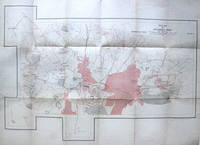
1922ref. 47648Calcutta: Printed at the Photo.-Litho. Office Survey of India 1922. Hardcover. Good. 6 48p. plus 8 leaves of maps partially colored; most folding. Original cloth-backed boards. 34 cm. Illegible institutional stamp on cover. Addenda and errata slips mounted on early page list of agents. Printed at the Photo.-Litho. Office, Survey of India hardcover books
1921ref. 47647Calcutta: Printed at the Photo.-Litho. Office Survey of India 1921. Hardcover. Good. 6 45p. plus 8 leaves of maps partially colored; most folding. Original cloth-backed boards. 34 cm. Cover wear. Presentation leaf laid in presenting this volume to the Secretary of the Physical Laboratory of the Royal College of Science in South Kensington. Printed at the Photo.-Litho. Office, Survey of India hardcover books
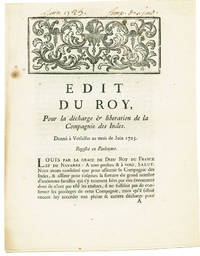
1725ref. 40677Paris. 1725. Reorganizing the Compagnie des Indes after the Mississippi Bubble A French royal decree releasing the Compagnie from some of its debts an important step in its reorganization. In 1721 the Compagnie had declared bankruptcy and was reorganized after the Mississippi Bubble burst. "This decree discharges the Compagnie des Indes of a large number of financial burdens which had been weighing on it for a number of years" - Maggs. Wroth locates only one copy at NYPL; OCLC identifies three more copies. Scarce. From the library of Cardinal Etienne Charles de Lomenie de Brienne 1727–94 Minister of Louis XVI Archbishop of Toulouse and of Sens. A friend of Voltaire and a member of the Académie Française Brienne wielded significant power as head of the Finance Ministry which earned him many enemies. He died in prison during the French Revolution despite having renounced Catholicism in 1793 presumably as an attempt to save his life. Quarto. Unbound folded sheets. Minor foxing. Light soiling along spine edge. Contemporary inscription. Very good. MAGGS FRENCH COLONISATION OF AMERICA 311 this copy. WROTH ACTS OF FRENCH ROYAL ADMINISTRATION 1101. OCLC 62370774. unknown books
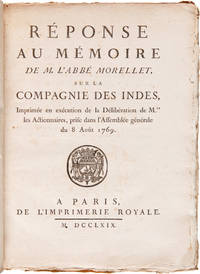
1769ref. 47671Paris. 1769. Jacques Necker 1732-1804 was serving as a director of the French East India Company when he penned this rebuttal to the MÉMOIRE of Abbe Morellet. Morellet had argued against the Compagnie's trading monopoly which Necker here defends. Necker would become Finance Minister under Louis XVI until the French Revolution. Quarto. Contemporary marbled wrappers stitched. Spine lightly worn and faded. Minor foxing to first and last leaves. Very good plus. unknown books
1788ref. 47799Paris. 1788. Memorial of the French East India Company freshly reconstituted in 1785 after its liquidation in 1769. Twenty-four pages of tables provide a detailed accounting of the Compagnie's commercial activities from 1769 through 1777 while the text advocates the importance of the Compagnie and details its further activities to date. Fewer than ten copies are located in OCLC. Quarto. Contemporary blue paper wrappers stitched. Minor wear and soiling. Near fine. unknown books
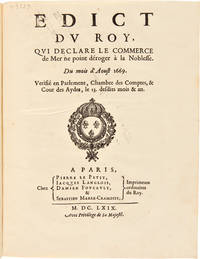
1669ref. 15822Paris. 1669. The French Aristocracy Freely Admitted to Maritime Trade A variant issue with a slightly different title of this important edict which allows members of the nobility to trade by sea without foregoing any of their privileges. Previously their activities had been circumscribed by ordinances preventing their entering commerce. Apparently a catalyst for this edict was the formation of the Compagnie des Indes in 1664 which is specifically mentioned in the text. A note on the last page states that this copy was collated against the King's Ministry copy. OCLC locates only one copy at the University of Oxford. Rare. 7pp. Small quarto. Modern boards leather label. Light soiling around the edges. Very good. WROTH ACTS OF FRENCH ROYAL ADMINISTRATION 95 ref. MAGGS FRENCH COLONIZATION OF AMERICA 10 ref. hardcover books
ref. 29156INDIA TEMPLES OF SOUTH INDIA. Delhi: Ministry of Information and Broadcasting 1960. 8vo. Wrappers. 52 pages plates. Spine chipped. unknown books
ref. 29164INDIA ARCHAEOLOGICAL REMAINS MONUMENTS AND MUSEUMS. Two volumes. New Delhi: Archaeological Survey of India 1964. 8vo. Wrappers. First edition. Lower spine and tips bruised. unknown books
ref. 12447ANCIENT INDIA. Numbers 18 and 19. New Delhi: Director General of Archaeology in India 1963. 4to. Wrappers. iv 250 pages 61 plates 4 folding charts. First edition. Including articles by S.R. Rao B.B. Lal and Niharranjan Ray. Name in ink text lightly foxed and cockled. unknown books
ref. 29157INDIA 5000 YEARS OF INDIAN ARCHITECTURE. Delhi: Ministry of Information and Broadcasting 1956. Small 4to. Wrappers. 52 pages. Third edition. Spine rubbed. unknown books
ref. 12412ARCHITECTURE AND SCULPTURE OF INDIA. N.P.: Ministry of Information and Broadcasting 1956. Small folio. Wrappers. Frontispiece vi pages 19 plates. First edition. Photographs showing the sculpture and construction of Indian monuments. Worn. unknown books
ref. 12448ANCIENT INDIA. Number 16. New Delhi: Director General of Archaeology in India 1962. 4to. Wrappers. ii 88 pages 47 plates 2 folding charts. First edition. With articles by B.B. Lal V.D. Krishnaswami H. Sarkar and T.R. Gairola; illustrated. Name in ink some coverwear. unknown books
ref. 336875Bombay: The Times of India. paperback. very good/very good. 42 black and white photographs. 24 pages oblong 4to printed green wrappers. Bombay: The Times of India ca. 1903. In very good condition with minor fading and marks to wrappers. The Times of India unknown books
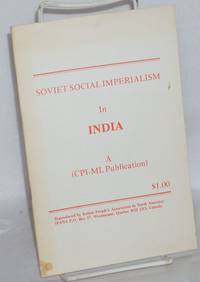
1976ref. 201529Westmount Quebec: Indian People's Association in North America 1976. 32p. staplebound pamphlet 5.5x8.25 inches; mildly worn covers. Indian People's Association in North America unknown books
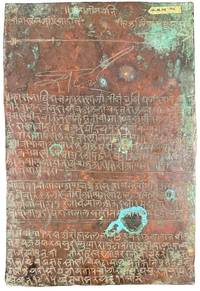
1819ref. 42798Eastern India possibly Bengal or Assam circa 18th-19th century. Copper plate 13 7/8 x 9 1/8 inches engraved on both sides. The principal face with several lines of incised text at the head followed by a large engraved validating or emblematic mark and below this three dense sections of text divided by ruled horizontal lines. The reverse largely uninscribed with three small engraved seals or validating marks near the edge. An inscribed copper plate of Indian origin possibly Bengal or Assam engraved in a Bengali or Bengali-Assamese script and preserving a formal documentary text in metal. This copper plate belongs to the South Asian tradition of preserving legal devotional and administrative records on durable metal supports. Copper plate documents often described as tamrapatra or copper charters were used for grants endowments title rights decrees and other formal acts their material permanence giving them authority beyond that of ordinary manuscript documents. The present example appears to preserve a substantial text arranged in ruled sections and accompanied by validating marks. The script appears close to Bengali or Bengali-Assamese. The letterforms show rounded and looped shapes consistent with scripts used in eastern India. If confirmed this would suggest an origin in Bengal Assam or a neighbouring region where related scripts were used for administrative and religious writing. From their earliest centuries of development copper plate inscriptions have occupied a central place in South Asian documentary culture particularly in the recording of land grants royal edicts temple endowments and other formal transactions. Their durability made them suitable for preserving records intended to endure and they were often deposited in temples or held by families or institutions as proof of rights and privileges. While earlier examples are frequently associated with royal chancelleries the practice continued into the early modern and colonial periods with regional administrations and local authorities maintaining related forms of documentation. The present plate appears to belong to this later phase of the tradition when such documents were still being produced for administrative legal or commemorative purposes. Its relatively large format and the density of inscription suggest a formal text of some substance while the additional engraved devices indicate an effort to authenticate or formalise the record. The copper plate offers a direct example of a documentary practice that bridges manuscript culture and more durable forms preserving both the text itself and the physical conventions of its transmission. unknown books
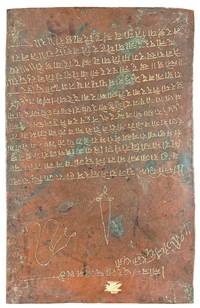
1819ref. 42797Western or Northern India circa 18th or 19th century. Copper plate 15 1/2 x 9 3/4 inches engraved on both sides one face densely filled with horizontal lines of incised text and with additional marks including a dagger or torch device and other validating or ownership marks. The reverse more sparsely inscribed with two lines of text. An inscribed copper plate of Indian origin engraved on both sides and belonging to the South Asian tradition of preserving legal devotional and commemorative texts. A striking survival from the documentary culture of South Asia where copper served as a durable support for records intended to outlast paper and palm leaf. Such copper records often described as tamrapatra or copper charters were valued because they were portable difficult to alter and capable of serving as enduring witnesses to grants decrees endowments title rights and other formal acts. The script appears to belong to the Nagari family possibly Devanagari or a related cursive administrative hand such as Modi the script long used for Marathi official and business writing. From their earliest centuries of development copper plate inscriptions have occupied a central place in South Asian documentary culture particularly in the recording of land grants royal edicts temple endowments and other formal transactions. Their durability made them suitable for preserving records intended to endure and they were often deposited in temples or held by families or institutions as proof of rights and privileges. While earlier examples are frequently associated with royal chancelleries the practice continued into the early modern and colonial periods with regional administrations and local authorities maintaining related forms of documentation. The present plate appears to belong to this later phase of the tradition when such documents were still being produced for administrative legal or commemorative purposes. Its relatively large format and the density of inscription suggest a formal text of some substance while the additional engraved devices indicate an effort to authenticate or formalise the record. The copper plate offers a direct example of a documentary practice that bridges manuscript culture and more durable forms preserving both the text itself and the physical conventions of its transmission. unknown books
1796ref. 398421796. The archive comprises: 1. Autograph letter signed "John Canning." Bifolium 13 x 8 1/4 inches 21 lines in fine Malay Jawi with Arabic opening formula docketed "Calcutta 10 Dec 1796"; octagonal red-wax armorial seal of the Canning family. Letter requests that local rulers receive Capt. Hogan "as our agent. to conclude a treaty advantageous to both sides" dated 22 Jumada II 1211 / 10 Dec 1796. 2. to 5. 4 Paper wrappers. English addresses in a copperplate hand & parallel Jawi headings each with intact Canning seal. Addressed to the Sultan of Magindanao King of Mempawah Borneo King of Bali Sultan of Borneo. 6. to 8. 3 Yellow-silk diplomatic covers. Golden satin sleeves with paper address bands in two languages; two remain unopened and sealed. Addressed to the Sultan of Johor unopened King of Sumbawa unopened Sultan of Sulu wrapper only. An exceptional archive uniting British Malay and Islamic manuscript traditions that captures the East India Company’s first concerted overtures to the island-states of Southeast Asia. Drafted in the wake of the Dutch East India Company's collapse and the French Revolutionary Wars this archive documents the East India Company's first concerted diplomatic overtures to the maritime courts of the Malay world. With Dutch control unraveling after the 1795 Batavian Revolution Britain saw a strategic opportunity to enter the lucrative Spice Island trade. Lacking on-the-ground alliances the Company turned to private initiative: Captain Michael Hogan an Irish-American merchant and former convict transport captain was enlisted as unofficial envoy aboard his ship Marquis Cornwallis. The diplomatic texts were composed by Captain John Goodall Canning then Harbour-Master of the port in refined court Malay using Jawi script the Islamic-inflected lingua franca of diplomacy from Aceh to Sulu. In keeping with regional tradition the letters open with Islamic invocation and florid honorifics followed by carefully phrased expressions of friendship and commercial intent. The surviving autograph letter fixes the date of the mission and declares its purpose: "to plant affection and concord and if Your Highness deem it good to enter with us into a compact benefiting both realms." After disembarking convicts in Port Jackson Sydney in February 1796 the Marquis Cornwallis passed northward through Torres Strait calling at New Guinea the Moluccas and ports across the Java Sea almost certainly delivering these and parallel documents en route. The silk wrappers signal the elevated diplomatic status of the messages which were meant to be presented in person by Hogan and opened only in the presence of the addressee. The present archive offers a rare and vivid glimpse into the hybrid ceremonial linguistic and political world of early modern Southeast Asia and into the improvisational diplomacy of the Company at the edge of empire. unknown books
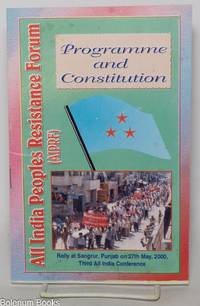
2001ref. 345406Delhi: AIPRF 2001. 24p. staplebound booklet emails added in pen to page with contact information otherwise very good. Passed at the third All India Conference in Sangrur Punjab in 2000. AIPRF unknown books
1970ref. 30482Bombay: Produced by the Directorate of Tourism Govt. of Maharashtra through Marg Publications 1970. n.ed. Loose plates in portfolio. Very good plates in a torn and worn portfolio. Unpaged 4 pp. 12 lvs. Illus. with 12 tipped-in color plates. 4to. Wonderful color photographs of the caves and architecture of Ellora. Produced by the Directorate of Tourism, Govt. of Maharashtra through Marg Publications unknown books
ref. 209189New Delhi India: Caxton Press. Staplebound. VG. Undated circa 1960's. Staplebound catalogue. Illustrated wraps. 12 pages color illustrations; 25 cm. Kondapalli toys are toys made of wood in Kondapalli of Krishna district Vijayawada in the Indian state of Andhra Pradesh. Bommala Colony translates to Toys Colony in Kondapalli is the place where the art of crafting takes place. It was registered as one of the geographical indication handicraft from Andhra Pradesh as per Geographical Indications of Goods Registration and Protection Act 1999. This GI application was filed by LIGHT LANCO Institute of General Humanitarian Trust and Kondapalli Wooden Toys Manufacturers.These toys were one of the varieties of toys assembled in the houses during the festivals of Sankranti and Navratri and is referred as Bommala Koluvu. The art of crafting is a 400-year-old tradition. The artisans who make the toys are referred as Aryakhastriyas also known as Nakarshalu who have their mention in the Brahmanda Purana. They are said to have migrated from Rajasthan in the 16th century to Kondappali and claims their origin to Muktharishi a sage endowed with skills in arts and crafts by Lord Shiva. The Kondapalli toys are made from soft wood known as Tella Poniki which are found in nearby Kondapalli Hills. Each part is carved out separately. Then makku- a paste of tamarind seed powder & sawdust is used to join pieces together add details and finish the toys. The later step involves coloring with either oil and water-colours or vegetable dyes and enamel paints are applied based on the type of the toys. The artisans mainly work on producing figures of mythology animals birds bullock carts rural life etc. and the most notable one is Dasavataram etc. Caxton Press unknown books
1942ref. 198066India: U.S. Army Forces in China Berma India 1942. Paperback. Good Heavily worn leather folder; many pages are annotated with practice Chinese characters or this book may have been used by a Chinese person to learn English; scattered toning and stains throughout; binding is solid. Brown leather binding with debossed lettering; 4 t.o.; folded map in pocket ifc; approximately 110 pp.; map; illustrations. An interesting wartime guide book issued by U.S. Armed Forces India a guide to the study of Chinese culture and language used by American forces stationed in the China-Burma-India theater of World War II. Sections provide English-to-Chinese translations on important military medical artillery and everyday terms. A notable section at the end even explains features to look for when trying to identify Japanese aircraft. Bound in a heavily worn leather folder many pages are annotated with practice Chinese characters or this book may have been used by a Chinese person to learn English. Scattered toning and stains throughout. [U.S. Army Forces in China, Berma, India] paperback books
1982ref. 195176Bombay: Crafts Council of Western India 1982. Hardcover. Good Boards are edgeworn scuffed and smudged; interior is clean; binding is solid./Good DJ is moderately edgeworn smudged and scuffed. Linen-esque boards with brown lettering; off-white DJ with brown lettering and illustration; 108 pp.; richly illustrated. "It would be impossible to encapsulate all the wealth of Indian crafts between the covers of a book. 'Shilpakar' then is only an attempt to lift the veil on a world of infinite richness -- and on the unknown craftsman who created it." -- Note from the Editor. Crafts Council of Western India hardcover books
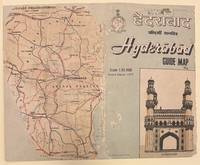
1980ref. 318087Survey of India Offices 1980. unbound. Map. Colored offset lithograph. Hyderabad Guide Map image size 31.5 x 44.5 inches Bus Routes image size 30 x 21.5 inches verso. Sheet size 35 x 46.5 inches. Both Hyderabad Guide and Bus Routes Maps both show some repairs to tears along original folds and some light staining. Guide Map is backed with sturdy paper to support Bus Routes map. Detailed key for Hyderabad Guide Map Second edition includes extensive list of places of interest including galleries cinemas offices and cultural centers among others. Bus routes supplied by Andhra Pradesh State Road Corporation up to date to June 1977. Survey of India Offices unknown books
1973ref. 316514Middletown: Wesleyan University Press 1973. hardcover. near fine. Illustrated with twelve color plates and thirty-nine monochrome plates including the frontispiece. 4to maroon cloth top edge gilt board slipcase. 1 page creased. Connecticut: Wesleyan University Press 1973. Second edition. Revised from the original 1935 edition. Near fine. Number 143 of four hundred thirty-five copies prepared for subscribing members of India House. Wesleyan University Press unknown books
1934ref. 275256India: Survey of India 1934. Colored offset Lithograph. Sheet maps 22" x 29.5". This 1934 pocket map depicts the plan of the Gulbarga Fort and vicinity located in the northern part of the state of Karnataka at the time Hyderabad State in southern India. Beautifully detailed the map notes the fort important roads lakes wells vegetation and a host of other topographic elements. Originally built by Raja Gulchand a feudatory of the Warangal Kakatiyas it was further fortified and enlarged in 1327 by Sultan Al-ud-din Bahmani of Bahmani Sultanate in 1327 and Adil Shah. Various monuments such as mosques palaces tombs and other structures were also built. Most notable of these is the Jami Masjid built on the lines of the Great Mosque of Cordoba in Spain is one of the first mosques in southern India. The fort remained the capital of the Bahmani Kingdom until 1424. Later the fort would be razed by the Vijaynagar Emperor and subsequently rebuilt by Yusuf Adil Shah the founder of the Bujapur Sultanate. This map was published under the authority of Brigadier H. J. Couchman Surveyor General of India. It is in good condition with minor wear along the original folds and some offsetting. The map is lined with silk. Survey of India unknown books