1.328 resultados
ref. SONG1619425491Used: Good unknown
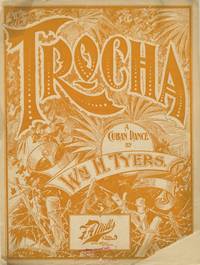
1890ref. List3666New York: Jos. W. Stern & Co 1890. Folio sheet music illustrated pictorial cover printed in orange. 5 pp. including cover. Approximately 13 ½ x 10 ½ inches. Covers detached loss to front cover contents complete fair to good. A decorative late nineteenth-century dance publication for “Trocha” described on the cover as “A Cuban Dance” composed by the African American composer and bandleader W. H. Tyers. The elaborate pictorial cover incorporates stylized tropical foliage and island scenery rendered in a bold single-color design typical for the period’s fascination with exoticized musical forms. William H. Tyers 1870–1924 was an African American composer arranger and bandleader active in New York during the ragtime era. Born in Petersburg Virginia to Henry Tyers and Jane “Jennie” Jones both formerly enslaved he spent part of his youth in Richmond before his family relocated to New York City where he began studying piano. His early teachers recognized an aptitude for composition as well as performance and by the mid-1880s he was writing dance pieces including polkas and waltzes. Around the age of twenty Tyers secured employment as a music librarian and arranger with a touring concert company a position that brought him to Europe where he studied orchestration and arranging with Professor Gaspari in Hamburg. Returning to New York Tyers became active in the city’s rapidly expanding popular music trade working as an arranger and composer for publishers including F. A. Mills and Jos. W. Stern & Co. In 1896 he published “Sambo” a syncopated march sometimes considered to be one of the first instrumental rags.1 “Trocha” also released in the 1980s brought Tyers prominence for his ability to write Latin-style rhythms. It was re-issued in 1913 as a tango and its success led Tyers to work as an arranger with Joseph W. Stern in 1897. Tyers’ compositions blended contemporary American dance music with Caribbean and Latin themes a style reflected in pieces such as Trocha and later in his well-known ragtime composition Panama 1911 which remained a staple of early jazz and dance orchestras. OCLC finds two copies with different entries at the Cleveland Public Library and the British Museum Reference Collections. 1 “William Tyers Music Arranger” African American Registry https://aaregistry.org/story/william-tyers-born/ accessed March 10 2026. Jos. W. Stern & Co unknown
1890ref. List3666New York: Jos. W. Stern & Co 1890. Folio sheet music illustrated pictorial cover printed in orange. 5 pp. including cover. Approximately 13 ½ x 10 ½ inches. Covers detached loss to front cover contents complete fair to good. A decorative late nineteenth-century dance publication for “Trocha” described on the cover as “A Cuban Dance” composed by the African American composer and bandleader W. H. Tyers. The elaborate pictorial cover incorporates stylized tropical foliage and island scenery rendered in a bold single-color design typical for the period’s fascination with exoticized musical forms. William H. Tyers 1870–1924 was an African American composer arranger and bandleader active in New York during the ragtime era. Born in Petersburg Virginia to Henry Tyers and Jane “Jennie” Jones both formerly enslaved he spent part of his youth in Richmond before his family relocated to New York City where he began studying piano. His early teachers recognized an aptitude for composition as well as performance and by the mid-1880s he was writing dance pieces including polkas and waltzes. Around the age of twenty Tyers secured employment as a music librarian and arranger with a touring concert company a position that brought him to Europe where he studied orchestration and arranging with Professor Gaspari in Hamburg. Returning to New York Tyers became active in the city’s rapidly expanding popular music trade working as an arranger and composer for publishers including F. A. Mills and Jos. W. Stern & Co. In 1896 he published “Sambo” a syncopated march sometimes considered to be one of the first instrumental rags.1 “Trocha” also released in the 1980s brought Tyers prominence for his ability to write Latin-style rhythms. It was re-issued in 1913 as a tango and its success led Tyers to work as an arranger with Joseph W. Stern in 1897. Tyers’ compositions blended contemporary American dance music with Caribbean and Latin themes a style reflected in pieces such as Trocha and later in his well-known ragtime composition Panama 1911 which remained a staple of early jazz and dance orchestras. OCLC finds two copies with different entries at the Cleveland Public Library and the British Museum Reference Collections. 1 “William Tyers Music Arranger” African American Registry https://aaregistry.org/story/william-tyers-born/ accessed March 10 2026. Jos. W. Stern & Co unknown books
1994ref. 004097S. l.: Bital Grupo Financiero 1994. Hardcover. Near Fine/very good . 4to. 200 2 pp. Bound in full black cloth stamped in in white on spine in illustrated dust jacket. Profusely illustrated many in full color including two fold-outs. Includes chronology list of works bibliography and an analysis of the composition of several works. Near Fine there is some bleed-through of adhesive on front and rear pastedowns otherwise bright copy in Very Good dust jacket with minor scuffing and wear. Bital Grupo Financiero hardcover
ref. DADAX1423101685New unknown
1849ref. G1027Paris, Firmin Didot Frères, Éditeurs, 1849 ; in-8, 4-160-164-156-102-2-8 pp. + 1 carte dépliante, 26 pl. hors-texte, broché (dos fendu, avec quelques petits manques, quelques rousseurs, quelques planches sont détachées). Collection: l'Univers«Histoire et description de tous les peuples». Ouvrage particulièrement intéressant sur les Antilles, qui sont peu nombreux. Illustré de gravures en taille-douce, exécutées par divers graveurs. État moyen.
1849Paris, Firmin Didot Frères, Éditeurs, 1849; in-8, 4-160-164-156-102-2-8 pp. + 1 carte dépliante, 26 pl. hors-texte, broché (dos fendu, avec quelques petits manques, quelques rousseurs, quelques planches sont détachées). Collection : l'Univers « Histoire et description de tous les peuples ». Ouvrage particulièrement intéressant sur les Antilles, qui sont peu nombreux. Illustré de gravures en taille-douce, exécutées par divers graveurs. État moyen.
1829ref. 18501829 Imprimerie Royale, Paris, 1829. In-8 demi-veau. xii, 608 pages. Traduit de l'Espagnol. Supplément sur les "Courants de l'Océan Atlantique"
1829ref. PHO-1018Paris,Baudry, 1829 volumes in-8 ,(180x110),xiii-473p,490p,413p,489p , relié demi veau époque, dos ornés avec pièces de titre et tomaison , bon exemplaire et 2eme édition française .
ref. awd-1172Affiche originale imprimée en lithographie sur papier brun par l’Atelier Bordas.
1940ref. 222371940. Puerto Rico Education Industrial era Puerto Rico elementary school class photo archive. Three vintage silver gelatin black-and-white photographs each mounted on photo studio original boards with decorative borders. Two are early prints circa 1940s; the third is dated 1961. Each measure about 7" x 9". This evocative trio of Puerto Rican school photographs captures diverse elementary-age students posed in front of their local schools documenting a pivotal era of transformation in the island's social and educational landscape. One of the earlier cabinet cards features a group of students seated outdoors with a teacher or administrator standing behind them; the setting includes neoclassical columns and a colonial street with visible signage. Another card marked "Escuela No. 29" shows a racially integrated group of students with the school's flag held at the center of the image. The final print dated 1961-declared "Año de la Educación" Year of Education in the printed caption-presents a classroom posed beneath a prominently displayed Puerto Rican flag reflecting both a growing sense of national identity and post-war political shifts toward public investment in education. These photographs span a transformative period in Puerto Rico's 20th-century history as the island transitioned from an agricultural economy to a more industrialized state-supported system under Operation Bootstrap Operación Manos a la Obra. Begun in the late 1940s and accelerated through the 1950s and early 1960s the program prioritized urban development mass education and labor force modernization. The 1961 card framed by official state messaging reflects this emphasis-part of Governor Luis Muñoz Marín's vision of expanding universal literacy and integrating Puerto Rican youth into a skilled industrial economy. At the same time these images document the continued presence of racial and class diversity within public schools signaling the layered complexities of colonial modernity and U.S. influence on the island's educational and political systems. Mild surface soiling and edge wear to the mounts with light silvering to the gelatin surfaces of the two older prints. Overall very good condition. A rare and compelling visual record of Puerto Rican childhood education and racial integration during a formative mid-century era of political and economic redefinition. unknown
1940ref. 222371940. Puerto Rico Education Industrial era Puerto Rico elementary school class photo archive. Three vintage silver gelatin black-and-white photographs each mounted on photo studio original boards with decorative borders. Two are early prints circa 1940s; the third is dated 1961. Each measure about 7" x 9". This evocative trio of Puerto Rican school photographs captures diverse elementary-age students posed in front of their local schools documenting a pivotal era of transformation in the island's social and educational landscape. One of the earlier cabinet cards features a group of students seated outdoors with a teacher or administrator standing behind them; the setting includes neoclassical columns and a colonial street with visible signage. Another card marked "Escuela No. 29" shows a racially integrated group of students with the school's flag held at the center of the image. The final print dated 1961-declared "Año de la Educación" Year of Education in the printed caption-presents a classroom posed beneath a prominently displayed Puerto Rican flag reflecting both a growing sense of national identity and post-war political shifts toward public investment in education. These photographs span a transformative period in Puerto Rico's 20th-century history as the island transitioned from an agricultural economy to a more industrialized state-supported system under Operation Bootstrap Operación Manos a la Obra. Begun in the late 1940s and accelerated through the 1950s and early 1960s the program prioritized urban development mass education and labor force modernization. The 1961 card framed by official state messaging reflects this emphasis-part of Governor Luis Muñoz Marín's vision of expanding universal literacy and integrating Puerto Rican youth into a skilled industrial economy. At the same time these images document the continued presence of racial and class diversity within public schools signaling the layered complexities of colonial modernity and U.S. influence on the island's educational and political systems. Mild surface soiling and edge wear to the mounts with light silvering to the gelatin surfaces of the two older prints. Overall very good condition. A rare and compelling visual record of Puerto Rican childhood education and racial integration during a formative mid-century era of political and economic redefinition. unknown books
19518vo., Second Impression, with frontispiece, numerous full-page photographs by Costa and double-page map on green stock, neat signature on front free endpaper; green cloth, gilt back, a very good, bright, clean copy in unclipped dustwrapper, the latter chipped (not affecting lettering) at extremities and with one short closed tear on front panel. Published a year after the first edition. The author's first book and a travel classic. EARLY PRINTINGS ARE VERY SCARCE IN THIS CONDITION.
1929Gilt lettering a bit faded to spine and front boards. Usual browned endpapers. Else a wonderful copy with all the maps in NF condition; With three specially drawn maps and seven plans. A rare Baedeker look-alike for a destination that almost nobody else published. Large interesting ad section at rear; 16mo 6" - 7" tall; x, 460 pages
19628vo., First Edition, with front and rear endpaper maps; original black cloth, gilt back, blue top (moderately faded), a very good, clean copy in unclipped dustwrapper, the latter lightly creased at edges, chipped with minor loss at head and tail (just affecting lettering) and with two short closed tears. Jacket design by William Belcher. SCARCE IN THE DUSTWRAPPER.
ref. DADAX0804752397New unknown
ref. DADAX019815982XNew unknown
ref. SONG0815324790Used: Good unknown
ref. DADAX0814762271New unknown
1973ref. 44039London: Caribbean Situationist 1973. First Edition. thus. Very good. Poster reproducing translated text by Khayati originally published in Internationale Situationniste and subsequently as a brochure in 1971 Ford 167. Illustrated with black and white photographs of Kingston Jamaica; Trinidad; and Hungary. Lower right corner includes a blank space intended to advertise a record shop where an LP of the text apparently spurious would be available. Uncommon. OCLC odes not locate a copy though there does appear to be on at Michigan. Wraps. Poster folded into quarters 36" x 23" approx. unfolded. Verso lightly toned; moderate wear to edges and fold lines. Creasing to corners. Very good. Caribbean Situationist unknown
1973ref. 44039London: Caribbean Situationist 1973. First Edition. thus. Very good. Poster reproducing translated text by Khayati originally published in Internationale Situationniste and subsequently as a brochure in 1971 Ford 167. Illustrated with black and white photographs of Kingston Jamaica; Trinidad; and Hungary. Lower right corner includes a blank space intended to advertise a record shop where an LP of the text apparently spurious would be available. Uncommon. OCLC odes not locate a copy though there does appear to be on at Michigan. Wraps. Poster folded into quarters 36" x 23" approx. unfolded. Verso lightly toned; moderate wear to edges and fold lines. Creasing to corners. Very good. Caribbean Situationist unknown books
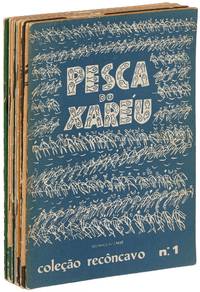
1955ref. 593625Bahia Brasil: Livraria Progresso 1955. Softcover. Very Good. First editions. Illustrated by Caribé. Nine volumes lacking the 10th Orixás. Slim octavos. Stapled wrappers. Text in Portuguese. Moderate tanning and wear wrappers with some foxing and soiling topedges with a small splash of white paint sound and near very good. Each volume prints illustrations by Caribé from the Bahia State Museum as well as text by Caribé Odorico Tavares Vasconcelos Main José Pedreira or Carlos Eduardo. Each also has a number stamp on the copyright page from an unknown limitation. The titles are: A pesca do xaréu; Pelourinho; O jogo da capoeira; Feira de água de meninos; Festa do bonfim; Conceicão da praia; Festa de yemanjá; Rampa do mercado; and Temas de candomblé. Livraria Progresso unknown
1955ref. 593625Bahia Brasil: Livraria Progresso 1955. Softcover. Very Good. First editions. Illustrated by Caribé. Nine volumes lacking the 10th Orixás. Slim octavos. Stapled wrappers. Text in Portuguese. Moderate tanning and wear wrappers with some foxing and soiling topedges with a small splash of white paint sound and near very good. Each volume prints illustrations by Caribé from the Bahia State Museum as well as text by Caribé Odorico Tavares Vasconcelos Main José Pedreira or Carlos Eduardo. Each also has a number stamp on the copyright page from an unknown limitation. The titles are: A pesca do xaréu; Pelourinho; O jogo da capoeira; Feira de água de meninos; Festa do bonfim; Conceicão da praia; Festa de yemanjá; Rampa do mercado; and Temas de candomblé. Livraria Progresso unknown books
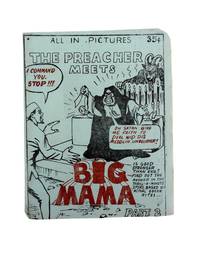
1967ref. 237191967. Black HistoryComics 1960s Guyanese comic book by an early influential Black cartoonist. Seymour Rudy. The Preacher Meets Big Mama: Part 2. Georgetown British Guyana: All in Pictures ca. 1967. First edition. Scarce. Illustrated throughout with black-and-white cartoon panels. Original pictorial wrappers printed in black and red on pale blue stock. A rare early work by Samuel Rudolph "Rudy" Seymour widely regarded as the father of Guyanese comics. This installment blends Christian moralism with Afro-Caribbean folklore in a visually arresting local comic format. Rudy Seymour was one of the earliest creators of locally produced comic books in Guyana whose illustrated narratives reflected and shaped mid-20th century Guyanese visual culture. In The Preacher Meets Big Mama Seymour depicts a confrontation between a Christian preacher and "Big Mama" a feared spiritualist figure with ties to Obeah a syncretic Afro-Caribbean spiritual system. The plot follows the preacher's attempt to rescue a boy from Big Mama's cult culminating in scenes of ritualistic sacrifice demonic invocation and divine intervention. The narrative unfolds in vernacular Guyanese Creole grounding the story in a distinctly local idiom. Seymour's stark expressive linework animates themes of good versus evil colonial Christianity versus ancestral spiritual knowledge and gendered power structures. While the portrayal of Big Mama leans into negative colonial stereotypes casting her as a devil-worshipper the comic simultaneously elevates Afro-Caribbean spiritual conflict to the central stage of popular print culture. Seymour's broader contributions to Caribbean arts extended beyond this title; his pioneering comics inspired future generations and played a foundational role in developing the graphic arts in Guyana. He continued illustrating through the 1970s and remained a cultural fixture until his passing in 2020. Minor wear to spine and covers; interior pages lightly toned but well-preserved and tightly bound. Overall very good condition. A mid-century Caribbean comic documenting a formative moment in Black diasporic graphic storytelling and the postcolonial negotiation of identity faith and resistance in Guyanese print media. unknown
1967ref. 237191967. Black HistoryComics 1960s Guyanese comic book by an early influential Black cartoonist. Seymour Rudy. The Preacher Meets Big Mama: Part 2. Georgetown British Guyana: All in Pictures ca. 1967. First edition. Scarce. Illustrated throughout with black-and-white cartoon panels. Original pictorial wrappers printed in black and red on pale blue stock. A rare early work by Samuel Rudolph "Rudy" Seymour widely regarded as the father of Guyanese comics. This installment blends Christian moralism with Afro-Caribbean folklore in a visually arresting local comic format. Rudy Seymour was one of the earliest creators of locally produced comic books in Guyana whose illustrated narratives reflected and shaped mid-20th century Guyanese visual culture. In The Preacher Meets Big Mama Seymour depicts a confrontation between a Christian preacher and "Big Mama" a feared spiritualist figure with ties to Obeah a syncretic Afro-Caribbean spiritual system. The plot follows the preacher's attempt to rescue a boy from Big Mama's cult culminating in scenes of ritualistic sacrifice demonic invocation and divine intervention. The narrative unfolds in vernacular Guyanese Creole grounding the story in a distinctly local idiom. Seymour's stark expressive linework animates themes of good versus evil colonial Christianity versus ancestral spiritual knowledge and gendered power structures. While the portrayal of Big Mama leans into negative colonial stereotypes casting her as a devil-worshipper the comic simultaneously elevates Afro-Caribbean spiritual conflict to the central stage of popular print culture. Seymour's broader contributions to Caribbean arts extended beyond this title; his pioneering comics inspired future generations and played a foundational role in developing the graphic arts in Guyana. He continued illustrating through the 1970s and remained a cultural fixture until his passing in 2020. Minor wear to spine and covers; interior pages lightly toned but well-preserved and tightly bound. Overall very good condition. A mid-century Caribbean comic documenting a formative moment in Black diasporic graphic storytelling and the postcolonial negotiation of identity faith and resistance in Guyanese print media. unknown books