Raynal, AbbeBiblio.com

815 results
1783ref. 17472London: W. Strahan and T. Cadell. Very Good-. Hardcover. Full leather boards with quite some rubbing. Book block split. Bookplate.; This is volume 5 only of the 8 volume edition. Was originally published in 10 volumes. Including a steel engraved map of the European settlements in Africa.; 8vo 8" - 9" tall; 499 pages . 1783. W. Strahan and T. Cadell hardcover
1783Full leather boards with quite some rubbing. Book block split. Bookplate. ; This is volume 5 only of the 8 volume edition. (Was originally published in 10 volumes). Including a steel engraved map of the European settlements in Africa. ; 8vo; 499 pages
1914ref. 020130Chicago / New York / Toronto / London / Edinburgh: Fleming H. Revell Company 1914. First Edition . Illustrated Cloth. Very Good/No DJ. Photographs of Hwang Hsing Etc. 142 Pp 2 Pp Catalog At Rear. Orange Cloth Stamped In Black And White With Allegorical Design. First Edition. Clean Lightly Used No Names Or Marks Hinges Solid Light Wear With Some Loss Of Lettering And Design In Black Ink On Front Cover But All Chalk Lettering And Design Present And Strong.Previous Owner's Name On Front Free Endpaper Signs Of Bookplate Removal On Facing Pastedown. Fleming H. Revell Company hardcover
1979ref. 020829N.Y.: J.B. Lippincott Company 1979. First U.S. Hardcover Edition paperback original published by Gold Medal 1972 so stated with complete number line beginning with 1. Fine in fine dust jacket not price clipped in protective mylar cover. Cover illustration by Don Brautigan. Travis McGee with help from his friend Meyer outwaits and outwits a deranged killer as he searches for a missing wife on the remote Caribbean island of Granada where he tangles with a baby-faced businessman with a lust for murder. First Edition. Hardcover. Fine/Fine. Illus. by Brautigan Don. Book. J.B. Lippincott Company
Cambridge, Mass., Harvard University Press, 1931. 4to. mayor; X-31 pp. Cubiertas originales.
2000296pp. 22 cm. Hardcover Very good condition good The story of Blanchard's Restaurant in Anguilla
1841280p. 24mo. Original quarter leather binding over marbled boards. Front board detached. Spine decorated in gold with leather label. Raised bands. Small loss at tail. Hardbound. Sabin 29312. **PRICE JUST REDUCED! LATIN AMERICA BOX 1.
ref. 1408509059.Gpaperback. Good. Access codes and supplements are not guaranteed with used items. May be an ex-library book. paperback
ref. 15951777like new. unknown
ref. 17848058like new. unknown
pp. 285-361, 16 figs. on 1 lithogr. pl. 8vo. Offprint, orig. wrs. Spine mended. - With historical introduction in German (pp. 286-293). Inscludes description of several new species of phanerogams.
1942680p., illus. Hardcover Good condition
1942680p., illus. Hardcover Very good condition chipped d.j. fair
2014ref. 500272323Editions Flammarion 2014 320 pages 13 4x2 6x20 8cm. 2014. Broché. 320 pages.
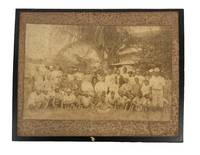
1890ref. 208021890. Unidentified photographers two albumen photographs of Black laborers circa 1890s to early 1900s document agricultural and skilled work performed by African Americans in the decades following emancipation when systems of sharecropping and tenant farming structured rural economies across the American South and parts of the Caribbean. These images provide visual evidence of labor organization racial hierarchy and economic dependency that persisted after the formal end of slavery with large groups of Black workers shown in relation to white overseers or employers. One photograph presents approximately forty five Black men gathered around three centrally seated white men emphasizing supervisory roles and social stratification within plantation labor systems. The clothing of the workers including cotton shirts loose trousers and wide brimmed hats reflects adaptation to agricultural work in hot climates while a smaller number of individuals in jackets and pocket watches suggests internal distinctions within Black labor communities. The second image depicts six Black carpenters engaged in coordinated manual work at an outdoor shop indicating the presence of skilled trades alongside agricultural labor. Group of two albumen photographs mounted on original cardstock measuring approximately 8 x 9.5 inches and 10 x 12 inches. The larger photograph shows an outdoor woodworking scene with six men using tools including a hammer and saw working under a thatched structure suggestive of southern or Caribbean environments. The second photograph shows a large assembled group of plantation workers with three white men seated at center. Faint pencil annotations appear in the margins of one mount. Both photographs retain strong compositional clarity with figures arranged to emphasize both collective labor and hierarchical relationships. These photographs contribute to the study of post emancipation Black life by documenting how agricultural dependency and limited access to capital shaped labor conditions into the late nineteenth and early twentieth centuries. The plantation scene illustrates the persistence of racially stratified labor organization while the carpentry image provides evidence of skilled Black tradesmen operating within local economies often without institutional support or pathways to independent enterprise. The visual contrast between collective field labor and artisanal work expands the interpretive scope of the archive situating these images within broader histories of labor race and economic transition following the end of slavery. Edge wear and minor chipping to mounts with noticeable foxing to one image primarily at the margins; images remain legible and structurally intact. Overall good condition. unknown
1890ref. 208021890. Unidentified photographers two albumen photographs of Black laborers circa 1890s to early 1900s document agricultural and skilled work performed by African Americans in the decades following emancipation when systems of sharecropping and tenant farming structured rural economies across the American South and parts of the Caribbean. These images provide visual evidence of labor organization racial hierarchy and economic dependency that persisted after the formal end of slavery with large groups of Black workers shown in relation to white overseers or employers. One photograph presents approximately forty five Black men gathered around three centrally seated white men emphasizing supervisory roles and social stratification within plantation labor systems. The clothing of the workers including cotton shirts loose trousers and wide brimmed hats reflects adaptation to agricultural work in hot climates while a smaller number of individuals in jackets and pocket watches suggests internal distinctions within Black labor communities. The second image depicts six Black carpenters engaged in coordinated manual work at an outdoor shop indicating the presence of skilled trades alongside agricultural labor. Group of two albumen photographs mounted on original cardstock measuring approximately 8 x 9.5 inches and 10 x 12 inches. The larger photograph shows an outdoor woodworking scene with six men using tools including a hammer and saw working under a thatched structure suggestive of southern or Caribbean environments. The second photograph shows a large assembled group of plantation workers with three white men seated at center. Faint pencil annotations appear in the margins of one mount. Both photographs retain strong compositional clarity with figures arranged to emphasize both collective labor and hierarchical relationships. These photographs contribute to the study of post emancipation Black life by documenting how agricultural dependency and limited access to capital shaped labor conditions into the late nineteenth and early twentieth centuries. The plantation scene illustrates the persistence of racially stratified labor organization while the carpentry image provides evidence of skilled Black tradesmen operating within local economies often without institutional support or pathways to independent enterprise. The visual contrast between collective field labor and artisanal work expands the interpretive scope of the archive situating these images within broader histories of labor race and economic transition following the end of slavery. Edge wear and minor chipping to mounts with noticeable foxing to one image primarily at the margins; images remain legible and structurally intact. Overall good condition. unknown books
ref. Z1-F-065-00096British Film Institute. Used - Good. Ships from UK in 48 hours or less usually same day. Your purchase helps support Sri Lankan Children's Charity 'The Rainbow Centre'. Ex-library so some stamps and wear but in good overall condition. 100% money back guarantee. We are a world class secondhand bookstore based in Hertfordshire United Kingdom and specialize in high quality textbooks across an enormous variety of subjects. We aim to provide a vast range of textbooks rare and collectible books at a great price. Our donations to The Rainbow Centre have helped provide an education and a safe haven to hundreds of children who live in appalling conditions. We provide a 100% money back guarantee and are dedicated to providing our customers with the highest standards of service in the bookselling industry. British Film Institute unknown
ref. AMA-1176London, Robillant + Voena, 2010. In 4°, broché, couverture à rabats. 37 pp.,[1 f.], illustrations en couleurs in texte.
1759ref. 6261BBLeipzig, Arkstee und Merkus, 1759. 4°. (1) Bl., (8) 726 (42) S., (1) Bl. Mit 17 (dv. 12 gef.) gest. Karten u. 11 gest. Tafeln. Lederband der Zeit mit restauriertem Rücken, schlichte Vergoldung und Rückenschild. + Wichtig: Für unsere Kunden in der EU erfolgt der Versand alle 14 Tage verzollt ab Deutschland / Postbank-Konto in Deutschland vorhanden +, A|B 17. Band.
1759ref. 6261BB17. Band. Leipzig, Arkstee und Merkus, 1759. 4°. (1) Bl., (8) 726 (42) S., (1) Bl. Mit 17 (dv. 12 gef.) gest. Karten u. 11 gest. Tafeln. Lederband der Zeit mit restauriertem Rücken, schlichte Vergoldung und Rückenschild.
1986Un volume broché au format poche de 222 pp.; couverture illustrée. Etat de neuf. Voir photo. Peu fréquent.
1836ref. 011073, 1836. Erstausgabe Goldgeprägter Halblederband Solide, Materiell Gut
1969ref. 98859New York, Kraus Reprint Co., 1969. 738 S. Gr.-8°, Halbleinen
1961128 pages. Features: Is the U.S. Losing Out in the Caribbean?; The Fourth of July - 1908; "Fair Play for America" Committee; The Fair Trae Racket; The Lost Colony of the Confederacy - A bizarre tale of a Colony of defeated Confederates who tried to start over again in South America; A Barber Speaks His Mind - things a customer should know in view of the rising price of haircuts; What Are You Reading These Days? - A critique that throws light on brainwashing techniques of the book and magazine publishers in America; Debatability of Fluoridation; Smith Street, U.S.A. - reprint of a 1939 article on the battle for democracy in the U.S.; Straight Talk; Nostalgia; Stage Fright - a common fear is explained; The Challenge of Underdevelloped Countries; Red Spies Plague America - an army of 300,000 spies steal military and atomic secrets; Underground "Noah's Ark" - man-made salt caverns in Kansas offer protection in the event of enemy attack; A "New" Task for the Church - the American home has become a real mission field; Old Warhorse Still in Harness - how Charlie Younts dealt with retirement; Exit the Aircraft Carrier; How to Prevent a Cold; Vi Murphy Keeps Her Word - courageous reporter goes to jail rather than betray news source; A Discovery That Changed the World - Paper; The Dalton Trumbo Trumpet - he was jailed in 1950 for contempt of Congress, has since written scripts for Exodus and Spartacus, and now receives adulation. Minimal markings. Moderate wear. A sound vintage copy bearing the address label of noted Madison, WI architect William Kaeser. Book
ref. 041370520X.Gpaperback. Good. Access codes and supplements are not guaranteed with used items. May be an ex-library book. paperback