GAGE (Thomas).Livre Rare Book
2 538 résultats
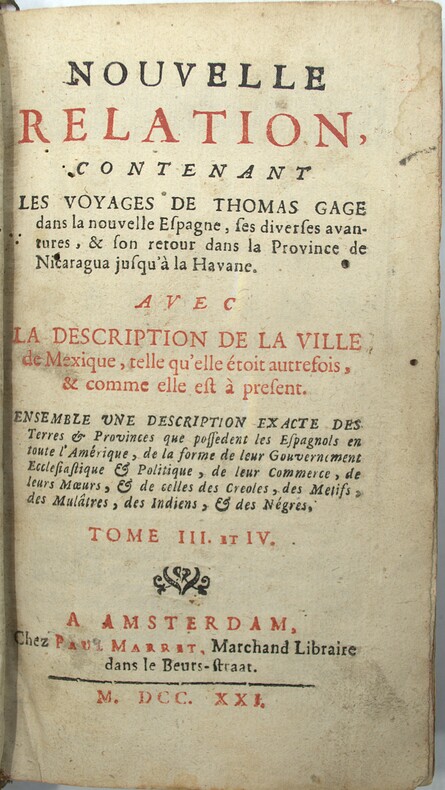
1721réf. PHO-2215Amsterdam, Paul Marret, 1721, in-12, 306pp.-3ff., basane époque, dos à nerfs avec titre et tomaison, petit accroc en pied, défauts d’usage.
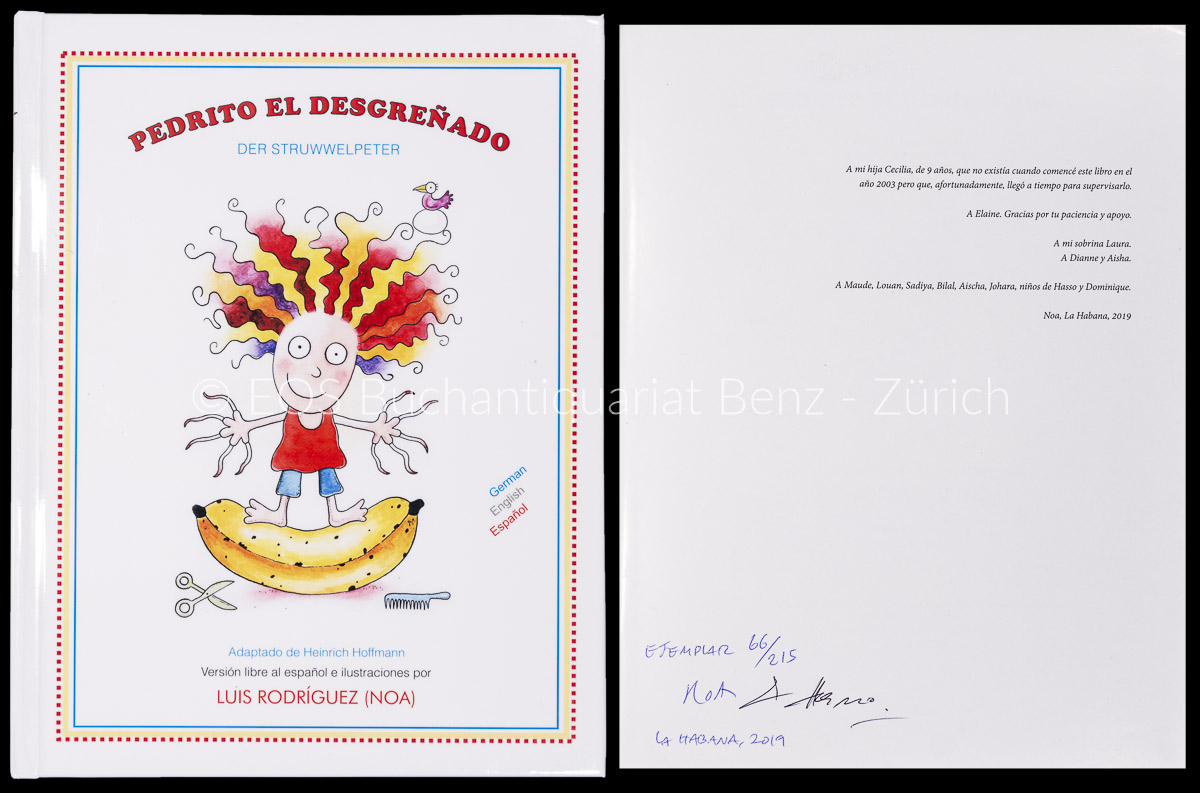
réf. 30682ABLa Habana, NOA-ART & doahböhme, 2019. 43 S. Mit farb. Illustr. von NOA (Luis Rodriguez). Illustrierter Orig.-Pappband. + Wichtig: Für unsere Kunden in der EU erfolgt der Versand alle 14 Tage verzollt ab Deutschland / Postbank-Konto in Deutschland vorhanden +, A 1. Auflage.
réf. 13978843Nanterre: Editions Erasme, 1989 in-4, xxxii-212 pages, carte dépliante, illustrations en couleurs. Reliure toile verte d'éd., petites taches sur le premier plat, autrement très bon état. Fac simile de l'édition de 1826, avec des illustrations extraites d'autres ouvrages de l'époque.
196326,5x20,5. 191p. +CIV láms. Fotogr. Cubierta algo deslucida. Lomo desprendido. Enc. Tela ed.
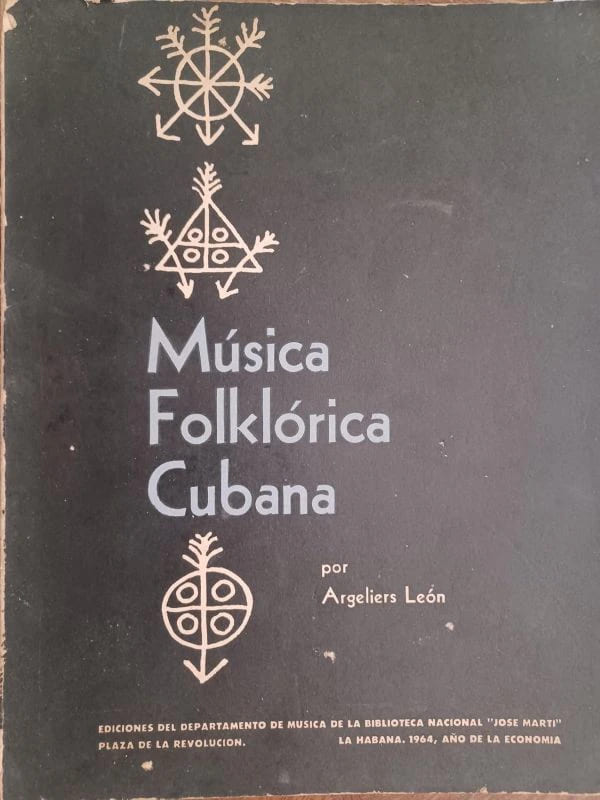
1964réf. 127318La Habana, Ediciones del Departamento de Música de la Biblioteca Nacional José Martí, 1964, in-4° (22 x 28 cm), 148-(1) pp, qqs illustrations, figures et partitions musicales, broché, dos lég. abîmé, bon état. Édition originale. Texte en espagnol
réf. 014630Orestes Ferrara (1876-1972), écrivain cubain d'origine italienne, s'étant battu pour l'indépendance de Cuba, et en devint ambassadeur et député. L.A.S., Hôtel Meurice, Paris, 18 novembre 1956, 1p in-8. A André Sabatier, directeur littéraire chez Albin-Michel. « Cher Mr Sabatier, Au revoir. Demain ou après-demain, nous partirons pour l'Espagne. Je suis un éternel chrétien errant. Les [cigares] ne sont pas trop grands et sont pour un bon fumeur. Ma femme et moi présentons nos meilleurs souvenirs à votre femme et à vous-même, que nous considérons comme nos plus sincères amis. Orestes Ferrara ». Rare lettre de ce révolutionnaire devenu cubain. [354]
réf. 014632Orestes Ferrara (1876-1972), écrivain cubain d'origine italienne, s'étant battu pour l'indépendance de Cuba, et en devint ambassadeur et député. L.A.S., Beau-Rivage-Palace, Lausanne, 28 août 1961, 4p in-12 [dont 2p 1/2 de lui et le reste de son épouse Marie-Louise]. A André Sabatier, directeur littéraire chez Albin-Michel. Belle lettre amicale, donnant des nouvelles, notamment de la vente de son livre sur Philippe II. Rare lettre de ce révolutionnaire devenu cubain. [354]
réf. 014634Orestes Ferrara (1876-1972), écrivain cubain d'origine italienne, s'étant battu pour l'indépendance de Cuba, et en devint ambassadeur et député. L.S. (signée deux fois), Grand Hôtel, Rome, 3 novembre 1965, 3p in-4. A André Sabatier, directeur littéraire chez Albin-Michel. Longue et belle lettre amicale, donnant quelques nouvelles, annonçant la traduction de son livre sur Philippe II en Italien, etc. Comme pour authentifier le premier feuillet, il signe OF en marge de la première page. Rare lettre de ce révolutionnaire devenu cubain. [354]
1907français Dédicacé par l'auteur Grand in-8 de 260 pp.; broché de l'éditeur. Envoi autographe signé de l'auteur en marge du faux-titre. Exemplaire non coupé. Rare.
Madrid, Imprenta del Cuerpo de Artillería, 1901. Doce volúmenes en 4to.; 648 pp. en paginación continuada y 17 láminas + 546 pp, en paginación continúada, y 29 láminas. Cubiertas originales. Contiene, entre otros textos, "Consideraciones militares sobre la campaña de Cuba" de Francisco J. de Moya, "Dominación y guerras de España en los Paises Bajos" de Francisco Barado, y "Estudio militar de Menorca" de Mariano Pena San Miguel y Gualterio M. Seco,.
réf. ria9781966932338_inpHardcover. New. New Book; Fast Shipping from UK; Not signed; Not First Edition; La usina del lenguaje lee el neobarroco latinoamericano como una maquinaria verbal contra la transparencia y el desgaste de las formas. En sus páginas el poema aparece como artefacto de máxima presión: una sintaxis que se pliega hardcover
1993réf. Q-1555911161Fulcrum Publishing 1993-06-22. Paperback. New. In shrink wrap. Looks like an interesting title! Fulcrum Publishing paperback
1988réf. Q-0673397661Scott Foresman & Co 1988-01-01. Paperback. New. In shrink wrap. Looks like an interesting title! Scott Foresman & Co paperback
First edition, 8vo, xix, [1] 395pp., with half-title, orig. blue cloth, spine lettered in gilt, a very good copy.
La Habana, 1957, 27 x 18 cm., numerosos facsímiles intercalados en el texto, 433 págs. + 2 h. (Carecemos del Tomo II de esta obra. Cubierta original anterior parcialmente desprendida y careciendo del lomo).
1900réf. 25439Havana Cuba: Not Published 1900. Both letters two pages on Samuel Wyman Smith Importer Havana Cuba letterhead paper; dated Jan. 4 1900 and Dec. 5 1900. Both addressed to "My Dear Gilbert"; the contents typed and concerning the fate of their mutual investment in "The Studio" restaurant & bar in Havana. ".all the papers that I can find at the Studio have been forwarded to you at Cambridge Springs. The reason for this delay has been that I have been quite ill having had a toe amputated.You will see the Studio is improving. I have just made an arrangement with two Chinamen as cooks Spanish waiters however.this should finally put the place on a paying basis." adding handwritten ".I trust you will soon send me a good sized check as I need money desperately." The letter of December relates Smith's attempts to find buyers and leasors for the restaurant ".I am bothered to death by the bills of the place existing before you left some of which I have personally guaranteed.have also had a proposition from a Spaniard to take the restaurant.As a restaurant is always a dead loser except under very competent management this seems to me to be most advantageous.The quarantine has been taken off the camps here and business is much better."; continuing to ask for money. With the original mailing envelopes addressed to Mr. W.E. Gilbert. This venture was perhaps an attempt to meet the needs of the very large population of North Americans residing in Cuba after the Spanish-American War; many businesses opened especially in Havana including hotels bars and restaurants. In his book "On Becoming Cuban: Identity Nationality and Culture" By Louis A. Perez 2008 Univ. of North Carolina Press an individual named Edward E. Nelson opened the Studio restaurant in Havana in 1899 and was not very successful per the contents of these letters. Envelopes very soiled and worn; letters with light wear old fold lines; in very good condition. Interesting Cuban - U.S. business history ephemera from the early days of the 20th century telling of the unsettled commercial climate. . Manuscript. Not Bound. Very Good. Not Published paperback books
1980réf. 24691Cuba: Union de Escritores y Artistas de Cuba UNEAC 1980. Poster in colors text in Spanish; Approx. 18 1/2" x 28" size some edge-crinkling roll-creases; in very good condition. Poster. Not Bound. Very Good. Union de Escritores y Artistas de Cuba UNEAC Paperback books
1977réf. 24689Cuba: Union de Escritores y Artistas de Cuba UNEAC 1977. Poster in colors text in Spanish. Also printed at bottom edge: C.P. "Evelio Rodriguez Curbelo"/Taller experimental. Approx. 20" x 30" size; in very good condition. Poster. Not Bound. Very Good. Union de Escritores y Artistas de Cuba UNEAC Paperback books
1980réf. 24687Cuba: Union de Escritores y Artistas de Cuba UNEAC 1980. Poster in colors text in Spanish. Approx. 20" x 30" size; crease in lower left corner; little edge-crinkling; in very good condition. Poster. Not Bound. Very Good. Union de Escritores y Artistas de Cuba UNEAC Paperback books
1977réf. 24690Cuba: Union de Escritores y Artistas de Cuba UNEAC 1977. Poster in colors text in Spanish; Approx. 20" x 29" size horizontal format; some edge-crinkling; in very good condition. Poster. Not Bound. Very Good. Union de Escritores y Artistas de Cuba UNEAC Paperback books
1947réf. 98519Havana, Cuban Tourist Commission, impr. Ucar, Garcia y Cia, Cuba 1947 1 carte. In-12 18,5 x 12,5 cm repliée, In-folio 55,5 x 71cm dépliée. Exemplaire en bon état.
2004réf. 165780Zch., gdz, 2004. 6 Nummern, je 50-70 S., mit zahlreichen s/w und farbigen Abbildungen. Original-Broschur, 4°. Heft 1: Dieter Bachmann über Bruno Monguzzi, ausserdem zahlreiche Abbildungen von Plakaten von Flavia Cocchi; Heft 2 mit einem Nachruf auf Max Caflisch, einem Aufsatz von Hans Eduard Meier: ABCSchrift: eine zeitgemässe Handschrift sowie einem Bericht "Das trikontinentale Solidaritätsplakat" von René Lechleiter; Heft 3: Gérard Ifert über "Schach und Gestaltungsunterricht"; Heft 4: Hans Rudolf Bosshard über Helmut Schmid, Typograph, und Guillaume Faisant, "Petit itinéraire d'un apprenti grafiste"; Heft 5/6: Überblick über "Typositionen", Ausrichtungen und Positionen in der Ausbidlung von Typographen. Viele Texte parallel deutsch-englisch. Redaktion Lukas Hartmann, für die RSI Claude Darbellay und andere. Die "Typografischen Monatsblätter",erst "Typographischen Monatsblätter" erschienen von 1933 bis 2014, sie waren lange Zeit massgebend für typographische Gestaltung.. Softcover Guter Zustand. TM - RSI - STM, Nr. 1-6, 2004
1995réf. 165748Zch., gdz, 1995. 6 Hefte, je 48 S., mit zahlreichen, teilweise farbigen Abbildungen. Original-Broschur, 4°. Heft 1: Hans Rudolf Bosshard über "Aussenbeschriftungen. Wahrnehmung und Lesbarkeit von Schrift im Stadtbild." Ausserdem Plakatentwürfe für die gdz, Wettbewerb. Im französischsprachigen Teil Max Bill "Sur la typographie" und Jan Tschichold "Foi et réalité". Heft 2: Aufsatz von Max Caflisch über "Die Cancelleresca in Vergangenheit und Gegenwart anhand der Poetica dargestellt". Ausserdem Christoph Hegger: "Die Zeit in den Kulturen. Ein Kalender". Im französischsprachigen Teil "Adrian Frutiger raconte ..." und Aufsatz von Roger Chatelain: "La fausse route de Francis Thibaudeau". Heft 3: Aufsatz von Hans Rudolf Bosshard: Lesbarkeit, Lesefreundlichkeit und typografische Gestaltung, Teil 1, ausserdem Aufsatz von Max Caflisch über die Stone Print. Im französischsprachigen Teil Aufsatz von Roger Chatelain: Comment Jan Tschichold voyait la "Nouvelle Typographie en 1930 ...". Heft 4: Teil 2 des Aufsatzes von Hans Rudolf Bosshard: Lesbarkeit, Lesefreundlichkeit und typografische Gestaltung, ausserdem Max Caflisch über die Big Caslon. Im französischsprachigen Teil "Maximilien Vox. Son analyse dans les années soixante ..." und "Le chantre de la 'graphie latine'" von Roger Chatelain. Heft 5: Design und Typografie aus Kuba; Heft 6: Max Caflisch: Silica, die neue Egyptienne. Redaktion Jean-Pierre Graber, Roger Chatelain und andere. Die "Typografischen Monatsblätter",erst "Typographischen Monatsblätter" erschienen von 1933 bis 2014, sie waren lange Zeit massgebend für typographische Gestaltung.. Softcover Guter Zustand. TM - RSI, Nr. 1-6, 1995
réf. 3752481846.Ghardcover. Good. Access codes and supplements are not guaranteed with used items. May be an ex-library book. hardcover
1485réf. 707731485. Mainz Peter Schöffer 28 März 1485 1 einspaltiges original Inkunabelblatt 286 x 210 mm; etwas fleckig. Erstdruck! Cap. 37: Aloes lignum - exn holtz. Aquilaria malaccensis La./ A. agallocha Rpxb. Kapitel Ende. Cap. 38: Aurum - golt. Aurum. "Im Gegensatz zu den meisten Kräuterbuch-Inkunabeln lässt sich das Druckdatum des "Gart der Gesundheit genau auf den 28. März 1485 festlegen wie es am Ende des Werks vermerkt ist: "Disser Herbarius ist rzu mentz gedruckt und geendet uff dem XXVIII dage des mertz -Anno-M-CCCC-LXXXV". An gleicher Stelle wird Peter Schöffer als Drucker durch das Fust-Schöffersche Signet bestätigt. Der "Gart der Gesundheit gilt wie Muther 1884: 88: "als wichtigstes naturhistorisches Werk des Mittelalters" und Klebs/Becher 1925: 11: "The most important mediaeval work on natural history with illustrations Choulant the publication of which forms an important landmark in the history of botanical Illustration and marks perhaps the grea-test single Step ever made in that art" meinten als wichtigste bebilderte Arzneipflanzen-Inkunabel. Auch Keil 1982: 604 bestätigte später diese Aussage: "Zweifellos ist der "Gart das wichtigste naturhistorische Werk des Mittelalters". Auf 359 Seiten die in 435 Kapitel gegliedert sind wird der gesamte zur damaligen Zeit bekannte Arzneischatz abgehandelt und mit 382 Holzschnitten illustriert. Die wichtigsten 366 Heilpflanzen zwei Wiederholungen werden jeweils einzeln in den verschiedenen Kapiteln beschrieben und abgebildet. Der Text ist 42zeilig geordnet." B. Baumann & H. Baumann Die Mainzer Kräuterbuch-Inkunabeln 2010 p.111 Johann Wonnecke von Kaub um 1430 in Kaub am Rhein; gestorben 1503/04 in Frankfurt am Main auch Johannfes Dronnecke bzw. Johannes de Cuba er selbst nannte sich "Johan von Cube" war ein deutscher Arzt und Botaniker. Am Mainzer Hof wirkte er als Leibarzt. Kapitel nicht vollständig. unknown