[HAVANA] [CUBA] American Express, et alBiblio.com
2,457 results
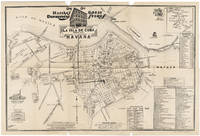
1930ref. 560Havana Cuba: American Express Co et al. 1930. Small archive of six items from a trip in the early years of the 1930s all good or better. Items include: One forty page brochure in decorated and printed card stock wrappers "CUBA The Pearl of the Antilles" with 16 itineraries and copious pictorial advertisements; two contemporary color picture postcards unused; small brochure folded to make four pages offering visits to "Algibe" Farm the "most typical Cuban Farm in the vicinity of Havana" where you are invited to see how crops are grown attend "Thrilling Cock-Fights at all hours" and "Royal Palm Climbing Exhibitions." Finally a fan-folded invitation to "Buy where Cubans buy" at La Isla de Cuba with an accompanying map 21 x 14 in. dated 1928 of the entire downtown Havana shopping district folded into twelve 7 x 3.75 in. panels with breaks at folds see photo. All good or better with nicks small closed tears and a few smudges. American Express Co, et al. unknown
1859288 p. Hardcover Very good condition some wear at spine ends & corners, remains of bookplate on front endpaper. BAL 4447 - 16 p. ads at end dated April 1859.
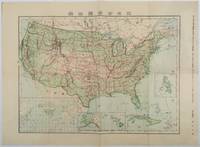
1911ref. 179415Tokyo.: 楠山正雄. Kusuyama Masao. Meiji 44 1911. Colour folding map 40 x 55cm inset maps showing the Philippines Alaska and Hawaii very good copy. This map was a supplement of October 1911 issue of a monthly magazine Shin Nippon 新日本 which was published between 1911 and 1918. The main map covers the contiguous United States with inset maps of the world showing the American territories of Alaska Hawaii and the Philippines. Curiously Cuba has been marked as an American territory having been directly occupied from 1906 to 1909 though at the time still beholden to the 1903 Cuban-American Treaty of Relations. . 楠山正雄. [Kusuyama Masao]. unknown
1485ref. 707261485. Mainz Peter Schöffer 28 März 1485 1 einspaltiges original Inkunabelblatt 238 x 166 mm 1 alt color. Holzschnitt. Erstdruck! Cap. 421: Vibek - byrck; Betula pubescens Ehr. Cap. 422: Usnea - maiß; Usnea jubata Hoofm.; Darstellung: schematisiert. Cap. 423: Vidriolum - vidril; Vitriol. "Im Gegensatz zu den meisten Kräuterbuch-Inkunabeln lässt sich das Druckdatum des "Gart der Gesundheit genau auf den 28. März 1485 festlegen wie es am Ende des Werks vermerkt ist: "Disser Herbarius ist rzu mentz gedruckt und geendet uff dem XXVIII dage des mertz -Anno-M-CCCC-LXXXV". An gleicher Stelle wird Peter Schöffer als Drucker durch das Fust-Schöffersche Signet bestätigt. Der "Gart der Gesundheit gilt wie Muther 1884: 88: "als wichtigstes naturhistorisches Werk des Mittelalters" und Klebs/Becher 1925: 11: "The most important mediaeval work on natural history with illustrations Choulant the publication of which forms an important landmark in the history of botanical Illustration and marks perhaps the grea-test single Step ever made in that art" meinten als wichtigste bebilderte Arzneipflanzen-Inkunabel. Auch Keil 1982: 604 bestätigte später diese Aussage: "Zweifellos ist der "Gart das wichtigste naturhistorische Werk des Mittelalters". Auf 359 Seiten die in 435 Kapitel gegliedert sind wird der gesamte zur damaligen Zeit bekannte Arzneischatz abgehandelt und mit 382 Holzschnitten illustriert. Die wichtigsten 366 Heilpflanzen zwei Wiederholungen werden jeweils einzeln in den verschiedenen Kapiteln beschrieben und abgebildet. Der Text ist 42zeilig geordnet." B. Baumann & H. Baumann Die Mainzer Kräuterbuch-Inkunabeln 2010 p.111 Johann Wonnecke von Kaub um 1430 in Kaub am Rhein; gestorben 1503/04 in Frankfurt am Main auch Johannfes Dronnecke bzw. Johannes de Cuba er selbst nannte sich "Johan von Cube" war ein deutscher Arzt und Botaniker. Am Mainzer Hof wirkte er als Leibarzt. unknown
1936ref. 29200La Habana, Cultural SA., 1936. Frontispiz, 56 S. u. 158 Taf., 1 Bl., 4°, OLwd.
2000ref. 54535Havana: Editorial Echevarria ca. 2000. Oblong 4to. 32 pp unpaginated. w/ 271 colour numbered Revolutionary trading cards all tipped-in including 3 for Revolutionist flags on verso front cover. Colour-illustrated coated softcovers cover art showing heroic Fidel Castro leading the revolutionaries rubbing creasing rippling to textblock still VG- copy. Facsimile souvenir of this famed piece of Cuban Revolutionary propaganda distributed free to the Cuban people originally by Felices Frutas the local canned fruit industry trying to stay afloat and appease Castro as all the countries industries and businesses were nationalized after the Revolution. Featuring the cartoon art of Capdevila this piece traces the return of the Castros from exile in Mexico as they fought capitalist exploitation the fall of Batista the bloody running battles and more all celebrating the success. Editorial Echevarria, paperback
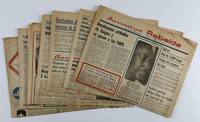
1969ref. 12628Havana: Union de Jovenas Comunistas 1969. Seven newspapers each between 6 and 8pp. on newsprint. Illustrated. Modest toning some edge wear and closed tears some bumped or dog-eared corners. Overall very good. A small but instant collection of an informative newspaper from Communist Cuba published daily by the youth wing of the Party. The issues are all dated in January 1969 specifically from January 11 15 22 28 29 30 and 31. The issues contain domestic and international reporting along with topics relevant to revolutionary young people. Interestingly one issue contains a translated interview with Hollywood legend Marlon Brando. The paper also prints a legion of photographs cultural event listings classifieds baseball statistics and updates cartoons and more. Union de Jovenas Comunistas unknown
1969ref. 12628Havana: Union de Jovenas Comunistas 1969. Seven newspapers each between 6 and 8pp. on newsprint. Illustrated. Modest toning some edge wear and closed tears some bumped or dog-eared corners. Overall very good. A small but instant collection of an informative newspaper from Communist Cuba published daily by the youth wing of the Party. The issues are all dated in January 1969 specifically from January 11 15 22 28 29 30 and 31. The issues contain domestic and international reporting along with topics relevant to revolutionary young people. Interestingly one issue contains a translated interview with Hollywood legend Marlon Brando. The paper also prints a legion of photographs cultural event listings classifieds baseball statistics and updates cartoons and more. Union de Jovenas Comunistas unknown books
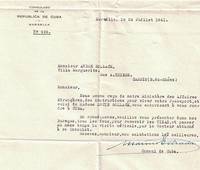
ref. 16-4373Marseille France: 24 juillet 1941. . TLS with franked envelope approving a visa for André and Lucie Bollack of Cassis.Provenance Estate of Paul Lombard. Né en 1889 Paul Lombard a été rédacteur en chef de la revue L’Homme libre journal de Clémenceau et critique littéraire sous le pseudonyme de Louis Méritan. Paul Lombard est de ces critiques qui comme l’a montré Thierry Laget Proust Prix Goncourt Gallimard 2019 reprochaient à l’Académie Goncourt d’avoir décerné leur prix à un écrivain trop vieux trop riche : "Au lieu de cela cette année le prix Goncourt … échoit à M. Proust qui n’est pas jeune : il a conquis en peu de jours une notoriété dont j’ignore le secret ; le prix Goncourt même s’il l’a mérité ne lui sera d’aucune utilité" déplore-t-il dans L’Homme libre du 11 décembre 1919 p. 2. Probablement aurait-il préféré que Les Croix de bois de Dorgelès remportât de prix d’autant que l'écrivain avait été un collaborateur régulier de L’Homme libre.Expertise by Ségolène Beauchamp 86bis rue de Bellébat 45000 Orléans and Pierre Prévost 75 rue Michel Ange 75016 Paris. Marseille, France: 24 juillet 1941. unknown
1486ref. 049666Basel: Michael Furter 1486. disbound. Very Good Condition. single leaf 7 1/4" x 10 3/4" with a hand colored illustration on each side. Slight chipping at edges faint tape marks on edge from having been mounted a little soiling. A nice example. Variously dated likely 1486-87. An early printing of this important German herbal first printed in Mainz in 1485. istc: ig00106500 Goff g101 Size: Folio. Quantity Available: 1. Shipped Weight: Under 1 kilo. Category: Science & Technology; Botany; Inventory No: 049666. Michael Furter unknown
1485ref. 049668Augsburg: H Schonsperger 1485. disbound. Very Good Condition. single leaf 8 1/4" x 11 3/8" with a hand colored illustrations of silverweed and a pea plant. Some chipping at edges faint tape marks on edge from having been mounted significant browning soiling in margins. An early printing of this important German herbal first printed in Mainz in 1485. Goff G97 ISTC ig00097000 Size: Folio. Quantity Available: 1. Shipped Weight: Under 1 kilo. Category: Science & Technology; Botany; Inventory No: 049668. H, Schonsperger unknown
ref. 3345OSPAAAL. 1970. Impression en offset, sur papier glacé. Dim: 520 x 327 mm. Défauts, anciennes restaurations. .
ref. 3345OSPAAAL. 1970. Impression en offset, sur papier glacé. Dim: 520 x 327 mm. Défauts, anciennes restaurations. .
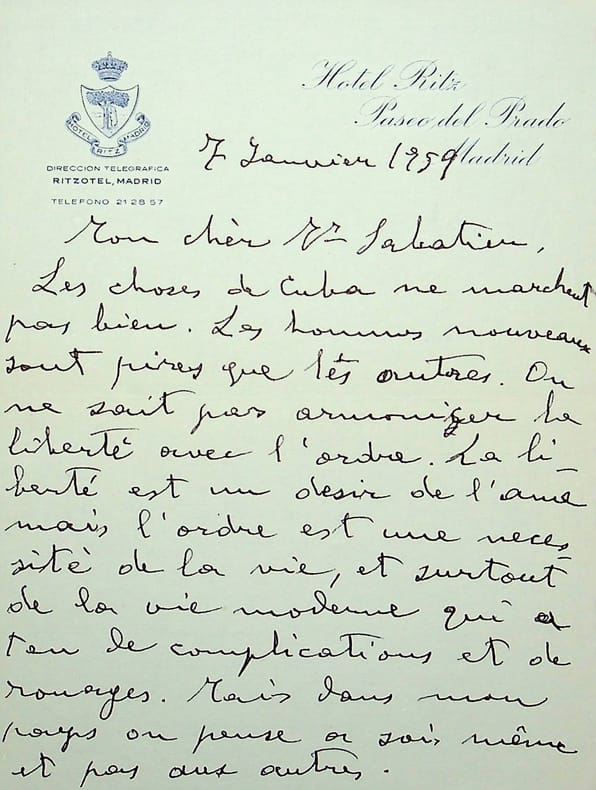
ref. 014631[Fidel Castro] Orestes Ferrara (1876-1972), écrivain cubain d'origine italienne, s'étant battu pour l'indépendance de Cuba, et en devint ambassadeur et député. L.A.S., Hôtel Ritz, Madrid, 7 janvier 1959, 2p in-8. A André Sabatier, directeur littéraire chez Albin-Michel. « Mon cher Mr Sabatier, Les choses de Cuba ne marchent pas bien. Les hommes nouveaux sont pires que les autres. On ne sait pas harmoniser la liberté avec l'ordre. La liberté est un désir de l'âme mais l'ordre est une nécessité de la vie, et surtout de la vie moderne qui a tant de complications et de rouages. Mais dans mon pays, on pense à soi-même et pas aux autres. Je ne sais pas si je resterai à l'Unesco. Je n'y tiens pas. Et si je peux me retirer sans apparaître que je démissionne pour des raisons d'ordre politique, je le ferai avec plaisir. Je n'aimais pas les anciens et je n'aime pas les nouveaux. Mon "Felipe II" est en train d'être copié. J'espère l'avoir dans un mois. Si je viens à Paris plus tard, je vous remettrai une copie avec quelque ami. Miomandre m'a félicité pour la nouvelle année. Je ne lui ai pas répondu par ce qu'il a été très mal élevé lorsqu'il m'a parlé par téléphone. Mes respectueuses salutations à madame Sabatier. A vous mon très amical coup de main. Orestes Ferrara ». Rare lettre de ce révolutionnaire devenu cubain qui critique ici l'arrivée au pouvoir de Fidel Castro et ses alliés. Battista a fui le pays le 31 décembre 1958 et dès le 1er janvier, Castro survole le pays avant d'être nommé le 7 janvier, le jour-même de cette lettre. [354]
ref. ORD-12016Essentiellement de Barcelone dans les années 1960. Soit 3 lettres manuscrites en français de l'éditeur Alberti de Barcelone, 2 lettres tapuscrites en catalan de Cruzet Editorial Selecta, 1 L.a.s. en catalan de Salvado Espriu, 2 lettres tapuscrites en catalan d'un représentant des Amics de Mistral dont je je n'ai pu déchiffrer la signature, à propos d'un événement douloureux, 1 L.a.s. en catalan de Jordi M. Ponell depuis l'Abadia de Montserrat, une importante correspondance manuscrite en catalan provenant de Santa Coloma de Gramanet (Barcelona) signées Josep Sol et d'un autre nom soit 9 L.a.s. et enfin une longue lettre tapuscrite en provençal de Louis Bayle depuis Rabat, 1952 à Josep Sol et la réponse également tapuscrite de ce dernier.
ref. ORD-12017De La Havane puis de Barcelone entre 1958 et 1965. 3 lettres tapuscrites gd in-8 dont 2 aérogrammes, adressées de La Havane en 1958 et 1959, 7 petites cartes manuscrites depuis Barcelone, courant années 60 et 1 faire-part de naissance et de mariage, et un poème de José Marti traduit par Pineda. Ensemble intéressant dans lequel Pineda i Fargas exprime fortement son adhésion à l'indépendance de la Catalogne.
Matanzas, Aurora del Yumurí, 1880, 21,5 x 14 cm., rústica editorial, 12 págs. (Muy raro. Solo hemos encontrado ejemplar en UC Berkeley ).
Habana, El Eco Militar, 1886, 21 x 14,5 cm., rústica editorial, 22 pags.
1938ref. 029977Julia Ellsworth Ford 1938. 1st Edition . Soft cover. Near Fine. 74 illustrations and maps. 9 Pp. Yellow Card Wrappers Printed In Black. With Paste-On Printed Sheets With Additional Text On Inner Side Of Wrappers. Nerar Fine. Scarce; Only Two Examples In Worldcat. Her Archives Are At Yale And Presented There As "Julia Ellsworth Ford Was A New York Socialite Art Collector And Patron And Author Of Children's Books. She Was Married To Simeon Ford A Financier And Co-Owner Of The Grand Union Hotel In New York. Ford Presided Over A Salon That Included The Lebanese Mystic Kahlil Gibran Irish Poet W. B. Yeats And American Dancer Isadora Duncan. Her Published Works Include: Simeon Solomon: An Appreciation 1908 Imagina 1914 And Snickerty Nick 1919 Among Others." The Archive Apparently Does Not Include This Booklet. [Julia Ellsworth Ford] paperback
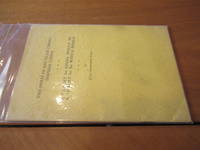
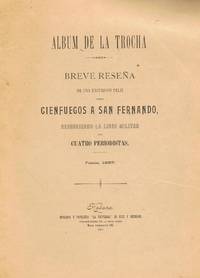
ref. 1032654. . Habana Cuba Imp. ¿La Universal¿ de Ruiz y Hermano. 1897. 30x20 cm. 90 págs. 55 láms. fotográficas en b/n. amplísimos márgenes. los periodistas fuerón: Eva Canel Nicolás de Gamboa Alejandro Menéndez y Antonio Porrúa. Viaje realizado dos años antes de la perdida de Cuba. unknown
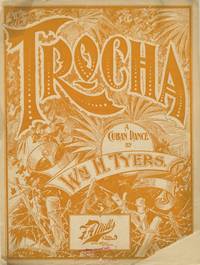
1890ref. List3666New York: Jos. W. Stern & Co 1890. Folio sheet music illustrated pictorial cover printed in orange. 5 pp. including cover. Approximately 13 ½ x 10 ½ inches. Covers detached loss to front cover contents complete fair to good. A decorative late nineteenth-century dance publication for “Trocha” described on the cover as “A Cuban Dance” composed by the African American composer and bandleader W. H. Tyers. The elaborate pictorial cover incorporates stylized tropical foliage and island scenery rendered in a bold single-color design typical for the period’s fascination with exoticized musical forms. William H. Tyers 1870–1924 was an African American composer arranger and bandleader active in New York during the ragtime era. Born in Petersburg Virginia to Henry Tyers and Jane “Jennie” Jones both formerly enslaved he spent part of his youth in Richmond before his family relocated to New York City where he began studying piano. His early teachers recognized an aptitude for composition as well as performance and by the mid-1880s he was writing dance pieces including polkas and waltzes. Around the age of twenty Tyers secured employment as a music librarian and arranger with a touring concert company a position that brought him to Europe where he studied orchestration and arranging with Professor Gaspari in Hamburg. Returning to New York Tyers became active in the city’s rapidly expanding popular music trade working as an arranger and composer for publishers including F. A. Mills and Jos. W. Stern & Co. In 1896 he published “Sambo” a syncopated march sometimes considered to be one of the first instrumental rags.1 “Trocha” also released in the 1980s brought Tyers prominence for his ability to write Latin-style rhythms. It was re-issued in 1913 as a tango and its success led Tyers to work as an arranger with Joseph W. Stern in 1897. Tyers’ compositions blended contemporary American dance music with Caribbean and Latin themes a style reflected in pieces such as Trocha and later in his well-known ragtime composition Panama 1911 which remained a staple of early jazz and dance orchestras. OCLC finds two copies with different entries at the Cleveland Public Library and the British Museum Reference Collections. 1 “William Tyers Music Arranger” African American Registry https://aaregistry.org/story/william-tyers-born/ accessed March 10 2026. Jos. W. Stern & Co unknown
1890ref. List3666New York: Jos. W. Stern & Co 1890. Folio sheet music illustrated pictorial cover printed in orange. 5 pp. including cover. Approximately 13 ½ x 10 ½ inches. Covers detached loss to front cover contents complete fair to good. A decorative late nineteenth-century dance publication for “Trocha” described on the cover as “A Cuban Dance” composed by the African American composer and bandleader W. H. Tyers. The elaborate pictorial cover incorporates stylized tropical foliage and island scenery rendered in a bold single-color design typical for the period’s fascination with exoticized musical forms. William H. Tyers 1870–1924 was an African American composer arranger and bandleader active in New York during the ragtime era. Born in Petersburg Virginia to Henry Tyers and Jane “Jennie” Jones both formerly enslaved he spent part of his youth in Richmond before his family relocated to New York City where he began studying piano. His early teachers recognized an aptitude for composition as well as performance and by the mid-1880s he was writing dance pieces including polkas and waltzes. Around the age of twenty Tyers secured employment as a music librarian and arranger with a touring concert company a position that brought him to Europe where he studied orchestration and arranging with Professor Gaspari in Hamburg. Returning to New York Tyers became active in the city’s rapidly expanding popular music trade working as an arranger and composer for publishers including F. A. Mills and Jos. W. Stern & Co. In 1896 he published “Sambo” a syncopated march sometimes considered to be one of the first instrumental rags.1 “Trocha” also released in the 1980s brought Tyers prominence for his ability to write Latin-style rhythms. It was re-issued in 1913 as a tango and its success led Tyers to work as an arranger with Joseph W. Stern in 1897. Tyers’ compositions blended contemporary American dance music with Caribbean and Latin themes a style reflected in pieces such as Trocha and later in his well-known ragtime composition Panama 1911 which remained a staple of early jazz and dance orchestras. OCLC finds two copies with different entries at the Cleveland Public Library and the British Museum Reference Collections. 1 “William Tyers Music Arranger” African American Registry https://aaregistry.org/story/william-tyers-born/ accessed March 10 2026. Jos. W. Stern & Co unknown books
1829ref. 18501829 Imprimerie Royale, Paris, 1829. In-8 demi-veau. xii, 608 pages. Traduit de l'Espagnol. Supplément sur les "Courants de l'Océan Atlantique"
1705Raffigurazione di una parte dell'America Centrale con particolare attenzione alle isole di Cuba, Giamaica, Santo Domingo, Guadalupe etc. La mappa si estende molto a nord fino ad includere le Bahamas
1861ref. 11927Paris E. Dentu [1861] in-12 de 2 ff.n.ch. et 446 pp. broché, couv. verte imprimée, infimes déch. au dos, petit manque angulaire au plat inf