2484 resultados
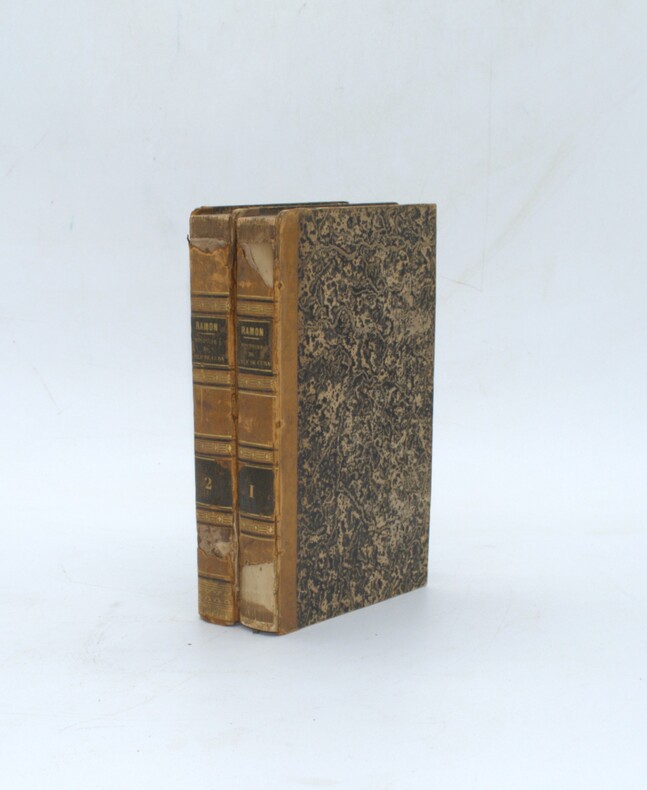
1860ref. 60111860 2 volumes (two books), reliure demi-chagrin havane (binding half shagreen) grand in-octavo, dos 5 nerfs ornés de filet (spine with raised bands illuminated with a gilt line) - titre frappé or (gilt title) et tomaison (volume numbering), papier marbré aux plats (cover with marbled paper), tête lisse (top edge smooth) - gouttière long papier (fore-edge great paper), pages de garde peignées à motif "caillouté" (painting flyleaf), marque-page en tissu (bookmark in tissue), sans illustration (no illustration), naissances de rousseurs sur le deuxième volume (beginning of the redness marks on the second book), XI+421 et 425 pages, 1860 à Paris Michel Lévy Frères Libraires-Editeurs,
1825In 8° (22x13,8 cm); 2 tomi: (4), IV, 470, (2) pp. e (4), 460 pp. Brossura editoriali (sia piatto anteriore che posteriore) conservate entro legatura degli inizi del XX° secolo in pieno cartoncino rigido con titolo in oro su fascetta in pelle al dorso. Esemplare in barbe. Nota manoscritta da mano coeva al recto del frontespizio che si intravede al frontespizio. Al recto del frontespizio anche firma autografa di Antommarchi. Prima rara edizione, ancor più rara a trovarsi in queste più che buone condizioni di conservazione (e con le sue brossure originali conservate), di questo celebre scritto del medico personale di Napoleone durante l'esilio di Sant'Elena e durante i suoi giorni di vita. L'opera è una delle foni principali sugli ultimi mesi di vita di Napoleone e sulle possibili cause della morte dell'imperatore. Francesco Carlo Antommarchi (Morsiglia, 5 luglio 1780 - Santiago di Cuba, 3 aprile 1838) è stato un medico francese. Nacque nel 1780 nella frazione di Stanti di Morsiglia, un paese nella penisola di Capo Corso in Corsica, a 50 km a nord di Bastia. Comincia i suoi studi a Livorno, poi studia all'Università di Pisa e nel marzo 1808 diventa dottore in filosofia e medicina. Si spostò quindi a Firenze dove lavorò all'Ospedale di Santa Maria Nuova; nel frattempo continuò i suoi studi e nel 1812 ottenne il diploma di dottore in chirurgia all'Università di Firenze e dopo essersi laureato lavorò agli ordini dell'anatomista Paolo Mascagni, a partire dal 7 luglio 1813. Su richiesta della madre di Napoleone, Maria Letizia Ramolino e di suo zio, il cardinale Joseph Fesch, diventa medico personale di Napoleone durante il suo esilio a Sant'Elena a partire dal 1819, dopo l'espulsione dall'isola del medico Barry Edward O'Meara. Partito da Firenze, arriva a Sant'Elena nel settembre 1819, il 5 maggio 1821 assiste alla morte di Napoleone e il giorno dopo esegue l'autopsia sul cadavere e afferma che la morte è avvenuta a causa di cancro allo stomaco. In seguito creò la maschera mortuaria di Napoleone, che asserì di aver tratto dal volto dell'imperatore subito dopo la morte e tuttora conservata al Musée de l'Armée di Parigi, anche se alcuni storici rimangono dubbiosi sulla sua paternità. Il 27 maggio 1821 si imbarca a Sant'Elena e sbarca in Inghilterra a Portsmouth il 31 luglio, raggiunge subito Parma dove si presenta a Maria Luigia d'Austria, consorte di Napoleone e ex imperatrice dei francesi e duchessa di Parma, Piacenza e Guastalla; qui si accorda con la vedova per le disposizioni testamentarie, poi raggiunge Roma dove incontra la madre di Napoleone. Dopo il soggiorno in Italia, raggiunge Parigi dove apre un gabinetto medico in 32 Rue de Rivoli e dove sarà sotto sorveglianza della gendarmeria. Dal 15 aprile al 7 settembre 1831 si reca in Polonia come ispettore generale degli ospedali polacchi e al suo ritorno sposta il suo gabinetto medico in 8 Rue Fouard. Nel 1834 partì per New Orleans dove arrivò l'8 novembre 1834: qui fece dono alla popolazione della maschera mortuaria in bronzo di Napoleone e, nei tre anni di residenza nella città, aprì un gabinetto medico e fece numerosi interventi alla cataratta. Nel maggio 1837 parte per il Messico, dove esercita come medico itinerante, e poi per Cuba dove incontra suo cugino Antonio-Benjamin Antommarchi che ha fatto fortuna con una piantagione di caffè. Il 2 gennaio 1838 raggiunge Santiago di Cuba, città cubana che ha accolto molti fuoriusciti francesi; all'arrivo in città è accolto con onori. Poco dopo in città si diffonde la febbre gialla e l'Antommarchi muore il 3 aprile, a 57 anni, a causa della malattia. Prima edizione, non comune. A good copy.
ref. 41923Paris Librairie Plon, E. Plon, Nourrit et Cie, Imprimeurs-Editeurs, sans date (vers 1886) 1876 in 12 (18x12) 1 volume reliure demi chagrin rouge de l'éditeur, dos à nerfs orné de caissons dorés, plat de percaline rouge avec double encadrement de filets à froid, tranches dorées, 325 pages, avec 10 gravures. Superbe exemplaire, intérieur très frais, tranches rutilantes ( Photographies sur demande / We can send pictures of this book on simple request )
1883ref. 10007Paris Plon, Nourrit et Cie 1883 in-12 demi-chagr. dos à nerfs, orné [Rel. de l'époque]
Cm. 24; pp. (4), XX, 594. + Una tavola grafica, a doppia pagina, fuori testo: "Des resultats numeriques que presente le relevé comparatif précédent des importations de farine a l'Ile de Cuba". Edizione originale della traduzione francese, l'originale in lingua spagnola comparve a Madrid nel 1845 con il titolo: "Informe fiscal sobre fomento de la poblacion blanca en la isla de Cuba y emancipacion progresiva de la esclava." Vasquez Queipo (1804 - 1893) uomo politico spagnolo, economista e matematico. Brossura moderna, dedica autografa del traduttore Arthur d'Avrainville al Conte Arrivabene di Mantova. Ottimo esemplare, in barbe. (23 / 481) 753 / 30
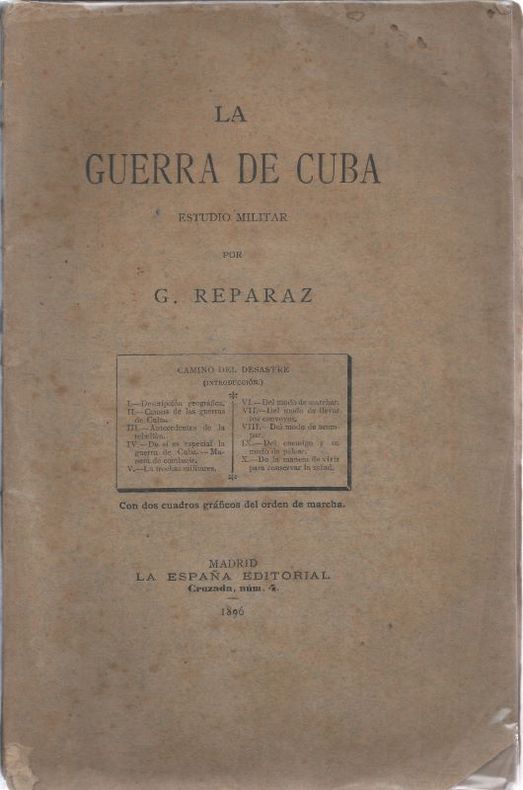
1896Madrid La Espana Editorial 1896, In-8 broché, 216 pages et deux croquis (con dos cuadros graficos del orden de marcha). Petits défauts à la couverture sans gravité, inétrieur en parfait état .Camino del desastre. Descripcion geografica. Causas de las guerra de Cuba. Antecedentes de la rebelion. De si es especial la guerra de Cubz. Manera de combatir. La trochas militares. Del modo de marchar. Del modo de llevar los convoyes. Del enigmo y su modo de pelear. De la manera de vivir para conservar la salud. Peu courant
1896ref. 99917626La Espana Editorial Madrid La Espana Editorial 1896, In-8 broché, 216 pages et deux croquis (con dos cuadros graficos del orden de marcha). Petits défauts à la couverture sans gravité, inétrieur en parfait état .Camino del desastre. Descripcion geografica. Causas de las guerra de Cuba. Antecedentes de la rebelion. De si es especial la guerra de Cubz. Manera de combatir. La trochas militares. Del modo de marchar. Del modo de llevar los convoyes. Del enigmo y su modo de pelear. De la manera de vivir para conservar la salud. Peu courant
1844ref. PHO-2506Paris, Arthus Bertrand, 1844, in-8, 2 volumes, LXXI-771-[2] pp. en numérotation continue, 20 diagrammes hors texte. Veau époque, dos lisse avec auteur, titre et tomaison. Manque aux dos, charnières fendues, quelques rousseurs, cachet aux titres.
1485ref. 707351485. Mainz Peter Schöffer 28 März 1485 1 einspaltiges original Inkunabelblatt 238 x 171 mm 1 alt color. Holzschnitt. Erstdruck! Cap. 316: Pirola - wintergrun; Pyrola chorantha Schwartz; Darstellung: klar erkennbar. Cap. 317: Peucedanum vel feniculus porcinus - harstrang: Peucedanum officinale L. "Im Gegensatz zu den meisten Kräuterbuch-Inkunabeln lässt sich das Druckdatum des "Gart der Gesundheit genau auf den 28. März 1485 festlegen wie es am Ende des Werks vermerkt ist: "Disser Herbarius ist rzu mentz gedruckt und geendet uff dem XXVIII dage des mertz -Anno-M-CCCC-LXXXV". An gleicher Stelle wird Peter Schöffer als Drucker durch das Fust-Schöffersche Signet bestätigt. Der "Gart der Gesundheit gilt wie Muther 1884: 88: "als wichtigstes naturhistorisches Werk des Mittelalters" und Klebs/Becher 1925: 11: "The most important mediaeval work on natural history with illustrations Choulant the publication of which forms an important landmark in the history of botanical Illustration and marks perhaps the grea-test single Step ever made in that art" meinten als wichtigste bebilderte Arzneipflanzen-Inkunabel. Auch Keil 1982: 604 bestätigte später diese Aussage: "Zweifellos ist der "Gart das wichtigste naturhistorische Werk des Mittelalters". Auf 359 Seiten die in 435 Kapitel gegliedert sind wird der gesamte zur damaligen Zeit bekannte Arzneischatz abgehandelt und mit 382 Holzschnitten illustriert. Die wichtigsten 366 Heilpflanzen zwei Wiederholungen werden jeweils einzeln in den verschiedenen Kapiteln beschrieben und abgebildet. Der Text ist 42zeilig geordnet." B. Baumann & H. Baumann Die Mainzer Kräuterbuch-Inkunabeln 2010 p.111 Johann Wonnecke von Kaub um 1430 in Kaub am Rhein; gestorben 1503/04 in Frankfurt am Main auch Johannfes Dronnecke bzw. Johannes de Cuba er selbst nannte sich "Johan von Cube" war ein deutscher Arzt und Botaniker. Am Mainzer Hof wirkte er als Leibarzt. unknown
1485ref. 707791485. Mainz Peter Schöffer 28 März 1485 1 einspaltiges original Inkunabelblatt 239 x 164 mm 1 alt color. Holzschnitt; etwas fleckig. Erstdruck! Cap. 14: Anetum - dille. Anethum graveolens L. Darstellung: klar erkennbar. "Im Gegensatz zu den meisten Kräuterbuch-Inkunabeln lässt sich das Druckdatum des "Gart der Gesundheit genau auf den 28. März 1485 festlegen wie es am Ende des Werks vermerkt ist: "Disser Herbarius ist rzu mentz gedruckt und geendet uff dem XXVIII dage des mertz -Anno-M-CCCC-LXXXV". An gleicher Stelle wird Peter Schöffer als Drucker durch das Fust-Schöffersche Signet bestätigt. Der "Gart der Gesundheit gilt wie Muther 1884: 88: "als wichtigstes naturhistorisches Werk des Mittelalters" und Klebs/Becher 1925: 11: "The most important mediaeval work on natural history with illustrations Choulant the publication of which forms an important landmark in the history of botanical Illustration and marks perhaps the grea-test single Step ever made in that art" meinten als wichtigste bebilderte Arzneipflanzen-Inkunabel. Auch Keil 1982: 604 bestätigte später diese Aussage: "Zweifellos ist der "Gart das wichtigste naturhistorische Werk des Mittelalters". Auf 359 Seiten die in 435 Kapitel gegliedert sind wird der gesamte zur damaligen Zeit bekannte Arzneischatz abgehandelt und mit 382 Holzschnitten illustriert. Die wichtigsten 366 Heilpflanzen zwei Wiederholungen werden jeweils einzeln in den verschiedenen Kapiteln beschrieben und abgebildet. Der Text ist 42zeilig geordnet." B. Baumann & H. Baumann Die Mainzer Kräuterbuch-Inkunabeln 2010 p.111 Johann Wonnecke von Kaub um 1430 in Kaub am Rhein; gestorben 1503/04 in Frankfurt am Main auch Johannfes Dronnecke bzw. Johannes de Cuba er selbst nannte sich "Johan von Cube" war ein deutscher Arzt und Botaniker. Am Mainzer Hof wirkte er als Leibarzt. unknown
1901Pages 1-58. Printed on glossy stock. Numerous black and white photos. Features: Nice Prescott Pianos ad inside front cover; The Woman's Club of Penacook; The First American Colony in Cuba - Neuvitas - great article with photos; Bygones - Some Things not Generally known in the history of Northfield; The English Guild System; The Statement of Adam More; Harry Bingham as a Schoolmaster; Poems; Nice full-page photo ad for the First National Bank in Concord, N.H.; New Hampshire Necrology. Moderate wear. Piece missing from lower corner of page one - contents unaffected. A worthy vintage copy. Magazine
1961116 pages. Features: Cover photo of Russian Yuri Gagarin, the first human to travel to outer space and back; Nice one-page ad for the Volkswagen (VW) truck (microbus); Showdown nears for Castro in Cuba; JFK and how he runs the White House; One-page photo ad for GE's two-way radio; Russia's Triumph in Space - What Does It Mean? - photo-illustrated article; Why The U.S. Wasn't First; A Look at what the U.S. has - and plans - in space; Where U.S. Went Wrong - The Ways to Catch Up; JFK Learns About Personal Diplomacy; Why De Gaulle is a Growing Problem for U.S.; Kennedy's plan to deal with corn surplus; Up Front with U.S. Guerrillas in Southeast Asia - an eyewitness report; A Close New Look at Nehru's India; The Red Terror in Tibet - Interview with the Dalai Lama; Crime Wave Hits Washington, D.C. - with photo of Dallas O. Williams who has 59 convictions, including murder; Critical thinking about the "Show" trial of Adolf Eichmann in Israel; Nice small photo ad for Checker Motors Corp. of Kalamazoo; Nice two-page color-photo ad for (red) Chevy trucks with IFS (independent front suspension) on excavation site; How the United Mine Workers (UMW) under John L. Lewis uses its considerable investments, and why; and more. Unmarked with average wear. A sound vintage copy. Book
196272 pages. Features: Girl Who Married a Family - Joan Beaulieu was wed at 21 - to a husband and six lively boys! - article with nice photos; Full-page colour photo ad for an apparently short-lived product from the Campbell's soup people - Red Kettle Chicken Noodle Soup; We Waste Too Much Time Sleeping - So says Dr. Mangalore Narasimha Pai - who sleeps only three hours each night - article with photos; Using Television in Education at Queen Elizabeth High School in Nova Scotia - article with photos; Photos of amazing oversized typwriter and people; Welsh girl Valerie Gearon stars in film about Gandhi - article with colour photos; Mouth-watering colour photo ad for Lowney's Bridge Mixture candies; Photos of Polar bear and her cub; How to Make Kids' Sports Safer - article with colour photos of (now antiquated) hockey equipment; Nice two-page colour ad for Arrow shirts; Why Soviet Aid Failed to Stave Off Chaos - Understanding Cuba - part 2 of 2 - article with photos; Colour centerfold ad for Parker pens; Edie Adams goes it alone - article with photo about Ernie Kovacs' widow who is now back on the stage; Fantastic colour photo and write-up of Toronto Maple Leaf star Frank Mahovlich; Ottawa's Tudor Singers - article and cover photo; Handicapped Artists Who Help Themselves; Harold Lloyd Rediscovered - his zany comedy stil draw laughs - article with photos; Flying Santa from the Lakehead - Orville Wieben flies north from Fort William each Christmas to distribute clothing, toys, etc. to needy native kids - article with nice colour photo of native babies strapped onto colourful boards; Fashion photos of "Frivolous Nothings"; Nipper comic.Westclox colour ad on back cover. Printed by newspapers across Canada as a weekend supplement. Unmarked with average wear. A sound vintage copy. Magazine
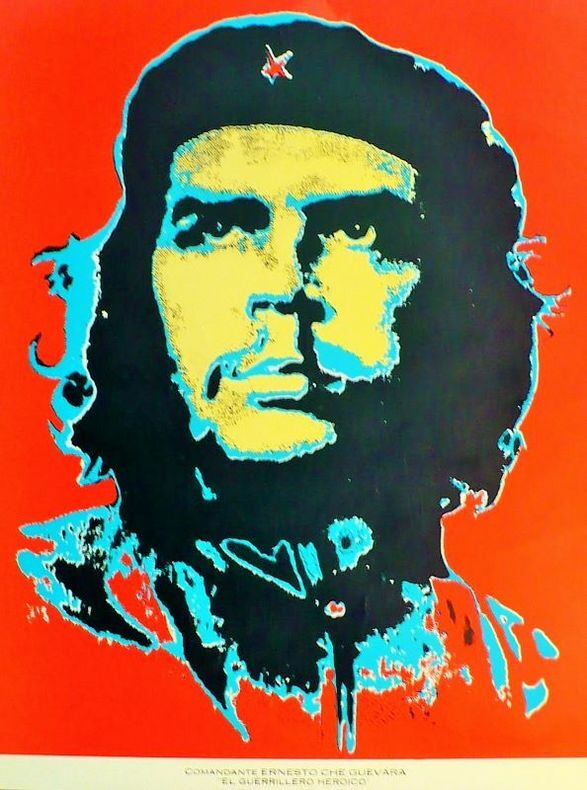
ref. 633Affiche, impression offset. Sans lieu, ni date.ca.1975. Dimensions: 55 x 47 cm.
ref. 632Affiche, impression offset. Instituto Cubano de Amistad con los Pueblos. ca.1975. Dimensions: 60 x 45 cm.
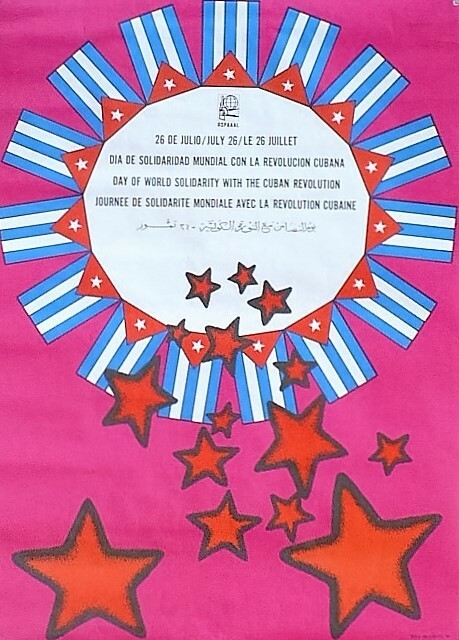
ref. 776Éditée par OSPAAL. 1975. Impression offset. Dimensions: 55,5x35. Petits manques coins inférieurs et une déchirure. Rare.
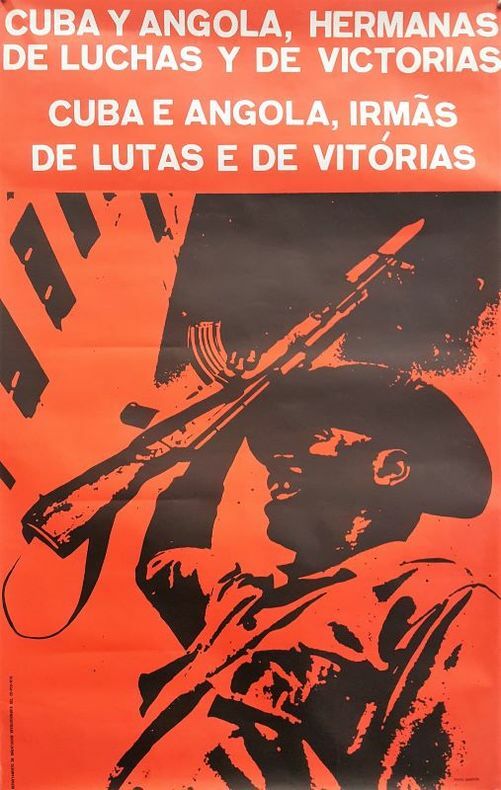
ref. 1105Impression offset. ca.1975. Dim: 72,7 x 46,5 cm. Departamento de Orientación Revolucionaria del Comité Central del Partido Comunista de Cuba. Bon état.
ref. 1106Impression offset. Affiche OSPAAL. ca.1975. Dim: 69 x 38 cm. Bon état.
195123x16. 238p. Cubierta algo deteriorada. Firma anterior poseedor. Fotogr. Ilstr.
ref. 630Thèse pour le doctorat en médecine à Paris. P. Rignoux, 1859. In-4 (26/20cm), 98 pages. Brochure.