2 364 résultats
1864réf. 981Havana: Viuda de Barcina y Comp 1864. Good. Twenty-three issues each approximately 32pp. No. 11 with folding chart lacks pp.25-32. No. 13 lacking last few leaves. With title page and half title at start of each volume. Original quarter calf and boards spine gilt. Spine ends chipped and worn some crude glue residue; hinges solid. Boards heavily worn. Light toning and wear to text light scattered worming throughout. A rare run of the first two years of the first Cuban pharmacological magazine and one of the island's earliest medical periodicals. La Emulacion was published from 1863 through 1867 with the present sammelband containing all issues published in 1863 and 1864 a total of twenty-three issues. Their mission statement that heads the first issue here reads in part: "Animados del deseo de ser útiles al pais -- en cuanto nuestras fuerzas lo permitan-- hemos resuelto dar à luz en esta ciudad un periódico que ocupándose preferentemente de todo lo relativo à la Farmacia no descuide por eso la química é historia natural médicas y la toxicología ciencias de que no pueden prescindir ni los Médicos ni los Farmacéuticos y cuya importancia en el dia pocos podrán desconocer. Procurarémos pues que en nuestro periódico hallen cabida las producciones originales de los que en Cuba cultivan la Farmacia la química é historia natural médicas y la toxicología; mas no olvidarémos por eso que léjos de nuestro suelo existen los mas célebres y laboriosos de los cultivadores de esas ciencias y que La Emulacion no llenaría la mision que nos proponemos si no hiciéramos figurar en ella lo que se dé à luz en Europa y merezca la sancion de las personas ilustradas." The resulting publication contains numerous original articles by Cuban pharmacists doctors and scientists as well as important work published outside of Cuba. Additionally the issues include biographies of significant figures in the field accounts of local scientific societies including the Real Academica de Ciencias de la Habana and publication of new pharmacological formulas discovered in Cuba or "adapted for the needs of the country." As a result the periodical forms an important record of medical and pharmacological developments and thought on the island in the mid-19th century. We locate only one run of this pioneering periodical at the National Library of Cuba with only the present set of issues appearing in auction records. Bound between Volumes I and II is a pamphlet by Fernando Paez "Manual de farmacia practica" Havana 1864 possibly incomplete at 8 pages; no examples of this pamphlet appear in OCLC. Viuda de Barcina y Comp unknown books
2018réf. 9560San Francisco CA: Cuba 2018. Unique. Hardcover. Fine. Minor edge wear else tight bright and unmarred. Loosely bound sheets. 8vo. np. Illus. colored plates. Unique copy. Signed by the artist. Acrylic paint marker drawings on paper. Artist' shop-book used to test/design work and color schemes. A unique books of acrylic paint marker drawings of graffiti murals most of which have been executed on walls throughout the San Francisco Bay area from 2009 2012. This is an amazingly beautiful example of urban art and valuable primary research materials for African American studies calligraphy type design urban studies art history and visual art. This an unusual work as he seldom does 'women' focused typically on more political issues. Here he blends women and politics with style and flare. Also unusually he includes a small self portrait. Cuba is one of the grandfathers of the San Francisco Mission School supplying both the aesthetic styles and the radical leftist politics that formed what may be the only coherent new school of American art since the Punk/graf rock art scene of the 1980s. It was a lot of punk rock shows and stuff like that. There was always graffiti in these places and I was just like "Who is this guy I keep on seeing this guy." There was this one guy Cuba he wrote "Cuba" and it was at all the same hardcore shows in the bathroom on the door and on the street. And then I was like "What who's doing this" It was different than my idea of what graffiti was before that. - Barry McGee in PBSs Art of this Century 2005 "We want to flex our skills and make the community look better" says the 41-year-old painter known as Cuba who has been working on walls with and without permission for more than 25 years. "It's our own form of urban renewal." -San Francisco Chronicle Monday March 7 2005 Cuba hardcover books
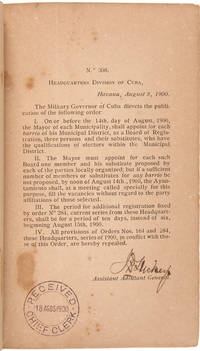
1900réf. WRCAM51843Havana 1900. Approximately 520; 600pp. including several folding charts. Over 200 separate imprints. Original half leather and brown cloth boards spine gilt. Corners and edges worn spine rubbed boards scuffed. Initial leaves of first volume torn away but present. Several other leaves chipped and torn throughout. With many official signatures and docketing stamps. Good. Two volumes of orders promulgated in 1889 and 1900 by the American military government of Cuba after the cessation of hostilities in the Spanish-American War. Under the terms of the Teller Amendment to the Congressional Joint Resolution for war with Spain in 1898 the United States denied the intention of using the conflict as a pretext for the annexation of Cuba and promised to leave the island following the termination of the war. The American military therefore oversaw the creation of the new independent Cuban government before departing in 1902. The documents contained in this collection consist of over two hundred orders in both English and Spanish from the Headquarters Division of Cuba that helped to shape the emerging civilian government. They include instructions for the running of elections the organization of the courts and school system the appointments for various government offices provisions for tax regulations and many other critical issues facing Cuba at its independence. The directives cover two periods from January to July in 1899 and from July to September in 1901. Many of the orders are signed in manuscript by the assistants to the military governor for the island Gen. Leonard Wood including assistant adjutant generals J.B. Hickey and L.W.V. Kennon and Brig. Gen. Chief of Staff Adna R. Chaffee. An interesting documentation of the first American occupation of Cuba. hardcover books
1847réf. LL 559"Appointment of Lieutenant General Federico Roncali count of alcoy "as governor and captain general of the island of cuba and president of the courts of the same" in replacement of general leopoldo o'donell. Given in the palace on november 30 1847. Begins: Doña Isabel Segunda por la gracia de Dios y por la constitucion de la monarquia española Reina de las Españas. "5750 Handwritten bifolio on paper with the printed heading of Isabel II. Queen's stamp signature and plate seal with fleur-de-lys shaped paper protection. Signature of Ramón Narváez. On the second page different statements appear in Madrid and Havana signed by the Count of Villanueva also by the Marquis of Selva Alegre. Federico Roncali count of Alcoy Cádiz 1800- Madrid 1857 came to generalship at the hands of Espartero. Between December 14 1852 and April 14 1853 he was president of the council of ministers after his time as Captaincy of the island of Cuba a position in which he replaced O'Donell. His mandate in Cuba was characterized by the creation of different infrastructures and the increase in the arrival of Chinese laborers that had begun in the previous period. During his mandate the lighthouse that bears his name Roncali was built of great importance for navigation in the Yucatan Strait "the last place on the island where the sun sets"; it is located at Cape San Antonio which was the last place where the aborigines remained at the time of colonization. The document talks about the replacement of Captain General Leopoldo O'Donell the oath that must be taken before taking office and how it should be exercised. UNIQUE AND OF UTMOST IMPORTANCE
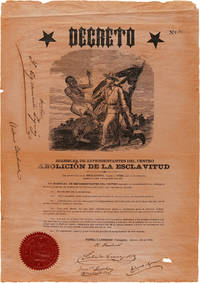
1869réf. WRCAM56566Camagüey Cuba 1869. Pictorial letterpress broadside 18 1/2 x 13 inches. Numbered "54" in manuscript bearing the embossed red seal of the Republica Cubana and signed in ink by Salvador Cisneros y Betancourt Eduardo Agramonte Ignacio Agramonte Loyn áz Francisco Sánchez y Betancourt and Antonio Zambrana. Old horizontal folds minor creasing handful of small edge chips. Small hole in bottom margin just touching one ink signature. Very good condition. A rare and significant pictorial Cuban decree from the provisional rebel government abolishing slavery on the part of the island they controlled issued by the radical faction of the Cuban nationalists fighting against Spanish rule in the first months of the Ten Years' War. This proclamation is illustrated with a dramatic woodcut signed "LFR" depicting an ill-clad but exultant freed slave and a rebel celebrating in front of the Cuban flag. This decree stipulated freedom for all the enslaved people of Cuba in hopes that they would join the revolutionary struggle. The decree also provided for eventual compensation to slaveholders and ordered that freed individuals must serve the revolution either through military service or by continuing with their previous work. Among the important leaders who signed the present document were Salvador Cisneros y Betancourt as president just below the printed text and Ignacio Agramonte y Loynáz as secretary to the left of the engraving. The practical effect of this decree was modest as the rebels only controlled limited territory before their ultimate defeat and their territory was generally under the control of more conservative military commanders but such a proclamation joined a growing chorus of abolitionist sentiment in Cuba which finally realized the end of slavery in 1886. A powerful statement of anti-slavery policy in mid-19th century Cuba with a striking illustration of a jubilant slave celebrating his short-lived freedom. Rare with no copies recorded in OCLC. unknown books
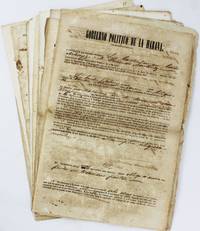
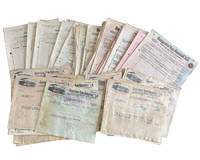
1869réf. 5608Various places in Cuba including Bejucal Havana Matanzas & Sagua la Grande 1869. Good plus. Sixteen broadside broadsheet and bifolium forms completed in manuscript. Previously folded with some short separations along old folds; one longer closed tear from lower left corner of one form. Some chipping and wear at edges not affecting text. Contemporary ink stamps. Varying degrees of tanning and foxing. A group of sixteen contracts for Chinese indentured laborers in Cuba executed during the 1860s. The importation of Chinese labor to Cuba began in earnest in 1853 and in 1860 a law passed by the colonial government essentially enjoined Chinese workers to renew their agreements. The forms present here are sixteen such contract renewals signed by Chinese workers who had completed their initial term of indentured servitude but had no recourse to fairer forms of employment or means to leave the island. "The new law required a change in the contract that required coolies who completed their original term of service to recontract with the same or another master. Otherwise they were obligated to leave Cuba within two months. There is no doubt that the Cubans issued the recontracting regulation in order to keep as many as possible of this captive alien labor force on the plantations knowing full well that very few of the coolies could have saved enough from their meager wages to pay for their passage home" - Hu-DuHart. The present group dating from 1862 to 1869 includes five renewals from Havana; four from Matanzas; three from Colon; two from Guanabacoa; and one apiece from the towns of Sancti Spiritus and Sagua la Grande. Each form gives the adopted Spanish name of the laborer his age place of birth the new and old masters in some cases the same and the duration of the new indenture from six months to two years. The forms also state that the laborers are signing fresh contracts in compliance with the law of 1860 and give the terms for worker and employer including daily hours to be worked amount of food provided weekly shelter if any and meager salaries amongst other stipulations. One contract is signed in Chinese but the preponderance are signed by "witnesses" or "interpreters" for the workers. Fascinating primary documents of the exploitative Chinese labor system in Cuba during the mid-19th century. Elizabeth Hu-Duhart "Chinese Coolie Labor in Cuba in the Nineteenth Century" Contributions in Black Studies 12 1994 pp. 43-46.
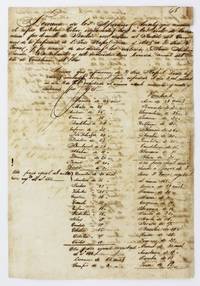
1866réf. 4747Havana: July 10 1866. Good. 3pp. on a bifolium. Separated at fold. Some wear to edge of first leaf cause some minor loss to text. A few scattered tape repairs and reattachments. Some offsetting. A colonial Spanish manuscript slave manifest for the steamship Cristobal Colon carrying dozens of enslaved Africans from Bailen to Partido del Cano both in Cuba. The text at the head reads as follows: "Nomina de los Africano bozales que conducten el vapor Cristobol Colon embarcado hoy a las siete de la mañana por el muelle de Bailen con destino al Partido del Cano unos de la propridad de D. José Rafael Diaz y otros de D. José Garcia y por encargo de sus dueños los custodia D. Juan Antonio Sanchez Bustamante y este individuo tiene biencia annal del Partido de Consolacion del Sur." Bailen is on the southern coast of Cuba north of the Isle of Pines; "El Cano" seems to have been a plantation outside of Havana while Consolacion del Sur is coastal town in the Pinar del Rio region of Cuba. The manifest lists 133 "Africanos bozales" that is slaves who could not speak Spanish in two or three columns separated between men "varones" and women "hembras" - their assigned names are given generally of Christian origin but with some range e.g "Ciforiana" "Liborio" and "Dionisia." Their ages are given one as young as nine several in their late thirties but most in their teens to early thirties. An additional leaf signed from Manila and dated July 10 1866 notes that although 133 people were sent only 115 survived the journey and lists the names of those who perished. July 10
1875réf. WRCAM56107Cuba 1875. Twenty-two partially-printed forms on folio sheets completed in manuscript in a variety of hands. Most printed and accomplished on the recto only though a few with print or manuscript on the verso as well. Some with old folds chipping and small tears to edges of most documents one document with the upper right corner cut away. Occasional foxing tanning and ink offsetting and bleedthrough. Several documents with additional manuscript annotations. About very good overall. An important collection of contracts documenting Chinese indentured servitude in Cuba two signed in Chinese. All but one are from various municipalities in the Matanzas Province usually attested to with an ink or blind stamp from a local official one with paper tax stamps affixed. Each contract stipulates the term of service for the "colono" - one or two years along with wages to be paid food and clothing issued duties and hours to be worked and so forth. The laborers are identified in the contracts by their assigned Spanish names with no surnames though some forms have a section for their "nombre nacional" and place of origin as well. There are provisions for what happens if the servant cannot complete their term of service due to illness pending agreement with the "patrono" and a section on options for contract renewal. The latest of these contracts dated May 24 1875 bears the laborer's signature in Chinese. He is described as "al asiatico José" aged 30 of Macao and is contracted to work for Ignacio de Cardenas for six years. Another contract from Bejucal in the Mayabeque Province is also signed in Chinese this one by "Antonio" "natural del pueblo de Leo Chao en China." This is also the only document in the collection with a signature area labeled: "Firma del interpréte ó de dos personas de confianza del colono ó dos testigos." Formal slavery continued in Cuba until it was abolished by Spanish royal decree in 1886; it was accompanied however by a significant population working in indentured servitude. As sugar exports rose in the mid to late 18th century there was a dramatic increase in the need for enslaved workers. "One of the explicit goals of Spanish reformist policy in the last third of the eighteenth century became the need to emulate other European nations' success with slave plantation development in the Caribbean. Partly because of this slave-based coffee and sugar estates sprang up in increasing numbers in portions of Cuba especially around Havana Santo Domingo and Puerto Rico. An expanded slave trade was a necessary condition of such growth. In Cuba alone approximately seventy thousand slaves were imported between 1763 and 1792 and another three hundred twenty-five thousand were brought in between 1790 and 1820.For the entire nineteenth century imports to Cuba amounted to about seven hundred thousand persons." - Drescher. The abolition of slavery in the British West Indies however meant that from the 1830s onward a new source of labor was necessary. It is this gap that indentured servitude filled. Unlike the earlier waves of European immigrants who travelled to the New World as indentured servants Asia was now the primary source. Between 1848 and 1874 125000 Chinese indentured servants arrived in Cuba alone - a figure outstripped only by the number who indentured themselves in California. "Some contemporaries and later historians.have condemned the servitude of the Asians as a thinly disguised revival of slavery. These critics have pointed to a variety of abuses to which the Asians were subjected both legally - with severe laws governing absenteeism vagrancy and insufficient work - and illegally in the form of harassment by vicious masters. Yet other observers have defended the system as a boon to the Asian workers. Voluntary reindenture at the end of their terms was common among the migrants suggesting that many Asians judged the system to be beneficial to them" - Drescher. Voluntary or not a large number of Chinese migrants were laboring in Cuba in the 19th century; for most of them these contracts are the only existing records of their work if not of their lives. Seymour Drescher & Stanley L. Engerman editors A HISTORICAL GUIDE TO WORLD SLAVERY New York 1998 pp.140-42 239-42. hardcover books
réf. 0012156Havana Cuba Santiago DE Cuba. Very Good with no dust jacket. Non-Book. On offer is a substantial 1937–1959 Bacardi Cuba corporate operations archive comprising approximately 110 documents from Compañía "Ron Bacardí " S. A. And related Cuban rum-industry files. Centered chiefly on Santiago de Cuba and Havana the archive documents Bacardi's pre-nationalization business through export invoices checks purchase requests receiving forms supplier correspondence freight records label orders tax payments advertising records and banking endorsements. What makes the archive particularly strong is that many records are functionally connected. Purchase requests correspond to receiving forms supplier letters explain pricing and material changes export invoices trace named overseas shipments and checks document freight taxes advertising transport and government-related payments. Together they provide a detailed working record of Bacardi as a producer exporter taxpayer advertiser purchaser of printed packaging user of Cuban freight networks and participant in the country's banking and fiscal systems during the final decades of privately operated Bacardi production in Cuba. Many documents identify the company as Compañía "Ron Bacardí " S. A. Santiago de Cuba y Habana Sucesores de Bacardí y Cía. Establecidos en 1862. Others describe it as "Propietarios del Bacardí y la Cerveza Hatuey " directly linking the archive to both Bacardi rum and Hatuey beer. Among the most historically important records are 1959 Bacardi checks showing ordinary private commercial activity continuing after the January Revolution and before the confiscation of Bacardi's Cuban assets in October 1960. A January 26 1959 check to Agrupación de Transporte S. A. Pays for hauling performed during the second half of January. Another check that day to Porteadora Cubana de Carga S. A. References a waybill and carries banking and customs-related endorsements. A June 1959 check pays the Cámara de Comercio de Camagüey for advertising while an August 1959 Trust Company of Cuba check covers freight on packages and boxes containing promotional materials. Two additional January 1959 checks concern relief at Sagua de Tánamo Oriente including one issued "Para socorrer a los habitantes de Sagua de Tánamo" to assist the inhabitants of Sagua de Tánamo. These records capture Bacardi still conducting transport advertising banking freight and civic activities during Cuba's revolutionary transition. A major portion of the archive documents Bacardi's label packaging and lithographic supply chain particularly through Compañía Litográfica de la Habana S. A. 1957 purchase requests include orders for 1000000 Carta Blanca analysis labels 1000000 Ron Palmas labels 100000 Carta de Oro labels 70000 Bacardi Imports Carta Blanca labels 12000 Añejo Brand miniature labels and 6000 aluminum-paper Añejo bottle wrappers. Several have corresponding receiving forms showing delivery through Porteadora Cubana de Carga. The Hatuey beer records reveal even greater scale. One receiving form records 3000000 Hatuey Clara labels another records 1200000 additional oval labels while supplier invoices document runs of 4000000 and 2800000 Cerveza Hatuey Pilsener labels. Supplier correspondence adds unusually detailed operational context. A 1956 letter explains that an order for 33000 aluminum-paper Añejo wrappers could only be partly filled at the old price because existing stock was exhausted forcing the remainder to be produced from more expensive new material. Other records concern paper substitutions cancellation of 50000 lithographed Bacardi envelopes and quotations for 26000 holiday greeting cards and 26000 envelopes. The archive includes 1950s export records documenting shipments to the United States Canada and Newfoundland Holland Honduras El Salvador and Hong Kong. A 1953 invoice to Gande Price & Co. Ltd. Hong Kong records 25 cartons of Bacardí Carta Blanca marked "DOUBLE STEEL STRAPPED. " A related Bacardi letter identifies the shipment as Embarque No. 157 and discusses documentation required for a Cuban public-works charge. A 1953 invoice to The Board of Liquor Control St. John's Newfoundland shipped aboard the Canadian Observer via Halifax records 500 cartons of Bacardí Carta de Oro Rum marked "DOUBLE STEEL STRAPPED " "STRENGTH: 40.0 G. L. " and "NO FODDER USED. " The total including freight was $8145.50. Related Nova Scotia material further documents Bacardi's Canadian-Caribbean trade. Earlier correspondence documents Bacardi's American label and distribution system. A 1939 letter to H. B. Estrada at the Empire State Building concerns "Etiquetas U. S. A. " and records shipment of 1200 Bacardí Carta Blanca labels 400 Bacardí Carta de Oro labels and 2000 analysis foot-labels. A 1940 letter on José M. Bosch Agent for Compañía Ron Bacardi Empire State Building letterhead requests additional Carta Blanca and Carta Oro label sets to be sent by air. The archive also documents Bacardi's interaction with Cuba's fiscal and banking systems. A 1950 check for $26928.00 records the purchase of liquor-tax stamps. Other documents concern income taxes wage-tax matters public-works charges treasury payments and banking clearance. Many retain original endorsements and stamps from institutions including the Tesorería General de la República Cámara Nacional de Compensaciones The Bank of Nova Scotia and other Cuban banking and fiscal bodies. Advertising records include Bacardi-Hatuey newspaper advertising Chamber of Commerce advertising promotional freight and a 1957 Propaganda Department order for 26000 greeting cards and 26000 envelopes for the 1958 holiday season. One unusual letter from F. M. Hitchcock of Wichita Kansas thanks Bacardi for miniature labels and requests sets of its full-size labels and medal label showing that Bacardi packaging was already being collected as brand ephemera during the period. Also included is related Cuban rum-industry material notably a 1959 José Arechabala S. A. Check providing comparative documentation from another major Cuban liquor producer during the same revolutionary year. The archive documents Bacardi's continued private operations in 1959 rum exports across North America Europe Central America and Asia multi-million-unit production of Hatuey beer labels Bacardí Carta Blanca Carta de Oro Ron Palmas and Añejo packaging lithographic suppliers and packaging production freight transport banking taxes and customs-related processing prewar U. S. Distribution through New York advertising and promotional material local civic and relief activity in Oriente and related José Arechabala rum-industry material. Founded in Santiago de Cuba in 1862 Bacardi became one of Cuba's most internationally recognized brands. Its Cuban assets were confiscated by the revolutionary government on October 14 1960. This archive preserves a detailed paper trail of the company before that event including 1959 records showing Bacardi still operating as a private Cuban business during the revolutionary transition. More than a group of isolated invoices and checks the archive shows how Bacardi actually functioned: labels ordered by the million bottles and promotional materials packaged overseas shipments processed suppliers negotiated with taxes paid freight moved and banking transactions cleared. Approximately 110 documents are included consisting of checks export invoices supplier invoices purchase requests receiving forms letters freight records tax and fiscal records advertising records and related commercial correspondence. Condition varies as expected for working corporate records. Documents show folds handling wear filing holes edge wear creases stamps endorsements perforated cancellations annotations and occasional tears or staining. Many retain original fiscal stamps bank and treasury marks routing notes and cancellation perforations. Overall Fair to Good. ; Manuscripts; Oblong Small 4to 9" - 11" tall; 110 pages; Signed by Author .
In 4° (234 x 163 mm), 3 parti in 1 volume.; [8], 358, [2] pagine; [28] carte; 47, [49] pagine, 64 carte geografiche a doppia pagina delle quali 27 raffiguranti il mondo antico e 37 raffiguranti il mondo moderno con la descrizione al retro, 12 xilografie e diagrammi nel testo, marche tipografiche (alcuni difetti.). Solida legatura coeva in pergamena con unghie (sguardie nuove).
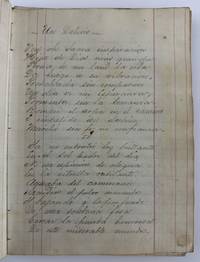
1889réf. 4403Havana Cuba 1889. Good. 69pp. of manuscript text plus 77pp. of newspaper extracts. Contemporary quarter calf and marbled paper-covered boards. Moderate scuffing and wear to boards and edges spine scuffed. Hinges broken with text block only nominally attached by threads with many leaves detached. Ownership ink stamp on front free endpaper "Manuel F. Barranco" with a gilt insignia affixed below reading "MB." A unique and personal manuscript journal and scrapbook composed and maintained by an important but obscure Cuban-American poet and author Manuel Francisco Barranco y Miranda 1843-1894. Barranco was born in Puerto Principe and lived about half of his life in Cuba before emigrating to Florida in 1875. He married Mercedes Fernández y Fernández-Mora and the couple raised a family in Cuba Florida and New York. Mentions of Barranco are rare in available records but he seems to have been a colleague of famed Cuban revolutionary figure Jose Marti. Barranco and Marti were involved with a Cuban revolutionary emigrant colony in Key West as well as Cuban literary and political societies in Havana and New York such as La Liga. Regarding the latter one of Barranco's poems in the present work composed in eleven parts is titled "Versos recitados en la sesion ordinaria de la Sociedad Literaria Hispano-Americana la noche del 17 de Maya de 1889." The Sociedad Literaria Hispano-Americana or Spanish American Literary Society provides a further connection to Jose Marti as Marti was one of the most prominent members of the club in the 1880s and '90s. Barranco presumably spent the remainder of his life between Cuba and the eastern coast of the United States where he passed away in Tampa Florida in 1894. The present material was written and compiled by Barranco over about a thirty year period in the mid-19th century before and after he emigrated to the United States. The chief feature of the present work is contained in almost seventy pages of manuscript poetry by Barranco. The poems which number around a couple dozen compositions include "Un Delirio" written in six parts "Versas improvisados en el Bautiro de mi hija Ana Maria el dia 1 de Enero de 1875" "Versos improvisados en comemora cion del Bautiro de mi hija Ana Maria el dio 1 de Enero del 1876" "Al congreso de la Paz" and various sonnets and other poems dated between 1875 and 1889. Barranco authored a few poems here about his wife Mercedes with titles such as "A Mercedes" "Improvisados a la orrilla del mon - A Mercedes" and "Al contemplar tu retrato." He also composed poems about his mother Ana Maria Sebastiana de Miranda. Several of the later poems from 1888-89 are datelined Havana next to the date of composition indicating Barranco moved back and forth between Cuba and America. The manuscript text is supplemented by almost eighty pages of newspaper extracts featuring various articles letters and printed poetry by Barranco published under his own name and a pen name "Leunam." The subject matter of these pieces include education women literature and various family members and other subjects in his own poetry. An example of the latter is a memorial poem for his granddaughter Margarita Barranco who died in Puerto Principe in 1866. Following the manuscript poems themselves is a single handwritten page of contents relating to these newspaper extracts. The extracts very likely come from Cuban newspapers and periodicals since they predate his move to Florida in 1875. A printed note laid into the book reads: "A Bound Journal Containing Published and Unpublished Handwritten Letters and Poems by My Grandfather Manuel Francisco Barranco y Miranda in Habana in the mid-19th Century Probably During the Period 1859-1869." Not much else is easily discovered about Barranco providing an excellent chance for original research into the work of this obscure but important 19th-century Cuban-American poet and writer. unknown
réf. LCS-17530Rare et bel album sur la vie cubaine des années 1850, entièrement lithographié en couleurs, conservé dans sa très décorative reliure en velours vert orné de fers rocailles dorés. [Berlin ou Hambourg], Storch & Kramer pour May y Cia, s.d. [c. 1851]. Petit in-folio oblong contenant 1 titre en chromolithographie, 27 chromolithographies, une carte dépliante de l’île et un plan dépliant de La Havane (infime déchirure ds. la marge bl.). Relié en velours vert de l’éditeur, large encadrement rocaillé en or autour des plats avec titre en lettres dorées au centre, tranches dorées. Reliure de l’époque. 242 x 342 mm.
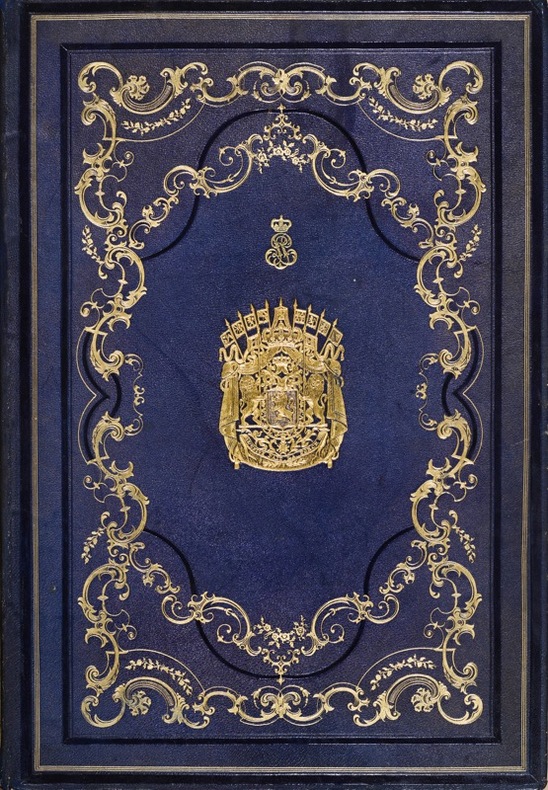
1842réf. 19517Paris Impr. et lithogr. de Maulde et Renou 1842 in-folio chagrin bleu nuit, filets dorés et à froid et large décor de motifs dorés encadrant les plats, armes dorées au centre du premier, monogramme doré au centre du second, dos lisse orné de motifs dorés, tranches dorées, encadrement intérieur de motifs dorés, [Rel. de l'époque], restaurée, manque le f. de table, la dernière planche est plus courte