2.538 Ergebnisse
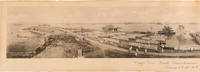
1910Best.-Nr. WRCAM55308Havana: American Photo Co. 1910. Panoramic photograph image 7 1/4 x 47 1/4 inches on sheet 10 x 49 inches. Printed caption title below image. Publisher and date written in negative at lower right corner; in the lower left corner is written: "#5 2d Regiment U.S. Atlantic Fleet Deer Point Camp Guantanamo Bay Feb. 13 1910. 'Minnesota' 'New Hampshire' 'Mississippi' 'Idaho.'" "Printed in Germany" printed below image at lower left. Some light soiling minor fading to right side of photo some rumpling from previous rolling. Very good. An impressive view of sailors and marines from the United States' Atlantic Fleet assembled on the parade grounds of Deer Point Camp Guantanamo Bay. Well over five hundred officers seamen and marines are in formation with encampments on both sides of the grounds. In the background looking out into the harbor nineteen ships are visible in the water including the four listed on the photo: MINNESOTA NEW HAMPSHIRE MISSISSIPPI and IDAHO. One camp building with a wide veranda is behind and to the left of the sailors. U.S. forces with their Cuban allies first occupied Guantanamo Bay in 1898 during the Spanish American War creating a forward- operating base in their effort to wrest Spanish control of the island. In 1903 the U.S. leased forty-five square miles of land and water at Guantanamo Bay from the newly- independent Cuban government and built the Deer Point Camp to support naval operations in the Caribbean. The American facilities at Guantanamo Bay are in use to this day. The American Photo Company advertised itself as "the best equipped commercial photographers in Cuba." It established a commercial network in Havana that distributed images of Cuba on a worldwide scale. This photo is rare. We found no records of it at auction and no copies in OCLC however the Naval History and Heritage Command lists a copy in their collections. "US Naval Station Guantanamo Bay Cuba" UA 571.45 copy of this image Washington Navy Yard D.C.: Naval History and Heritage Command Naval Heritage Foundation accessed online. American Photo Co. unknown books
1894Best.-Nr. 1064651894. Pamphlet format 70 pp. Illustrations; map. 14.3x11.8 cm 5½x4½" pictorial wrappers. Some light staining and wear to wrappers spine a little worn very good overall. Rare tourists' guide book produced under the auspices of the Grand Hotel Macotte with much on Havana transportation options sights to see including bull fights prices a Spanish vocabulary etc. with numerous advertisements for Cuban and some Florida businesses and other hotels. One advertisement features cigar maker La Corona. They even include an illustration of Christopher Columbus. OCLC/WorldCat lists only one copy at the California State Library Sutro Branch. J. Carbonell and P. Montero, Proprietors. books
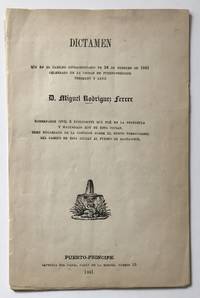
1861Best.-Nr. 1229Puerto-Principe: Imprenta del Fanal 1861. Good. 17pp. Leaves loose. Light wear one ink correction to text. A rare Cuban work printed outside of Havana outlining the necessity of a railroad between Puerto-Principe modern Camaguey and Santa Cruz. The many benefits of the plan are detailed herein with numerous charts. Miguel Rodriguez Ferrer 1815-1889 was a Spanish author and administrator but is best known for his work on the nature and culture of Cuba particularly his "Naturaleza y Civilizacion de la Grandiosa Isla de Cuba." He served in a number of civil administrator positions including mayor of San Antonio de los Baños and advisor to Puerto Principe. We locate a single copy at the National Library of Spain. Imprenta del Fanal unknown books
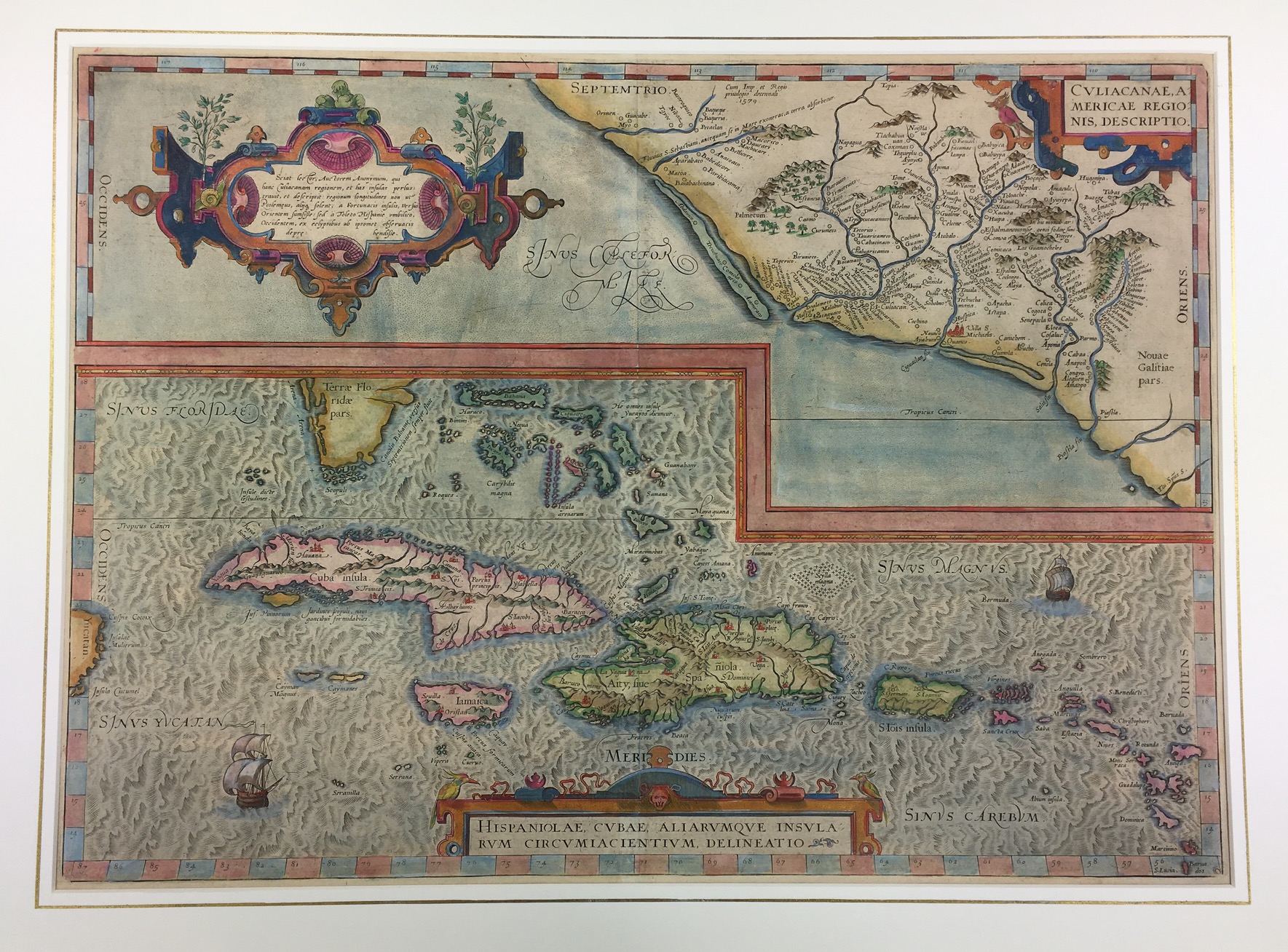
1685Best.-Nr. 37907Amsterdam, van Keulen (ca.1685). Altkolor. Kupferstichkarte im Format 51 x 58 cm. unter Passepartout. Gut erhalten.
1910Best.-Nr. 55308Havana: American Photo Co. 1910. The Early American Presence at Guantanamo Bay An impressive view of sailors and marines from the United States' Atlantic Fleet assembled on the parade grounds of Deer Point Camp Guantanamo Bay. Well over five hundred officers seamen and marines are in formation with encampments on both sides of the grounds. In the background looking out into the harbor nineteen ships are visible in the water including the four listed on the photo: Minnesota New Hampshire Mississippi and Idaho. One camp building with a wide veranda is behind and to the left of the sailors. U.S. forces with their Cuban allies first occupied Guantanamo Bay in 1898 during the Spanish American War creating a forward-operating base in their effort to wrest Spanish control of the island. In 1903 the U.S. leased forty-five square miles of land and water at Guantanamo Bay from the newly-independent Cuban government and built the Deer Point Camp to support naval operations in the Caribbean. The American facilities at Guantanamo Bay are in use to this day. The American Photo Company advertised itself as "the best equipped commercial photographers in Cuba." It established a commercial network in Havana that distributed images of Cuba on a worldwide scale. This photo is rare. We found no records of it at auction and no copies in OCLC; however the Naval History and Heritage Command lists a copy in their collections. Panoramic photograph image 7¼ x 47¼ inches on sheet 10 x 49 inches. Printed caption title below image. Publisher and date written in negative at lower right corner; in the lower left corner is written: "#5 2d Regiment U.S. Atlantic Fleet Deer Point Camp Guantanamo Bay Feb. 13 1910. 'Minnesota' 'New Hampshire' 'Mississippi' 'Idaho.'" "Printed in Germany" printed below image at lower left. Some light soiling minor fading to right side of photo some rumpling from previous rolling. Very good. "US Naval Station Guantanamo Bay Cuba" UA 571.45 copy of this image Washington Navy Yard D.C.: Naval History and Heritage Command Naval Heritage Foundation online. unknown
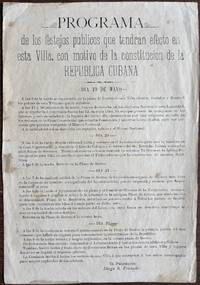
1901Best.-Nr. 3191Havana 1901. About very good. Broadside 12.5 x 9 inches. Light wear and soiling. Backed with tissue. Broadside outlining the celebrations planned for the adoption of the Cuban Constitution of 1901 following the eviction of both Spain and the United States from the country. Four days of celebrations were planned for May 19 20 21 and 22. Events including the singing of the National Anthem orchestral concerts fireworks dancing and other diversions. We find no record of this broadside in OCLC. An ephemeral piece commemorating Cuban independence. unknown
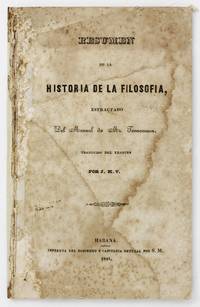
1845Best.-Nr. 5307Havana: Imprenta del Gobierno y Capitania General por S.M. 1845. Good. 684pp. Disbound. Some insect damage to gutter of title page ample staining throughout mostly minor foxing. A very rare mid-19th century Cuban imprint translating into Spanish a work by German philosophical historian Wilhelm Gottlieb Tennemann entitled Manual of the History of Philosophy. Tennemann originally published the work in 1812 as a much-abridged history of philosophy after authoring a massive multi-volume work on the subject. According to the translator's note at the beginning of the text the present work was produced in order to provide a text in Spanish for those studying the history of philosophy "at the Royal Academy and in the private schools of the island of Puerto Rico." The translator also notes that the history of philosophy is "one of the subjects.of the general plan of education that must be taught." The work itself is organized as a series of lectures detailing the history of philosophy chronologically from ancient Eastern and Egyptian times through the Greeks Pythagoras Socrates Plato Aristotle and many others concluding with modern thinkers such as Descartes Espinosa Hume Kant Hegel and others. The work ends with an Index and an Errata page. "Wilhelm Gottlieb Tennemann 1761–1819 German historian of philosophy was born at Erfurt. Educated at his native town he became lecturer on the history of philosophy at Jena in 1788. Ten years later he became professor at the same university where he remained till 1804. His great work is an eleven-volume history of philosophy which he began at Jena and finished at Marburg where he was professor of philosophy from 1804 till his death. He was one of the numerous German philosophers who accepted the Kantian theory as a revelation. In 1812 he published a shorter history of philosophy which was translated into English in 1852 under the title Manual of the History of Philosophy" - Encyclopedia Britannica. No copies located in the United States. Three copies found in OCLC -- two in Chile and one in Spain. Imprenta del Gobierno y Capitania General por S.M. unknown
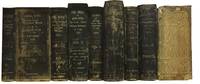
Best.-Nr. 38527Washington: Government Printing Office n. d. 1st edition presumed. ca. 1901. Black leather boards gilt stamped lettering to spine. Boards stamped in blind. Glossy marbled endpapers. All boards and spines rubbed chipped and soiled. Vol IX missing boards and spine Vol XI & I boards and spine detached from textblock Vol II boards & spine detaching. Spines and hinges loose. A few leaves and 2 unfolding maps detached soiled or chipped library "Property of Michigan Commandery Loyal Legion" blue stamping throughout volumes. A Good set. Individual volumes divers paginations within each volume. Many inserted plates of b/w images fold-out maps and charts / tables & portraits housed within all volumes. 9-5/8" x 7" OCLC records 7 institutional holdings of this set. Contents as stated in front pages of Vol. I: Vol I: Personal Report of General Wood Report of Lieutenant McCoy Aide-de-Camp Financial Exhibits accompanying same. Vol II: Civil Orders and Circulars issued during 1900. Vol III: Report of the Secretary of State and Government Reports of the various Civil Governors. Vol IV: Report of the Chief Sanitary Officer Report of the Chief Surgeon of the Department Report ofthe Superintendent Department of Charities. Vol V: Report of the Secretary of Finance Report of the Treasurer of Cuba Report of the Auditor for Cuba Report of the Chief of Customs Service Report of the Director General of Posts. Vol IX: Report of the Secretary of Public Works. Vol X: Report of the Secretary of Public Works continued Report of the Special Commissioner of Railroads Report of the Chief of the Light-House Board Report of the Captain of the Port Havana. Vol XI: Report of the Chief Engineer for the Fiscal Year ending June 30 1900. Vol XII: Report of the Chief Engineer for the six months ending Dec. 31 1900. Wood born on October 9 1860 in Winchester New Hampshire graduated Harvard Medical School in 1884. After working in private practice in Boston for two years he secured a job as army assistant surgeon with the rank of first lieutenant in January 1886. Routine successes and close relationships with political giants Wood formed a close friendship with Theodore Roosevelt and helped Roosevelt organize the 1st Volunteer Calvary Regiment for service in the Spanish-American War in May 1898 allowed for a quick advancement in his military service which eventually aroused some controversy. "Promoted to brigadier general and in December of that year he was promoted again to major general of volunteers and named military governor of Cuba. During his term in that post great strides were taken in improving internal conditions notably through the sanitation work of Maj. William C. Gorgas. Modern school police transportation and communications systems were established and a new constitution and body of laws were drawn up." Webster's American Military Biographies p. 488. In May of 1902 Wood stepped down from his executive position in order for the popularly elected President Tomas Estrada Palma to take over. "Aggressive ambitious and self-righteous Wood was not an easy man to work with; his change from medical doctor to fighting soldier and his rise from captain to brigadier general in the space of five years 1898-1903 aroused considerable distrust and hostility in and out of the army. his single-inded advocacy of the Plattsburgh Idea later to resurface as the ROTC contributed greatly to US readiness in World War I; unquestionably one of the greatest U.S. soldiers." -The Harper Encyclopedia of Military Biography p.807. (Government Printing Office) hardcover books
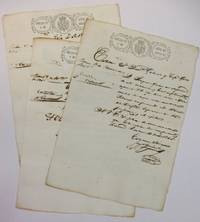
1845Best.-Nr. 37320Havana 1845. Each document 8-1/2" x 12-1/2" entirely in ink manuscript with decorative official printed ornamentation at head of each and signature "O'Donnell" in the left margins. Some toning and a few holes not affecting text. Good. Leopoldo O'Donnell y Jorris 1st Duke of Tetuán 1809-1867 was a Spaniard of Irish ancestry from Tenerife. He went to Cuba as Captain General in 1843 and later served three separate stints as prime minister of Spain. He approved each of these requests for travel. The named Cuban Slaves are of "Lucumi" ancestry originally from the Yoruba tribes of Benin and Nigeria. The documents all dated in October 1845 refer to the slaves Joaquin Garcia de Angarica and Florentino Armenteroy Regidor. These requests were made to transfer the slave from one hacienda to another for work purposes the terms of work engagement frequently stated here. unknown books
1903Best.-Nr. 6457V.p. 1903. 36 postcards all completed in manuscript generally very good or better with some wear and rounded corners. A fascinating assemblage of cards written by Pre-Castro intellectuals to a Maria de Serra though a few are written to other women. It is difficult to pin down de Serra though we do know she was highly educated and very well-known and connected. It makes sense to us that she is perhaps the Maria de Serra mentioned by William Wells Brown in his important work The Rising Son or the Antecedents and advancement of the Colored Race 1874. On pg 260 Brown writes: "The free blacks in Cuba form an important element in her population and these people are found in all the professions and trades. .one of the best young ladies' academies at present existing at Havana is personally conducted by an accomplished negro woman Maria de Serra to whom many a lady of high rank owes her social and intellectual accomplishments." Further research may be fruitful in retrieving more information on this Maria de Serra. It goes without saying that the sentiments and signatures are the most appealing part of this collection. Many of the cards appear to contain original verse and all are quite legible and well preserved. Equally as lovely are the cards themselves many being of exceptional beauty as they were all chosen by artists and intellectuals. All in all a remarkable set worthy of further research. The correspondents are as follows: Diego Vicente Tejera; one of the most famous turn-of-the-century Cuban poets but also known as a short story writer orator and political activists. Nestor Cargonell; famous poet and writer. His son went on to become a Hollywood star. Conde Kostia pseudonym of Aniceto Valdivia; writer journalist poet critic lecturer dramatist founder of newspapers and Cuban diplomat. Rafael Maria Merchain; very influential poet and philosopher Enrique Fontanills; very prominent Cuban journalist. Florimel: great Cuban journalist writer and poet who died early in life. Manuel Raul Blanco Belmonte; Cuban poet. Ramon Meza; One of the most important Cuban writers of his time. Many of his books are considered classics and remain in print. Aurelio Cancio; Cuban journalist who founded "La Discusion" newspaper. Manuel Serafin Pichardo; one of the most popular Cuban poet of the 1900s. Frederico Mendes Cobos; a Cuban politician who became a a senator in 1902. Juan Maria Alberti: influential Cuban politician. Manuel Marquez Sterling; fine writer and politician. Jose Manuel Govin; journalist and director of the popular newspaper "El Munto" Cesar Cancio; Very popular Cuban poet born in St Spiritus. Pablo Bonachea; great Cuban journalist and director of "La Discussion" newspaper for one year. Jose Ernesto Trian; Cuban writer with political connections. Was ambassador to Venezuela. Manuel Tierso; Romantic Cuban poet Alvaro de la Iglesia. revered Cuban writer who penned the great "Cuban Traditions" Frederico Ledesma Balsunde: journalist and editor at "El Lucero." Fabio Fiallo; a leading Dominican writer poet and politician. He died in Cuba. Dulce Maria Borrero de Lujan; the most important Cuban woman writer and poet of her time. Frederico Hermida; author of any Cuban novels in the 1900s. Mariana Comas; Cuban essayist Joaquin Lopez Sena; renown Cuban poet and a politician from the 1900s to the 1920s. Eliseo Giberga; a very powerful and influential Cuban politician of the early 1900s. Manuek Coronado; an important Cuban journalist. Antonio San Miguel; Cuban writer and journalist. Pablo Santi Rois; Poet and respected journalist. Armando Celorio; One of the finest Cuban poets. Jose Maria Carbonell; famous Cuban poet and writer. Marcos Trazivark; famous Cuban writer and Musician. Esteban Joven; Cuban writer poet and essayist. Narciso de Puso; famous poet well entrenched in Cuban high society. Eduardo Mencis Capote; Cuban journalist popular among the elite. Lorenzo Frau Marsal; respected Cuban journalist . unknown
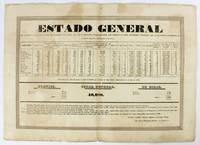
1838Best.-Nr. 5957Sancti Spiritus 1838. Good plus. Broadside measuring 12.5 x 17.5 inches. Previously folded. Light wear to edges and along old fold lines with a few small chips at edges. Moderate toning and soiling. An unrecorded broadside that prints statistics relating to agricultural production for the region of Sancti Spiritus in central Cuba during the late 1830s. For each municipality the broadside prints the number of property owners; ranches; land-grant farms; slaves; white employees; animals including mules donkeys cows and sheep; distances to transport and shipping hubs; and several other figures. In the bottom third of the broadside are printed the census figures from 1836 with the population totaling just over 40000 people and split into Black and white groups. Rather pointedly the figures for the white population are divided by gender while the figures for the Black population are divided by status free or slave. A very interesting statistical snapshot of a smaller rural region in colonial Cuba in 1838. Not in OCLC. unknown
1856Best.-Nr. 0006868New York: D. Appleton 1856. First edition. Hardcover. fine. 12mo xii 412 pages original light brown embossed cloth. These observations are related in a series of 61 letters. These were originally composed in Spanish then translated into English by Joseito. "I have thereby been enabled to impart entirely new data and reliable information instead of merely copying from books already known. . I applied myself to natives who besides an intimate knowledge of affairs in general possessed a sound judgment and an investigating disposition. It has beeen indeed a very happy incident to have found them. . That part of my work which treats on judicial matters and the secrets of the management of the tribunals will especially attract the attention of my readers. - Introductory Letter." Sabin 17816; Treiles BIBLIO. CUBANA vo. 4 p.17. D. Appleton hardcover
1584Best.-Nr. 53607Antwerpen, Plantin 1584. Orig.- Altkolor. Kupferstichkarte 36 x 50 cm. (Blattgröße 54 x 56 cm.) Unter Passepartout. Gleichmäßige Papierbräunung. Gut erhalten.
1908Best.-Nr. ZB573260Habana: Rambla y Bouza printers last two volumes with libreria 1908-1919. 40 volumes all issued; text browning especially at margins needs rebinding. - If you are reading this this item is actually physically in our stock and ready for shipment once ordered. We are not bookjackers. Buyer is responsible for any additional duties taxes or fees required by recipient's country. Photos available upon request. Habana: Rambla y Bouza, printers last two volumes with libreria unknown
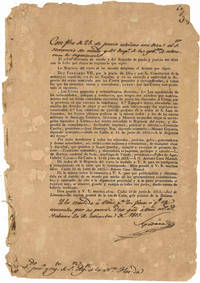
1813Best.-Nr. WRCAM46892Havana 1813. 1p. plus integral blank. Folio. Old fold lines. Moderately chipped and worn at edges. Lightly and evenly toned. Contemporary manuscript notations. Good. A rare printed decree from Cuba at the beginning of the 19th century as Spanish power in the world was waning but Spain's grip on Cuba was still quite firm. This decree issued by the King on June 14 1813 and printed on September 20 announces new laws regarding the rights to vote and to be elected to hold government positions for professors and scholars from certain universities collegiums and seminars. The decree forbade these rights to the Knights of Justice of the Order of St. John of Jerusalem as well as members of the four military orders of Santiago Calatrava Alcantara and Montesa. It is endorsed in manuscript with the imprint and header also written in by hand. Early Caribbean imprints are rare. unknown books
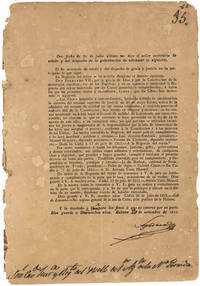
1813Best.-Nr. WRCAM46891Havana 1813. 1p. plus integral blank. Folio. Old fold lines. Moderately chipped and worn at edges. Evenly tonned. Contemporary manuscript notations. Good. A rare Havana imprint. As Spanish power in the New World was waning its grip on Cuba was threatened by domestic and foreign intruders. This decree issued by Fernando VII on June 17 1813 and printed on September 20 orders the annulment of all criminal cases. This amnesty policy extended to other areas of New Spain as well sought to placate opposition forces. It calls on all levels of government to announce and enforce the decree. It is endorsed in manuscript. unknown books
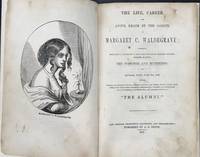
1852Best.-Nr. 57744New Orleans Charleston Baltimore and Philadelphia: A.R. Orton 1852. the original wrapper was dated 1853 apparently accounting for that date being used in each of the three OCLC listings. First edition of this rather primitively printed pamphlet. 8vo. 2 11-36 pp. Portrait frontispiece three wood-engraved plates. OCLC: "Sensational and presumably fictitious account of the criminal career of Margaret C. Waldegrave probably written by the publishers" the author of several similar lurid tales in the early 1850s. Contemporary pencil inscription on verso of frontispiece "Allow one vol. / plain binding / leather back." Not in Wright "American Fiction" McDade "Annals of Murder" or Jumonville "New Orleans Imprints." OCLC locates four copies American Antiquarian Soc. New York Historical Soc. Juniata British Library; AAS also holds a prospectus broadside for the work. Some interior foxing and soiling corner of one leaf renewed not affecting text. Recent plain gray wrappers. #4698. A.R. Orton hardcover books
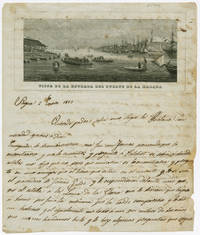
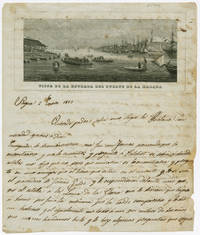
1853Best.-Nr. WRCAM54601Havana 1853. 4pp. on a bifolium. Previously folded. Some chipping at fore- edge slightly affecting text. Light dampstaining and tanning. About very good. An attractive Cuban pictorial letter sheet with a neatly executed third-page lithograph illustration of the port of Havana. The image depicts several small boats rowing barrels to and from a loading dock. In another small boat a plantation owner or some form of dignitary is being rowed to shore by a crew of men. On the right side of the image several larger ships lie at anchor and in the background on the shore is the fort guarding the mouth of the harbor the Morro Castle. The sheet is filled out by a man named Juan Fabre writing to his parents on Jan. 2 1853 advising them of his safe arrival in Havana. He talks about meeting up with a relative that he had not seen in two years and working at a shoe shop with another relative who adds a brief post script on the verso of the second leaf. Pictorial letter sheets of Cuba are quite rare on the market. unknown books
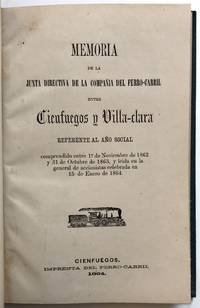
1864Best.-Nr. 1312Cienfuegos: Imprenta del Ferro-Carril 1864. About very good. 20pp. plus seven tables two folding. Original green cloth blind stamped and gilt lettered. Light wear at edges and spine ends; minor rubbing to boards. Manuscript letter laid in. Separation along fold and short closed tear at gutter of one plate. Light tanning. A rare annual report on the railroad that connected Cienfuegos to Santa Clara in the central portion of Cuba during the mid-1860s. The text gives details of the company's revenue and shipping totals passenger services work and improvements undertaken and levels of employment including discussion of indentured Chinese labor. The tables at the rear provide more complete statistics on the amount of products shipped number of passengers carried types of repairs carried out and the number of accidents and hospitalizations amongst employees and laborers. This copy was presented to a Señor Enrique Gatke likely a Havana investor in the company with his named lettered in gilt on the front board and with a letter from the company secretary Pedro Fernandez de Castro laid in. A scarce and detailed account of railroad operations in central Cuba during the mid-19th century. We locate only one example of any edition of these reports outside of the National Library of Cuba a copy of the 1862 report at the New York Public Library. Imprenta del Ferro-Carril unknown books
1856Best.-Nr. 2026Remedios 1856. About very good. 4pp. on a large bifolium. Printed form completed in manuscript. Separated at fold repaired with tissue. Light wear at edges. Light tanning and foxing. Rare Cuban population census form listing the number of residents in and around the town of Remedios located on the northern central coast of Cuba in 1856. The present document completed in manuscript lists the population according to various categories such as ethnicity and race age range occupations marital status location of residence and several others. The census includes slaves of African origin newly arrived Chinese indentured servants "colonos Asiaticos" immigrant laborers from Yucatan freedmen and free white residents "Blancos". In all there are just over 2000 people living in and around Remedios at this time comprising just over 1300 free whites over 300 free people of color 460 slaves and 19 Chinese laborers. One of the most interesting sections records the population by place of residence which shows that the great majority people in the area lived on estancias with a good part of the remaining population living on livestock farms and sugar plantations. On the final page are two additional sections which enumerate the types of property farms and other enterprises in the regions and provide statistics on agricultural and industrial production and land usage along with some manuscript notes with the signatures of the census takers or local magistrates. An interesting document of slavery agriculture and population in rural Cuba during the mid-19th century. unknown books
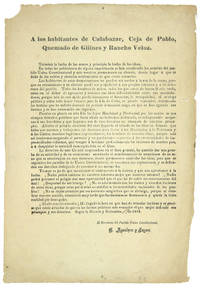
1878Best.-Nr. WRCAM38237Cuba 1878. Broadside 12 1/2 x 8 3/4 inches. Chip at upper left corner not affecting text. Small tears in all edges several repaired by tape on verso. Good. A rare and fascinating Cuban political broadside calling for an end to armed struggle but a beginning to a "struggle for ideas" at the conclusion of Cuba's "Ten Years' War" the battle for independence from Spain in 1868 to 1878. The broadside is addressed to the residents of the region around the north-central coast of Cuba some 150 miles east of Havana. The text of the broadside is signed in print by Gabriel Aguilera y Zayas Secretary of the Partido Union Constitucional PUC one of the two main political parties that developed out of the Ten Years' War. The PUC which was a conservative pro-Spanish party led by prominent Creoles sought a measure of local political autonomy while favoring continued Spanish control over Cuba. The text exhorts Cubans to partake in the ideological struggle that would succeed the armed rebellion and urges them not to fall into lethargy but to continue the battle of ideas against radicals seeking independence from Spanish colonial rule. Due to their ephemeral nature as well as the climate of the Caribbean any such Cuban broadsides are scarce. No copies of this broadside are located in OCLC. Important evidence of the political factionalism and the strength of pro-Spanish sentiment in Cuba in the late 19th century. Rare and possibly unique. unknown books
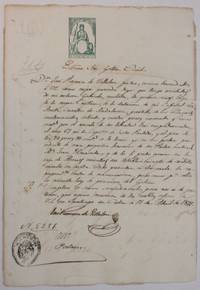
Best.-Nr. 37208Each document a single manuscript page 8-1/2" x 12-1/2." Each with official stamp one also has a decorative illustrated green stamp at the head. Light wear and toning Good. Each document names the slaveholder and the enslaved person granted "libertad" and the cost in escudos or pesetas of that liberty. The slaves liberated here are Saturnia "morenita criolla" age 14; Gabriela "esclava mulata" age 15; and Dolores "parda criolla" age 16. unknown books
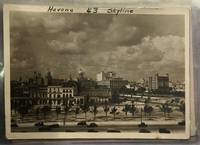
1930Best.-Nr. RF 56517 original photos from La Habana. 8vo. 17 photographs from Havana. Photographs are 17.5 cm x 12.5 cm. Each photograph bears an ink handwritten description across the top: Prado & Morro Castle; Havana Skyline; Prado & Capitol; Residential Palace; El Morro no inscription; Race Track Havana; Prado from the Capitol; Prado from the Capitol another view Maine Monument; Capitol Grounds; Tropical Beer Garden; Main Monument & National Hotel Havana; Race Track another view; National Theatre and Capitol. Set of photographs of Havana from the 1920s 1930s. The inscriptions on each photograph are in English. Unidentified photographer. Interesting Cuban photographici conography. O02G000074 RF 565 X99X001603
Best.-Nr. 8028Ao.J. Pressefoto. 20 x 15 cm.
1853Best.-Nr. 54601Havana. 1853. Writing Home from Havana An attractive Cuban pictorial lettersheet with a neatly executed third-page lithograph illustration of the port of Havana. The image depicts several small boats rowing barrels to and from a loading dock. In another small boat a plantation owner or some form of dignitary is being rowed to shore by a crew of men. On the right side of the image several larger ships lie at anchor and in the background on the shore is the fort guarding the mouth of the harbor the Morro Castle. The sheet is filled out by a man named Juan Fabre writing to his parents on Jan. 2 1853 advising them of his safe arrival in Havana. He talks about meeting up with a relative that he had not seen in two years and working at a shoe shop with another relative who adds a brief post script on the verso of the second leaf. Pictorial lettersheets of Cuba are quite rare on the market. Previously folded. Some chipping at fore-edge slightly affecting text. Light dampstaining and tanning. About very good. unknown