OLAÑETEA, José Antonio de.MareMagnum

2 528 résultats
183925x15,5. 201p. Colección de varios escritos presentados por su apoderado y defensor. Ej. Mareado con páginas amarronadas. Enc. Plena piel con nervios y ruedas en planos con pequeñas rozaduras. Cantos dorados.
1861réf. 11929Paris Collection Hetzel, E. Dentu [1861] in-12 de 2 ff.n.ch. et 446 pp. demi-veau glacé bleu, dos à nerfs rehaussés de point. dorés, fleurettes dans les entrenerfs [Rel. de l'époque]
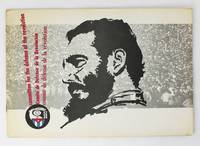
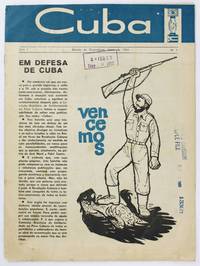
1965réf. 6257Habana 1965. Very good. 16pp. Oblong pamphlet in original pictorial wrappers stapled. Light wear and toning at wrapper edges with a few faint creases. Internally clean. A visually rich pro-Casto and pro-Communist pamphlet that highlights the history and core activities of Cuba's Committee for the Defense of the Revolution CDR neighborhood-based civil defense organizations created by Castro in 1960 to defend the revolution and maintain social and political control at the local level. This often included activities like surveillance distribution of propaganda and vigilante justice. The pamphlet is illustrated with photos throughout and also contains a two-page spread with maps of the island and charts data and statistics about the Cuban people. It contains a year-by-year account of the Committee's achievements and activities and ends with a section concerning its relations with other countries and their visits to Cuba. The rear wrapper states that editions were published in English French and Spanish as evidenced by the trilingual title on the front cover but we find no evidence of any edition in OCLC. Scarce and with much interesting and propagandized information about Castro's local enforcers during the early years of the Communist regime. unknown
1965réf. 6257Habana 1965. Very good. 16pp. Oblong pamphlet in original pictorial wrappers stapled. Light wear and toning at wrapper edges with a few faint creases. Internally clean. A visually rich pro-Casto and pro-Communist pamphlet that highlights the history and core activities of Cuba's Committee for the Defense of the Revolution CDR neighborhood-based civil defense organizations created by Castro in 1960 to defend the revolution and maintain social and political control at the local level. This often included activities like surveillance distribution of propaganda and vigilante justice. The pamphlet is illustrated with photos throughout and also contains a two-page spread with maps of the island and charts data and statistics about the Cuban people. It contains a year-by-year account of the Committee's achievements and activities and ends with a section concerning its relations with other countries and their visits to Cuba. The rear wrapper states that editions were published in English French and Spanish as evidenced by the trilingual title on the front cover but we find no evidence of any edition in OCLC. Scarce and with much interesting and propagandized information about Castro's local enforcers during the early years of the Communist regime. unknown books
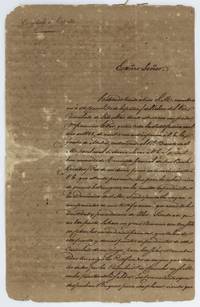
1828réf. 2401Gibraltar 1828. Good. 3pp. on a bifolium. Previously folded with separations. Tanned somewhat brittle. An interesting example of official communications concerning trade between colonial Cuba and the Spanish mainland. In this manuscript letter date March 14 1828 the new Spanish Vice Consul in Gibraltar writes to the Governor General of Cuba concerning several topics. These include the regulation of shipping to Cuba and by implication the rest of the Caribbean through Gibraltar particularly of French ships leaving Mediterranean ports. Also discussed is keeping track of individuals particularly merchants going to Cuba by means of identification papers and other documents. The consul also reminds the colonial government of the importance of documenting duties and tariffs paid for shipping cargo and goods. unknown
1828réf. 2401Gibraltar 1828. Good. 3pp. on a bifolium. Previously folded with separations. Tanned somewhat brittle. An interesting example of official communications concerning trade between colonial Cuba and the Spanish mainland. In this manuscript letter date March 14 1828 the new Spanish Vice Consul in Gibraltar writes to the Governor General of Cuba concerning several topics. These include the regulation of shipping to Cuba and by implication the rest of the Caribbean through Gibraltar particularly of French ships leaving Mediterranean ports. Also discussed is keeping track of individuals particularly merchants going to Cuba by means of identification papers and other documents. The consul also reminds the colonial government of the importance of documenting duties and tariffs paid for shipping cargo and goods. unknown books
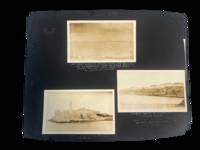
1920réf. 227281920. Havana Cuba travel photo album circa 1920s documents an American visitor's encounter with Havana during the interwar years when U.S. tourism commercial presence and Spanish-American War memory shaped how many American travelers interpreted the city. The vernacular photographs record arrival by steamship harbor landmarks civic buildings commercial streets factories boulevards monuments cemeteries and guarded public spaces giving insight into both Havana's urban landscape and the traveler's assumptions about access history and spectacle. The album's references to the USS Maine and Spanish-American War memorials place ordinary sightseeing within a longer history of U.S. intervention in Cuba; the Maine exploded in Havana Harbor on February 15 1898 killing more than 260 sailors and intensifying the crisis that led to war with Spain. Approximately 25 sepia-toned silver gelatin photographs each about 3 x 5 inches mounted to black album leaves with detailed handwritten captions in white pencil. The sequence begins aboard the S.S. Kroonland with one caption reading "My first view of Havana from the deck. three miles out at sea in a dark storm" followed by a landing view captioned "where we landed in Havana Cuba." The S.S. Kroonland returned to Panama Pacific Line service in 1923 on a New York to San Francisco route via Havana the Panama Canal and Los Angeles supporting the album's interwar travel context. The photographs then trace Havana's maritime and civic topography: harbor views Morro Castle captioned "Famous during the Spanish-American War" the waterfront in front of the fortress the Court House the President's Palace a "600-year-old church" the Henry Clay Cigar Store Havana's factory district and public boulevards "where all streets have parks in the center." Other images include a cemetery visit captioned "All people in Cuba are laid to rest above the ground" and a restricted-view street or carriage scene captioned "Officer would not let me take picture but when he turned I took it anyway" a revealing note on tourist privilege and unauthorized looking. Several images directly record the ways American travelers consumed Havana through imperial memory and Cuban nationalist commemoration. One monument is captioned "This was given by the Cuban people to the American soldiers that fell in the Spanish-American War" while another marks "the spot where the Maine sank at the entrance of the harbor." The album was made after Cuba's formal independence in 1902 and during the long aftermath of the Platt Amendment framework under which the United States retained extensive influence over Cuban affairs and intervened repeatedly in the early twentieth century. Album leaves chipped at edges several with corner losses not affecting images; prints generally sharp with strong contrast and clear annotations very good overall. Socially revealing Havana travel album documenting how a U.S. visitor pictured Cuba through steamship tourism colonial architecture cigar commerce Spanish-American War remembrance and the everyday authority structures of an interwar Caribbean capital. unknown
1920réf. 227281920. Havana Cuba travel photo album circa 1920s documents an American visitor's encounter with Havana during the interwar years when U.S. tourism commercial presence and Spanish-American War memory shaped how many American travelers interpreted the city. The vernacular photographs record arrival by steamship harbor landmarks civic buildings commercial streets factories boulevards monuments cemeteries and guarded public spaces giving insight into both Havana's urban landscape and the traveler's assumptions about access history and spectacle. The album's references to the USS Maine and Spanish-American War memorials place ordinary sightseeing within a longer history of U.S. intervention in Cuba; the Maine exploded in Havana Harbor on February 15 1898 killing more than 260 sailors and intensifying the crisis that led to war with Spain. Approximately 25 sepia-toned silver gelatin photographs each about 3 x 5 inches mounted to black album leaves with detailed handwritten captions in white pencil. The sequence begins aboard the S.S. Kroonland with one caption reading "My first view of Havana from the deck. three miles out at sea in a dark storm" followed by a landing view captioned "where we landed in Havana Cuba." The S.S. Kroonland returned to Panama Pacific Line service in 1923 on a New York to San Francisco route via Havana the Panama Canal and Los Angeles supporting the album's interwar travel context. The photographs then trace Havana's maritime and civic topography: harbor views Morro Castle captioned "Famous during the Spanish-American War" the waterfront in front of the fortress the Court House the President's Palace a "600-year-old church" the Henry Clay Cigar Store Havana's factory district and public boulevards "where all streets have parks in the center." Other images include a cemetery visit captioned "All people in Cuba are laid to rest above the ground" and a restricted-view street or carriage scene captioned "Officer would not let me take picture but when he turned I took it anyway" a revealing note on tourist privilege and unauthorized looking. Several images directly record the ways American travelers consumed Havana through imperial memory and Cuban nationalist commemoration. One monument is captioned "This was given by the Cuban people to the American soldiers that fell in the Spanish-American War" while another marks "the spot where the Maine sank at the entrance of the harbor." The album was made after Cuba's formal independence in 1902 and during the long aftermath of the Platt Amendment framework under which the United States retained extensive influence over Cuban affairs and intervened repeatedly in the early twentieth century. Album leaves chipped at edges several with corner losses not affecting images; prints generally sharp with strong contrast and clear annotations very good overall. Socially revealing Havana travel album documenting how a U.S. visitor pictured Cuba through steamship tourism colonial architecture cigar commerce Spanish-American War remembrance and the everyday authority structures of an interwar Caribbean capital. unknown books
2007réf. 300-05028Grafika Press 2007-11-01. paperback. New. In shrink wrap! Looks like an interesting title! Grafika Press paperback
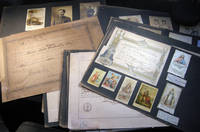
1857réf. 030167Cuba 1857. The Carbonells were of great political scientific diplomatic and business prominence in Cuba before the 20th century Revolution as evidenced here by the various degrees awards and membership documents including that signed by the President of the Republic. Most members subsequently emigrated to the U.S. after their properties were confiscated under the Castro regime. Of particular interest is the career of José María Zarragoitia y Carbonell a Havana-born engineer who graduated from Norwich University Vermont in 1906 and went on to a long career in engineering in his home country "…having helped to construct the important Air Base of San Julian Pinar del Rio Cuba working steadily there up to the time of its completion. His last work was in the Pontezuela Dam for the aqueduct of the City of Canaguey…When the United States declared war on Japan he went to the U S. Embassy here in Havana to offer his services if not for active duty due to his age at least as an engineer…" Rosa and Mercedes Carbonell writing notice of their brother's death for the Norwich University Record publication In roughly chronological order the collection includes: Photographs: 1865 - 1887 5 photos; 1887 Mercedita & criandera Maria Tejera ; Grandfather 1875; and again in 1878 graduating with his law degree Habana; 1865 carte-de-visite of Dr. Manuel Carbonell y Ruiz "hermano de Abuelo"; a group photo of grandparents & Rosa Rita & Mercedita. Affixed to the same sheet is the thermoplastic business card of Establecimiento Fotografico de G. Fernandez Carrido Habana. 1868 - 1898 Group of 6 photos family portraiture of Meredith & Rosa Rita Carbonell brothers as children; the brothers at Guanabacoa school and a 1868 carte-de-visite of grandfather after his graduation. A faded photo of Guanabacoa 1897-1898 shows the brothers and their dogs staff and Black servants. 1899 - 1908 Carbonell brothers Ramon Raul & Jose New York; a photo of Rosa Rita & Mercedita and grandparents "En los Catskills 1908"; and three tintypes in their holders of Ramon & Jose as children and one-year old Mercedita and her un-named Black criandera nanny. C. 1904 - 1908 Series of three portrait photographs identified as Jose Carbonell y Zarragoitia while a student at Norwich University; two of these in cadet uniform. Approx. 3 ½" x 5 ½"; laid-down to paper backer. Awards Certificates Degrees Appointments: 1857 Universidad de la Habana baccalaureate degree in Philosophy for Carbonell y Ruiz signed and sealed; Latin text. Approx. 12 ½" x 18" overall size; old discoloration at lower left corner; in good condition. 1857 Another as above awarding the baccalaureate in Philosophy of Science. 1861 Universidad de la Habana baccalaureate degree in jurisprudence for Carbonell y Ruiz signed and sealed; Latin text. Approx. 11 ½" x 17" overall size; old discoloration at lower right corner; in fair to good condition. 1861 Membership certificate for the Real Sociedad Economica de la Habana signed by this learned society's governing board and welcoming Ramon Carbonell y Ruiz as a member. Approx. 12 1/2" x 17 1/4"; affixed to black paper backer; old discoloration at left side; in fair to good condition. 1866 Leceo Artistico y Leterario del Havana graduation diploma for Jose maria Carbonell y Ruiz signed by school dignitaries. Approx. 12 ½" x 16 ¼"; affixed to black paper backer; corners chipped and worn away old discoloration in bottom corner; in fair to good condition. 1867 Certificate Utile Dulci Recreo de Pueblo-Nuevo Matanzas certifying Carbonell y Ruiz as Socio Facultativo and signed. Approx. 12 ½" x 18"; affixed to black paper backer; couple of corners chipped and worn away old discolorations and trimmed close at bottom and top; in fair to good condition. 1871 Another Real Sociedad Economica de la Habana certificate noting membership in good standing and signed by this learned society's leadership board. Approx. 9" x 11 1/2"; affixed to black paper backer; in very good condition. 1875 Universidad de la Habana awarding Asignatura de Economia Politica y Estadristica honors course for Carbonell y Ruiz signed and sealed. Approx. 10" x 15 1/2" overall size; old discoloration at lower left corner and poor paper repair also at left obscuring some letters; top corner chipped; in fair to good condition. 1892 Certificate El Circulo de Abogados de la Habana signed and sealed. Approx. 8" x 13"; affixed to black paper backer; edges crudely trimmed; in good condition. 1894 Certificate of academic excellence from Escuelas Pias de Guanabacoa for Jose Carbonell y Zarrogoitia signed. Approx. 8" x 12"; affixed to black paper backer. In very good condition. 1894 Certificate of academic excellence as above from Escuelas Pias de Guanabacoa for Ramon Carbonell y Zarrogoitia signed. Approx. 8" x 12"; affixed to black paper backer. In very good condition. 1910 Certificate of citizenship for Ramon Ysidro Restituto Margarita Carbonell y Ruiz the Republica de Cuba signed by Jose Francisco Remirez de Estenoz Secretary of the Republic and with official blind-stamp seal. Approx. 11 ¼" x 12 ¾"; affixed to black paper backer; in very good condition. 1914 Certificate signed and with his blind-stamp seal by Mario G. Menocal 1866 - 1941 3rd Presidente of the Republica bestowing the "Titulo de Notario" for Carbonel y Ruiz resident of Mayare. Two-sided with additional attestations and signatures on the reverse. Approx. 12 1/2" x 17 ¾"; old paper tape at left margin; document paper darkened with some bleed-through of reverse writing and with old spotting and discoloration; in fair to good condition. Miscellaneous: 1918 Certificate Asociacion General Del Rosario Perpetuo membership for Rosa Carbonell. Approx. 8" x 9 ¾"; printed with colors and affixed to black paper backer trimmed oddly along left edge; along with 6 color-printed religious cards; one is dated 1908 in pen; two small pasted-in note-slips noting the Primera Comunion de Gerardo Montejo y Carbonell la Vibora Habana in 1917 and another for the First Holy Communion of Amelia Desvernine at the Church of the Sacred Heart New York in 1909. In very good condition. Undated Typed poetry broadside with manuscript title "Un Hombre Agradecido" - Estimado Carbonel:/Por juzgarlo procedente/cojo maquina y papel/y le escribio lo siguiente:…" Unsigned and undated. Approx. 4 ¼" x 10 ½" size; pasted down to backer; faint old fold line; in very good condition. 1886 - 1895 A group of mostly French & European-printed Christian religious inspirational cards; one card with elaborate layers of decoration. With various notes for Mercedes Carbonell y Zarragoitia; Rosa Rita Carbonell y Zarragoitia and Maria Ana a Rosa Rita & Maria Fejera. Another sheet Of 15 religious cards various sizes and styles. Another sheet Of 9 religious cards. Evidence of the loss of one card removed. Condition as noted; good overall. . Collection. Good.
1961réf. 5832Guanabara 1961. About very good. 111pp. Small folio. Original pictorial self-wrappers stapled. Contemporary and slightly later ink stamps to front wrap. Light edge wear. Some tanning and dust soiling. First issue of this evidently unrecorded periodical published by the "Comissão Brasileira de Solidariedade ao Pavo Cubano" in May 1961. The publication contains numerous positive stories on the progress of the Cuban Revolution and support of the cause from the Brazilian people. Illustrated throughout with photographs and drawings including the beginning of a serial comic on the history of the revolution at the rear. The front wrap depicts Fidel Castro with his foot on the chest of a supine eagle and a rifle raised triumphantly over his head. Interesting support for the Communist cause in Cuba from South America. Not in OCLC. unknown
1961réf. 5832Guanabara 1961. About very good. 111pp. Small folio. Original pictorial self-wrappers stapled. Contemporary and slightly later ink stamps to front wrap. Light edge wear. Some tanning and dust soiling. First issue of this evidently unrecorded periodical published by the "Comissão Brasileira de Solidariedade ao Pavo Cubano" in May 1961. The publication contains numerous positive stories on the progress of the Cuban Revolution and support of the cause from the Brazilian people. Illustrated throughout with photographs and drawings including the beginning of a serial comic on the history of the revolution at the rear. The front wrap depicts Fidel Castro with his foot on the chest of a supine eagle and a rifle raised triumphantly over his head. Interesting support for the Communist cause in Cuba from South America. Not in OCLC. unknown books
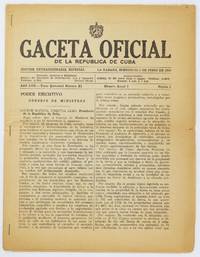
1959réf. 5470Habana: June 3 1959. Good plus. 11pp. Small folio. Previously folded; stapled along gutter margin. Some edge and corner wear; closed tear to initial leaf from fore-edge along old fold. Toned cheap newsprint. A special edition of the Gaceta Oficial of Communist Cuba devoted to the printing of the First Agrarian Reform Law passed and signed on May 17 1959. The law effected the first major land redistribution under Fidel Castro and the Communist Party. Under its authority all properties were over 420 hectares were confiscated and redistributed to the people and native businesses. Prior to the law over 80% of Cuban land was owned by foreign mostly American companies. The preamble and sixty-seven articles lay out the motivations for the law the parameters for confiscation by the Department of Agriculture the mechanisms for seizure and redistribution and the creation of a new government organization to facilitate the land transfers the Instituto Nacional de Reforma Agraria. Signed in print by Fidel as Prime Minister Manuel Urrutia Lleo as President and a slew of other officials. June 3 unknown
1959réf. 5470Habana: June 3 1959. Good plus. 11pp. Small folio. Previously folded; stapled along gutter margin. Some edge and corner wear; closed tear to initial leaf from fore-edge along old fold. Toned cheap newsprint. A special edition of the Gaceta Oficial of Communist Cuba devoted to the printing of the First Agrarian Reform Law passed and signed on May 17 1959. The law effected the first major land redistribution under Fidel Castro and the Communist Party. Under its authority all properties were over 420 hectares were confiscated and redistributed to the people and native businesses. Prior to the law over 80% of Cuban land was owned by foreign mostly American companies. The preamble and sixty-seven articles lay out the motivations for the law the parameters for confiscation by the Department of Agriculture the mechanisms for seizure and redistribution and the creation of a new government organization to facilitate the land transfers the Instituto Nacional de Reforma Agraria. Signed in print by Fidel as Prime Minister Manuel Urrutia Lleo as President and a slew of other officials. June 3 unknown books
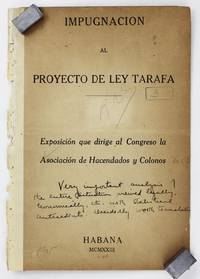
1923réf. 5672Havana 1923. Fair. 14pp. Original wrappers rear cover lacking. Contemporary ink notation to front cover reinforced at spine with later paper tanned. Text guillotined; leaves silked some chipping and wear at edges. A rare work arguing against railroad consolidation in Cuba and a victim of the New York Public Library's microfilming project. The subtitle reads "Exposicion que dirige al Congreso la Asociacion de Hacendados y Colonos." We locate only the microfilm copy at NYPL in OCLC no physical copies. unknown
1923réf. 5672Havana 1923. Fair. 14pp. Original wrappers rear cover lacking. Contemporary ink notation to front cover reinforced at spine with later paper tanned. Text guillotined; leaves silked some chipping and wear at edges. A rare work arguing against railroad consolidation in Cuba and a victim of the New York Public Library's microfilming project. The subtitle reads "Exposicion que dirige al Congreso la Asociacion de Hacendados y Colonos." We locate only the microfilm copy at NYPL in OCLC no physical copies. unknown books
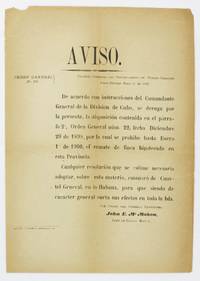
1899réf. 5378Puerto-Principe Cuba: Imp. el Progreso-Soledad January 11 1899. Good. Broadside 11.75 x 8.25 inches. Old folds minor chip at top left corner uniformly tanned and somewhat tender. An unrecorded general order issued in Spanish by the American "Jefe de Estado Mayor" Chief of Staff John E. McMahon during the military occupation of Cuba in the Spanish-American War. The order stipulates that a paragraph in a previous order prohibiting the auction of mortgaged property in the province of Puerto-Principe until January 1 1900 is hereby repealed and any further instructions on this matter will come from the Army's General Headquarters in Havana. McMahon issued several general orders during the American Army's occupation of Cuba and all appear to be rare. An interesting artifact from America's expansionist period with no other copies in OCLC auction history or the trade. Imp. el Progreso-Soledad, January 11 unknown
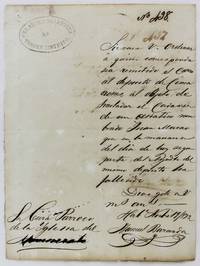
1872réf. 3066Havana 1872. Very good. Manuscript form approximately 8.5 x 6.25 inches. Minor wear at edges; a few small worm holes. Contemporary ink stamp. Light tanning and offsetting. This 1872 manuscript form from a Havana jail the Celaduria de la Punta notes the death there of an "Asiatico" a Chinese indentured servant with the given name of Juan Macao and orders the transfer of the body to the mortuary for cremation. Indentured servants found themselves jailed for several reasons including suspicion of theft and other crimes recapture following runaway or mere suspicion of abandoning a contract. unknown
1872réf. 3066Havana 1872. Very good. Manuscript form approximately 8.5 x 6.25 inches. Minor wear at edges; a few small worm holes. Contemporary ink stamp. Light tanning and offsetting. This 1872 manuscript form from a Havana jail the Celaduria de la Punta notes the death there of an "Asiatico" a Chinese indentured servant with the given name of Juan Macao and orders the transfer of the body to the mortuary for cremation. Indentured servants found themselves jailed for several reasons including suspicion of theft and other crimes recapture following runaway or mere suspicion of abandoning a contract. unknown books
1899réf. 5378Puerto-Principe Cuba: Imp. el Progreso-Soledad January 11 1899. Good. Broadside 11.75 x 8.25 inches. Old folds minor chip at top left corner uniformly tanned and somewhat tender. An unrecorded general order issued in Spanish by the American "Jefe de Estado Mayor" Chief of Staff John E. McMahon during the military occupation of Cuba in the Spanish-American War. The order stipulates that a paragraph in a previous order prohibiting the auction of mortgaged property in the province of Puerto-Principe until January 1 1900 is hereby repealed and any further instructions on this matter will come from the Army's General Headquarters in Havana. McMahon issued several general orders during the American Army's occupation of Cuba and all appear to be rare. An interesting artifact from America's expansionist period with no other copies in OCLC auction history or the trade. Imp. el Progreso-Soledad, January 11 unknown books
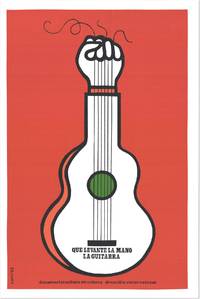
1983réf. 83069Havana: S.i. 1983. Original illustrated poster with text and pictorial elements silkscreened in four colors on white stock measuring 51cm x 76.25cm 20 1/8" x 30". Mild handling to extremities ele a bright Fine copy unbacked. Striking poster designed by Concepción Robinson Mendoza aka. "Coni" for Victor Cassaus's 1983 documentary Que Levante la Mano la Guitarra centered around Cuban musician and folk singer Silvio Rodríguez Domínguez. 83069. S.i. unknown
1983réf. 83069Havana: S.i. 1983. Original illustrated poster with text and pictorial elements silkscreened in four colors on white stock measuring 51cm x 76.25cm 20 1/8" x 30". Mild handling to extremities ele a bright Fine copy unbacked. Striking poster designed by Concepción Robinson Mendoza aka. "Coni" for Victor Cassaus's 1983 documentary Que Levante la Mano la Guitarra centered around Cuban musician and folk singer Silvio Rodríguez Domínguez. 83069. S.i. unknown books
1887réf. 64748Barcelona Spain: Campania Trasatlantica Espanola S.A. C.T.E. 1887. 8vo. 72 pp. With 2 large double-page colour maps 5 large folding engraved colour deck plans for CTE ocean liners. Red cloth-backed colour chromolithograph boards cover art of CTE liner in port at Gibraltar CTE Barcelona insignia on back cover minor scuffing edgewear minor soiling front cover slightly shaken 2 deckplans w/ very minor closed tears still a VG- copy. First edition of this very rare transatlantic guidebook timetable and deck plans for the Campania Trasatlantica Espanola S.A. Barcelona CTE ocean liner service between Spain Cuba Mexico New York & Colombia. Ports of call after New York included Boston Philadelphia Baltimore Georgetown Charleston Savannah and New Orleans with stops in various ports in Cuba Puerto Rico Jamaica Veracruz Mexico as well as several in Colombia and the Guiana’s. Deck plans engraved by Hermenagilda Miralles Bailan in Barceolna include those for the 8600 ton Reina Ma Cristina 9850 ton Buenos Aires 5450 ton Veracruz 6720 ton Ciudad de Santander and finally the 9700 ton Alfonso XII. Founded originally in 1850 by Spanish businessman and slave trader Don Antonio L. Lopez in 1850 to feed African-American slaves into both Havana as well as Mobile AL & New Orleans LA prior to the Civil War and headquarters was established in Barcelona after the marriage of Lopez to Luisa Bru Lassus. After 1883 Don Claudio B. Lopez took charge of the company and by 1887 had reached over 30 steamships and ocean liners many of which were used by the Spanish Navy following the outbreak of the Spanish-American War. Campania Trasatlantica [Espanola S.A.] (C.T.E.), hardcover
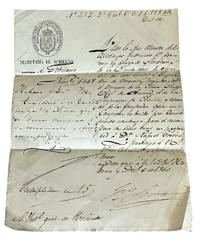
1860réf. 234291860. Spanish colonial administration in Havana used port health regulation as a mechanism of commercial and maritime control with the Captaincy General directing military customs and sanitary officials through centralized orders. This December 6 1860 manuscript concerns the "Junta local de Sanidad" "víveres averiados" and Dr. Rafael Cortés placing damaged provisions public health authority and port enforcement within the same bureaucratic chain. The phrase "usando de las facultades que me competen" invokes the vested powers of the colonial government confirming that the matter was handled through Spanish imperial authority rather than local civic discretion. Gobierno y Capitanía General de la Isla de Cuba. Secretaría de Gobierno sección de Gobierno. Manuscript order. Havana Cuba: December 6 1860. Single folded manuscript document with printed colonial seal and heading docketed "Habana y Dic. 6 de 1860" and addressed to maritime or port authorities. The text instructs compliance with a petition or order involving the local Board of Health damaged provisions or foodstuffs and Dr. Rafael Cortés with official endorsements and large administrative signatures below. The verso bears docketing and filing marks consistent with bureaucratic circulation. The document belongs directly to Spanish colonial governance in Cuba where the Governor and Captain General exercised civil military and administrative power over the island until the end of Spanish rule in 1898. Its contents connect colonial rule to the management of ports food safety and public health all crucial areas in Havana's nineteenth-century Atlantic economy. Folded as issued with toning scattered foxing edge wear and original folds; seal heading date and principal manuscript text remain legible. Overall good condition. unknown
1860réf. 234291860. Spanish colonial administration in Havana used port health regulation as a mechanism of commercial and maritime control with the Captaincy General directing military customs and sanitary officials through centralized orders. This December 6 1860 manuscript concerns the "Junta local de Sanidad" "víveres averiados" and Dr. Rafael Cortés placing damaged provisions public health authority and port enforcement within the same bureaucratic chain. The phrase "usando de las facultades que me competen" invokes the vested powers of the colonial government confirming that the matter was handled through Spanish imperial authority rather than local civic discretion. Gobierno y Capitanía General de la Isla de Cuba. Secretaría de Gobierno sección de Gobierno. Manuscript order. Havana Cuba: December 6 1860. Single folded manuscript document with printed colonial seal and heading docketed "Habana y Dic. 6 de 1860" and addressed to maritime or port authorities. The text instructs compliance with a petition or order involving the local Board of Health damaged provisions or foodstuffs and Dr. Rafael Cortés with official endorsements and large administrative signatures below. The verso bears docketing and filing marks consistent with bureaucratic circulation. The document belongs directly to Spanish colonial governance in Cuba where the Governor and Captain General exercised civil military and administrative power over the island until the end of Spanish rule in 1898. Its contents connect colonial rule to the management of ports food safety and public health all crucial areas in Havana's nineteenth-century Atlantic economy. Folded as issued with toning scattered foxing edge wear and original folds; seal heading date and principal manuscript text remain legible. Overall good condition. unknown books