Cuba, IvanBiblio.com

2.536 Ergebnisse
1950Best.-Nr. 93352Auckland New Zealand: The Atlas Press 1950. Hardcover. Very Good/Good. plates mostly color 37p. Original boards. dj. 25 cm. Modest splitting along bottom portion of front joint. Jacket somewhat soiled and edge-worn including three jagged chips on front panel. Laid in is an undated autograph letter signed by Cuba to M. B. Bradshaw of the Art Exhibition Bureau in London. Cuba reports that he is busy ". trying to paint London in the smog. The Atlas Press hardcover
Best.-Nr. 2343094624.Gpaperback. Good. Access codes and supplements are not guaranteed with used items. May be an ex-library book. paperback
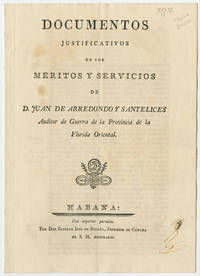
1815Best.-Nr. 49642Havana: Esteban José de Boloña 1815. An early Cuban imprint printed by Esteban José de Boloña the first printer in Cuba after the 1776 ban on printing. Juan de Arrondo y Santilices was an official in Spanish Florida the Auditor of War of East Florida during the early 19th century. This is a work detailing the deeds of Arrondo y Santilices likely an attempt to secure a pension. Rare with one copy located by OCLC at the John Carter Brown Library. Gathered signatures stitched. Stitching mostly perished. Light fold lines minimal foxing ink marginal notations contemporary ink inscription after the text. Very good. unknown
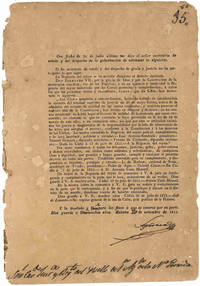
1813Best.-Nr. 46892Havana. Sept. 20 1813. Early Havana Imprint A rare printed decree from Cuba at the beginning of the 19th century as Spanish power in the world was waning but Spain's grip on Cuba was still quite firm. This decree issued by the King on June 14 1813 and printed on September 20 announces new laws regarding the rights to vote and to be elected to hold government positions for professors and scholars from certain universities collegiums and seminars. The decree forbade these rights to the Knights of Justice of the Order of St. John of Jerusalem as well as members of the four military orders of Santiago Calatrava Alcantara and Montesa. It is endorsed in manuscript with the imprint and header also written in by hand. Early Caribbean imprints are rare. Folio. Old fold lines. Moderately chipped and worn at edges. Lightly and evenly toned. Contemporary manuscript notations. Good. unknown
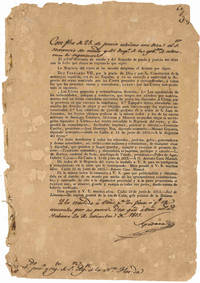
1813Best.-Nr. 46891Havana. Sept. 20 1813. Amnesty to Curry Favor A rare Havana imprint. As Spanish power in the New World was waning its grip on Cuba was threatened by domestic and foreign intruders. This decree issued by the Council of Regents "Cortes" standing in for Fernando VII on June 17 1813 and printed on September 20 orders the annulment of all criminal cases. This amnesty policy extended to other areas of New Spain as well sought to placate opposition forces. It calls on all levels of government to announce and enforce the decree. It is endorsed in manuscript. Folio. Old fold lines. Moderately chipped and worn at edges. Evenly toned. Contemporary manuscript notations. Good. unknown
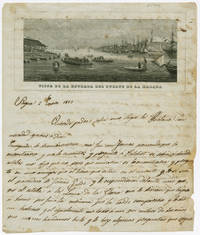
1853Best.-Nr. 54601Havana. 1853. Writing Home from Havana An attractive Cuban pictorial lettersheet with a neatly executed third-page lithograph illustration of the port of Havana. The image depicts several small boats rowing barrels to and from a loading dock. In another small boat a plantation owner or some form of dignitary is being rowed to shore by a crew of men. On the right side of the image several larger ships lie at anchor and in the background on the shore is the fort guarding the mouth of the harbor the Morro Castle. The sheet is filled out by a man named Juan Fabre writing to his parents on Jan. 2 1853 advising them of his safe arrival in Havana. He talks about meeting up with a relative that he had not seen in two years and working at a shoe shop with another relative who adds a brief post script on the verso of the second leaf. Pictorial lettersheets of Cuba are quite rare on the market. Previously folded. Some chipping at fore-edge slightly affecting text. Light dampstaining and tanning. About very good. unknown
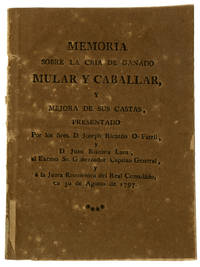
1799Best.-Nr. 51487Havana: Imprenta de la Capitanía 1799. 18th-Century Cuban Imprint A short tract on equine husbandry with its own titlepage but published as a part of a royal decree entitled "Gracia concedida por S.M. à los habitantes de esta isla para la introduccion de caballos frisones de ambos sexôs desde las provincias del Norte de América" which approved the importation of horses to Cuba. Initially presented to government officials in 1797 the report by Joseph Ricardo O'Farril and Juan Bautista Lanz laments poor breeding practices in Cuba that have led to weaknesses in the horse stock and recommends the introduction of North American horses and different breeding methods. Until the suggestions of this work were implemented by the decree in 1798 horses were not allowed to be imported from other sources in greater numbers than they were from Spain. According to Trelles this is the first Cuban imprint to address issues related to livestock and animal husbandry. Dbd. Loose sheets. Heavily tanned outer leaves slightly chipped. Good. SABIN 56747. MEDINA HABANA 162. TRELLES pp.177-78. unknown
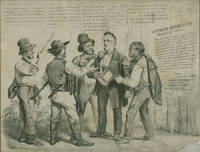
1856Best.-Nr. 53452New York: Nathaniel Currier 1856. Trying to Grab Cuba A scarce political cartoon regarding the controversial Ostend Manifesto the initially-secret attempt by the United States to purchase Spanish-controlled Cuba. Earlier President Franklin Pierce had instructed Pierre Soulé upon his appointment as minister to Spain in April 1853 to negotiate to buy Cuba. Three American foreign ministers serving in Europe - James Buchanan John Y. Mason and Soulé - met secretly at Ostend Belgium in late 1854 to draft a plan to either buy Cuba from Spain or force Spain to give up Cuba by inciting a Cuban revolution. The plan met with overwhelming opposition once it was made public in America. In the present political cartoon Buchanan is attacked for his role in the Ostend controversy. He is surrounded by four armed ruffians seeking to rob him of his coat hat watch and money a particularly sharp turn-about on the American minister to Great Britain. The muggers' demands include quotations from the manifesto which is pasted to the fence at right. Buchanan calls out: "Why! Why! This is rank robbery! Help! Help! All honest men!" The fallout from the Ostend controversy was widespread. President Pierce's Democratic Party split asunder after he refused to continue any discussions of the plan or any other expansionist ideas; Soulé understandably resigned; and the international community saw it as a threat to Spanish sovereignty in the region. Oddly enough James Buchanan was not too hurt by the controversy; he was easily elected president in 1856 and still harbored hope for Cuban annexation. He was smart enough however to table the Cuba question for the foreseeable future after meeting with both popular opposition and increasingly bitter sectional conflict the latter only spurred on by incidents such as the Ostend controversy. Broadside 10 x 13 inches. Foxed bottom right corner chipped. Lower margin trimmed costing the title. Good only. Framed under glass. CURRIER & IVES: CATALOGUE RAISONNÉ 5021. NEVINS & WEITENKAMPF p.72-73. unknown
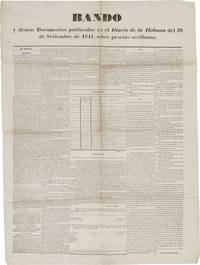
1841Best.-Nr. 15527Havana. Sept. 29 1841. A proclamation by the Spanish military government in Cuba concerning legal tender and its circulation and providing a series of regulations for commerce and exchange. Broadside 23 x 16 1/2 inches. Splitting on middle fold else very good. unknown
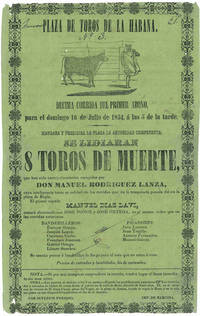
1854Best.-Nr. 46994Havana. 1854. A Bullfighting Broadside from Cuba in 1854 Cuban broadside advertising a bullfight featuring matador Don Manuel Rodriguez Lanza and the "8 toros de muerte." The top of the sheet features a woodcut of a matador holding his cape out to a bull. The first swordsman for the fight is Manuel Diaz Lavi with two alternates listed. The names of the Banderilleros and Picadores for the fight are also noted. Bullfighting was a popular entertainment in Cuba during the Spanish colonial period though it was done away with after Cuban independence at the beginning of the 20th century. Broadside 12½ × 8 inches. Printed on green paper. Old fold lines. Light wear and soiling minor separation at some folds. A few contemporary notations. Very good. unknown
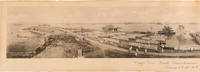
1910Best.-Nr. 55308Havana: American Photo Co. 1910. The Early American Presence at Guantanamo Bay An impressive view of sailors and marines from the United States' Atlantic Fleet assembled on the parade grounds of Deer Point Camp Guantanamo Bay. Well over five hundred officers seamen and marines are in formation with encampments on both sides of the grounds. In the background looking out into the harbor nineteen ships are visible in the water including the four listed on the photo: Minnesota New Hampshire Mississippi and Idaho. One camp building with a wide veranda is behind and to the left of the sailors. U.S. forces with their Cuban allies first occupied Guantanamo Bay in 1898 during the Spanish American War creating a forward-operating base in their effort to wrest Spanish control of the island. In 1903 the U.S. leased forty-five square miles of land and water at Guantanamo Bay from the newly-independent Cuban government and built the Deer Point Camp to support naval operations in the Caribbean. The American facilities at Guantanamo Bay are in use to this day. The American Photo Company advertised itself as "the best equipped commercial photographers in Cuba." It established a commercial network in Havana that distributed images of Cuba on a worldwide scale. This photo is rare. We found no records of it at auction and no copies in OCLC; however the Naval History and Heritage Command lists a copy in their collections. Panoramic photograph image 7¼ x 47¼ inches on sheet 10 x 49 inches. Printed caption title below image. Publisher and date written in negative at lower right corner; in the lower left corner is written: "#5 2d Regiment U.S. Atlantic Fleet Deer Point Camp Guantanamo Bay Feb. 13 1910. 'Minnesota' 'New Hampshire' 'Mississippi' 'Idaho.'" "Printed in Germany" printed below image at lower left. Some light soiling minor fading to right side of photo some rumpling from previous rolling. Very good. "US Naval Station Guantanamo Bay Cuba" UA 571.45 copy of this image Washington Navy Yard D.C.: Naval History and Heritage Command Naval Heritage Foundation online. unknown
2008Best.-Nr. 1561041967Kessinger Publishing USA 2008. Reprint. Softcover. Very Good Condition. Reprint. Book is in very good condition. Text appears to be clean. Cover has some wear scuffsdings and corner bumps. Spine is in very good condition. May have book store sticker. Quantity Available: 1. Shipped Weight: Under 1 kilo. ISBN: 1436816793. ISBN/EAN: 9781436816793. Pictures of this item not already displayed here available upon request. Inventory No: 1561041967. . 9781436816793 Kessinger Publishing paperback
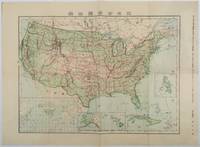
1911Best.-Nr. 179415Tokyo.: 楠山正雄. Kusuyama Masao. Meiji 44 1911. Colour folding map 40 x 55cm inset maps showing the Philippines Alaska and Hawaii very good copy. This map was a supplement of October 1911 issue of a monthly magazine Shin Nippon 新日本 which was published between 1911 and 1918. The main map covers the contiguous United States with inset maps of the world showing the American territories of Alaska Hawaii and the Philippines. Curiously Cuba has been marked as an American territory having been directly occupied from 1906 to 1909 though at the time still beholden to the 1903 Cuban-American Treaty of Relations. . 楠山正雄. [Kusuyama Masao]. unknown
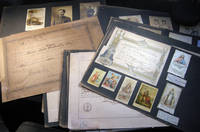
1857Best.-Nr. 030167Cuba 1857. The Carbonells were of great political scientific diplomatic and business prominence in Cuba before the 20th century Revolution as evidenced here by the various degrees awards and membership documents including that signed by the President of the Republic. Most members subsequently emigrated to the U.S. after their properties were confiscated under the Castro regime. Of particular interest is the career of José María Zarragoitia y Carbonell a Havana-born engineer who graduated from Norwich University Vermont in 1906 and went on to a long career in engineering in his home country "…having helped to construct the important Air Base of San Julian Pinar del Rio Cuba working steadily there up to the time of its completion. His last work was in the Pontezuela Dam for the aqueduct of the City of Canaguey…When the United States declared war on Japan he went to the U S. Embassy here in Havana to offer his services if not for active duty due to his age at least as an engineer…" Rosa and Mercedes Carbonell writing notice of their brother's death for the Norwich University Record publication In roughly chronological order the collection includes: Photographs: 1865 - 1887 5 photos; 1887 Mercedita & criandera Maria Tejera ; Grandfather 1875; and again in 1878 graduating with his law degree Habana; 1865 carte-de-visite of Dr. Manuel Carbonell y Ruiz "hermano de Abuelo"; a group photo of grandparents & Rosa Rita & Mercedita. Affixed to the same sheet is the thermoplastic business card of Establecimiento Fotografico de G. Fernandez Carrido Habana. 1868 - 1898 Group of 6 photos family portraiture of Meredith & Rosa Rita Carbonell brothers as children; the brothers at Guanabacoa school and a 1868 carte-de-visite of grandfather after his graduation. A faded photo of Guanabacoa 1897-1898 shows the brothers and their dogs staff and Black servants. 1899 - 1908 Carbonell brothers Ramon Raul & Jose New York; a photo of Rosa Rita & Mercedita and grandparents "En los Catskills 1908"; and three tintypes in their holders of Ramon & Jose as children and one-year old Mercedita and her un-named Black criandera nanny. C. 1904 - 1908 Series of three portrait photographs identified as Jose Carbonell y Zarragoitia while a student at Norwich University; two of these in cadet uniform. Approx. 3 ½" x 5 ½"; laid-down to paper backer. Awards Certificates Degrees Appointments: 1857 Universidad de la Habana baccalaureate degree in Philosophy for Carbonell y Ruiz signed and sealed; Latin text. Approx. 12 ½" x 18" overall size; old discoloration at lower left corner; in good condition. 1857 Another as above awarding the baccalaureate in Philosophy of Science. 1861 Universidad de la Habana baccalaureate degree in jurisprudence for Carbonell y Ruiz signed and sealed; Latin text. Approx. 11 ½" x 17" overall size; old discoloration at lower right corner; in fair to good condition. 1861 Membership certificate for the Real Sociedad Economica de la Habana signed by this learned society's governing board and welcoming Ramon Carbonell y Ruiz as a member. Approx. 12 1/2" x 17 1/4"; affixed to black paper backer; old discoloration at left side; in fair to good condition. 1866 Leceo Artistico y Leterario del Havana graduation diploma for Jose maria Carbonell y Ruiz signed by school dignitaries. Approx. 12 ½" x 16 ¼"; affixed to black paper backer; corners chipped and worn away old discoloration in bottom corner; in fair to good condition. 1867 Certificate Utile Dulci Recreo de Pueblo-Nuevo Matanzas certifying Carbonell y Ruiz as Socio Facultativo and signed. Approx. 12 ½" x 18"; affixed to black paper backer; couple of corners chipped and worn away old discolorations and trimmed close at bottom and top; in fair to good condition. 1871 Another Real Sociedad Economica de la Habana certificate noting membership in good standing and signed by this learned society's leadership board. Approx. 9" x 11 1/2"; affixed to black paper backer; in very good condition. 1875 Universidad de la Habana awarding Asignatura de Economia Politica y Estadristica honors course for Carbonell y Ruiz signed and sealed. Approx. 10" x 15 1/2" overall size; old discoloration at lower left corner and poor paper repair also at left obscuring some letters; top corner chipped; in fair to good condition. 1892 Certificate El Circulo de Abogados de la Habana signed and sealed. Approx. 8" x 13"; affixed to black paper backer; edges crudely trimmed; in good condition. 1894 Certificate of academic excellence from Escuelas Pias de Guanabacoa for Jose Carbonell y Zarrogoitia signed. Approx. 8" x 12"; affixed to black paper backer. In very good condition. 1894 Certificate of academic excellence as above from Escuelas Pias de Guanabacoa for Ramon Carbonell y Zarrogoitia signed. Approx. 8" x 12"; affixed to black paper backer. In very good condition. 1910 Certificate of citizenship for Ramon Ysidro Restituto Margarita Carbonell y Ruiz the Republica de Cuba signed by Jose Francisco Remirez de Estenoz Secretary of the Republic and with official blind-stamp seal. Approx. 11 ¼" x 12 ¾"; affixed to black paper backer; in very good condition. 1914 Certificate signed and with his blind-stamp seal by Mario G. Menocal 1866 - 1941 3rd Presidente of the Republica bestowing the "Titulo de Notario" for Carbonel y Ruiz resident of Mayare. Two-sided with additional attestations and signatures on the reverse. Approx. 12 1/2" x 17 ¾"; old paper tape at left margin; document paper darkened with some bleed-through of reverse writing and with old spotting and discoloration; in fair to good condition. Miscellaneous: 1918 Certificate Asociacion General Del Rosario Perpetuo membership for Rosa Carbonell. Approx. 8" x 9 ¾"; printed with colors and affixed to black paper backer trimmed oddly along left edge; along with 6 color-printed religious cards; one is dated 1908 in pen; two small pasted-in note-slips noting the Primera Comunion de Gerardo Montejo y Carbonell la Vibora Habana in 1917 and another for the First Holy Communion of Amelia Desvernine at the Church of the Sacred Heart New York in 1909. In very good condition. Undated Typed poetry broadside with manuscript title "Un Hombre Agradecido" - Estimado Carbonel:/Por juzgarlo procedente/cojo maquina y papel/y le escribio lo siguiente:…" Unsigned and undated. Approx. 4 ¼" x 10 ½" size; pasted down to backer; faint old fold line; in very good condition. 1886 - 1895 A group of mostly French & European-printed Christian religious inspirational cards; one card with elaborate layers of decoration. With various notes for Mercedes Carbonell y Zarragoitia; Rosa Rita Carbonell y Zarragoitia and Maria Ana a Rosa Rita & Maria Fejera. Another sheet Of 15 religious cards various sizes and styles. Another sheet Of 9 religious cards. Evidence of the loss of one card removed. Condition as noted; good overall. . Collection. Good.
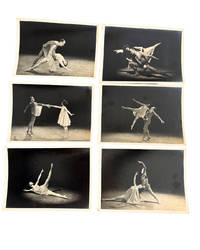
1964Best.-Nr. 0012155Havana Cuba. Good with no dust jacket. 1964. Non-Book. On offer is a cohesive series of six original 1964 Cuban television dance photographs showing Emilia Villamil and Raymond Ramon Iglesias in a staged dance sequence for a television showbroadcast on Canal 6 the Havana television channel associated with Cubavisión. Thephotographs appear to be publicity stills and all belong to the same production series and bearsthe professional studio/lab stamp OLIVIA FOTOS 9.1833 on the verso. On the verso of someof the photos are handwritten notes that provide information about the dancers TV channel andyear. Villamil and Iglesias were Tropicana-era Cuban performers here seen performing in a post-Revolution broadcast studio bridging Havanas pre-Revolution cabaret and theatrical culture with the new television environment of the 1960s. Cubavisións institutional history traces itsorigins to CMQ-TV Channel 6. Villamil was often referred to as La China and is sometimes known as China Villamil. AnEl Nuevo Herald profile of her son television journalist Camilo Egaña identifies her as labailarina Emilia Villamil fundadora de la televisión cubana the dancer Emilia Villamil founder/pioneer of Cuban television. A 1979 San Antonio Express-News profile identifies Raymond Iglesias as a Cuban refugee andformer Havana dancer-choreographer-singer who later became a fashion designer. The articleexplains that his given name was Ramon but that he used and preferred Raymond a usefulclarification for the present group because one verso notation gives his first name as Ramon. The same profile records that as a youth in Havana he studied dance with Alicia Alonso Ballet performed internationally with partner Elena del Cueto under the billing Clarissa andRaymond and toured as a dancer for ten years. This is a valuable archive from a comparatively under-documented area of Cuban culturalhistory: the movement of established theatrical cabaret and dance performers into early post-Revolution television. Original production stills from this period are not commonly encounteredin coherent identified groups. Notes on Canal 6 CMQ-TV Cubavisión Following the nationalization of Cuban broadcasting in 1960 theformer commercial station Canal 6 CMQ-TV was incorporatedinto the state system and became the principal outlet of what wasincreasingly identified as Cubavisión the national televisionservice centered in Havana. Contemporary scholarship andbroadcast histories note that early 1960s programming on Canal6/Cubavisión retained a strong continuity with pre-Revolutionformatsparticularly live studio variety music and dancewhile being reorganized under state cultural policy Rivero 2015; Chanan 2004. Surviving program references from theperiod include musical and variety broadcasts such as Ritmos deCuba a recurring dance-music revue format dramatizedliterary and theatrical adaptations newsreel-style current affairssegments and childrens programming blocks all of whichformed the backbone of early revolutionary televisionscheduling Rivero 2015; Chanan 2004; Pérez Jr. 1995. Condition: Expected light handling wear minor edge and corner wear and typical surface signsfrom age and use. The images remain strong with good contrast and clear detail. Verso stampsand notations are present as described. Overall Very Good. ; Photograph; 8vo 8" - 9" tall; 6 pages . unknown
Best.-Nr. 1331054575.Gpaperback. Good. Access codes and supplements are not guaranteed with used items. May be an ex-library book. paperback
Best.-Nr. 1966932332.Ghardcover. Good. Access codes and supplements are not guaranteed with used items. May be an ex-library book. hardcover
Best.-Nr. 1966932200.Gpaperback. Good. Access codes and supplements are not guaranteed with used items. May be an ex-library book. paperback
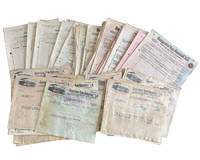
Best.-Nr. 0012156Havana Cuba Santiago DE Cuba. Very Good with no dust jacket. Non-Book. On offer is a substantial 1937–1959 Bacardi Cuba corporate operations archive comprising approximately 110 documents from Compañía "Ron Bacardí " S. A. And related Cuban rum-industry files. Centered chiefly on Santiago de Cuba and Havana the archive documents Bacardi's pre-nationalization business through export invoices checks purchase requests receiving forms supplier correspondence freight records label orders tax payments advertising records and banking endorsements. What makes the archive particularly strong is that many records are functionally connected. Purchase requests correspond to receiving forms supplier letters explain pricing and material changes export invoices trace named overseas shipments and checks document freight taxes advertising transport and government-related payments. Together they provide a detailed working record of Bacardi as a producer exporter taxpayer advertiser purchaser of printed packaging user of Cuban freight networks and participant in the country's banking and fiscal systems during the final decades of privately operated Bacardi production in Cuba. Many documents identify the company as Compañía "Ron Bacardí " S. A. Santiago de Cuba y Habana Sucesores de Bacardí y Cía. Establecidos en 1862. Others describe it as "Propietarios del Bacardí y la Cerveza Hatuey " directly linking the archive to both Bacardi rum and Hatuey beer. Among the most historically important records are 1959 Bacardi checks showing ordinary private commercial activity continuing after the January Revolution and before the confiscation of Bacardi's Cuban assets in October 1960. A January 26 1959 check to Agrupación de Transporte S. A. Pays for hauling performed during the second half of January. Another check that day to Porteadora Cubana de Carga S. A. References a waybill and carries banking and customs-related endorsements. A June 1959 check pays the Cámara de Comercio de Camagüey for advertising while an August 1959 Trust Company of Cuba check covers freight on packages and boxes containing promotional materials. Two additional January 1959 checks concern relief at Sagua de Tánamo Oriente including one issued "Para socorrer a los habitantes de Sagua de Tánamo" to assist the inhabitants of Sagua de Tánamo. These records capture Bacardi still conducting transport advertising banking freight and civic activities during Cuba's revolutionary transition. A major portion of the archive documents Bacardi's label packaging and lithographic supply chain particularly through Compañía Litográfica de la Habana S. A. 1957 purchase requests include orders for 1000000 Carta Blanca analysis labels 1000000 Ron Palmas labels 100000 Carta de Oro labels 70000 Bacardi Imports Carta Blanca labels 12000 Añejo Brand miniature labels and 6000 aluminum-paper Añejo bottle wrappers. Several have corresponding receiving forms showing delivery through Porteadora Cubana de Carga. The Hatuey beer records reveal even greater scale. One receiving form records 3000000 Hatuey Clara labels another records 1200000 additional oval labels while supplier invoices document runs of 4000000 and 2800000 Cerveza Hatuey Pilsener labels. Supplier correspondence adds unusually detailed operational context. A 1956 letter explains that an order for 33000 aluminum-paper Añejo wrappers could only be partly filled at the old price because existing stock was exhausted forcing the remainder to be produced from more expensive new material. Other records concern paper substitutions cancellation of 50000 lithographed Bacardi envelopes and quotations for 26000 holiday greeting cards and 26000 envelopes. The archive includes 1950s export records documenting shipments to the United States Canada and Newfoundland Holland Honduras El Salvador and Hong Kong. A 1953 invoice to Gande Price & Co. Ltd. Hong Kong records 25 cartons of Bacardí Carta Blanca marked "DOUBLE STEEL STRAPPED. " A related Bacardi letter identifies the shipment as Embarque No. 157 and discusses documentation required for a Cuban public-works charge. A 1953 invoice to The Board of Liquor Control St. John's Newfoundland shipped aboard the Canadian Observer via Halifax records 500 cartons of Bacardí Carta de Oro Rum marked "DOUBLE STEEL STRAPPED " "STRENGTH: 40.0 G. L. " and "NO FODDER USED. " The total including freight was $8145.50. Related Nova Scotia material further documents Bacardi's Canadian-Caribbean trade. Earlier correspondence documents Bacardi's American label and distribution system. A 1939 letter to H. B. Estrada at the Empire State Building concerns "Etiquetas U. S. A. " and records shipment of 1200 Bacardí Carta Blanca labels 400 Bacardí Carta de Oro labels and 2000 analysis foot-labels. A 1940 letter on José M. Bosch Agent for Compañía Ron Bacardi Empire State Building letterhead requests additional Carta Blanca and Carta Oro label sets to be sent by air. The archive also documents Bacardi's interaction with Cuba's fiscal and banking systems. A 1950 check for $26928.00 records the purchase of liquor-tax stamps. Other documents concern income taxes wage-tax matters public-works charges treasury payments and banking clearance. Many retain original endorsements and stamps from institutions including the Tesorería General de la República Cámara Nacional de Compensaciones The Bank of Nova Scotia and other Cuban banking and fiscal bodies. Advertising records include Bacardi-Hatuey newspaper advertising Chamber of Commerce advertising promotional freight and a 1957 Propaganda Department order for 26000 greeting cards and 26000 envelopes for the 1958 holiday season. One unusual letter from F. M. Hitchcock of Wichita Kansas thanks Bacardi for miniature labels and requests sets of its full-size labels and medal label showing that Bacardi packaging was already being collected as brand ephemera during the period. Also included is related Cuban rum-industry material notably a 1959 José Arechabala S. A. Check providing comparative documentation from another major Cuban liquor producer during the same revolutionary year. The archive documents Bacardi's continued private operations in 1959 rum exports across North America Europe Central America and Asia multi-million-unit production of Hatuey beer labels Bacardí Carta Blanca Carta de Oro Ron Palmas and Añejo packaging lithographic suppliers and packaging production freight transport banking taxes and customs-related processing prewar U. S. Distribution through New York advertising and promotional material local civic and relief activity in Oriente and related José Arechabala rum-industry material. Founded in Santiago de Cuba in 1862 Bacardi became one of Cuba's most internationally recognized brands. Its Cuban assets were confiscated by the revolutionary government on October 14 1960. This archive preserves a detailed paper trail of the company before that event including 1959 records showing Bacardi still operating as a private Cuban business during the revolutionary transition. More than a group of isolated invoices and checks the archive shows how Bacardi actually functioned: labels ordered by the million bottles and promotional materials packaged overseas shipments processed suppliers negotiated with taxes paid freight moved and banking transactions cleared. Approximately 110 documents are included consisting of checks export invoices supplier invoices purchase requests receiving forms letters freight records tax and fiscal records advertising records and related commercial correspondence. Condition varies as expected for working corporate records. Documents show folds handling wear filing holes edge wear creases stamps endorsements perforated cancellations annotations and occasional tears or staining. Many retain original fiscal stamps bank and treasury marks routing notes and cancellation perforations. Overall Fair to Good. ; Manuscripts; Oblong Small 4to 9" - 11" tall; 110 pages; Signed by Author .
Best.-Nr. 0266181406.Ghardcover. Good. Access codes and supplements are not guaranteed with used items. May be an ex-library book. hardcover
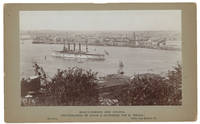
1890Best.-Nr. LIST110Havana: R. Testar 1890. Albumen photograph on cardstock mount image measuring 7 1/4 x 4 1/2 inches on 8 3/4 x 5 1/2 inch mount. A view of an American warship in Havana harbor likely taken prior to the outbreak of hostilities between the United States and Spain in early 1898. The photographers Leach and Patterson of Calle San Rafael published several views of Cuba at this time mostly of bucolic scenes around Havana and its environs. The American cruiser is similar in design to the U.S.S. Maine with slight differences - two smokestacks instead of three. An excellent example with minor wear to mount and fine image. R. Testar unknown
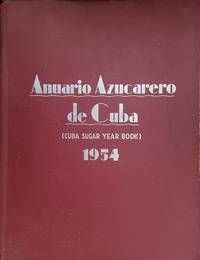
1954Best.-Nr. 5156Anuario azucarero de cubacuba sugar year book 1954 censo de la industria azucarera de cuba y manual estadistico nacional e internacionalcuban sugar census national and international statistical manual.primera edicioncaratulas originaleslibro ilustrado.edicion original de 1954.publicado por Cuba economica y financiera juan b suris director.El Anuario azucarero de Cuba Cuba sugar yearbook es un catálogo anual publicado por el Ministerio del Comercio Exterior de Cuba que reúne datos estadísticos comerciales y técnicos sobre la industria azucarera cubana y su relación con el mercado nacional e internacional.refleja su doble función: por un lado como censo que recoge información sobre la producción consumo exportaciones e importaciones de azúcar; y por otro como manual estadístico que ofrece datos históricos y actuales sobre la actividad azucarera y su contexto económico.el Anuario es una referencia clave para estudios sobre la economía cubana especialmente en el sector azucarero y se ha editado en varias ediciones algunas en bilingüe español-inglés para facilitar su uso en el ámbito internacional Cuba economica y financiera hardcover
Best.-Nr. 0483755001.Ghardcover. Good. Access codes and supplements are not guaranteed with used items. May be an ex-library book. hardcover
1976Best.-Nr. 183513Havana Cuba: Department of Revolutionary Orientation Publishing 1976. 145 pages. The cover has a litlte wear. The page edges are lightly tanned. Books listed here are not stored at the shop. Please contact us if you want to pick up a book from Newtown. Hardcover. Very Good/No Dust Jacket. Department of Revolutionary Orientation Publishing
Best.-Nr. 133418450X.Gpaperback. Good. Access codes and supplements are not guaranteed with used items. May be an ex-library book. paperback