[Cuba]. [Chinese Labor]Biblio.com
2 457 résultats
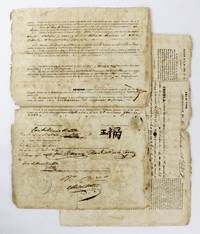
1863réf. 6222Havana 1863. Good. Two partially printed broadsheets completed in manuscript 13 x 9 inches. Old folds wear at edges; some light worming slightly affecting text. Lightly soiled. A pair of documents recording the indenture of a Chinese national in Havana. The present documents contract the "Asiatico Francisco" as a cook to Don Jose Antonio Battle y Olle; the contract is dated June 28 1861 and is signed by "Francisco" in Chinese characters for a term of two years. At the end it is noted in manuscript that the Asiatico Francisco has completed the two years of his contract. The cedula is dated 1863 and indicates that Francisco is 33 years of age and now indentured for eight years as a "cocinero." An interesting pair of documents showing the continuing servitude of imported Chinese laborers particularly attractive for being signed in Chinese characters. unknown
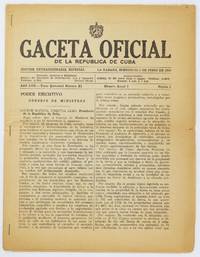
1959réf. 5470Habana: June 3 1959. Good plus. 11pp. Small folio. Previously folded; stapled along gutter margin. Some edge and corner wear; closed tear to initial leaf from fore-edge along old fold. Toned cheap newsprint. A special edition of the Gaceta Oficial of Communist Cuba devoted to the printing of the First Agrarian Reform Law passed and signed on May 17 1959. The law effected the first major land redistribution under Fidel Castro and the Communist Party. Under its authority all properties were over 420 hectares were confiscated and redistributed to the people and native businesses. Prior to the law over 80% of Cuban land was owned by foreign mostly American companies. The preamble and sixty-seven articles lay out the motivations for the law the parameters for confiscation by the Department of Agriculture the mechanisms for seizure and redistribution and the creation of a new government organization to facilitate the land transfers the Instituto Nacional de Reforma Agraria. Signed in print by Fidel as Prime Minister Manuel Urrutia Lleo as President and a slew of other officials. June 3 unknown
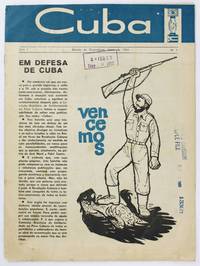
1961réf. 5832Guanabara 1961. About very good. 111pp. Small folio. Original pictorial self-wrappers stapled. Contemporary and slightly later ink stamps to front wrap. Light edge wear. Some tanning and dust soiling. First issue of this evidently unrecorded periodical published by the "Comissão Brasileira de Solidariedade ao Pavo Cubano" in May 1961. The publication contains numerous positive stories on the progress of the Cuban Revolution and support of the cause from the Brazilian people. Illustrated throughout with photographs and drawings including the beginning of a serial comic on the history of the revolution at the rear. The front wrap depicts Fidel Castro with his foot on the chest of a supine eagle and a rifle raised triumphantly over his head. Interesting support for the Communist cause in Cuba from South America. Not in OCLC. unknown
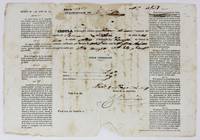
1857réf. 4502Havana 1857. Good plus. Small broadside form approximately 8.5 x 12.5 inches. Previously folded with some separation and minor loss along vertical fold. Completed in manuscript with additional manuscript docketing on blank verso. Ink burn causing additional minor loss in a few small areas. Light edge wear; some staining and offsetting; light tanning. A 19-century Cuban identification form known as a cedula filled out in manuscript to authorize the travel of an Asian indentured servant between plantations in early May 1857. The document was completed for a twenty-six-year-old Asian fieldhand named Chan who had signed a contract to work for one Gallego Toriceo to be transferred to the premises of "P. Soler y Compañia." Printed at the left and right edges are nine articles from an 1855 decree that outline the regulations for issuing and keeping such documents including the following: "Estas cédulas servirán de documentos de seguridad y además de licencias de transito para los colonos que se trasladen de un punto á otro de la Isla. Los patronos respectivos cuidarán de que los colonos no emprendan el viage sin licencia expresa suya que haràn constar al pié de la cedula. Si algun colono fuere hallado sin cédula deberá ser detenido y puesto à disposicion del Gobernador ó Capitan del partido mas inmediato e cual dará conocimiento al patrono dentro de segundo dia." On the otherwise blank verso is additional contemporary manuscript docketing concerning the transfer of the cedula and therefore the laborer concerned to the receiver located in Matanzas. A very interesting document of the bureaucracy and control of indentured servitude in Cuba during the mid-19th century. unknown
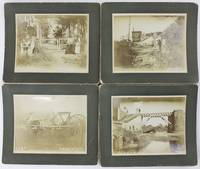
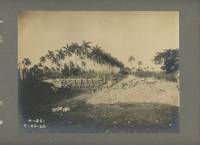
1898réf. 4079Puerto Principe 1898. Good plus. Thirteen photographs each approximately 4 x 5 inches on original card mounts. A few images rather faded. Light edge wear to mounts. Some photo credits in negatives; each with manuscript caption on mount verso. An interesting group of thirteen photographs taken by an amateur military photographer while deployed to Cuba during the Spanish-American War. The photos are centered around Puerto Principe now Camaguey in Central Cuba an unusual location for photos of this genre and focus on natives local architecture and natural views. Crude credits in the negatives of several images attribute the photographs to "Woodward" or "W.D.W" of the "15th U.S.I.B" i.e. 15th U.S. Infantry Battalion . Each image is also captioned in manuscript on the rear of its mount as follows: 1 Rail Road Bridge Near Puerto Principe Cuba 2 Same Bridge Different View 3 Natives in Cuba 4 Military Headquarters 5 Soldier Camp in Cuba 6 Cuban Prison 7 Cemetery in Puerto Principe Cuba 8 Water Wagon in Cuba 9 Plaza in Puerto Principe Cuba 10 Residence in Cuba 11 Cuban Carriage 12 Summer Resort in Cuba 13 Military Headquarters Inside. unknown
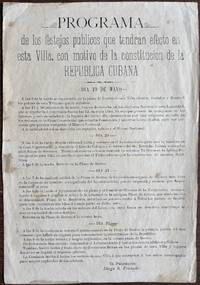
1901réf. 3191Havana 1901. About very good. Broadside 12.5 x 9 inches. Light wear and soiling. Backed with tissue. Broadside outlining the celebrations planned for the adoption of the Cuban Constitution of 1901 following the eviction of both Spain and the United States from the country. Four days of celebrations were planned for May 19 20 21 and 22. Events including the singing of the National Anthem orchestral concerts fireworks dancing and other diversions. We find no record of this broadside in OCLC. An ephemeral piece commemorating Cuban independence. unknown
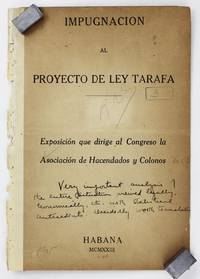
1923réf. 5672Havana 1923. Fair. 14pp. Original wrappers rear cover lacking. Contemporary ink notation to front cover reinforced at spine with later paper tanned. Text guillotined; leaves silked some chipping and wear at edges. A rare work arguing against railroad consolidation in Cuba and a victim of the New York Public Library's microfilming project. The subtitle reads "Exposicion que dirige al Congreso la Asociacion de Hacendados y Colonos." We locate only the microfilm copy at NYPL in OCLC no physical copies. unknown
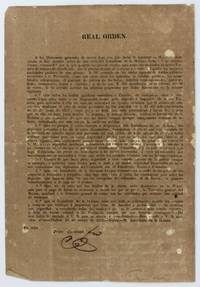
1818réf. 3189Havana 1818. Good. Broadside 11.75 x 8 inches. Heavily tanned. An apparently unrecorded Havana imprint comprising a broadside authorization for increased funding to be extended to the superintendent of Havana so that he can maximize the potential of the island's tobacco plantations. This credit is matched by the superintendent’s promise to use the money "con el preciso destino de comprar y remitir á España las mayores cantidades posibles de este género." The superintendent must also swear to be vigilant and honest in his account-taking reports to Spain and "Avise con toda la anticipacion posible los acopios y compras que verifique à proporcion que tenga de hacerlos y probabilidad en las remesas con seguridad aprovechándo todas las ocasiones que se le presenten para remitir cigarros y hoja de buena calidad á la Peninsula aunque sea con bandera extrangera." Signed in print and rubricated in manuscript by Pedro Carambot a Cuban official of the late 1810s. Not in OCLC. unknown
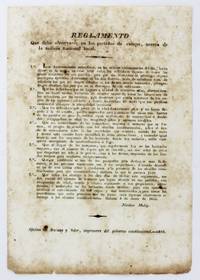
1822réf. 3190Havana: January 5 1822. Good. Broadside 11.5 x 8 inches. Foxed faint signs of folding a few small wormholes not affecting text. An apparently unrecorded broadside order from the captain general of Cuba Nicolas Mahy directing all able-bodied men under the age of fifty to join up with their local militias in order to keep the peace. The local militias are directed to go out on nightly forays "en nùmero capaz de evitar las incursiones de los salteadores por los caminos y la desercion que pueda acontecer de los negros de los ingenios cafetales y demas haciendas." Additionally all men between the ages of fifty and seventy are told to report to “las casas mas fuertes de los pueblos" to form a garrison that can protect women children and the elderly in case of insurrection. By the formation of these militias and the establishment of "el uso de los pasaportes" it was hoped to identify and arrest "los vagos y mal entretenidos." All mayors within ten days of receipt of this regulation were to report the number of men they had enlisted along with their particulars. In the early 1820s much of Spanish colonial America was gripped by revolution and with these orders the Cuban government likely hoped to avoid similar unrest on the island. Several independence groups had been formed in Cuba as of the promulgation of this decree the largest of which was the Soles y Rayos de Bolívar established in 1821. Signed in print by Mahy; not in OCLC. January 5 unknown
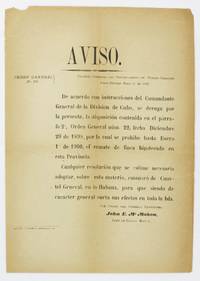
1899réf. 5378Puerto-Principe Cuba: Imp. el Progreso-Soledad January 11 1899. Good. Broadside 11.75 x 8.25 inches. Old folds minor chip at top left corner uniformly tanned and somewhat tender. An unrecorded general order issued in Spanish by the American "Jefe de Estado Mayor" Chief of Staff John E. McMahon during the military occupation of Cuba in the Spanish-American War. The order stipulates that a paragraph in a previous order prohibiting the auction of mortgaged property in the province of Puerto-Principe until January 1 1900 is hereby repealed and any further instructions on this matter will come from the Army's General Headquarters in Havana. McMahon issued several general orders during the American Army's occupation of Cuba and all appear to be rare. An interesting artifact from America's expansionist period with no other copies in OCLC auction history or the trade. Imp. el Progreso-Soledad, January 11 unknown
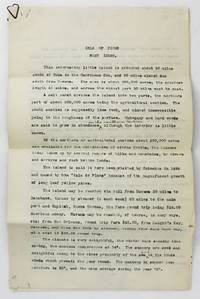
1910réf. 5377N.p. 1910. Very good. 11pp. of folio typescript totaling around 3000 words with a handful of manuscript corrections. Old folds minor marginal stains from old paper clips. An anonymously-written typescript promotional and business prospectus touting the Isle of Pines Isla de la Juventud off the southern coast of Cuba in the West Indies. The author writes of the many advantages of the Isle of Pines noting "This interesting little island is situated about 50 miles south of Cuba in the Caribbean Sea" with a population of "well-to-do Americans who own about 95% of the island and are after the other 5%." The author also states that "the laborers are mostly 'Pineros' or Isle of Pines people and are very efficient. They are kind and courteous and seem well pleased with the present situation. They are paid from $1.00 to $1.50 per day according to the grade of work." More of the usual language encouraging emigration to the island follows describing the agriculture climate soil government business environment the "old Spanish cities on the island" and more along with several pages of cost estimates for creating a working ten-acre fruit grove. The anonymous author mentions that he and his partner in Nueva Gerona J.A. Miller bought forty acres in Cuchilla Alta or Santa Ana Estates at $40 per acre from H.R. Leland "the sole representative in the United States." The author states he has given up his profession as an engineer in order to devote his time and energy to building a grapefruit grove and pineapple farm and to get others interested in investing with him "We will organize a Development Company with a Citrus Fruit Expert at its head.". He concludes by reiterating that "the country itself is a delightful place to live.raises a superior quality of fruit" and he is glad he "learned about it in time to enable us to enjoy all the benefits of the 'Great Ground Floor.' unknown
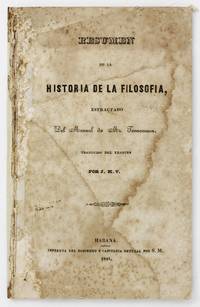
1845réf. 5307Havana: Imprenta del Gobierno y Capitania General por S.M. 1845. Good. 684pp. Disbound. Some insect damage to gutter of title page ample staining throughout mostly minor foxing. A very rare mid-19th century Cuban imprint translating into Spanish a work by German philosophical historian Wilhelm Gottlieb Tennemann entitled Manual of the History of Philosophy. Tennemann originally published the work in 1812 as a much-abridged history of philosophy after authoring a massive multi-volume work on the subject. According to the translator's note at the beginning of the text the present work was produced in order to provide a text in Spanish for those studying the history of philosophy "at the Royal Academy and in the private schools of the island of Puerto Rico." The translator also notes that the history of philosophy is "one of the subjects.of the general plan of education that must be taught." The work itself is organized as a series of lectures detailing the history of philosophy chronologically from ancient Eastern and Egyptian times through the Greeks Pythagoras Socrates Plato Aristotle and many others concluding with modern thinkers such as Descartes Espinosa Hume Kant Hegel and others. The work ends with an Index and an Errata page. "Wilhelm Gottlieb Tennemann 1761–1819 German historian of philosophy was born at Erfurt. Educated at his native town he became lecturer on the history of philosophy at Jena in 1788. Ten years later he became professor at the same university where he remained till 1804. His great work is an eleven-volume history of philosophy which he began at Jena and finished at Marburg where he was professor of philosophy from 1804 till his death. He was one of the numerous German philosophers who accepted the Kantian theory as a revelation. In 1812 he published a shorter history of philosophy which was translated into English in 1852 under the title Manual of the History of Philosophy" - Encyclopedia Britannica. No copies located in the United States. Three copies found in OCLC -- two in Chile and one in Spain. Imprenta del Gobierno y Capitania General por S.M. unknown
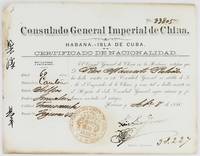
1880réf. 2592Havana: September 8 1880. Very good. Partially-printed broadside 6.5 x 8.25 inches completed in manuscript in Spanish and Chinese. Small marginal wormhole mild edge wear light toning. Ink stamp of the Consulado General at bottom-center. A scarce certificate issued in 1880 by the Chinese Consulate in Havana authenticating the registration and details of a Chinese laborer in Cuba. The printed form is completed in manuscript with the name of the recipient his age place of origin occupation and place of residence. The present examples were completed for a sixty-year-old laborer from Canton being called Pedro Pulido who was going to work and/or live at 48 Calle Figueroa in Havana. The printed text states that "El Cónsul General de China en la Habana certifica que blank ha hecho constar en este Consulado General ser súbdito de S.M. el Emperador de la China y como tal se halla inscrito en el Registro de dicho Consulado General segun número y filiacion anotados al márgen." The certificate is dated September 8 1880 and is stamped with the seal of the consulate in red and with the rubberstamped signature of the Consul General Lin Liang Yuan. The form are also bears two ink signatures in Chinese in the left margin a rare occurrence. An excellent document of the bureaucracy surrounding imported Chinese labor to Cuba in the last quarter of the 19th century. September 8 unknown
1931réf. 4532La provincia heroica y legendaria camaguey ano 1931 the heroic and legendary province primera edicion 1931 bilingual edition spanish and english.nueva encuadernacionguia de la provincia de camaguey ano 1931en buenas condiciones edicion original de la epoca.con ilustracioens con un directorio profesional y comercial por cada municipio ademas un listado de las principales companias de la provincia. El camagueyano s a impresores hardcover
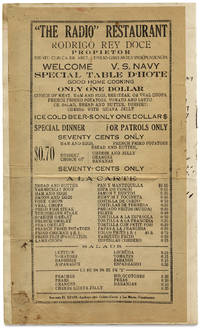
réf. 3726630Guantanamo Cuba: Imprenta El Suaso Aguilerae ntre Calixto Carćia y Los Maceo. ca. 1930s. 13½ x 7½ inches. Broadside simple ornamental border. Single sheet mounted to a larger ledger sheet. Two short tears upon fold lines in margins; tanning; good. A rare unrecorded Cuban restaurant menu directed at American naval servicemen. This bilingual broadside functions as both menu and advertisement for Rodrigo Rey Doce’s restaurant aptly named “The Radio” promising “Good Home Cooking” to the U.S. Navy through a fixed-price offering. For one dollar patrons could order familiar comforts—ham and eggs “beesteak” “french fried potatoes” veal chops or cheese with guava jelly—while ice-cold beer was offered at the same price a detail that hints at the economics of leisure near a U.S. base. An à la carte menu supplemented the set meal listing dishes in both English and Spanish including bacon and eggs fried fish steak fried fish parguitos vermicelli soup and simple fruit desserts. The menu suggests a steady clientele of American sailors likely stationed at Guantánamo and captures a small but telling moment of cultural exchange between Cuban proprietors and the U.S. Navy. A rare survival likely kept as a souvenir by a sailor and brought home to the United States. unknown
1486réf. 049666Basel: Michael Furter 1486. disbound. Very Good Condition. single leaf 7 1/4" x 10 3/4" with a hand colored illustration on each side. Slight chipping at edges faint tape marks on edge from having been mounted a little soiling. A nice example. Variously dated likely 1486-87. An early printing of this important German herbal first printed in Mainz in 1485. istc: ig00106500 Goff g101 Size: Folio. Quantity Available: 1. Shipped Weight: Under 1 kilo. Category: Science & Technology; Botany; Inventory No: 049666. Michael Furter unknown
1485réf. 049668Augsburg: H Schonsperger 1485. disbound. Very Good Condition. single leaf 8 1/4" x 11 3/8" with a hand colored illustrations of silverweed and a pea plant. Some chipping at edges faint tape marks on edge from having been mounted significant browning soiling in margins. An early printing of this important German herbal first printed in Mainz in 1485. Goff G97 ISTC ig00097000 Size: Folio. Quantity Available: 1. Shipped Weight: Under 1 kilo. Category: Science & Technology; Botany; Inventory No: 049668. H, Schonsperger unknown
réf. 0656614382.Gpaperback. Good. Access codes and supplements are not guaranteed with used items. May be an ex-library book. paperback
réf. 6501013437.Gpaperback. Good. Access codes and supplements are not guaranteed with used items. May be an ex-library book. paperback
réf. 0265173809.Ghardcover. Good. Access codes and supplements are not guaranteed with used items. May be an ex-library book. hardcover
réf. 1023611511.Ghardcover. Good. Access codes and supplements are not guaranteed with used items. May be an ex-library book. hardcover
réf. 026508086X.Gpaperback. Good. Access codes and supplements are not guaranteed with used items. May be an ex-library book. paperback
1906réf. List3021La Habana Province Republic of Cuba 1906. Twenty-two photographs measuring 7 ¼ x 9 ½ inches mounted on heavy cardstock measuring 10 x 12 inches. Photos numbered and dated on negative. In album embossed with “Havana Central Railroad Co./ Progress Photographs/ GUANAJAY”. Photos with fine contrast and some wear; mounts with minor damage slightly warped with some detached from binding. Overall excellent. Havana Central Railroad Company was an American company formed in April 1905. It opened two electric tram lines—Havana to Guanajay in 1906 and Havana to Güines in 1907—before it was bought by the English company United Railways following the Panic of 1907. Offered here is a photo album showing the construction of the Guanajay line. The photographs show laborers assisted by horse-drawn carts digging culverts laying tracks and erecting bridges and buildings. This project came on the heels of the successful efforts of the Cuba Company another railroad company to make the emerging Cuban Republic amenable to American business.They did so first by using ‘revocable permits’ which could ostensibly be revoked by the new government when it was formed to circumvent the Foraker Amendment prohibiting concessions to American companies by the US’s military government; and second by using their close relationships to several members of the Cuban Constitutional Convention to include a law allowing irrevocable permits.1 These along with the Platt Amendment and Governor Leonard Wood’s General Railway Law led to what would amount to domination by US interests in Cuba particularly but not exclusively in the railroad industry.2 Of interest to scholars of the early Republic of Cuba especially the history of US businesses in the country. 1 Juan C. Santamarina “The Cuba Company and the Expansion of American Business in Cuba 1898–1915” The Business History Review 74 no. 1 Spring 2000: 41–83. 2 Louis A. Pérez Jr. “Insurrection Intervention and the Transformation of Land Tenure Systems in Cuba 1895–1902” Hispanic American Historical Review 65 no. 2 1985: 229–254. unknown
réf. 1715116623.Gpaperback. Good. Access codes and supplements are not guaranteed with used items. May be an ex-library book. paperback
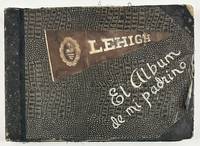
réf. 12844Various locations in Cuba and Pennsylvania: contents ca 1973. 25 leaves totaling 40pp. illustrated with thirty black-and-white and sepia-toned photographs with detailed manuscript captions plus seven large clippings from school publications and six additional ephemeral items. Oblong folio. Black cloth with alligator-patterned cloth on front board with manuscript title below a drawn representation of a small pennant for Lehigh University. Covers worn frayed and chipped alligator-style cloth curling a bit along fore edge. A few items loose from adhesive and a few with small tears scattered spotting and soiling. Overall very good condition with fascinating materiality. A lovingly-compiled photograph album and memorial book created by a young woman named Magdalena Sofia Guitart in tribute to her godfather Rafael Genó a Cuban engineer who studied at Lehigh University in Pennsylvania. Juan Rafael Genó Rizo was born in Santiago de Cuba in 1883. A doctoral thesis on Cuban architecture found online deems him one of the premiere Art Deco architects of Santiago and the only one to obtain a degree abroad. Genó graduated with a degree in Civil Engineering from Lehigh in 1909 and from the University of Havana in 1913. He died in Miami Florida in 1973. This doting scrapbook was compiled and heavily captioned in Spanish which we hereafter present in translation as a "Memorial which with love and pride I dedicate to my godfather and some of his works; a pale reflection of all the good he has done in his life" by Magdalena Sofia Guitart who was born in 1936 in Santiago and arrived in Miami in 1958. She includes photos of Genó as a baby and a boy of 11 "From a very young age as you can see here my godfather was a little gentleman" as well as in uniform alongside Mexican and Costa Rican comrades at Pennsylvania's Wayne Field. She lauds his "triumphs" and "genius" in "thousands of battles." Genó likely came to the United States following the Spanish-American War during the growth of Cuban immigration resulting from increased American attention of the island country. All of the content in the album is artfully presented within decorative rules or floral borders providing an unusual flair to the presentation. The book displays not only the hand-drawn Lehigh pennant on the cover but also large artistic renditions of the campus and an internal shot of its library clipped from school publications and comparing views from 1873 1909 and 1933 the relevance of Lehigh at the later date is unclear. Additional photographs and decorative designs share the story as "our engineer" returns to Cuba and "begins to demonstrate his knowledge" in the mines of Ponupo. Soon "his hard work integrity and honesty led him to be chosen" for other feats of engineering including "la Iglesia church Los Desamparados constructed by my godfather 1932" and a train terminal in Guantánamo. Images and a photographic clipping laud his renovations of "Colegio La Salle" in 1937. There are also six photos and a clipping showing Genó's work on the altar for the Eucharistic Congress held in Santiago in 1936 during which the original statue of Our Lady of Charity of El Cobre Patroness of Cuba was granted a canonical coronation by Pope Pius XI. The album also holds a clipping naming Genó as president of the Board of Directors of Santiago's Urban Property Center an inauguration ribbon and brochure for the Municipal Food Market in 1950 with which he was also involved and photos of the celebrated engineer later in life. A captivating and carefully-assembled homage created by a Cuban immigrant to the United States honoring a loved one who was educated in Pennsylvania and then returned to his home country to serve as a noted engineer during the first half of the 20th century. contents ca unknown