TUTINO Saverio.MareMagnum
TUTINO, SaverioMareMagnum
Gli anni di Cuba
1973In-8°, pp. 371, brossura editoriale.

Libreria Xodo · Italie12,00 €
2 545 résultats
Paris, François Maspéro, Cahiers libres 143-144, 1969. In-8, broché, 315 pp. Première traduction.
réf. 4852Paris, François Maspéro, Cahiers libres 143-144, 1969. In-8, broché, 315 pp.
1974Cm. 18, cart. edit., pag. 414 (10). Terza edizione. Sottolineature a inchiostro al solo capitolo quinto e a matita sparse. Buon esemplare.
1968In 16° br. pp. 414, ben tenuto
1973In-8°, pp. 371, brossura editoriale.
1968Mm 100x175 "Piccola Biblioteca Einaudi". Brossura editoriale, 414 pagine. Tenui tracce d'uso esterne, peraltro buono stato. Spedizione entro 24 ore dalla conferma dell'ordine.
1968Mm 100x175 "Piccola Biblioteca Einaudi" - Brossura editoriale, 414 pagine. Copia ottima mai letta. Spedizione entro 24 ore dalla conferma dell'ordine.
19681 Vol. In-16 pag. 414 PROG 39948 CATT_ATT 52
réf. 0332477975.Ghardcover. Good. Access codes and supplements are not guaranteed with used items. May be an ex-library book. hardcover
réf. 1332709818.Gpaperback. Good. Access codes and supplements are not guaranteed with used items. May be an ex-library book. paperback
réf. 0331535211.Ghardcover. Good. Access codes and supplements are not guaranteed with used items. May be an ex-library book. hardcover
réf. 0331535114.Gpaperback. Good. Access codes and supplements are not guaranteed with used items. May be an ex-library book. paperback
1678In -4°, pp. (40), 146, (6), pergamena coeva, difetti al dorso. Prima edizione. Nato a Saragozza, l’autore insegnò a Napoli e Roma prima di partire per Cuba, dove avrebbe passato la vecchiaia. Il libro, interessante e curioso, si occupa di prostituzione e della sua accettabilità dottrinaria, argomento rispetto al quale l’autore è fortemente contrario. Lo scritto replica a un manoscritto (poi stampato a Catania, “Resolutio theologica moralis in qua occasione cuiusdam casus occurrentis afferitur et propugnatur, licite permitti posse Meretrices”, 1677) del francescano Giovanni dell’Olmo, che difendeva il diritto delle prostitute a entrare nelle dimore nobiliari napoletane. La polemica svela molto sui costumi del sesso a pagamento all’epoca. Born in Saragoza, the author was a professor in Naples and Rome before leaving to Cuba. This curious book deals with prostitution and its doctrinaire acceptability (that the author is strongly against to). This work replies to a manuscript (then printed in Catania, “Resolutio theologica moralis in qua occasione… licite permitti posse meretrices”, 1677) of a franciscan preacher, Giovanni dell’Olmo, who supports permission to prostitutes to enter in neapolitan noble palaces. This controversy reveals many facts about prostitution at time.
1963In-8° gr. pp. 94 con molte foto n.t. Bross. edit.
réf. 427091 vol in-8 broché - N° 3 de juillet / août 1964 - 171 pages
réf. 45410886-nnew. unknown
2026réf. LRB48055631Paris: Editions Recreasoft 2026 Language: English. Approximately 632 pages. English: Print-on-demand reprint. Original edition : 1900. Text in English. This document presents a detailed statement of expenditures made on public buildings works and wharves in Cuba during the fiscal year 1899 as reported by the U.S. Secretary of War. It includes copies of relevant contracts and provides an official record of the financial transactions related to these projects. The report is a valuable resource for historians and researchers interested in U.S.-Cuba relations and the administrative processes of the War Department during this period. Book images are non-contractual. Editions Recreasoft. Softcover. New. Editions Recreasoft paperback
réf. 0332601897.Ghardcover. Good. Access codes and supplements are not guaranteed with used items. May be an ex-library book. hardcover
Madrid, M. García y Galo Sáez, 1916, 19,5 x 13 cm., rústica editorial, 258 págs. + 1 hoja. (Luis Gonzaga Urbina está considerado como uno de los grandes poetas mexicanos; en esta obra recoge sus impresiones de la vida en La Habana donde ejerció la docencia y el periodismo).
in-8°, 298 pages, broche, couverture illustree Bon etat. [AZ-12]
1959réf. 93985Havana: Office of the Prime Minister of Cuba 1959. Pamphlet. 32p. one photographic reproduction soupkitchen: "This is why Cuba needs the land reform" 8.5 x 5.5 inches wraps of substantial white paperstock decorated with the Cuban coat-of-arms rendered in 3 colors staplebound. wraps mildly soiled minor handling wear. Dated from internal declaration on p.31 over Urrutia Lleo's name; "Enacted in la Plata Sierra Maestra on May 17 1959 'Year of the Liberation.'" Also suggestive that 1959 date is correct is professional presswork and cover color work sophisticated by standards that in a year or two will be much lower as money and professionals run out. Office of the Prime Minister of Cuba unknown books
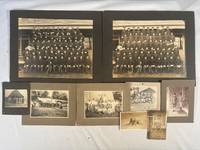
1909réf. 224671909. Soldier Harold Howard's person documentaation of service in the 11th U.S. Cavalry during the period of American military occupation and intervention in Cuba following the Spanish American War. These photographs place an enlisted cavalryman within the broader framework of U.S. expansionist policy in the Caribbean under the Platt Amendment when American troops were repeatedly deployed to Cuba to oversee political stability infrastructure and economic interests. The archive includes identified images of Sgt. Harold Howard and captures both formal military organization and informal daily life offering a ground-level record of U.S. cavalry presence during a period of continued occupation and reintervention including the second U.S. occupation of Cuba from 1912 to 1913. Archive of nine vintage silver gelatin photographs ranging approximately from 3.5 x 5 inches to 10 x 13 inches many mounted to original photographer boards and some annotated in ink or pencil. Two large-format formal group portraits depict Troop K 11th U.S. Cavalry at Fort Oglethorpe Georgia 1913 showing soldiers in full dress uniform arranged in tiered formation with visible regimental flag marked "11" and "K" with Howard identified in one image. Smaller photographs include a group portrait of U.S. cavalrymen in Pinar del Río Cuba dated 1908 showing soldiers in campaign dress posed near a stable as well as candid camp scenes featuring cooking areas barracks life and assembled troops. Two photo postcards function as personal correspondence with handwritten messages from Howard dated April 1 and September 9 1913 addressed to Mrs. A. L. Howard in Maine referencing weather conditions and upcoming exhibition drills providing direct evidence of mobility and routine within cavalry service. Additional images include a cabinet card of two uniformed soldiers and a scene depicting Black Cuban civilians posed near a thatched structure situating U.S. military presence within local social environments. Taken together the archive documents the lived experience of a U.S. cavalryman operating within the infrastructure of American imperial policy in the Caribbean linking domestic military bases such as Fort Oglethorpe with overseas deployment in Cuba. The photographs record both the formal visual culture of the U.S. Army and the everyday conditions of enlisted service while the inclusion of Cuban subjects and locations underscores the entanglement of military occupation with local populations. General edge wear throughout with occasional pinholes adhesive remnants and minor chipping to mounts; some toning to boards. Photographs remain clear and stable with annotations legible. Overall very good condition. unknown
1909réf. 224671909. Soldier Harold Howard's person documentaation of service in the 11th U.S. Cavalry during the period of American military occupation and intervention in Cuba following the Spanish American War. These photographs place an enlisted cavalryman within the broader framework of U.S. expansionist policy in the Caribbean under the Platt Amendment when American troops were repeatedly deployed to Cuba to oversee political stability infrastructure and economic interests. The archive includes identified images of Sgt. Harold Howard and captures both formal military organization and informal daily life offering a ground-level record of U.S. cavalry presence during a period of continued occupation and reintervention including the second U.S. occupation of Cuba from 1912 to 1913. Archive of nine vintage silver gelatin photographs ranging approximately from 3.5 x 5 inches to 10 x 13 inches many mounted to original photographer boards and some annotated in ink or pencil. Two large-format formal group portraits depict Troop K 11th U.S. Cavalry at Fort Oglethorpe Georgia 1913 showing soldiers in full dress uniform arranged in tiered formation with visible regimental flag marked "11" and "K" with Howard identified in one image. Smaller photographs include a group portrait of U.S. cavalrymen in Pinar del Río Cuba dated 1908 showing soldiers in campaign dress posed near a stable as well as candid camp scenes featuring cooking areas barracks life and assembled troops. Two photo postcards function as personal correspondence with handwritten messages from Howard dated April 1 and September 9 1913 addressed to Mrs. A. L. Howard in Maine referencing weather conditions and upcoming exhibition drills providing direct evidence of mobility and routine within cavalry service. Additional images include a cabinet card of two uniformed soldiers and a scene depicting Black Cuban civilians posed near a thatched structure situating U.S. military presence within local social environments. Taken together the archive documents the lived experience of a U.S. cavalryman operating within the infrastructure of American imperial policy in the Caribbean linking domestic military bases such as Fort Oglethorpe with overseas deployment in Cuba. The photographs record both the formal visual culture of the U.S. Army and the everyday conditions of enlisted service while the inclusion of Cuban subjects and locations underscores the entanglement of military occupation with local populations. General edge wear throughout with occasional pinholes adhesive remnants and minor chipping to mounts; some toning to boards. Photographs remain clear and stable with annotations legible. Overall very good condition. unknown books
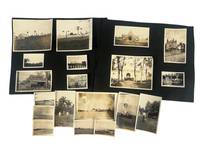
1915réf. 224781915. Polk George Washington Jr. Havana and rural Cuba photo archive 1915 documents Cuba through the viewpoint of an American military traveler during the Platt Amendment era when U.S. power shaped Cuban sovereignty port security naval access and commercial movement. The photographs record ships in Havana Harbor coastal fortifications rural dwellings Cuban farmers agricultural landscapes and colonial plazas providing insight into how U.S. military personnel visually encountered Cuba just before American entry into World War I. The Platt Amendment gave the United States broad authority to intervene in Cuban affairs and required Cuba to lease land for naval stations remaining central to U.S.-Cuba relations until its repeal in 1934; this archive therefore places vernacular travel photography within a larger framework of military oversight and commercial access. Polk George Washington Jr. Havana Cuba vernacular photo collection. Havana Cuba: unpublished December 1915. Twenty-eight silver gelatin photographs pasted to album pages with some loose or partially detached ranging from approximately 2 x 2½ inches to 4½ x 3½ inches many with handwritten ink annotations dated December 22 to 29 1915. The images include vessels anchored in Havana Harbor harbor views from on board ship Morro Castle and other coastal fortification views colonial civic plazas local laborers and civilians thatched rural huts or bohíos sugarcane fields and agricultural scenes captioned "Orange Trees & Coconut Palms Near Havana." One photograph is captioned "Cuban Farmer & Son Near Havana Dec 22 1915" giving the archive direct documentary value for rural family life and American observation of Cuban agricultural communities. Other captions identify boats as "U.S.C. 5th Protectors off Havana" and refer to the United Fruit Company steamer Abangarez on the Havana-Colon route; the Abangarez was a United Fruit Company passenger and cargo vessel completed in 1909 and later brought under United States registry during World War I. The photographs combine military commercial and rural subjects in a compact record of U.S.-Cuban contact. Polk's annotations and the repeated Potchernick-Birdsong Co. Kodak Place San Antonio Texas stamps on versos indicate that the images were developed in the United States after the trip or sent home for processing preserving the path by which overseas military travel became a personal photographic record. Polk's later military service is supported by burial and veterans' records identifying George Washington Polk Jr. as born May 13 1889 died July 27 1976 and buried at Fort Rosecrans National Cemetery; the supplied description identifies him as later a Colonel in the U.S. Army Air Corps and instructor in the early U.S. Air Force. Most photographs lightly pasted along one edge to scrapbook leaves with some detached or partially affixed; a few corner creases otherwise sharp images with strong contrast good to very good overall. Focused 1915 Cuba archive linking Havana Harbor rural Cuban labor vernacular architecture United Fruit maritime movement and American military observation during the U.S. protectorate period. unknown
1915réf. 224781915. Polk George Washington Jr. Havana and rural Cuba photo archive 1915 documents Cuba through the viewpoint of an American military traveler during the Platt Amendment era when U.S. power shaped Cuban sovereignty port security naval access and commercial movement. The photographs record ships in Havana Harbor coastal fortifications rural dwellings Cuban farmers agricultural landscapes and colonial plazas providing insight into how U.S. military personnel visually encountered Cuba just before American entry into World War I. The Platt Amendment gave the United States broad authority to intervene in Cuban affairs and required Cuba to lease land for naval stations remaining central to U.S.-Cuba relations until its repeal in 1934; this archive therefore places vernacular travel photography within a larger framework of military oversight and commercial access. Polk George Washington Jr. Havana Cuba vernacular photo collection. Havana Cuba: unpublished December 1915. Twenty-eight silver gelatin photographs pasted to album pages with some loose or partially detached ranging from approximately 2 x 2½ inches to 4½ x 3½ inches many with handwritten ink annotations dated December 22 to 29 1915. The images include vessels anchored in Havana Harbor harbor views from on board ship Morro Castle and other coastal fortification views colonial civic plazas local laborers and civilians thatched rural huts or bohíos sugarcane fields and agricultural scenes captioned "Orange Trees & Coconut Palms Near Havana." One photograph is captioned "Cuban Farmer & Son Near Havana Dec 22 1915" giving the archive direct documentary value for rural family life and American observation of Cuban agricultural communities. Other captions identify boats as "U.S.C. 5th Protectors off Havana" and refer to the United Fruit Company steamer Abangarez on the Havana-Colon route; the Abangarez was a United Fruit Company passenger and cargo vessel completed in 1909 and later brought under United States registry during World War I. The photographs combine military commercial and rural subjects in a compact record of U.S.-Cuban contact. Polk's annotations and the repeated Potchernick-Birdsong Co. Kodak Place San Antonio Texas stamps on versos indicate that the images were developed in the United States after the trip or sent home for processing preserving the path by which overseas military travel became a personal photographic record. Polk's later military service is supported by burial and veterans' records identifying George Washington Polk Jr. as born May 13 1889 died July 27 1976 and buried at Fort Rosecrans National Cemetery; the supplied description identifies him as later a Colonel in the U.S. Army Air Corps and instructor in the early U.S. Air Force. Most photographs lightly pasted along one edge to scrapbook leaves with some detached or partially affixed; a few corner creases otherwise sharp images with strong contrast good to very good overall. Focused 1915 Cuba archive linking Havana Harbor rural Cuban labor vernacular architecture United Fruit maritime movement and American military observation during the U.S. protectorate period. unknown books