[Cuba]: [Buchanan, James]:Biblio.com
2642 risultati
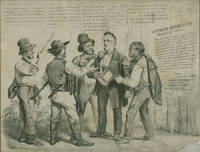
1856rif. 53452New York: Nathaniel Currier 1856. Trying to Grab Cuba A scarce political cartoon regarding the controversial Ostend Manifesto the initially-secret attempt by the United States to purchase Spanish-controlled Cuba. Earlier President Franklin Pierce had instructed Pierre Soulé upon his appointment as minister to Spain in April 1853 to negotiate to buy Cuba. Three American foreign ministers serving in Europe - James Buchanan John Y. Mason and Soulé - met secretly at Ostend Belgium in late 1854 to draft a plan to either buy Cuba from Spain or force Spain to give up Cuba by inciting a Cuban revolution. The plan met with overwhelming opposition once it was made public in America. In the present political cartoon Buchanan is attacked for his role in the Ostend controversy. He is surrounded by four armed ruffians seeking to rob him of his coat hat watch and money a particularly sharp turn-about on the American minister to Great Britain. The muggers' demands include quotations from the manifesto which is pasted to the fence at right. Buchanan calls out: "Why! Why! This is rank robbery! Help! Help! All honest men!" The fallout from the Ostend controversy was widespread. President Pierce's Democratic Party split asunder after he refused to continue any discussions of the plan or any other expansionist ideas; Soulé understandably resigned; and the international community saw it as a threat to Spanish sovereignty in the region. Oddly enough James Buchanan was not too hurt by the controversy; he was easily elected president in 1856 and still harbored hope for Cuban annexation. He was smart enough however to table the Cuba question for the foreseeable future after meeting with both popular opposition and increasingly bitter sectional conflict the latter only spurred on by incidents such as the Ostend controversy. Broadside 10 x 13 inches. Foxed bottom right corner chipped. Lower margin trimmed costing the title. Good only. Framed under glass. CURRIER & IVES: CATALOGUE RAISONNÉ 5021. NEVINS & WEITENKAMPF p.72-73. unknown
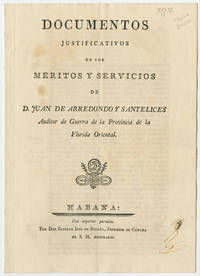
1815rif. 49642Havana: Esteban José de Boloña 1815. An early Cuban imprint printed by Esteban José de Boloña the first printer in Cuba after the 1776 ban on printing. Juan de Arrondo y Santilices was an official in Spanish Florida the Auditor of War of East Florida during the early 19th century. This is a work detailing the deeds of Arrondo y Santilices likely an attempt to secure a pension. Rare with one copy located by OCLC at the John Carter Brown Library. Gathered signatures stitched. Stitching mostly perished. Light fold lines minimal foxing ink marginal notations contemporary ink inscription after the text. Very good. unknown books
1815rif. 49642Havana: Esteban José de Boloña 1815. An early Cuban imprint printed by Esteban José de Boloña the first printer in Cuba after the 1776 ban on printing. Juan de Arrondo y Santilices was an official in Spanish Florida the Auditor of War of East Florida during the early 19th century. This is a work detailing the deeds of Arrondo y Santilices likely an attempt to secure a pension. Rare with one copy located by OCLC at the John Carter Brown Library. Gathered signatures stitched. Stitching mostly perished. Light fold lines minimal foxing ink marginal notations contemporary ink inscription after the text. Very good. unknown
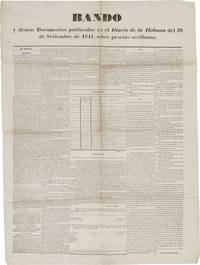
1841rif. 15527Havana. Sept. 29 1841. A proclamation by the Spanish military government in Cuba concerning legal tender and its circulation and providing a series of regulations for commerce and exchange. Broadside 23 x 16 1/2 inches. Splitting on middle fold else very good. unknown
1841rif. 15527Havana. Sept. 29 1841. A proclamation by the Spanish military government in Cuba concerning legal tender and its circulation and providing a series of regulations for commerce and exchange. Broadside 23 x 16 1/2 inches. Splitting on middle fold else very good. unknown books
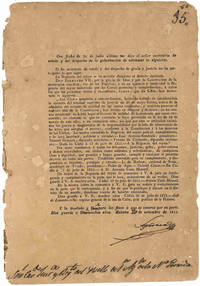
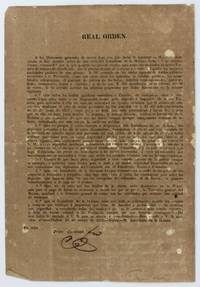
1813rif. 46892Havana. Sept. 20 1813. Early Havana Imprint A rare printed decree from Cuba at the beginning of the 19th century as Spanish power in the world was waning but Spain's grip on Cuba was still quite firm. This decree issued by the King on June 14 1813 and printed on September 20 announces new laws regarding the rights to vote and to be elected to hold government positions for professors and scholars from certain universities collegiums and seminars. The decree forbade these rights to the Knights of Justice of the Order of St. John of Jerusalem as well as members of the four military orders of Santiago Calatrava Alcantara and Montesa. It is endorsed in manuscript with the imprint and header also written in by hand. Early Caribbean imprints are rare. Folio. Old fold lines. Moderately chipped and worn at edges. Lightly and evenly toned. Contemporary manuscript notations. Good. unknown
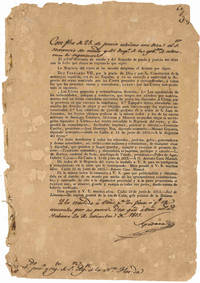
1813rif. 46891Havana. Sept. 20 1813. Amnesty to Curry Favor A rare Havana imprint. As Spanish power in the New World was waning its grip on Cuba was threatened by domestic and foreign intruders. This decree issued by the Council of Regents "Cortes" standing in for Fernando VII on June 17 1813 and printed on September 20 orders the annulment of all criminal cases. This amnesty policy extended to other areas of New Spain as well sought to placate opposition forces. It calls on all levels of government to announce and enforce the decree. It is endorsed in manuscript. Folio. Old fold lines. Moderately chipped and worn at edges. Evenly toned. Contemporary manuscript notations. Good. unknown
1813rif. 46892Havana. Sept. 20 1813. Early Havana Imprint A rare printed decree from Cuba at the beginning of the 19th century as Spanish power in the world was waning but Spain's grip on Cuba was still quite firm. This decree issued by the King on June 14 1813 and printed on September 20 announces new laws regarding the rights to vote and to be elected to hold government positions for professors and scholars from certain universities collegiums and seminars. The decree forbade these rights to the Knights of Justice of the Order of St. John of Jerusalem as well as members of the four military orders of Santiago Calatrava Alcantara and Montesa. It is endorsed in manuscript with the imprint and header also written in by hand. Early Caribbean imprints are rare. Folio. Old fold lines. Moderately chipped and worn at edges. Lightly and evenly toned. Contemporary manuscript notations. Good. unknown books
1813rif. 46891Havana. Sept. 20 1813. Amnesty to Curry Favor A rare Havana imprint. As Spanish power in the New World was waning its grip on Cuba was threatened by domestic and foreign intruders. This decree issued by the Council of Regents "Cortes" standing in for Fernando VII on June 17 1813 and printed on September 20 orders the annulment of all criminal cases. This amnesty policy extended to other areas of New Spain as well sought to placate opposition forces. It calls on all levels of government to announce and enforce the decree. It is endorsed in manuscript. Folio. Old fold lines. Moderately chipped and worn at edges. Evenly toned. Contemporary manuscript notations. Good. unknown books
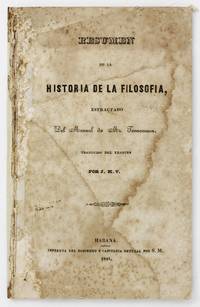
1845rif. 5307Havana: Imprenta del Gobierno y Capitania General por S.M. 1845. Good. 684pp. Disbound. Some insect damage to gutter of title page ample staining throughout mostly minor foxing. A very rare mid-19th century Cuban imprint translating into Spanish a work by German philosophical historian Wilhelm Gottlieb Tennemann entitled Manual of the History of Philosophy. Tennemann originally published the work in 1812 as a much-abridged history of philosophy after authoring a massive multi-volume work on the subject. According to the translator's note at the beginning of the text the present work was produced in order to provide a text in Spanish for those studying the history of philosophy "at the Royal Academy and in the private schools of the island of Puerto Rico." The translator also notes that the history of philosophy is "one of the subjects.of the general plan of education that must be taught." The work itself is organized as a series of lectures detailing the history of philosophy chronologically from ancient Eastern and Egyptian times through the Greeks Pythagoras Socrates Plato Aristotle and many others concluding with modern thinkers such as Descartes Espinosa Hume Kant Hegel and others. The work ends with an Index and an Errata page. "Wilhelm Gottlieb Tennemann 1761–1819 German historian of philosophy was born at Erfurt. Educated at his native town he became lecturer on the history of philosophy at Jena in 1788. Ten years later he became professor at the same university where he remained till 1804. His great work is an eleven-volume history of philosophy which he began at Jena and finished at Marburg where he was professor of philosophy from 1804 till his death. He was one of the numerous German philosophers who accepted the Kantian theory as a revelation. In 1812 he published a shorter history of philosophy which was translated into English in 1852 under the title Manual of the History of Philosophy" - Encyclopedia Britannica. No copies located in the United States. Three copies found in OCLC -- two in Chile and one in Spain. Imprenta del Gobierno y Capitania General por S.M. unknown books
1845rif. 5307Havana: Imprenta del Gobierno y Capitania General por S.M. 1845. Good. 684pp. Disbound. Some insect damage to gutter of title page ample staining throughout mostly minor foxing. A very rare mid-19th century Cuban imprint translating into Spanish a work by German philosophical historian Wilhelm Gottlieb Tennemann entitled Manual of the History of Philosophy. Tennemann originally published the work in 1812 as a much-abridged history of philosophy after authoring a massive multi-volume work on the subject. According to the translator's note at the beginning of the text the present work was produced in order to provide a text in Spanish for those studying the history of philosophy "at the Royal Academy and in the private schools of the island of Puerto Rico." The translator also notes that the history of philosophy is "one of the subjects.of the general plan of education that must be taught." The work itself is organized as a series of lectures detailing the history of philosophy chronologically from ancient Eastern and Egyptian times through the Greeks Pythagoras Socrates Plato Aristotle and many others concluding with modern thinkers such as Descartes Espinosa Hume Kant Hegel and others. The work ends with an Index and an Errata page. "Wilhelm Gottlieb Tennemann 1761–1819 German historian of philosophy was born at Erfurt. Educated at his native town he became lecturer on the history of philosophy at Jena in 1788. Ten years later he became professor at the same university where he remained till 1804. His great work is an eleven-volume history of philosophy which he began at Jena and finished at Marburg where he was professor of philosophy from 1804 till his death. He was one of the numerous German philosophers who accepted the Kantian theory as a revelation. In 1812 he published a shorter history of philosophy which was translated into English in 1852 under the title Manual of the History of Philosophy" - Encyclopedia Britannica. No copies located in the United States. Three copies found in OCLC -- two in Chile and one in Spain. Imprenta del Gobierno y Capitania General por S.M. unknown
1894rif. 1064651894. Pamphlet format 70 pp. Illustrations; map. 14.3x11.8 cm 5½x4½" pictorial wrappers. Some light staining and wear to wrappers spine a little worn very good overall. Rare tourists' guide book produced under the auspices of the Grand Hotel Macotte with much on Havana transportation options sights to see including bull fights prices a Spanish vocabulary etc. with numerous advertisements for Cuban and some Florida businesses and other hotels. One advertisement features cigar maker La Corona. They even include an illustration of Christopher Columbus. OCLC/WorldCat lists only one copy at the California State Library Sutro Branch. J. Carbonell and P. Montero, Proprietors. books
1894rif. 1064651894. Pamphlet format 70 pp. Illustrations; map. 14.3x11.8 cm 5½x4½" pictorial wrappers. Some light staining and wear to wrappers spine a little worn very good overall. Rare tourists' guide book produced under the auspices of the Grand Hotel Macotte with much on Havana transportation options sights to see including bull fights prices a Spanish vocabulary etc. with numerous advertisements for Cuban and some Florida businesses and other hotels. One advertisement features cigar maker La Corona. They even include an illustration of Christopher Columbus. OCLC/WorldCat lists only one copy at the California State Library Sutro Branch. J. Carbonell and P. Montero, Proprietors.
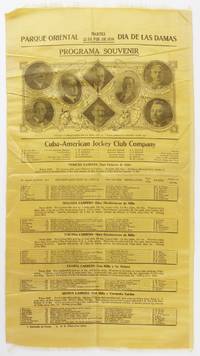
1916rif. 4158Havana 1916. Very good. Broadside printed on light orange silk approximately 16.25 x 9 inches. Minor edge wear one small tear near bottom right. A seemingly unrecorded silk broadside issued by the Cuba-American Jockey Club Company advertising the lineup of horses and the schedule for a series of five races during Dia de las Damas "Ladies Day" at the Oriental Park racetrack in Marianao Havana in 1916. In addition the top of the broadside is printed with small oval- and diamond-shaped portraits picturing the nine officers of the club who are identified by name and their position within the club. Below these portraits is a listing of fourteen officers of the club. The Oriental Park Racetrack "Parque Oriental" opened in 1915 for winter racing which began in November and lasted into March each year. The racetrack was the only thoroughbred track in Cuba until Fidel Castro practically shut it down after the Cuban Revolution in 1959. The present broadside is a visual reminder of the influx of American business interests in Cuba in the early 20th century. No copies reported in OCLC. unknown books
1916rif. 4158Havana 1916. Very good. Broadside printed on light orange silk approximately 16.25 x 9 inches. Minor edge wear one small tear near bottom right. A seemingly unrecorded silk broadside issued by the Cuba-American Jockey Club Company advertising the lineup of horses and the schedule for a series of five races during Dia de las Damas "Ladies Day" at the Oriental Park racetrack in Marianao Havana in 1916. In addition the top of the broadside is printed with small oval- and diamond-shaped portraits picturing the nine officers of the club who are identified by name and their position within the club. Below these portraits is a listing of fourteen officers of the club. The Oriental Park Racetrack "Parque Oriental" opened in 1915 for winter racing which began in November and lasted into March each year. The racetrack was the only thoroughbred track in Cuba until Fidel Castro practically shut it down after the Cuban Revolution in 1959. The present broadside is a visual reminder of the influx of American business interests in Cuba in the early 20th century. No copies reported in OCLC. unknown
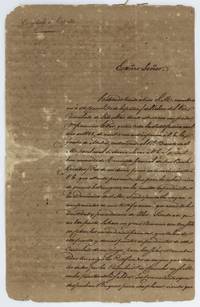
1828rif. 2401Gibraltar 1828. Good. 3pp. on a bifolium. Previously folded with separations. Tanned somewhat brittle. An interesting example of official communications concerning trade between colonial Cuba and the Spanish mainland. In this manuscript letter date March 14 1828 the new Spanish Vice Consul in Gibraltar writes to the Governor General of Cuba concerning several topics. These include the regulation of shipping to Cuba and by implication the rest of the Caribbean through Gibraltar particularly of French ships leaving Mediterranean ports. Also discussed is keeping track of individuals particularly merchants going to Cuba by means of identification papers and other documents. The consul also reminds the colonial government of the importance of documenting duties and tariffs paid for shipping cargo and goods. unknown books
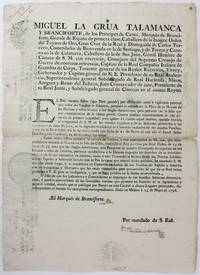
1796rif. 5074Mexico City: May 13 1796. About very good. Broadside 17 x 12.25 inches. Old fold lines. Slight separation and loss at center fold slightly affecting a few letters. Minor wear else. Proclamation made by the Viceroy of New Spain authorizing trade between Cuba and the United States. The Caribbean was in tumult in the 1790s with Toussaint L'Ouverture overthrowing the French colonial government and outlawing slavery. Likewise in Cuba there was a similar revolt against slavery demanding abolition and equality -- both revolutions were of substantial concern to slaveholders in the American South. Specifically the present decree mentions flour and other vital foodstuffs as a measure against shortages in Cuba intended to prevent further trouble. "Para precaver la escasez de viveres y con especialidad de harinas que verosimilmente causaria la guerra concedio El Rey Permiso por Real Orden de 25 Junio de 93. para que los Anglo-Americanos.pudiesen conducirlos a la Havana pagando los derechos los puertos habilitados de España." The Viceroy at the time was Don Miguel de la Grua Talamanca de Carini y Branciforte First Marques de Branciforte. The Marques was notoriously corrupt even for colonial Spain having gained position through marriage to the Prime Minister's sister. He made sure to make some profit on everything that passed through his hands including taking advantage of the war in Cuba to remove the French from their lands and sell them to his benefit. A rare and interesting decree. We locate a single copy in OCLC at the University of Minnesota. May 13 unknown books
1818rif. 3189Havana 1818. Good. Broadside 11.75 x 8 inches. Heavily tanned. An apparently unrecorded Havana imprint comprising a broadside authorization for increased funding to be extended to the superintendent of Havana so that he can maximize the potential of the island's tobacco plantations. This credit is matched by the superintendent’s promise to use the money "con el preciso destino de comprar y remitir á España las mayores cantidades posibles de este género." The superintendent must also swear to be vigilant and honest in his account-taking reports to Spain and "Avise con toda la anticipacion posible los acopios y compras que verifique à proporcion que tenga de hacerlos y probabilidad en las remesas con seguridad aprovechándo todas las ocasiones que se le presenten para remitir cigarros y hoja de buena calidad á la Peninsula aunque sea con bandera extrangera." Signed in print and rubricated in manuscript by Pedro Carambot a Cuban official of the late 1810s. Not in OCLC. unknown books
1828rif. 2401Gibraltar 1828. Good. 3pp. on a bifolium. Previously folded with separations. Tanned somewhat brittle. An interesting example of official communications concerning trade between colonial Cuba and the Spanish mainland. In this manuscript letter date March 14 1828 the new Spanish Vice Consul in Gibraltar writes to the Governor General of Cuba concerning several topics. These include the regulation of shipping to Cuba and by implication the rest of the Caribbean through Gibraltar particularly of French ships leaving Mediterranean ports. Also discussed is keeping track of individuals particularly merchants going to Cuba by means of identification papers and other documents. The consul also reminds the colonial government of the importance of documenting duties and tariffs paid for shipping cargo and goods. unknown
1796rif. 5074Mexico City: May 13 1796. About very good. Broadside 17 x 12.25 inches. Old fold lines. Slight separation and loss at center fold slightly affecting a few letters. Minor wear else. Proclamation made by the Viceroy of New Spain authorizing trade between Cuba and the United States. The Caribbean was in tumult in the 1790s with Toussaint L'Ouverture overthrowing the French colonial government and outlawing slavery. Likewise in Cuba there was a similar revolt against slavery demanding abolition and equality -- both revolutions were of substantial concern to slaveholders in the American South. Specifically the present decree mentions flour and other vital foodstuffs as a measure against shortages in Cuba intended to prevent further trouble. "Para precaver la escasez de viveres y con especialidad de harinas que verosimilmente causaria la guerra concedio El Rey Permiso por Real Orden de 25 Junio de 93. para que los Anglo-Americanos.pudiesen conducirlos a la Havana pagando los derechos los puertos habilitados de España." The Viceroy at the time was Don Miguel de la Grua Talamanca de Carini y Branciforte First Marques de Branciforte. The Marques was notoriously corrupt even for colonial Spain having gained position through marriage to the Prime Minister's sister. He made sure to make some profit on everything that passed through his hands including taking advantage of the war in Cuba to remove the French from their lands and sell them to his benefit. A rare and interesting decree. We locate a single copy in OCLC at the University of Minnesota. May 13 unknown
1818rif. 3189Havana 1818. Good. Broadside 11.75 x 8 inches. Heavily tanned. An apparently unrecorded Havana imprint comprising a broadside authorization for increased funding to be extended to the superintendent of Havana so that he can maximize the potential of the island's tobacco plantations. This credit is matched by the superintendent’s promise to use the money "con el preciso destino de comprar y remitir á España las mayores cantidades posibles de este género." The superintendent must also swear to be vigilant and honest in his account-taking reports to Spain and "Avise con toda la anticipacion posible los acopios y compras que verifique à proporcion que tenga de hacerlos y probabilidad en las remesas con seguridad aprovechándo todas las ocasiones que se le presenten para remitir cigarros y hoja de buena calidad á la Peninsula aunque sea con bandera extrangera." Signed in print and rubricated in manuscript by Pedro Carambot a Cuban official of the late 1810s. Not in OCLC. unknown
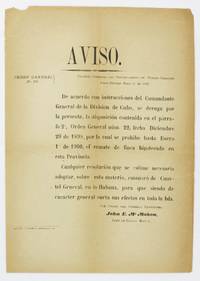
1899rif. 5378Puerto-Principe Cuba: Imp. el Progreso-Soledad January 11 1899. Good. Broadside 11.75 x 8.25 inches. Old folds minor chip at top left corner uniformly tanned and somewhat tender. An unrecorded general order issued in Spanish by the American "Jefe de Estado Mayor" Chief of Staff John E. McMahon during the military occupation of Cuba in the Spanish-American War. The order stipulates that a paragraph in a previous order prohibiting the auction of mortgaged property in the province of Puerto-Principe until January 1 1900 is hereby repealed and any further instructions on this matter will come from the Army's General Headquarters in Havana. McMahon issued several general orders during the American Army's occupation of Cuba and all appear to be rare. An interesting artifact from America's expansionist period with no other copies in OCLC auction history or the trade. Imp. el Progreso-Soledad, January 11 unknown books
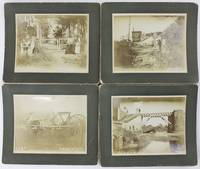
1898rif. 4079Puerto Principe 1898. Good plus. Thirteen photographs each approximately 4 x 5 inches on original card mounts. A few images rather faded. Light edge wear to mounts. Some photo credits in negatives; each with manuscript caption on mount verso. An interesting group of thirteen photographs taken by an amateur military photographer while deployed to Cuba during the Spanish-American War. The photos are centered around Puerto Principe now Camaguey in Central Cuba an unusual location for photos of this genre and focus on natives local architecture and natural views. Crude credits in the negatives of several images attribute the photographs to "Woodward" or "W.D.W" of the "15th U.S.I.B" i.e. 15th U.S. Infantry Battalion . Each image is also captioned in manuscript on the rear of its mount as follows: 1 Rail Road Bridge Near Puerto Principe Cuba 2 Same Bridge Different View 3 Natives in Cuba 4 Military Headquarters 5 Soldier Camp in Cuba 6 Cuban Prison 7 Cemetery in Puerto Principe Cuba 8 Water Wagon in Cuba 9 Plaza in Puerto Principe Cuba 10 Residence in Cuba 11 Cuban Carriage 12 Summer Resort in Cuba 13 Military Headquarters Inside. unknown books
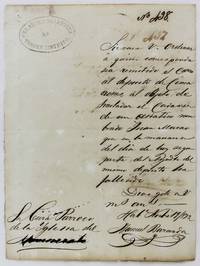
1872rif. 3066Havana 1872. Very good. Manuscript form approximately 8.5 x 6.25 inches. Minor wear at edges; a few small worm holes. Contemporary ink stamp. Light tanning and offsetting. This 1872 manuscript form from a Havana jail the Celaduria de la Punta notes the death there of an "Asiatico" a Chinese indentured servant with the given name of Juan Macao and orders the transfer of the body to the mortuary for cremation. Indentured servants found themselves jailed for several reasons including suspicion of theft and other crimes recapture following runaway or mere suspicion of abandoning a contract. unknown books
1899rif. 5378Puerto-Principe Cuba: Imp. el Progreso-Soledad January 11 1899. Good. Broadside 11.75 x 8.25 inches. Old folds minor chip at top left corner uniformly tanned and somewhat tender. An unrecorded general order issued in Spanish by the American "Jefe de Estado Mayor" Chief of Staff John E. McMahon during the military occupation of Cuba in the Spanish-American War. The order stipulates that a paragraph in a previous order prohibiting the auction of mortgaged property in the province of Puerto-Principe until January 1 1900 is hereby repealed and any further instructions on this matter will come from the Army's General Headquarters in Havana. McMahon issued several general orders during the American Army's occupation of Cuba and all appear to be rare. An interesting artifact from America's expansionist period with no other copies in OCLC auction history or the trade. Imp. el Progreso-Soledad, January 11 unknown