MONTANER. Carlos Alberto.MareMagnum

2.533 Ergebnisse
Barcelona, Ediciones 29, 1972. 4to.; 209 pp. 1 h. Cubiertas originales.
1975Mm 130x215 Volume nella sua brossura originale, 356 pagine. Opera in buone condizioni, presenta una piccola etichetta di biblioteca dismessa alla prima carta. Spedizione in 24 ore dalla conferma dell'ordine.
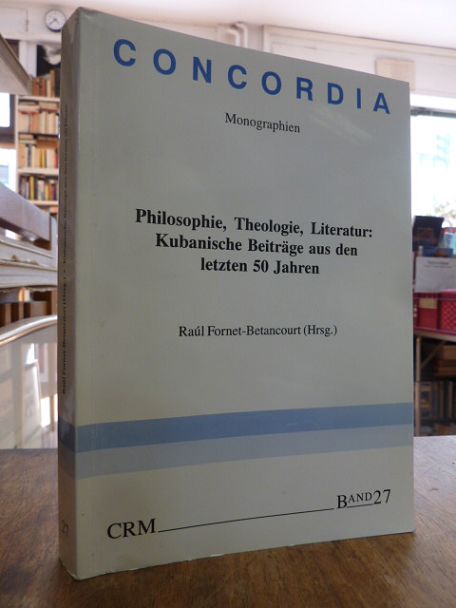
1999Best.-Nr. 30338ABAachen, Wissenschaftsverlag Mainz (= Concordia / Reihe Monographien = Serie monografías, CRM, Band 27), 1999. 8°, 382 S., original Kartonage (Paperback), wenige Seiten zu Beginn mit einigen gelben Farbmarkerunterstreichungen, sonst ein schönes, sauberes Exemplar (K36)
1900Best.-Nr. 50718- Photographie 4 x 7, 5 cm. Notice biographique collée au dos.
1900Best.-Nr. 52322- Photographie 4 x 7, 5 cm collée sur carton.
1900Best.-Nr. 53606- Photographie 4 x 7, 5 cm. Notice biographique collée au dos.
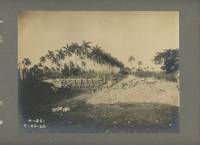
1906Best.-Nr. List3021La Habana Province Republic of Cuba 1906. Twenty-two photographs measuring 7 ¼ x 9 ½ inches mounted on heavy cardstock measuring 10 x 12 inches. Photos numbered and dated on negative. In album embossed with “Havana Central Railroad Co./ Progress Photographs/ GUANAJAY”. Photos with fine contrast and some wear; mounts with minor damage slightly warped with some detached from binding. Overall excellent. Havana Central Railroad Company was an American company formed in April 1905. It opened two electric tram lines—Havana to Guanajay in 1906 and Havana to Güines in 1907—before it was bought by the English company United Railways following the Panic of 1907. Offered here is a photo album showing the construction of the Guanajay line. The photographs show laborers assisted by horse-drawn carts digging culverts laying tracks and erecting bridges and buildings. This project came on the heels of the successful efforts of the Cuba Company another railroad company to make the emerging Cuban Republic amenable to American business.They did so first by using ‘revocable permits’ which could ostensibly be revoked by the new government when it was formed to circumvent the Foraker Amendment prohibiting concessions to American companies by the US’s military government; and second by using their close relationships to several members of the Cuban Constitutional Convention to include a law allowing irrevocable permits.1 These along with the Platt Amendment and Governor Leonard Wood’s General Railway Law led to what would amount to domination by US interests in Cuba particularly but not exclusively in the railroad industry.2 Of interest to scholars of the early Republic of Cuba especially the history of US businesses in the country. 1 Juan C. Santamarina “The Cuba Company and the Expansion of American Business in Cuba 1898–1915” The Business History Review 74 no. 1 Spring 2000: 41–83. 2 Louis A. Pérez Jr. “Insurrection Intervention and the Transformation of Land Tenure Systems in Cuba 1895–1902” Hispanic American Historical Review 65 no. 2 1985: 229–254. unknown
1906Best.-Nr. List3021La Habana Province Republic of Cuba 1906. Twenty-two photographs measuring 7 ¼ x 9 ½ inches mounted on heavy cardstock measuring 10 x 12 inches. Photos numbered and dated on negative. In album embossed with “Havana Central Railroad Co./ Progress Photographs/ GUANAJAY”. Photos with fine contrast and some wear; mounts with minor damage slightly warped with some detached from binding. Overall excellent. Havana Central Railroad Company was an American company formed in April 1905. It opened two electric tram lines—Havana to Guanajay in 1906 and Havana to Güines in 1907—before it was bought by the English company United Railways following the Panic of 1907. Offered here is a photo album showing the construction of the Guanajay line. The photographs show laborers assisted by horse-drawn carts digging culverts laying tracks and erecting bridges and buildings. This project came on the heels of the successful efforts of the Cuba Company another railroad company to make the emerging Cuban Republic amenable to American business.They did so first by using ‘revocable permits’ which could ostensibly be revoked by the new government when it was formed to circumvent the Foraker Amendment prohibiting concessions to American companies by the US’s military government; and second by using their close relationships to several members of the Cuban Constitutional Convention to include a law allowing irrevocable permits.1 These along with the Platt Amendment and Governor Leonard Wood’s General Railway Law led to what would amount to domination by US interests in Cuba particularly but not exclusively in the railroad industry.2 Of interest to scholars of the early Republic of Cuba especially the history of US businesses in the country. 1 Juan C. Santamarina “The Cuba Company and the Expansion of American Business in Cuba 1898–1915” The Business History Review 74 no. 1 Spring 2000: 41–83. 2 Louis A. Pérez Jr. “Insurrection Intervention and the Transformation of Land Tenure Systems in Cuba 1895–1902” Hispanic American Historical Review 65 no. 2 1985: 229–254. unknown books
1896Best.-Nr. 100758Havana (Havanna), Edwin W. Wilson, o.J. (um 1896). 48 unpag. S. Mit 24 ganzseitigen s/w Abbildungen. Quer-Kl.-4°. Lwd. d. Z. mit mont. hs. Deckelschild u. eingeb. OU. mit goldgepr. Umschlagtitel.
1949Best.-Nr. LFA-126711332N° 18 - 1er mai 1949 - Hebdomadaire de 8 pages, format 260 x 320 mm, illustré de bandes dessinées en couleurs et en noir, bon état
1949Best.-Nr. LFA-126711333N° 20 - 15 mai 1949 - Hebdomadaire de 8 pages, format 260 x 320 mm, illustré de bandes dessinées en couleurs et en noir, bon état
1949Best.-Nr. LFA-126711334N° 21 - 22 mai 1949 - Hebdomadaire de 8 pages, format 260 x 320 mm, illustré de bandes dessinées en couleurs et en noir, bon état
1949Best.-Nr. LFA-126711335N° 22 - 29 mai 1949 - Hebdomadaire de 8 pages, format 260 x 320 mm, illustré de bandes dessinées en couleurs et en noir, bon état
1949Best.-Nr. LFA-126711336N° 23 - 5 juin 1949 - Hebdomadaire de 8 pages, format 260 x 320 mm, illustré de bandes dessinées en couleurs et en noir, bon état
192719x12. 338p. Lomo algo deteriorado. Primera Edición.
192719x12. 338p. Lomo algo deteriorado. Primera Edición.
1989Best.-Nr. 8193Colorado Springs Colo: Colorado Springs Fine Arts Center 1989. Softcover. VG fresh and tight clean with seveal small stamps from previous owner. Appears unused. Quarto. Softcover. BW & color illus. glossy wraps. 196 pp. 59 bw 65 color plates. Issued in conjunction with a series of 1989 exhibitions. The first study of this important school and the artists' colony which developed around it. Text by Stanley L. Cuba and Elizabeth Cunningham. Includes biographical sketches of artists including the following: Barrett Biddle Warren Chappell Eduardo Chavez Davey Dehn Laura Gilpin Yasuo Kuniyoshi Ernest Lawson Doris Lee Lockwood Mechau Robinson Sandzen and others. Wonderful illustrations extensive text. Colorado Springs Fine Arts Center paperback books
Best.-Nr. 33282London, Bernhard Shapero Rare Books, o. J. 4°, 104 S.; Catalogue edited by Daniel Crouch; in englischer Sprache Bezahlung per PayPal möglich, we accept PayPal, eine unt. Ecke angeknickt, sonst min. Gebr.sp., kartoniert
Best.-Nr. 48240Barcelona Fundacio Joan Miro 1978 in 8 (25x20) 1 volume broché, couverture illustrée en couleurs, 51 pages, avec de nombreuses illustrations en noir et blanc, et en couleurs. Bel exemplaire ( Photographies sur demande / We can send pictures of this book on simple request )
1901Best.-Nr. 2221928First edition. Small octavo. Illustrated with b/w photos by V.K. Van De Venter Robin H. Ford John H. Rising L.E. Mayo and W.G. Spiker. Original grey pictorial cloth stamped in gilt black and green. No dust jacket. Very good small crack at rear joint. 220 pages 3 pages of ads. No signatures or bookplates. Scarce. The Rumford Press hardcover
1901Best.-Nr. 2221928First edition. Small octavo. Illustrated with b/w photos by V.K. Van De Venter Robin H. Ford John H. Rising L.E. Mayo and W.G. Spiker. Original grey pictorial cloth stamped in gilt black and green. No dust jacket. Very good small crack at rear joint. 220 pages 3 pages of ads. No signatures or bookplates. Scarce. The Rumford Press hardcover books
1925Milano, 1925, stralcio con copertina posticcia muta, pp. 781/784 con 3 fotografie. - !! ATTENZIONE !!: Con il termine estratto (o stralcio) intendiamo riferirci ad un fascicolo contenente un articolo, completo in se, sia che esso sia stato stampato a parte utilizzando la stessa composizione sia che provenga direttamente da una rivista. Le pagine sono indicate come "da/a", ad esempio: 229/231 significa che il testo è composto da tre pagine. Quando la rivista di provenienza non viene indicata é perché ci è sconosciuta. - !! ATTENTION !!: : NOT A BOOK : “extract” or “excerpt” means simply a few pages, original nonetheless, printed in a magazine. Pages are indicated as in "from” “to", for example: 229/231 means the text comprises three pages (229, 230 and 231). If the magazine that contained the pages is not mentioned, it is because it is unknown to us.
Best.-Nr. CUBA I/9Editorial en marcha, La Havane, Cuba, 1961 (Année de l'Education), 15 x 20,5, 80 pages agrafées. Comparution du Docteur Fidel Castro Ruiz - Premier ministre du gouvernement révolutionnaire - à la transmission spéciale télévisée de l'Université populaire, pour informer le peuple sur l'invasion des mercenaires, dimanche 23 avril 1961. Introduction de Ricardo Alarçon.
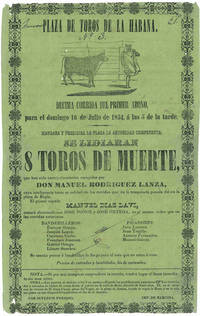
1854Best.-Nr. 46994Havana. 1854. A Bullfighting Broadside from Cuba in 1854 Cuban broadside advertising a bullfight featuring matador Don Manuel Rodriguez Lanza and the "8 toros de muerte." The top of the sheet features a woodcut of a matador holding his cape out to a bull. The first swordsman for the fight is Manuel Diaz Lavi with two alternates listed. The names of the Banderilleros and Picadores for the fight are also noted. Bullfighting was a popular entertainment in Cuba during the Spanish colonial period though it was done away with after Cuban independence at the beginning of the 20th century. Broadside 12½ × 8 inches. Printed on green paper. Old fold lines. Light wear and soiling minor separation at some folds. A few contemporary notations. Very good. unknown