AA.VVMareMagnum

2538 risultati
1900AA.VV 1983. Numero especial. , Universad de La Habana 1900, Condizioni mediocri: copertina sporca con segni di usura ai margini, dorso con segni di usura, tagli ingialliti, pagine ingiallite, scritte a matita all'interno del libr Mediocre (Poor) . 238
1967rif. 99947042Maspero Maspero, 1967. In-8 broché de 271 pages. Bon état.
1967Maspero 1967, In-8 broché 271 p. Bon état.
1967rif. 139905Couverture souple. Broché. 271 pages.
1820rif. 7589AHavana, Kuba, 1820. 21 x 29 cm. 3 Seiten.
1981rif. 86364Havana Cuba: Political Publishers 1981. Presumed First Edition First printing. Hardcover. Good/Good. 116 4 pages. Index. Among the topics addressed in the Index are Socioeconomic Developments Revolutionary Armed Forces Social Organizations Ministry of the Interior Union of Young Communists Communist Party Ideological Struggle Foreign Policy and Economics. Fidel Alejandro Castro Ruz 13 August 1926 - 25 November 2016 was a Cuban revolutionary and politician who was the leader of Cuba from 1959 to 2008 serving as the prime minister of Cuba from 1959 to 1976 and president from 1976 to 2008. Ideologically a Marxist-Leninist and Cuban nationalist he also served as the first secretary of the Communist Party of Cuba from 1965 until 2011. Under his administration Cuba became a one-party communist state; industry and business were nationalized and socialist reforms were implemented throughout society. On January 20 1981 Fidel Castro gave the closing speech at the Communist Party of Cuba's second Congress held from January 17-20. He addressed almost 150 foreign delegations representing pro-Soviet communist parties liberation movements and even some social democratic parties of the Socialist international as well as more than a million Cubans. This fact alone is a measure of the prestige which the CPC has among many political trends and working people around the world. But the economic situation in Cuba brought to light during the congress and the path which Castro is proposing to the peoples struggling against imperialism give food for thought and should lead us to question the supposedly revolutionary path which Castro claims to be defending. One of the main concerns of the congress was the economic situation in Cuba. Despite an overall situation envied by many of the peoples dominated by U.S. imperialism the main report presented by Castro revealed that the objectives of the 5-year plan adopted at the First Congress in 1975 were not attained. Economic growth reached only 4% despite an objective of 6% and the industrialization plan met with difficulties. These results are of some importance since the objectives set at the last congress were consciously modest. Given this situation the Second Congress underlined the need for increased mobilization in production and stepped up plans to implement the new system to manage the economy which was first adopted at the First Congress. At the time this system was presented as an answer to the idealist errors of the 1965-70 period when it was claimed that all forms of market economy had abruptly been eliminated. The system clearly draws inspiration from the experience of the economic reforms introduced in the U.S.S.R. by Khrushchev in the early sixties which are judged as positive. These reforms underlined the importance of "the law of value the necessity that in all enterprises including State enterprises there are buy and sell relations and that within these relations the market categories function as indispensable instruments for measuring the use we make of our productive resources. in order to decide which investments are the most advisable and to know which enterprises.work the best.". Political Publishers hardcover
rif. Cub7Hbk 421pp blue cloth boards with gilt titles no dj as issued now in custom acetate jacket an excellent clean tight unmarked copy as new Havana: Political Publishers, 1981, hardcover
1978Political edition. VG pbk. 15561. eng
1962Un volume (22,5 cm) di 191 pagine, con illustrazioni in nero. In lingua francese. Brossura editoriale con foto di Fidel.
rif. 163153 handwritten documents in ink regarding the sale of slave girls in Cuba. The documents are written in Spanish and include details such as purchase price age and names of the girls being sold. Documents are large: 12 ½ x 8 ¾ in. Some shadows from storage with other documents paper acidification from ink. Some losses from ink acidification and wormholes. Marks from previous binding along left edge. Sale documents are numbered at bottom of pages with signatures and all have stamp from Cuban government. Good condition. One of the documents includes the year 1875 dating some of these papers to the dwindling years of the slavery in Cuba which was officially outlawed in 1886. unknown books
rif. Suojoki, SaaraIn Pristine Condition. unknown
rif. Frimodt, LisbethIn Pristine Condition. unknown
2003rif. 017614Madrid Spain: Centro de Arte Contemporaneo Wifredo Lam 2003. Book. Very good condition. Paperback. First Edition. Octavo 8vo. 431 pages of text. Paperback binding with a minor crease to the spine. The text is clean and unmarked. Profusely illustrated in full color. Text is in Spanish. Art museum located in La Habana or Havana Cuba. First edition. Centro de Arte Contemporaneo Wifredo Lam Paperback
2003rif. 017614Madrid Spain: Centro de Arte Contemporaneo Wifredo Lam 2003. Book. Very good condition. Paperback. First Edition. Octavo 8vo. 431 pages of text. Paperback binding with a minor crease to the spine. The text is clean and unmarked. Profusely illustrated in full color. Text is in Spanish. Art museum located in La Habana or Havana Cuba. First edition. Centro de Arte Contemporaneo Wifredo Lam Paperback books
rif. 27053Dimensions (à vue) : 293 x 188 mm + passe-partout.
1936In-8°. 14 pp. Tavole fotografiche. Brossura editoriale.
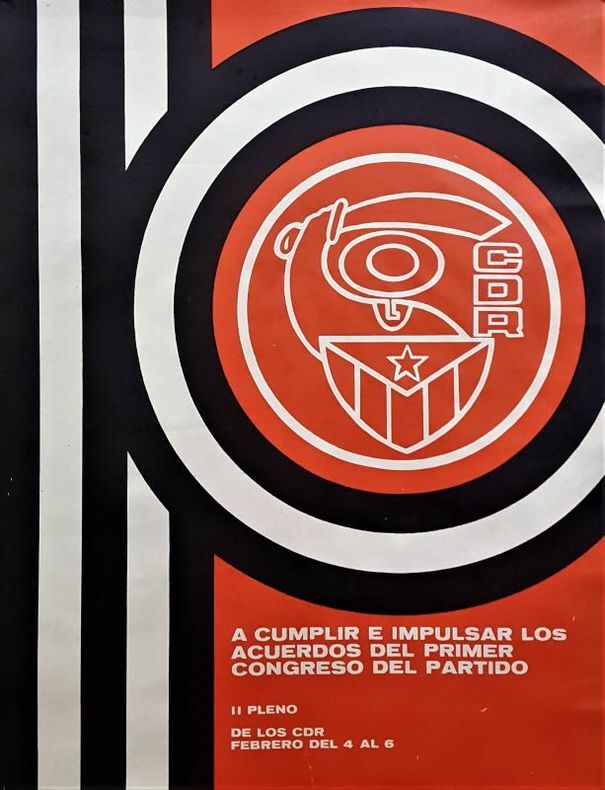
rif. 1440Impression en offset. ca.1970. Dim: 70 x 53 cm
rif. 1440Impression en offset. ca.1970. Dim: 70 x 53 cm
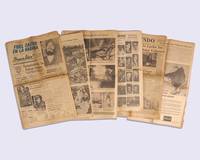
rif. 900066CASTRO'S ARRIVAL IN HAVANA AND THE EARLY DAYS OF THE REVOLUTION CUBA MEXICO AND MIAMI A collection of newspapers spanning the years 1959-1960 Mexico City/Miami Beach: El Mundo Prensa Libre Ultimas Noticias Excelsior 1950-60 A collection of five newspapers each measuring up to 62 x 40cm when fully unfolded; between 8 and 26 pages in length including 'El Mundo' 'Presna Libre' and 'Ultimas Noticias Excelsior' printed mostly in black but with occasional titles in blue; containing numerous black and white photographs of Fidel and Ramon Castro Che Guevara Celia Sanchez Adolfo Lopez Mateos and other members of the Revolution including the execution of Garcia Olayon as well as Richard Nixon J. F. K and other political figures; all newspapers fragile and toned in accordance with age with some splits and chips along folds some loss of text in places; chips to edges and occasional brown spots; one small annotation in blue ink of 'Imogen Browning National Coffee Shop' in Miami; remarkable survivals nonetheless and very good overall. A scarce collection of newspapers which together portray a vivid picture of the turbulent political and social scene towards the end of the 1950s. Articles include 'The Destruction of Santa Clara' and 'With the Rebel Leaders in the Villages' with copious photographs and there are numerous celebratory passages welcoming in Fidel Castro the 'Supreme Leader' and 'Los Gloriosos Heroes de la Revolucion'. There is also a map of the invasion of Cuba and advertisements for children's toys which include automatic pistols army trucks and plastic rockets. All text in Spanish. Please note that these items contain some graphic images unknown
1959Roma, 1959, 1 febbraio, copertina illustrata a colori in fascicolo originale completo di pp. 32 de “La Tribuna Illustrata".
Madrid, Editorial Renacimiento, 1913. 4to.; 308 pp. Cubiertas originales.
1908rif. 228161908. Ober Frederick A. A Guide to the West Indies and Bermudas. New York: Dodd Mead & Company 1908. First edition. First printing. 525 pages with five fold-out color maps and numerous black-and-white photographic illustrations. Original red cloth stamped in gilt as issued with no dust jacket. 8vo. An early 20th-century travel guide reflecting U.S. and European imperial tourism in the Caribbean at the height of American expansion following the Spanish-American War. Ober a prolific writer on the Caribbean and Latin America interweaves geography natural history and colonial ethnography offering a period perspective into the ways tourists imperial authorities and travel publishers framed the predominantly Black Afro-Caribbean and Creole cultures of the region during the Jim Crow era. This guide includes detailed chapters on Cuba Puerto Rico Jamaica Trinidad Barbados Guadeloupe Martinique and dozens of other island territories along with sections on "The Bermudas" "The Lesser Antilles" "The South Coast of Cuba" and "A Glimpse of South America." The contents pages visible here show Ober's systematic movement through the archipelago giving each island a discrete treatment with notes on climate agriculture transportation and colonial governance. As Ober writes in his introduction the West Indies form "a region of infinite variety" a phrase that reflects both genuine admiration and the period's exoticizing tone common to pre-WWI travel literature. The fold-out maps chart shipping routes railways ports and political boundaries at a moment when the United States had recently taken possession of Puerto Rico 1898 and solidified its influence in Cuba and the broader Caribbean basin. Light rubbing to cloth with slight sunning to spine; corners mildly worn. Five fold-out maps complete crisp and clean one with a minor tear near margins. Interior exceptionally bright with no writing or markings; binding tight. Overall very good condition. A well-preserved first printing of an important Caribbean travel guide valuable for scholars of U.S. imperial history Caribbean studies tourism studies and the racial-cultural representation of the West Indies during the early American century. unknown
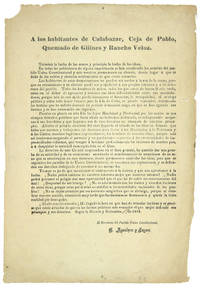
1878rif. WRCAM38237Cuba 1878. Broadside 12 1/2 x 8 3/4 inches. Chip at upper left corner not affecting text. Small tears in all edges several repaired by tape on verso. Good. A rare and fascinating Cuban political broadside calling for an end to armed struggle but a beginning to a "struggle for ideas" at the conclusion of Cuba's "Ten Years' War" the battle for independence from Spain in 1868 to 1878. The broadside is addressed to the residents of the region around the north-central coast of Cuba some 150 miles east of Havana. The text of the broadside is signed in print by Gabriel Aguilera y Zayas Secretary of the Partido Union Constitucional PUC one of the two main political parties that developed out of the Ten Years' War. The PUC which was a conservative pro-Spanish party led by prominent Creoles sought a measure of local political autonomy while favoring continued Spanish control over Cuba. The text exhorts Cubans to partake in the ideological struggle that would succeed the armed rebellion and urges them not to fall into lethargy but to continue the battle of ideas against radicals seeking independence from Spanish colonial rule. Due to their ephemeral nature as well as the climate of the Caribbean any such Cuban broadsides are scarce. No copies of this broadside are located in OCLC. Important evidence of the political factionalism and the strength of pro-Spanish sentiment in Cuba in the late 19th century. Rare and possibly unique. unknown books
1939rif. 141591939. Lausanne Librairie Payot 1939 s.p. - Broché couv. rempliée 16 cm x 22 cm 22 pages - Texte de Armand Godoy envoi de l'auteur - Bon état