2.730 Ergebnisse
1994Best.-Nr. 2-1560007869Transaction Pub 1994. Paperback. New. 1st edition. 176 pages. 9.25x6.25x0.50 inches. Transaction Pub paperback
1985Best.-Nr. PHOT0794London, Zena 1985. 4°. 191 S. mit zahlreichen farb. Abb., OPpbd. m. OU., Vorsatzblatt m. Rückständen eines Klebeetiketts.
2007Best.-Nr. 38485BBChapel Hill, Publishers: The University of South Carolina Press, 2007. Original Flexible Boards. Very good Condition with only minimal Signs of Usage at the Cover. No Markings in the Text! No Underlinings! No private Owner's Note!
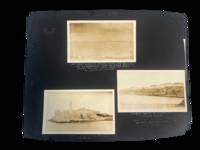
1920Best.-Nr. 227281920. Havana Cuba travel photo album circa 1920s documents an American visitor's encounter with Havana during the interwar years when U.S. tourism commercial presence and Spanish-American War memory shaped how many American travelers interpreted the city. The vernacular photographs record arrival by steamship harbor landmarks civic buildings commercial streets factories boulevards monuments cemeteries and guarded public spaces giving insight into both Havana's urban landscape and the traveler's assumptions about access history and spectacle. The album's references to the USS Maine and Spanish-American War memorials place ordinary sightseeing within a longer history of U.S. intervention in Cuba; the Maine exploded in Havana Harbor on February 15 1898 killing more than 260 sailors and intensifying the crisis that led to war with Spain. Approximately 25 sepia-toned silver gelatin photographs each about 3 x 5 inches mounted to black album leaves with detailed handwritten captions in white pencil. The sequence begins aboard the S.S. Kroonland with one caption reading "My first view of Havana from the deck. three miles out at sea in a dark storm" followed by a landing view captioned "where we landed in Havana Cuba." The S.S. Kroonland returned to Panama Pacific Line service in 1923 on a New York to San Francisco route via Havana the Panama Canal and Los Angeles supporting the album's interwar travel context. The photographs then trace Havana's maritime and civic topography: harbor views Morro Castle captioned "Famous during the Spanish-American War" the waterfront in front of the fortress the Court House the President's Palace a "600-year-old church" the Henry Clay Cigar Store Havana's factory district and public boulevards "where all streets have parks in the center." Other images include a cemetery visit captioned "All people in Cuba are laid to rest above the ground" and a restricted-view street or carriage scene captioned "Officer would not let me take picture but when he turned I took it anyway" a revealing note on tourist privilege and unauthorized looking. Several images directly record the ways American travelers consumed Havana through imperial memory and Cuban nationalist commemoration. One monument is captioned "This was given by the Cuban people to the American soldiers that fell in the Spanish-American War" while another marks "the spot where the Maine sank at the entrance of the harbor." The album was made after Cuba's formal independence in 1902 and during the long aftermath of the Platt Amendment framework under which the United States retained extensive influence over Cuban affairs and intervened repeatedly in the early twentieth century. Album leaves chipped at edges several with corner losses not affecting images; prints generally sharp with strong contrast and clear annotations very good overall. Socially revealing Havana travel album documenting how a U.S. visitor pictured Cuba through steamship tourism colonial architecture cigar commerce Spanish-American War remembrance and the everyday authority structures of an interwar Caribbean capital. unknown books
1920Best.-Nr. 227281920. Havana Cuba travel photo album circa 1920s documents an American visitor's encounter with Havana during the interwar years when U.S. tourism commercial presence and Spanish-American War memory shaped how many American travelers interpreted the city. The vernacular photographs record arrival by steamship harbor landmarks civic buildings commercial streets factories boulevards monuments cemeteries and guarded public spaces giving insight into both Havana's urban landscape and the traveler's assumptions about access history and spectacle. The album's references to the USS Maine and Spanish-American War memorials place ordinary sightseeing within a longer history of U.S. intervention in Cuba; the Maine exploded in Havana Harbor on February 15 1898 killing more than 260 sailors and intensifying the crisis that led to war with Spain. Approximately 25 sepia-toned silver gelatin photographs each about 3 x 5 inches mounted to black album leaves with detailed handwritten captions in white pencil. The sequence begins aboard the S.S. Kroonland with one caption reading "My first view of Havana from the deck. three miles out at sea in a dark storm" followed by a landing view captioned "where we landed in Havana Cuba." The S.S. Kroonland returned to Panama Pacific Line service in 1923 on a New York to San Francisco route via Havana the Panama Canal and Los Angeles supporting the album's interwar travel context. The photographs then trace Havana's maritime and civic topography: harbor views Morro Castle captioned "Famous during the Spanish-American War" the waterfront in front of the fortress the Court House the President's Palace a "600-year-old church" the Henry Clay Cigar Store Havana's factory district and public boulevards "where all streets have parks in the center." Other images include a cemetery visit captioned "All people in Cuba are laid to rest above the ground" and a restricted-view street or carriage scene captioned "Officer would not let me take picture but when he turned I took it anyway" a revealing note on tourist privilege and unauthorized looking. Several images directly record the ways American travelers consumed Havana through imperial memory and Cuban nationalist commemoration. One monument is captioned "This was given by the Cuban people to the American soldiers that fell in the Spanish-American War" while another marks "the spot where the Maine sank at the entrance of the harbor." The album was made after Cuba's formal independence in 1902 and during the long aftermath of the Platt Amendment framework under which the United States retained extensive influence over Cuban affairs and intervened repeatedly in the early twentieth century. Album leaves chipped at edges several with corner losses not affecting images; prints generally sharp with strong contrast and clear annotations very good overall. Socially revealing Havana travel album documenting how a U.S. visitor pictured Cuba through steamship tourism colonial architecture cigar commerce Spanish-American War remembrance and the everyday authority structures of an interwar Caribbean capital. unknown
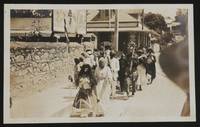
Best.-Nr. PD19Oblong Folio album ca. 285x36 cm. 49 black paper album leaves. With ca. 260 mounted gelatin silver photographs of various size including ca. 20 large photos from ca. 245x32 cm 9 ½ x 12 ½ in to ca. 155x225 cm 6 x 8 ¾ in and 21 panoramas ca. 85x29 cm 3 ¼ x 11 1 /2 in or slightly smaller. The rest of the photos are from ca. 12x17 cm 4 ¾ x 6 ¾ in to ca. 4x6 cm 1 ½ x 2 ¼ in; most photos are ca. 8x14 cm 3 ¼ x 5 ½ in. No captions. About twenty photos with period ink notes “D.K.M. 10” in the corners. Period style black half morocco with cloth boards; decorative gilt-tooled borders on both boards and spine. Album leaves brittle several with tears and losses on extremities two large photos with tears and losses on extremities two small photos with losses of one corner each one photo has been apparently previously removed a few photos smildly faded or with mild silvering but overall a very good album of interesting photos. Historically significant album with lively amateur snapshots and original studio photos taken and collected by a family of American tourists during a Caribbean cruise in the early 1910s onboard the steamship “Moltke” of the Hamburg America Line Hamburg-Amerikanische Packetfahrt-Aktien-Gesellschaft or HAPAG. Launched in 1901 S.S. “Moltke” went on regular cruises around the Caribbean and the Mediterranean until it was seized by Italy in 1915 in the course of WW1. Her Caribbean or West Indies cruises departed from New York and included stops in Cuba Puerto Rico Jamaica Panama Canal Venezuela Trinidad Barbados Martinique St. Thomas Dutch West Indies Bermuda & Bahamas. The album opens with several large views and panoramas of Havana harbour and waterfront featuring Castillo del Morro the iconic building of Lonja del Comercio commodities and stock exchange and S.S. “Moltke.” The other photos show Havana streets and passers-by the interior of a Catholic church &c. Over twenty photos are the views of the city and harbour of Charlotte Amalie on St. Thomas Island – then the capital of the Danish West Indies since 1917 the U.S. Virgin Islands. The images show the city harbour from the distance and close-up a sign of “St. Thomas Bay & Rum Co.” is seen on one of the photos the statue of King Christian IX erected in the Emancipation Garden in 1909 removed in 2021 streets residential neighbourhoods on sloping hills a local market an official residence with the waving Danish flag garden of a Catholic convent with one of the monks posing alone and with a young tourist &c. Over thirty identified views of Puerto Rico a U.S. colony since 1898 a Commonwealth controlled by the U.S. since 1952 show San Juan: Plaza de Armas with the City Hall completed in 1842 Palacio de la Real Independencia now housing the Department of State of Puerto Rico Castillo San Felipe del Morro in the San Juan Bay Plaza Colon with Christopher Columbus monument San Juan harbour city streets and shops building of the “Hotel y Banos” a passenger train with the travellers walking at the front native cart drivers passers-by &c. A large group of photos ca. sixty depict the French Island of Martinique with a series of views of Fort-de-France: statues of Empress Josephine erected in 1859 destroyed in 2020 and Victor Schloelcher erected in 1904 removed in 2020 St. Louis Cathedral with the spire still under construction city streets and harbour “Hotel de l’Europe” distinctive cliffs on the coast near Fort-de-France &c. The views of Martinique include over twenty images of the ill-fated town of St. Pierre which perished during Mount Pelee’s eruption in May 1902. The photos include one view of St. Pierre before the destruction as well as general views of the ruins and desolation with posing tourists. Several images show the ruins of the Co-Cathedral of Our Lady of Assumption the downtown core with a grid of destroyed buildings and charred trees wrecked ships in the harbour a surviving bridge and the remains of the victims. A couple of images feature the top of Mount Pelee with a distinctive lava spine or the “Needle of Pelee” which was formed in October 1902 and collapsed in March 1903. Among the identified photos of Nassau Bahamas are the views of the famous silk cotton tree St. Matthews Anglican church completed in 1802 and the interior of Fort Charlotte. The other images show sugar cane plantations and native workers Caribbean residences streets and markets ports the American coastal steamer “Colonia” a series of scenes from a street carnival procession portraits of local market goers families diving children &c. Several images portray the tourists on board the S.S. Moltke including a group portrait with a lifebuoy of “Moltke Hamburg”. Overall a historically significant visual source on the history of American tourism to the Caribbean in the early 20th century with interesting views of the aftermath of the destruction of St. Pierre by the volcanic eruption. hardcover
Best.-Nr. 0483788252.Gpaperback. Good. Access codes and supplements are not guaranteed with used items. May be an ex-library book. paperback
Best.-Nr. 0483788457.Ghardcover. Good. Access codes and supplements are not guaranteed with used items. May be an ex-library book. hardcover
1941pp. xi, 498 + folding map. 8vo. Original full cloth binding. Original dust jacket, worn. Hardbound. Second printing. LATIN AMERICA BOX 1.
Best.-Nr. 0428831729.Ghardcover. Good. Access codes and supplements are not guaranteed with used items. May be an ex-library book. hardcover
Best.-Nr. 0656886277.Ghardcover. Good. Access codes and supplements are not guaranteed with used items. May be an ex-library book. hardcover
1980Best.-Nr. 157147La Habana: Ministerio de Cultura 1980. First edition presumed. Paperback. Used; Very Good. 4to large wrps 478 p. index boards. Comprehensive annotated bibliography of Cuban periodical publications. Includes title subject and author indices. Ministerio de Cultura paperback
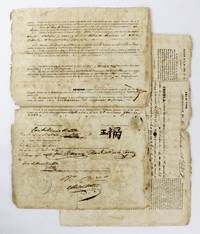
1863Best.-Nr. 6222Havana 1863. Good. Two partially printed broadsheets completed in manuscript 13 x 9 inches. Old folds wear at edges; some light worming slightly affecting text. Lightly soiled. A pair of documents recording the indenture of a Chinese national in Havana. The present documents contract the "Asiatico Francisco" as a cook to Don Jose Antonio Battle y Olle; the contract is dated June 28 1861 and is signed by "Francisco" in Chinese characters for a term of two years. At the end it is noted in manuscript that the Asiatico Francisco has completed the two years of his contract. The cedula is dated 1863 and indicates that Francisco is 33 years of age and now indentured for eight years as a "cocinero." An interesting pair of documents showing the continuing servitude of imported Chinese laborers particularly attractive for being signed in Chinese characters. unknown books
1863Best.-Nr. 6222Havana 1863. Good. Two partially printed broadsheets completed in manuscript 13 x 9 inches. Old folds wear at edges; some light worming slightly affecting text. Lightly soiled. A pair of documents recording the indenture of a Chinese national in Havana. The present documents contract the "Asiatico Francisco" as a cook to Don Jose Antonio Battle y Olle; the contract is dated June 28 1861 and is signed by "Francisco" in Chinese characters for a term of two years. At the end it is noted in manuscript that the Asiatico Francisco has completed the two years of his contract. The cedula is dated 1863 and indicates that Francisco is 33 years of age and now indentured for eight years as a "cocinero." An interesting pair of documents showing the continuing servitude of imported Chinese laborers particularly attractive for being signed in Chinese characters. unknown
1969In-8 (cm. 21), brossura, pp. 243, (11). Prima edizione italiana. In buono stato di conservazione (good copy).
19698°, BROSSURA CON ALI IN ALCUNE PARTI BRUNITA (A. KLINZ E G. CARRER), PG. 243 (13), TRAD. DI V. DI GIURO, BUONO STATO. PRIMA EDIZIONE. (C)
1969In 8°, br. edit. con ali., pp. 243,(13). Prima edizione Maggio 1969, copia molto buona. (S04/B) (La spedizione standard è SEMPRE tracciata con raccomandata - piego di libri, eventuale FATTURA da richiedere all'ordine) (S04/B)
1969DISPONIBILITÀ GARANTITA AL 99%; SPEDIZIONE ENTRO 12 ORE DALL'ORDINE. OTTIME CONDIZIONI, MAI SFOGLIATO, LIEVI SEGNI DEL TEMPO, MACCHIETTE/FIORITURE SPARSE; TIMBRO DI BIBLIOTECA ESTINTA IN ANTIPORTA. Dalla quarta di copertina. Dove ci accadrà di incontrare ancora il personaggio-uomo? L’affettuoso incantesimo che, nei romanzi del’Ottocento, ci rendeva cari e familiari i personaggi, sembra finito per sempre. La narrativa contemporanea spesso non sa, o non può, offrirci più di referti clinici, detriti di naufraghi, talismani da supermarket. Essa delude un nostro antico bisogno: quella di conoscere la vita concreta degli altri, il mondo quotidiano della famiglia che, turisti ignoranti e patetici, abbiamo intravisto fuggevolmente intorno a un lume in una casa di campagna, il giro di pensieri dietro i volti che sfioriamo tra la folla di una città. (...). Descrizione bibliografica Titolo: Indagine su un villaggio cubano Titolo originale: In the Fist of the Revolution: Life in Castro's Cuba Autore: José Yglesias Traduzione di: Vittorio Di Giuro Copertina di: Anita Klinz, Guido Carrer Editore: Milano: il Saggiatore di Alberto Mondadori, 1969 Lunghezza: 243 pagine; 22 cm Collana: Volume 4 di Indagini Soggetti: Cuba, Mayari, Reportage, Rivoluzione cubana, Baia dei Porci, Riforma agraria, Fidel Castro, Barbabietola da zucchero, Fabbriche, Vita quotidiana, Abitanti, Lavoratori, Nicaro, Nichel, Raul Castro, Cicloni, Famiglie, Storia locale, Campesinos, Operai, Rhum, Comunità rurali, Ideologie politiche, Disgustados, Bitiri, Enfermedad, Machismo, Cultura, Contadini, Donne, Uomini, Comunismo, Che Guevara, Americani, Carretera central, Holguin, Santa Clara, Santiago, Avana, Biografie, Esperienze, Anni Sessanta, Libri Vintage, Organizzazione, Controrivoluzionari, Oppositori, Caraibi, America centrale, Cuban Revolution, Bay of Pigs, Land Reform, Sugar Beet, Factories, Daily Life, Inhabitants, Workers, Nicar, Nickel, Cyclones, Families, Local History, Workers, Rural Communities, Political Ideologies, Disgustados, Culture, Peasants, Women, Men, Communism, Americans, Biographies, Experiences, Sixties, Vintage Books, Organization, Counterrevolutionaries, Opponents, Caribbean, Viaggio, Travel, Voyage Parole e frasi comuni Administracion American Angela Argelio Bitiri Brooklyn campesino canefields CDR's Chepi coffee Communist companeros counterrevolutionaries Cuba Cuban cane desk dining room doctor explained eyes father Fidel friends Gallego girl Granda Guatemala Havana Holguin Hortencio hospital Hurricane Flora husband Jaime Hernandez jeep Jose judge laughed Leyte Vidal Listen Luisa Margarita married Mayari Mella months morning Moro mother Naranjal Negro Nicaro night Orden Publica Party Pinares Playa Rebelde Revolution revolutionary Robertico Rubio Sapito shook Sierra Maestra Soni street Sugar tetracycline things thought town UMAP United Fruit Company Ventura waiting week wife woman women workers young
1969Mm 155x210 Prima edizione. Collana "Indagini" - Brossura editoriale con bandelle, 243 pagine. Dorso brunito appena, peraltro opera in condizioni eccellenti, ovvero mai letta. SPEDIZIONE IN 24 ORE DALLA CONFERMA DELL'ORDINE.
1960Roma, 1960, 9 febbraio, copertina illustrata a colori in fascicolo originale completo di, pp. 32 de "La Tribuna illustrata" .
1902Best.-Nr. ZB387526Washington: GPO 1902. 11 pp issued as 57th Congress 1st Session SD 363; light extraction roughness at spine now disbound in self wrappers. - If you are reading this this item is actually physically in our stock and ready for shipment once ordered. We are not bookjackers. Buyer is responsible for any additional duties taxes or fees required by recipient's country. Washington: GPO, unknown
1985Best.-Nr. 5111Wuppertal, Peter Hammer Verlag, 1985. 8°, 386 S., Hammer TB 33 Bräunung des OS, sonst gutes Ex kartoniert/ Taschenbuch
1932Milano, 1932, 8vo stralcio con copertina posticcia muta, pp. 39/44 con 10 illustrazioni fotografiche. - !! ATTENZIONE !!: Con il termine estratto (o stralcio) intendiamo riferirci ad un fascicolo contenente un articolo, completo in se, sia che esso sia stato stampato a parte utilizzando la stessa composizione sia che provenga direttamente da una rivista. Le pagine sono indicate come "da/a", ad esempio: 229/231 significa che il testo è composto da tre pagine. Quando la rivista di provenienza non viene indicata é perché ci è sconosciuta. - !! ATTENTION !!: : NOT A BOOK : “extract” or “excerpt” means simply a few pages, original nonetheless, printed in a magazine. Pages are indicated as in "from” “to", for example: 229/231 means the text comprises three pages (229, 230 and 231). If the magazine that contained the pages is not mentioned, it is because it is unknown to us.