Guillen NicolasMareMagnum
Sinclair (Andrew).MareMagnum
Guevara.
1970Un volume broché au format poche de 144 pp.; couverture illustrée. Couverture insolée en marge; sinon parfait état. Voir photo.

Sciardet Daniel · France8,00 €
2 642 résultats
1963Guillen Nicolas Guillen Nicolas. Elegia a Jesus Menéndez. Associazione Italia-Cuba 1963.. Torino, Associazione Italia-Cuba 1963 multilingual, in ottavo pp. 85 13100 Guillen Nicolas. Elegia a Jesus Menéndez. Associazione Italia-Cuba 1963. In-8. 85 pp. Brossura. Molto buono. Testi in spagnolo e italiano.
1925réf. 7552ABoston, Houghton, 1925. Kl.8°. CCXLIX, 595 S. und umfangreicher, ill. Werbeanhang. Mit 2 Karten und 27 Plänen. OLn. mit Deckel- und RVg. Vergoldung verblichen.
1995256pp., avec illustrations en couleurs, 22cm., reliure cart. d'éditeur, bon état, V95260
1992256pp., with illustrations in colour, text in Spanish, 22cm., publisher's hardcover, good condition, V95259
1992réf. V95259, Planeta/ Gérard Père et Fils 1992 256pp., with illustrations in colour, text in Spanish, 22cm., publisher's hardcover, good condition, V95259
1995réf. V95260, Planeta/ Gérard Père et Fils 1995 256pp., avec illustrations en couleurs, 22cm., reliure cart. d'éditeur, bon état, V95260
1970Un volume broché au format poche de 144 pp.; couverture illustrée. Couverture insolée en marge; sinon parfait état. Voir photo.
Madrid, Editora Nacional, 1974. 4to.; 256 pp., 1 h. Cubiertas originales.
1898Veduta notturna dello sbarco delle truppe americane il 22 giugnon nei pressi di Santiago di Cuba. Testo al retro
197118,5x11,5. 139p. Segunda Edición. Col. Ediciones de Bolsillo. Serie Narrativa.
La Habana, Ediciones Unión de Escritores y Artistas de Cuba, 1963. 4to.; 155 pp., 2 hs. Primera edición cubana. Cubiertas originales.
19708vo., First Edition, with plates and maps; red cloth, gilt back, a near fine copy in price-clipped, very lightly sunned dustwrapper. VERY SCARCE, ESPCIALLY IN THIS CONDITION.
1968réf. 22628CBBerlin, Wagenbach (= Rotbuch-Taschenbuch 9), 1968. 8°, 158 S., farbig illustr. original Kartonage (Paperback), deutsche Erstausgabe Einband ein wenig berieben und minimal fleckig, Seite 145 bis 148 oben mit Eckknickspur, sonst gutes, sauberes Exemplar
1986Coautor Jorge Ronet. Película en la que los autores consiguen adentrarse y adentrarnos en la laberíntica temática del hombre cubano, el hombre nuevo, el hombre cualquiera y siempre, antes y después de la revolución, donde quiera. Un libro analítico, lleno de inteligencia, humanidad y humor.
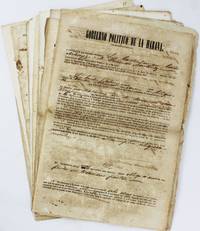
1869réf. 5608Various places in Cuba including Bejucal Havana Matanzas & Sagua la Grande 1869. Good plus. Sixteen broadside broadsheet and bifolium forms completed in manuscript. Previously folded with some short separations along old folds; one longer closed tear from lower left corner of one form. Some chipping and wear at edges not affecting text. Contemporary ink stamps. Varying degrees of tanning and foxing. A group of sixteen contracts for Chinese indentured laborers in Cuba executed during the 1860s. The importation of Chinese labor to Cuba began in earnest in 1853 and in 1860 a law passed by the colonial government essentially enjoined Chinese workers to renew their agreements. The forms present here are sixteen such contract renewals signed by Chinese workers who had completed their initial term of indentured servitude but had no recourse to fairer forms of employment or means to leave the island. "The new law required a change in the contract that required coolies who completed their original term of service to recontract with the same or another master. Otherwise they were obligated to leave Cuba within two months. There is no doubt that the Cubans issued the recontracting regulation in order to keep as many as possible of this captive alien labor force on the plantations knowing full well that very few of the coolies could have saved enough from their meager wages to pay for their passage home" - Hu-DuHart. The present group dating from 1862 to 1869 includes five renewals from Havana; four from Matanzas; three from Colon; two from Guanabacoa; and one apiece from the towns of Sancti Spiritus and Sagua la Grande. Each form gives the adopted Spanish name of the laborer his age place of birth the new and old masters in some cases the same and the duration of the new indenture from six months to two years. The forms also state that the laborers are signing fresh contracts in compliance with the law of 1860 and give the terms for worker and employer including daily hours to be worked amount of food provided weekly shelter if any and meager salaries amongst other stipulations. One contract is signed in Chinese but the preponderance are signed by "witnesses" or "interpreters" for the workers. Fascinating primary documents of the exploitative Chinese labor system in Cuba during the mid-19th century. Elizabeth Hu-Duhart "Chinese Coolie Labor in Cuba in the Nineteenth Century" Contributions in Black Studies 12 1994 pp. 43-46. books
1869réf. 5608Various places in Cuba including Bejucal Havana Matanzas & Sagua la Grande 1869. Good plus. Sixteen broadside broadsheet and bifolium forms completed in manuscript. Previously folded with some short separations along old folds; one longer closed tear from lower left corner of one form. Some chipping and wear at edges not affecting text. Contemporary ink stamps. Varying degrees of tanning and foxing. A group of sixteen contracts for Chinese indentured laborers in Cuba executed during the 1860s. The importation of Chinese labor to Cuba began in earnest in 1853 and in 1860 a law passed by the colonial government essentially enjoined Chinese workers to renew their agreements. The forms present here are sixteen such contract renewals signed by Chinese workers who had completed their initial term of indentured servitude but had no recourse to fairer forms of employment or means to leave the island. "The new law required a change in the contract that required coolies who completed their original term of service to recontract with the same or another master. Otherwise they were obligated to leave Cuba within two months. There is no doubt that the Cubans issued the recontracting regulation in order to keep as many as possible of this captive alien labor force on the plantations knowing full well that very few of the coolies could have saved enough from their meager wages to pay for their passage home" - Hu-DuHart. The present group dating from 1862 to 1869 includes five renewals from Havana; four from Matanzas; three from Colon; two from Guanabacoa; and one apiece from the towns of Sancti Spiritus and Sagua la Grande. Each form gives the adopted Spanish name of the laborer his age place of birth the new and old masters in some cases the same and the duration of the new indenture from six months to two years. The forms also state that the laborers are signing fresh contracts in compliance with the law of 1860 and give the terms for worker and employer including daily hours to be worked amount of food provided weekly shelter if any and meager salaries amongst other stipulations. One contract is signed in Chinese but the preponderance are signed by "witnesses" or "interpreters" for the workers. Fascinating primary documents of the exploitative Chinese labor system in Cuba during the mid-19th century. Elizabeth Hu-Duhart "Chinese Coolie Labor in Cuba in the Nineteenth Century" Contributions in Black Studies 12 1994 pp. 43-46.
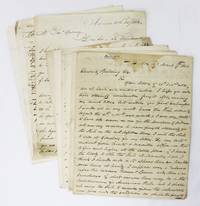
1824réf. 6529Bristol R.I.; Matanzas Cuba 1824. Good plus. Nine letters totaling 17pp. plus docketing. Some loss where previously sealed not affecting text. Otherwise old folds light wear at edges and some toning and dampstaining. Nine manuscript letters addressed to Edward Spalding a shipping agent in Havana and Matanzas with connections to trade out of Bristol and New England during the 1820s. The letters highlight the significant commercial networks between Cuba New England Europe and South America. The correspondence concerns shipments of sugar coffee molasses tobacco cotton and indigo and also reflects on the effects of European political tensions on Atlantic commerce. Several letters are from members of the notable DeWolf family who were major players in trade from Rhode Island to the Caribbean and also quite involved in the transatlantic slave trade that was a large part of the 19th-century Cuban economy. Spalding himself was active in the Cuban slave trade and in its many other facets until at least the end of the 1820s. A good group of correspondence with much firsthand information on trade between Cuba and the United States in the early 19th century. unknown books
1824réf. 6529Bristol R.I.; Matanzas Cuba 1824. Good plus. Nine letters totaling 17pp. plus docketing. Some loss where previously sealed not affecting text. Otherwise old folds light wear at edges and some toning and dampstaining. Nine manuscript letters addressed to Edward Spalding a shipping agent in Havana and Matanzas with connections to trade out of Bristol and New England during the 1820s. The letters highlight the significant commercial networks between Cuba New England Europe and South America. The correspondence concerns shipments of sugar coffee molasses tobacco cotton and indigo and also reflects on the effects of European political tensions on Atlantic commerce. Several letters are from members of the notable DeWolf family who were major players in trade from Rhode Island to the Caribbean and also quite involved in the transatlantic slave trade that was a large part of the 19th-century Cuban economy. Spalding himself was active in the Cuban slave trade and in its many other facets until at least the end of the 1820s. A good group of correspondence with much firsthand information on trade between Cuba and the United States in the early 19th century. unknown
Madrid, Librería General de Victoriano Suárez, 1902. 4to.; 290 pp., y una lámina con el retrato del autor. Cubiertas originales.
190218x12. 290p.
réf. 139173646X.Ghardcover. Good. Access codes and supplements are not guaranteed with used items. May be an ex-library book. hardcover
Málaga, Excma. Diputación, 1999, 30 x 24,5 cm., cartulina editorial, 307 págs. con profusión de láminas, la mayoría en colores.
195123x16. 238p. Cubierta algo deteriorada. Firma anterior poseedor. Fotogr. Ilstr.
1999EDITORI RIUNITI 1999. FONDO DI MAGAZZINO: BRUNITURE AI TAGLI, SEGNI DEL TEMPO, VOLUME INTONSO. La società statunitense si presenta come un universo complesso, del quale è difficile individuare caratteri di fondo e linee di tendenza. Questo volume analizza l'intreccio tra trasformazioni economiche, condizioni sociali e situazione politica negli Stati Uniti di questi anni, con un continuo riferimento alla dialettica tra politica interna e politica estera. La configurazione e l'evoluzione del capitalismo di quel paese sono viste sullo sfondo della situazione internazionale, nel tentativo di intravedere quali saranno gli sviluppi futuri tra gli Stati.
1969In 16° br. pp. 111, ben tenuto