2,665 results
2006ref. 007314Moers, Syndikat A, 2006. -- Broschiert -- 8°
Habana, Próspero Massana, 1858, 23,5 x 16,5 cm., retrato + IV + 70 págs. + 2 láminas. (Contiene varias Juntas realizadas por esta Real Sociedad, y, entre otros artículos: Informe sobre el cultivo y la elaboración del azúcar en Luisiana, por Ch. L. Pleischmann. Noticias sobre los modos de embalsamar practicados por los indios americanos, por Alvaro Reynoso...).
La Habana, Imprenta El Siglo XX, 1953. 4to. mayor; 200 pp., 1 h. y 2 láminas fotográficas. Cubiertas originales.
1916ref. 1702080014Academia Nacional de Artes y Letras Cuba 1/1/1916. Hardcover. Good. 0x0x0. 2 volume set. Volume 1 & 2 1916-1917. Hardcover. Good binding and cover. Light university library stamps and markings. This is an oversized or heavy book which requires additional postage for international delivery outside the US. Academia Nacional de Artes y Letras (Cuba) hardcover
1962ref. 4785Various locations in Cuba Europe and the United States 1962. Very good. 113 leaves of scrapbook cardstock illustrated with 388 photographs chiefly silver gelatin photographs several colored or in color in mounting corners. Most captioned in Spanish. Square folio. Contemporary brown cloth spring-loaded spine cover gilt. Joints split but holding well moderate rubbing and dust-soiling. Light foxing handful of images lacking some images slightly browned or with mild edge wear. An extensively-annotated vernacular family photograph album centering on the German-Cuban Coyula-Moeller family picturing their lives family members travels and more in Cuba the United States Germany and other locations in Europe mainly during the 1920s and '30s. The album was likely compiled by Gerardo Coyula y Moeller who was born in the early-1920s and attended Aloisiuskolleg in Bad Godesberg in the late-1930s. The album includes numerous pictures of Coyula y Moeller as a toddler young man and teenager traveling with his mother and various family members attending school and more with numerous photographs featuring the family and their environs in Cuba and Germany. The caption to a family photograph indicates that the Coyula family were shareholders in the German Club "Club Aleman" in Havana from 1939 to 1960. Other family members identified through the profuse captions include Aunt Merci Aunt Hortensia Uncle Gustavo Estela grandfather Enrique Moeller grandmother Rosa Gelpi and others. The album also contains several photographs relating to the Nazi Party in Germany before the war as well as two photographs with captions poignantly noting one young man who would die in a concentration camp in Germany. One of the latter examples pictures a young man named Gerd Wolf with the Spanish caption translated as "Rabbi Fidellis eating bananas - He was with the Resistance and died in the Dachau concentration camp." Notably an antecedent of the family was apparently friends with a German individual who is documented as later helping usher Hitler into power and the album records two additional Nazi individuals who "visited grandfather's house" and "fled to Brazil" to escape the consequences of their war crimes. Yet another family photograph shows a group of adults posed in a garden with the caption reading: "Nuestro amigo: Resulto ser Himmler" "Our friend: turned out to be Himmler". Indeed the image shows the man third from right is clearly Heinrich Himmler. In addition to pictures of the family at home in Cuba the album captures them in various locations in Germany mainly Bonn Hamburg and the aforementioned Bad Godesberg. The family also traveled to New York in the United States and Southampton England among other places with several photographs documenting their travels in each location. The album is also replete with identified photographs of a legion of family friends and acquaintances providing ample opportunity for deeper research into the connections within the family but also to the family's larger community. According to a previous owner the album came out of the noted Weber family in Cuba. An exceptional and well-preserved collection presenting the lives of this noted German-Cuban family. unknown books
1962ref. 4785Various locations in Cuba Europe and the United States 1962. Very good. 113 leaves of scrapbook cardstock illustrated with 388 photographs chiefly silver gelatin photographs several colored or in color in mounting corners. Most captioned in Spanish. Square folio. Contemporary brown cloth spring-loaded spine cover gilt. Joints split but holding well moderate rubbing and dust-soiling. Light foxing handful of images lacking some images slightly browned or with mild edge wear. An extensively-annotated vernacular family photograph album centering on the German-Cuban Coyula-Moeller family picturing their lives family members travels and more in Cuba the United States Germany and other locations in Europe mainly during the 1920s and '30s. The album was likely compiled by Gerardo Coyula y Moeller who was born in the early-1920s and attended Aloisiuskolleg in Bad Godesberg in the late-1930s. The album includes numerous pictures of Coyula y Moeller as a toddler young man and teenager traveling with his mother and various family members attending school and more with numerous photographs featuring the family and their environs in Cuba and Germany. The caption to a family photograph indicates that the Coyula family were shareholders in the German Club "Club Aleman" in Havana from 1939 to 1960. Other family members identified through the profuse captions include Aunt Merci Aunt Hortensia Uncle Gustavo Estela grandfather Enrique Moeller grandmother Rosa Gelpi and others. The album also contains several photographs relating to the Nazi Party in Germany before the war as well as two photographs with captions poignantly noting one young man who would die in a concentration camp in Germany. One of the latter examples pictures a young man named Gerd Wolf with the Spanish caption translated as "Rabbi Fidellis eating bananas - He was with the Resistance and died in the Dachau concentration camp." Notably an antecedent of the family was apparently friends with a German individual who is documented as later helping usher Hitler into power and the album records two additional Nazi individuals who "visited grandfather's house" and "fled to Brazil" to escape the consequences of their war crimes. Yet another family photograph shows a group of adults posed in a garden with the caption reading: "Nuestro amigo: Resulto ser Himmler" "Our friend: turned out to be Himmler". Indeed the image shows the man third from right is clearly Heinrich Himmler. In addition to pictures of the family at home in Cuba the album captures them in various locations in Germany mainly Bonn Hamburg and the aforementioned Bad Godesberg. The family also traveled to New York in the United States and Southampton England among other places with several photographs documenting their travels in each location. The album is also replete with identified photographs of a legion of family friends and acquaintances providing ample opportunity for deeper research into the connections within the family but also to the family's larger community. According to a previous owner the album came out of the noted Weber family in Cuba. An exceptional and well-preserved collection presenting the lives of this noted German-Cuban family. unknown
ref. RF5883334 pp.: ills. 235x155 cm. In original publisher’s cloth binding with lettering on the front cover. With the binder’s ticket of the printer P. Fernández y Co. “Capitolio” on the front pastedown. With the piece of original dust-jacket tipped in showing the illustration on the front side of the wrapper. Binding slightly worn piece of dust-jacket with tears but otherwise a very good copy. Scarce. First edition. Text in Spanish. Dedicated to General Alberto Herrera y Franch 1874-1954 Chief of the Army General Staff. A rare imprint of Cuban propaganda and apparently the earliest official record of the wave of bombings that swept Cuba under President Gerardo Machado 1871-1939 from October 1930 to November 1931. The book was compiled by Florindo L. Fernández Prieto First Lieutenant of Coast Artillery and Inspector General of Explosives in an attempt to attribute the bombings to foreign influence. The title page also identifies him as a doctor of pharmacy and of the natural and physical-chemical sciences a professor of explosives and war gases at army schools and a member of the American Chemical Society. Gerardo Machado was elected President of Cuba in 1924 and secured re-election in 1928 after extending his mandate through constitutional reform. The Great Depression and falling sugar prices deepened economic hardship and opposition to his regime. Tensions escalated on 30 September 1930 when police violently suppressed a student demonstration at the University of Havana mortally wounding Rafael Trejo 1910-1930. Bombings soon spread across the island followed by sabotage an armed uprising in August 1931 and increasingly brutal government repression. Machado’s rule ended on 12 August 1933 when a general strike army defections and US pressure forced him to resign and flee Cuba. The volume opens with a prologue by Ramiro Cabrera dated Havana November 1931. In the text Cabrera denies that the bombings could be a native Cuban phenomenon blaming instead “a breath of communism that comes from abroad” linked to Russia Spain “the great organizations created in the United States” China India and England. The introductory chapters survey Spanish and Cuban explosives legislation from 1894 to 1931 the history of bombs and grenades and the composition and handling of explosives detonators and fuses. The main section provides a day-by-day chronicle of attacks across the island from October 1930 to November 1931 targeting schools churches theatres banks cafés transport networks government offices and foreign legations. It documents the evolution of devices from paper petards to shrapnel bombs and factory-made fragmentation grenades as well as clandestine workshops discovered in Havana Trinidad and Santiago de Cuba. Importantly the edition features detailed expert reports on the bombings of the Presidential Palace and the Royal Bank of Canada co-signed by the author. The account also records foreign connections imported German shotgun cartridges American-made explosives and detonators and dynamite found alongside communist and anarchist pamphlets. Especially interesting are photographs of Fernández's field tests of seized grenades at the National Explosives Factory in Santiago de las Vegas and Castillo de Atarés together with images of the detonations and official witnesses. The book is supplemented with numerous extremely rare black-and-white photographs showing seized bombs grenades tear-gas and phosphorus ampoules bomb-makers’ tools and the bomb sites children victims with the identification of names etc. The volume concludes with statistical tables recording 562 bombs exploded 627 bombs and 1755 grenades seized lists of casualties inventories of confiscated explosives by town including nearly 89000 detonators and over 12000 lb of potassium chlorate and a province-by-province list of prosecutions under the explosives law. Overall a rare piece of propaganda and vivid record of political violence in Cuba on the eve of the 1933 Revolution compiled by the officer charged with defusing it. Excerpts from the book: “¡Es comunismo es anarquismo es lo que se quiera!. pero no es local…” p. 12 “It is communism it is anarchism it is whatever you like!… but it is not local…” “Esto es simplemente un soplo de comunismo que viene de afuera; la máscara que informa de la libertad de la constitución pisoteada; de la crisis económica; de los desaciertos de un gobierno descarriado sirve de pretexto y se está urdiendo con ella un movimiento tendencioso análogo al que se está agitando en otros países lejanos por parte de Rusia de España; del fondo de las grandes organizaciones creadas en los Estados Unidos…” p. 12 “This is simply a breath of communism that comes from abroad; the mask of liberty of the trampled constitution of the economic crisis of the blunders of a misguided government serves as a pretext and with it a tendentious movement is being woven like the one stirring in other distant countries on the part of Russia of Spain from the depths of the great organisations created in the United States…” “La existencia en la Habana de estas bombas y máquinas infernales no pueden ser producto de una elucubración genuinamente nativa. Estamos a no dudarlo frente a un fenómeno de índole distinta. La Habana es campo escogido de actividades que se agitan en otros países.” p. 10 “The existence in Havana of these bombs and infernal machines cannot be the product of a genuinely native invention. We are without doubt facing a phenomenon of a different kind. Havana is the chosen field of activities stirring in other countries.” Extremely Rare. Not found in the Worldcat hardcover
ref. 8774N° 2 de 5 juin 1898 - broché
M., Asilo de Huérfanos, 1926, 24 x 16'5 cm., 24 págs. con una lámina.
Madrid, Ediciones Guadarrama, 1971. 4to. menor; 363 pp. Cubiertas originales.
1955Features include: Rancho Pilila - An Orchidophile's Mecca in Cuba; Miltonia roezlii; Ovule Culture and Growth of Vanilla Seedlings; On the Judging of Miltonias; Collectors' Item: Brassia keiliana Rchb. f.; Judging Miltonias; What Makes a Fine Miltonia?; and Beginners' Handbook: Growing Orchids Out-of-Doors. Light wear. Unmarked. A clean copy. Book
1961128 pages. Features: Civil Defense Needs the Veterans; The Fulbright Memorandum - a shocking document that attacks military leaders for their efforts to enlighten their personnel and the public about Communism; He Makes the Reds Look Ridiculous - West German publisher Heinrich Baer jabs the Commies with cartoons; Sarah Hale and Thanskgiving; U.S. Taxpayers Financing Communism - money poured into Red Poland being used to bolster Red Cuba; A Creed for Conservaties; American speech - Its Color and variety; The Care and Feeding of Intellectuals - a look at a hothouse species spawned by higher education in the semantics of dialectic materialism; The American guilt Complex - are we being pressured into spending millions on 'conscience' money?; British Guiana - New Red Beachhead after the election of Jagan's Communist oriented P.P.P. to power; The case for Saying No; The Kremlin's Cultural Exchange Fraud - a counterspy views Communist subversion; New York's Role in the Civil War; Seattle World's Fair; Higher Auto Insurance Rates; Country Living for the Younger Set - Kiddies Country Club (KCC); Prophet of the Ozarks - W.H. "Coin" Harvey predicted world disaster... in 1910; Stop the Free Delivery of Communist Propaganda inflow of Communist mail involving the Universal Postal Union; and more. Moderate wear. A sound vintage copy. Book
2016brossura "Almeno il pane Fidel!" è una guida alternativa alla Cuba turistica, da cartolina, che tanto piace al regime. Un libro che rappresenta un'analisi di un paese che ha abbandonato da tempo il sogno della Rivoluzione Socialista. Il volume si apre con un reportage di viaggio datato 2005, l'ultimo prima che Gordiano Lupi venisse dichiarato dal regime persona non gradita, si avventura in una ricostruzione della storia cubana, traccia un quadro dei problemi quotidiani e racconta gli ultimi anni caratterizzati dalle riforme di Raúl Castro. Un capitolo finale scritto da Domenico Vecchioni dimostra come niente sia cambiato per il cubano medio nonostante un nuovo rapporto con gli Stati Uniti.
ref. 036507960X.Ghardcover. Good. Access codes and supplements are not guaranteed with used items. May be an ex-library book. hardcover
ref. 0364301090.Gpaperback. Good. Access codes and supplements are not guaranteed with used items. May be an ex-library book. paperback
190717x11. 124p. Lomo algo tocado en esquinas.
2009ref. 58649BBKrefeld / Nürnberg., Kunstmuseen Krefeld / Verlag für moderne Kunst Nürnberg., 2009. 27 x 21 cm. 124 S., 2 Blatt. OHalbleinen., 58649BB Erste Auflage. Sehr gutes Exemplar.
ref. L3419Instituto del libro, 1968. Plaquette in-8 agrafée. Texte de l'allocution par le commandant Fidel Castro pour analyser les événements de Tchécoslovaquie du vendredi 23 août 1968. E.O.
1961Buenos Aires La Plata 1961, In-4 broché, 306 pages. Trés bon état.
ref. QWA-17166Oficina Del historiador de la Ciudad de la Habana / Goethe Institut, 1997, in-8 br. oblong ( 21 x 22,5), 132 p., texte en espagnol, présentation par Georg Trefftz, préface de Eusebio Leal Spengler, illustrations n. et b. et coul., bon état.
ref. LCS-17530Rare et bel album sur la vie cubaine des années 1850, entièrement lithographié en couleurs, conservé dans sa très décorative reliure en velours vert orné de fers rocailles dorés. [Berlin ou Hambourg], Storch & Kramer pour May y Cia, s.d. [c. 1851]. Petit in-folio oblong contenant 1 titre en chromolithographie, 27 chromolithographies, une carte dépliante de l’île et un plan dépliant de La Havane (infime déchirure ds. la marge bl.). Relié en velours vert de l’éditeur, large encadrement rocaillé en or autour des plats avec titre en lettres dorées au centre, tranches dorées. Reliure de l’époque. 242 x 342 mm.
ref. 114571aafB. May y Ca, / Berlin, Oilprinting Storch & Kramer, (1853), in-4to oblong, 28 planches en chromolithographie (page de titre incluse) avec légendes en espagnol + 1 carte dépl. de l’ile + 1 plan de la ’Havane, rousseurs surtout dans les marges, reliure en toile rouge d’origine, plat devant avec titre doré dans un décor pressé à froid, dos restauré.
1991BUONE CONDIZIONI
2000ref. 54535Havana: Editorial Echevarria ca. 2000. Oblong 4to. 32 pp unpaginated. w/ 271 colour numbered Revolutionary trading cards all tipped-in including 3 for Revolutionist flags on verso front cover. Colour-illustrated coated softcovers cover art showing heroic Fidel Castro leading the revolutionaries rubbing creasing rippling to textblock still VG- copy. Facsimile souvenir of this famed piece of Cuban Revolutionary propaganda distributed free to the Cuban people originally by Felices Frutas the local canned fruit industry trying to stay afloat and appease Castro as all the countries industries and businesses were nationalized after the Revolution. Featuring the cartoon art of Capdevila this piece traces the return of the Castros from exile in Mexico as they fought capitalist exploitation the fall of Batista the bloody running battles and more all celebrating the success. Editorial Echevarria, paperback
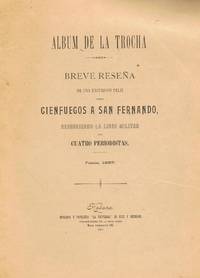
ref. 1032654. . Habana Cuba Imp. ¿La Universal¿ de Ruiz y Hermano. 1897. 30x20 cm. 90 págs. 55 láms. fotográficas en b/n. amplísimos márgenes. los periodistas fuerón: Eva Canel Nicolás de Gamboa Alejandro Menéndez y Antonio Porrúa. Viaje realizado dos años antes de la perdida de Cuba. unknown