Hall, Sarah J (Christie, Sarah J)Biblio.com

462 resultados
ref. 016607No Place: No Publisher. Unbound. Good. No place or date presumed Dover New Hampshire circa 1869. Blue lined letter paper measuring approximately 10 by 8 inches. Blindstamp reading "Learned" within an emblem of some sort at the top left of each page. Pages attached along the left edge originating as single sheets folded into pages. 8 pages with 3 ¼ pages written on. "Libel for Divorce S.J. Hall vs D Hall" written on the reverse of one page. PLEASE NOTE: the truth to this letter and its contents has not at this time been verified. Research in local records and other sources has not turned up a record of a marriage between a Sarah J. Christie and Daniel Hall. A Daniel Hall did live in Dover New Hampshire during this period. He was a lawyer and served as an aide to President Lincoln. He may have spent time learning law in Dover under Daniel M. Christie who did have a daughter named Sarah J. Christie. Records do indicate a later marriage for her. It is possible that this is perhaps some sort of spoof or satire letter written for entertainment or other reasons unknown. Names of other residents of the area are included in the letter. A handwritten petition submitted to the Court of Chancery in Dover New Hampshire apparently written and signed by Sarah J. Hall maiden name Christie seeking a divorce from her husband Daniel Hall. The letter gives the date of marriage the location of the marriage ceremony and the justice of the peace who presided and asserts the author "has faithfully performed her duties devolving upon her as a faithful affectionate and loving woman." Ms. Hall then proceeds to state that Daniel has "wantonly cruelly and without any provocation whatever wholly abandoned and deserted her the said Sarah and left her destitute." Continuing the letter asserts that "Daniel wholly regardless of his duty as a husband . has at divers varied and sundry times and in immeasurable places and in promiscuous assemblies frequented the company of and consorted with divers strange and fascinating women." He is accused of writing letters filled with "protestations of love and undying attachment" and had passed himself off as being single. A particular incident is noted perhaps 1869 or 1859 date somewhat illegible at the house of a "notorious and public" character in Dover in which Daniel "lay his head in the lap of a certain abandoned woman." It seems Daniel also possessed a head of curly hair to the delight of his wife but that he cut off locks of said hair to give to various "beautiful and fascinating women." Secret small town scandal or satire GOOD condition. Horizontal fold creases present. Some splitting to the paper along the hinge. Some toning fading very minor spotting and soiling to the letter. No Publisher unknown
1819ref. 014277Washington: Gales and Seaton Printer 1819. Pamphlet. Good. Pamphlet lacking any wrapppers issued. Presumably disbound from a larger work. 96 pp. MISSING the lastleaf or leaves with loss of the last letter extract included in this pamphlet. A lengthy work providing statements speeches and letters by President James Monroe discussing troubles with Spain including an alleged expedition from the United States against the province of Texas. Present is a printing of the Adams-Onis Treaty of 1819 that ceded Florida to the US from Spain as well as established the border between the US and New Spain. This includes many documents and letters from US and Spanish officials in Spanish and translated to English regarding land grants treaties boundaries territories etc. including discussion of Florida the land around Mobile Bay the Red River etc. GOOD condition. Lacking the aforementioned leaf or leaves at the rear. Heavy offsetting and browning to the outer pages with general moderate browning to the paper. Scattered foxing and soiling. Spine curled. Some creasing with some chipping along the extremities. Remains of binding along the spine. Gales and Seaton, Printer unknown
1801ref. 003919New York: Printed by L. Nichols and Co. for John Tiebout bookseller and Stationer 1801. Pamphlet. Good. Disbound tract pamphlet. 63 1 pp. An 1801 printing of the original New York City charter publishing the various recitals and oaths given by Montgomerie as well as delineating the various boundaries and territories of New York City specifying its division into seven wards outlining its city government and procedures. With a 2 by 4 inch Federal Eagle illustration on the title page in which the eagle clutches a branch in one talon and a group of arrows in the other as well as carrying a banner in its beak with the slogan E Plurbus Unum. In GOOD condition. Minor foxing and moderate browning to the pages. Minor scattered soiling with some faint darkish spotting to the title page. Poughkeepsie written in pencil on the rear of the last page with a few doodles in pencil as well as several stray lines in ink. Minor creasing to a few page corners. Remains of binding along the spine. Sabin 54170. Printed by L. Nichols and Co. for John Tiebout, bookseller and Stationer unknown
ref. 009895No Place: No Publisher. Soft Cover. Good. No date or names of family found although a few dates on some photos indicate this is post 1933 presumably mid 1930s maybe early 1940s. Flexible card covers. String tied binding. Folio. 63 leaves. Various sized photos throughout most around 2 ½ by 4 ½ inches although a few are panoramic shots and some are smaller. Most appear taken by the family with some appearing to be souvenir photos purchased on the trip. The majority of photos depict areas of Western United States including Colorado and the Pikes Peak Railroad and various mining operations Bryce Canyon Salt Lake City and Zion in Utah the Grand Canyon areas in California along the coast Yosemite Washington areas in and around Alberta Canada Yellowstone and other areas. The subject is mostly scenery with the family members often posed in the front as well as a few shots of buildings small western towns or cities including those in California. Laid in at the rear is a Shell map of the United States with the route driven apparently traced in ink. A small record of expenditures filled in by hand is also present as well as two souvenir letters from Butte Montana printed on copper. GOOD condition. General fading minor curling scuffing and edgewear to the covers. Paper toned in the interior although the photos are crisp. No Publisher unknown
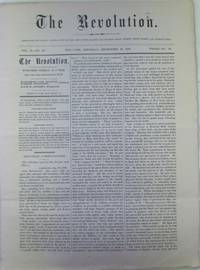
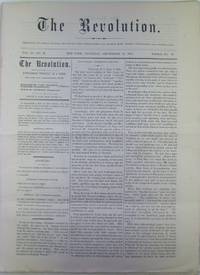
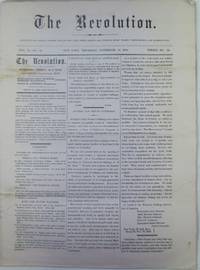
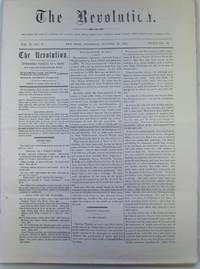
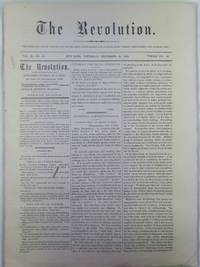
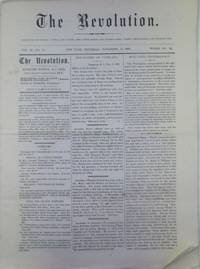
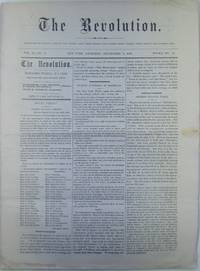
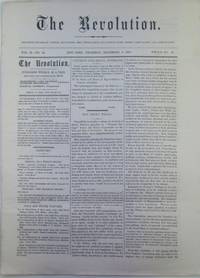
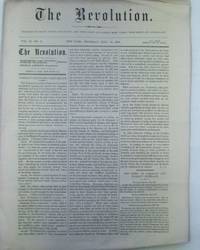
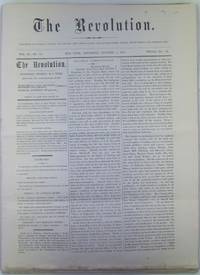
1868ref. 020102New York: Susan B. Anthony Proprietor; R.J. Johnson Publisher 1868. Wraps. Good. Side sewn journal. Approximately 12 ¼ by 9 inches. 16 pp. Single issue of the Revolution a groundbreaking and influential newspaper produced by Elizabeth Cady Stanton Susan B. Anthony and Parker Pillsbury. The paper was established to provide a voice to activists and suffragists such as Stanton and Anthony whose voices were marginalized by the mainstream press as well as many abolitionist publications with whom they had been previously allied. Anthony and Stanton advocated for an amendment giving suffrage to women along with the amendment sponsored by abolitionists that would give Black men the right to vote. Many abolitionists actively discouraged Stanton and Anthony from pursuing their amendment until the amendment enfranchising Black men passed creating a rift in the abolitionist movement as well as the women's suffrage movement. Feeling betrayed by abolitionists and Republicans who initially supported them they established the Revolution with financial help from George Francis Train a Democrat who supported women's rights but was openly racist. As the name indicates The Revolution adopted a combative radical tone with Stanton and others unafraid to take on critics. The paper openly discussed sexual and physical abuse in marriage and advocated better divorce laws that would offer women a way to escape abusive marriages. In 1869 the paper broke with Train who had supplied very little of the funding he initially offered. It published until 1872 struggling to make expenses along the way. This issue with a lengthy column written by Elizabeth Cady Stanton on her travels in the US spanning almost two pages. Very small paragraph by Susan B. Anthony present soliciting 6 to 8 women for potential employment. A few pieces discuss voting rights for Black men. GOOD condition. Several fold creases present with other general wrinkling. Minor toning and scattered soiling in the interior. Small hole in the upper front page. Susan B. Anthony, Proprietor; R.J. Johnson, Publisher unknown
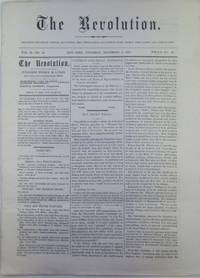
1868ref. 020196New York: Susan B. Anthony Proprietor; R.J. Johnson Publisher 1868. Wraps. Good. Side sewn journal. Approximately 12 ¼ by 9 inches. 16 pp. Early issue of the Revolution a groundbreaking and influential newspaper produced by Elizabeth Cady Stanton Susan B. Anthony and Parker Pillsbury. The paper was established to provide a voice to activists and suffragists such as Stanton and Anthony whose voices were marginalized by the mainstream press as well as many abolitionist publications with whom they had been previously allied. Anthony and Stanton advocated for an amendment giving suffrage to women along with the amendment sponsored by abolitionists that would give Black men the right to vote. Many abolitionists actively discouraged Stanton and Anthony from pursuing their amendment until the amendment enfranchising Black men passed creating a rift in the abolitionist movement as well as the women's suffrage movement. Feeling betrayed by abolitionists and Republicans who initially supported them they established the Revolution with financial help from George Francis Train a Democrat who supported women's rights but was openly racist. As the name indicates The Revolution adopted a combative radical tone with Stanton and others unafraid to take on critics. The paper openly discussed sexual and physical abuse in marriage and advocated better divorce laws that would offer women a way to escape abusive marriages. In 1869 the paper broke with Train who had supplied very little of the funding he initially offered. It published until 1872 struggling to make expenses along the way. This issue with a lengthy column written by Elizabeth Cady Stanton on her travels in the US spanning almost two pages. Another piece by Stanton discusses the upcoming presidential election and the potential affiliation of the Revolution with the Democrats. Three small paragraphs by Susan B. Anthony one on the National Unitarian Convention the National Workingmen's Congress and one soliciting more subscribers. A few pieces discuss voting rights for Black men. GOOD condition. Small piece torn from the upper edge of one leaf and another from the bottom corner of the last leaf. Several fold creases present with other general wrinkling. Minor toning and scattered soiling in the interior. Susan B. Anthony, Proprietor; R.J. Johnson, Publisher unknown
1868ref. 020221New York: Susan B. Anthony Proprietor; R.J. Johnson Publisher 1868. Wraps. Good. Side sewn journal. Approximately 12 ¼ by 9 inches. 16 pp. This issue with a front page "Appeal for Equal Suffrage" undersigned by Elizabeth Cady Stanton Abby Hopper Gibbons Mrs. Horace Greeley Susan B. Anthony and Elizabeth Smith Miller. With two pieces "Hester Vaughan" and "Our Children at School" both written by Elizabeth Cady Stanton. GOOD condition. Front page separating from the spine somewhat tenuously attached. Several fold creases present with other general wrinkling. Minor toning and scattered soiling in the interior. Minor staining to the front cover. Susan B. Anthony, Proprietor; R.J. Johnson, Publisher unknown
1868ref. 020291New York: Susan B. Anthony Proprietor; R.J. Johnson Publisher 1868. Wraps. Good. Side sewn journal. Approximately 12 ¼ by 9 inches. 16 pp. arly issue of the Revolution a groundbreaking and influential newspaper produced by Elizabeth Cady Stanton Susan B. Anthony and Parker Pillsbury. The paper was established to provide a voice to activists and suffragists such as Stanton and Anthony whose voices were marginalized by the mainstream press as well as many abolitionist publications with whom they had been previously allied. Anthony and Stanton advocated for an amendment giving suffrage to women along with the amendment sponsored by abolitionists that would give Black men the right to vote. Many abolitionists actively discouraged Stanton and Anthony from pursuing their amendment until the amendment enfranchising Black men passed creating a rift in the abolitionist movement as well as the women's suffrage movement. Feeling betrayed by abolitionists and Republicans who initially supported them they established the Revolution with financial help from George Francis Train a Democrat who supported women's rights but was openly racist. As the name indicates The Revolution adopted a combative radical tone with Stanton and others unafraid to take on critics. The paper openly discussed sexual and physical abuse in marriage and advocated better divorce laws that would offer women a way to escape abusive marriages. In 1869 the paper broke with Train who had supplied very little of the funding he initially offered. It published until 1872 struggling to make expenses along the way. This issue with a lengthy profile of Anna Elizabeth Dickinson written by Elizabeth Cady Stanton as well as an essay on marriage and mistresses that questions legal rulings favoring men in marriage over women. Also present is an essay by actor and writer Olive Logan titled "U.S". GOOD condition. Several fold creases present with other general wrinkling. Minor toning and scattered soiling in the interior. Small tear affecting the title at the top of the first page appearing to have happened during the printing. Susan B. Anthony, Proprietor; R.J. Johnson, Publisher unknown
1868ref. 020339New York: Susan B. Anthony Proprietor; R.J. Johnson Publisher 1868. Wraps. Fair. Side sewn journal. Approximately 12 ¼ by 9 inches. 16 pp. Early issue of the Revolution a groundbreaking and influential newspaper produced by Elizabeth Cady Stanton Susan B. Anthony and Parker Pillsbury. The paper was established to provide a voice to activists and suffragists such as Stanton and Anthony whose voices were marginalized by the mainstream press as well as many abolitionist publications with whom they had been previously allied. Anthony and Stanton advocated for an amendment giving suffrage to women along with the amendment sponsored by abolitionists that would give Black men the right to vote. Many abolitionists actively discouraged Stanton and Anthony from pursuing their amendment until the amendment enfranchising Black men passed creating a rift in the abolitionist movement as well as the women's suffrage movement. Feeling betrayed by abolitionists and Republicans who initially supported them they established the Revolution with financial help from George Francis Train a Democrat who supported women's rights but was openly racist. As the name indicates The Revolution adopted a combative radical tone with Stanton and others unafraid to take on critics. The paper openly discussed sexual and physical abuse in marriage and advocated better divorce laws that would offer women a way to escape abusive marriages. In 1869 the paper broke with Train who had supplied very little of the funding he initially offered. It published until 1872 struggling to make expenses along the way. This issue with a lengthy column editorial correspondence written by Elizabeth Cady Stanton wherein she discusses her time in Philadelphia and Pennsylvania as well as the case of Hester Vaughn. There are two other lengthy articles on Hester Vaughn one written by Elizabeth Cady Stanton. Vaughan was tried and convicted of murdering her newborn baby to which she gave birth alone. The circumstances around the birth and death the child were murky and she was sentenced to death by an all male jury. The Revolution took up her case seeking her pardon and inferred she was raped. Stanton and Anthony attracted a lot of publicity to the case. Vaughn was eventually pardoned by the governor of Pennsylvania and sent back to England. The cause proved a bit divisive for Stanton and Anthony and the Revolution with modern historians asserting it helped to set back their work for women's suffrage. FAIR condition. Front leaf DETACHED with the binding a bit fragile. Several fold creases present with other general wrinkling. Minor toning and scattered soiling in the interior. Susan B. Anthony, Proprietor; R.J. Johnson, Publisher unknown
1868ref. 020366New York: Susan B. Anthony Proprietor; R.J. Johnson Publisher 1868. Wraps. Good. Side sewn journal. Approximately 12 ¼ by 9 inches. 16 pp. Early issue of the Revolution a groundbreaking and influential newspaper produced by Elizabeth Cady Stanton Susan B. Anthony and Parker Pillsbury. The paper was established to provide a voice to activists and suffragists such as Stanton and Anthony whose voices were marginalized by the mainstream press as well as many abolitionist publications with whom they had been previously allied. Anthony and Stanton advocated for an amendment giving suffrage to women along with the amendment sponsored by abolitionists that would give Black men the right to vote. Many abolitionists actively discouraged Stanton and Anthony from pursuing their amendment until the amendment enfranchising Black men passed creating a rift in the abolitionist movement as well as the women's suffrage movement. Feeling betrayed by abolitionists and Republicans who initially supported them they established the Revolution with financial help from George Francis Train a Democrat who supported women's rights but was openly racist. As the name indicates The Revolution adopted a combative radical tone with Stanton and others unafraid to take on critics. The paper openly discussed sexual and physical abuse in marriage and advocated better divorce laws that would offer women a way to escape abusive marriages. In 1869 the paper broke with Train who had supplied very little of the funding he initially offered. It published until 1872 struggling to make expenses along the way. This issue with a piece "The Dignity of the Ballot" and an account of the Boston Woman's Suffrage Convention both written by Elizabeth Cady Stanton. GOOD condition. Several fold creases present with other general wrinkling. Minor toning and scattered soiling in the interior. Small crease to the lower front page corner. Susan B. Anthony, Proprietor; R.J. Johnson, Publisher unknown
1868ref. 020469New York: Susan B. Anthony Proprietor; R.J. Johnson Publisher 1868. Wraps. Good. Side sewn journal. Approximately 12 ¼ by 9 inches. 16 pp. Early issue of the Revolution a groundbreaking and influential newspaper produced by Elizabeth Cady Stanton Susan B. Anthony and Parker Pillsbury. The paper was established to provide a voice to activists and suffragists such as Stanton and Anthony whose voices were marginalized by the mainstream press as well as many abolitionist publications with whom they had been previously allied. Anthony and Stanton advocated for an amendment giving suffrage to women along with the amendment sponsored by abolitionists that would give Black men the right to vote. Many abolitionists actively discouraged Stanton and Anthony from pursuing their amendment until the amendment enfranchising Black men passed creating a rift in the abolitionist movement as well as the women's suffrage movement. Feeling betrayed by abolitionists and Republicans who initially supported them they established the Revolution with financial help from George Francis Train a Democrat who supported women's rights but was openly racist. As the name indicates The Revolution adopted a combative radical tone with Stanton and others unafraid to take on critics. The paper openly discussed sexual and physical abuse in marriage and advocated better divorce laws that would offer women a way to escape abusive marriages. In 1869 the paper broke with Train who had supplied very little of the funding he initially offered. It published until 1872 struggling to make expenses along the way. This issue with a lengthy article written by Elizabeth Cady Stanton on women's suffrage in Texas as well as a shorter piece asking "What is a Democrat" Two short pieces on the front page look at a new suffrage movement in Boston regarding 18 year old boys and woman suffrage in Michigan. An anonymous piece discusses "Indian Troubles in Kansas" describing attacks on white settlers by various tribes in the region. The author asserts that the Native American image as described by Longfellow peaceful is wrong and asserting that "murder and plunder are their ruling spirit." GOOD condition. Several fold creases present with other general wrinkling. Minor toning and scattered soiling in the interior. Front and rear page tenuously attached along the spine. Susan B. Anthony, Proprietor; R.J. Johnson, Publisher unknown
1868ref. 020532New York: Susan B. Anthony Proprietor; R.J. Johnson Publisher 1868. Wraps. Good. Side sewn journal. Approximately 12 ¼ by 9 inches. 16 pp. Early issue of the Revolution a groundbreaking and influential newspaper produced by Elizabeth Cady Stanton Susan B. Anthony and Parker Pillsbury. The paper was established to provide a voice to activists and suffragists such as Stanton and Anthony whose voices were marginalized by the mainstream press as well as many abolitionist publications with whom they had been previously allied. Anthony and Stanton advocated for an amendment giving suffrage to women along with the amendment sponsored by abolitionists that would give Black men the right to vote. Many abolitionists actively discouraged Stanton and Anthony from pursuing their amendment until the amendment enfranchising Black men passed creating a rift in the abolitionist movement as well as the women's suffrage movement. Feeling betrayed by abolitionists and Republicans who initially supported them they established the Revolution with financial help from George Francis Train a Democrat who supported women's rights but was openly racist. As the name indicates The Revolution adopted a combative radical tone with Stanton and others unafraid to take on critics. The paper openly discussed sexual and physical abuse in marriage and advocated better divorce laws that would offer women a way to escape abusive marriages. In 1869 the paper broke with Train who had supplied very little of the funding he initially offered. It published until 1872 struggling to make expenses along the way. This issue with a lengthy piece on Hon. Henry Wilson being harshly critical and mocking written by Elizabeth Cady Stanton. GOOD condition. Several fold creases present with other general wrinkling. Minor toning and scattered soiling in the interior. Susan B. Anthony, Proprietor; R.J. Johnson, Publisher unknown
ref. 013720New York: Virtue and Yorston. Half-Leather. Good. no date presumed circa 1867 or 1877 based on a date on the half title illustration of volume three and a misbound map in the same volume with a date of 1877. Half leather with brown cloth. Small folios. 664 680 738 pp. All illustrations present as called for although a map from volume 3 is misbound in volume one with a few other portraits misbound or DETACHED and laid in. A reprint of this work originally published under the title "The War with the South" and issued in parts. This edition continued and finished by Benjamin Smith. A general history of the Civil War looking at the various battles campaigns notable figures etc. GOOD condition. A few illustrations detached but present. Heavy scuffing to the leather along the extremities and spine with general fading and otherwise minor scuffing to the covers. Minor soiling and staining to the covers. Interiors with light scattered soiling and uneven heavy toning to some of the pages. Some foxing to some of the plates. See Dornbush Volume 3 #257 for this work with a Worthington imprint. Virtue and Yorston unknown
1887ref. 011564Washington: Government Printing Office 1887. Half Leather. Good. Half leather with marbled boards. Pagination varies throughout. Nine volumes including index volumes plus a report volume containing testimony from railroad officials government officials and others associated with railroads in the United States ascertaining their finances and benefit to the US government and how the financing and relationship between the government and railroads should continue. GOOD condition. Moderate to heavy scuffing to the leather along the extremities and hinges. Owner's name in gilt at the foot of each spine. Minor fading. Some dustiness and light soiling to the covers. Light toning to the paper. Government Printing Office unknown
1706ref. 64859Leyden 1706. Folio. Nyere marmorert kartonasjebind med pergamentrygg. Kobberstukket vignet på tittelbladet. 27 2 s. Med et kobberstukket kart over Vest-India.Folio. Recent marbled boards with vellum spine. Engraved vignette on titlepage. 27 2 pp. With one folding map showing the West Indies. By Pieter van der Aa Nederlandsk. hardcover
1849ref. 54750Madrid La Imprenta Nacional 1849. Small 4to. Contemp. hcloth. Gilt lettering on spine. Stamp on title-page. 2468 pp. 1 folded table. Internally clean and fine. This edition not in Sabin. Sabin 19679 for other editions. hardcover
1822ref. 011473Boston: Cummings and Hilliard 1822. Quarter Leather. Good. Stated second edition. Quarter calf leather with marbled boards. Xii 480;2481-818 plus errata. Fold out color map at the front with five fold out plates at the rear. An early work studying the mineralogy and geology of the United States by Parker Cleaveland a geologist and professor who drew on his own collection of minerals to compile this work. With general discussion of the properties of minerals as well as sections studying specific minerals in the US. GOOD condition. Leather cracked flaking and darkened along the spine being rather brittle. Some darkening along the extremities of the boards. Minor scuffing and bumping to the edges. Scattered minor foxing throughout heavier to the first few pages and to a few pages scattered throughout. Misfolding present to the plates in the rear. Map with several wrinkles and some toning. Owner's signature present with front endpaper torn along the upper hinge. Sabin 13611 for first edition and this. Cummings and Hilliard unknown
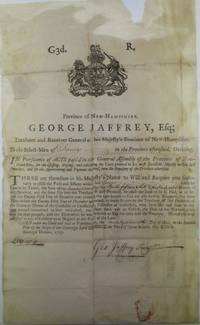
1767ref. 020556Portsmouth: No Publisher 1767. Unbound. Good. Single sheet printed on a single side only. 12 ¼ by 7 ½ inches. Armorial ornament of King George III at the top of the sheet followed by printed text asserting that in pursuance of the Acts passed in the General Assembly of the Province of New Hampshire the town named Dover New Hampshire was required to pay the stated sum of taxes as well as naming the constables or collectors who collected the sums. Signed by George Jaffrey at the bottom with the remains of a wax seal present. George Jaffrey Esquire was part of a prominent New Hampshire family who essentially held an oligarchy in the province. They and a few others sought to separate New Hampshire from the province of Massachusetts and through various machinations and political maneuverings did so. George Jaffrey eventually became treasurer of New Hampshire. In the run up to and during the American Revolutionary War Jaffrey was a staunch Loyalist asserting that it was just a few people causing the turmoil and that eventually the colonies would remain with England. Despite his beliefs and the danger it caused him he held his post and remained in Portsmouth New Hampshire during the war. GOOD condition. Horizontal and vertical fold creases present with a few small tears along the folds. A 1 inch triangular area torn off from the upper edge. Uneven toning. Handwriting on the reverse clerical in nature. Many small old paper repairs present along the center fold. No Publisher unknown
1777ref. 000205No Publisher Given 1777. Hard Cover. Very Good/No Jacket. A Parliamentary Chronicle: or accounts of the proceedings and debates of the House of Commons upon the opening of the present sessions. This spans from October 30 1776 to February 25 1777. No author. These proceedings open with an address by King George to parliament regarding the American Revolution. It begins "Nothing could have afforded me so much satisfaction as to have been able to inform you at the opening of this session that the troubles which have so long distracted my colonies in North America were at an end; and that my unhappy people recovered from their delusion had delivered themselves from the oppression of their leaders and returned to their duty .". After this address various members of parliament respond some with support for the war and others advocating granting America its independence. Some of these speeches go into detail in regard to troops morale conduct propaganda in the US press especially propaganda by General Gage. Also discussed within are Britainn's defenses against Spain and France Jamaica and many other interesting topics. The debates over the war with America are amazing historical references serving to frame the Revolutionary War through the eyes of the British. This book has been re-bound in blue cloth with the title in gilt in a small strip of leather on the spine. VERY GOOD condition with light soiling light fading and moderate scuffing mostly noticeable to the top and bottom of the spine. Light bumping and edgewear. Pages clean and solid but browning. Still very readable. The last page of the text seems to end mid sentence as if this was excerpted from a larger text. A very scarce historical record of the beginnings of the Revolutionary War in VERY GOOD condition. No Publisher Given unknown
1868ref. 020098New York: Susan B. Anthony Proprietor; R.J. Johnson Publisher 1868. Wraps. Good. Side sewn journal. Approximately 12 ¼ by 9 inches. 16 pp. Early issue of the Revolution a groundbreaking and influential newspaper produced by Elizabeth Cady Stanton Susan B. Anthony and Parker Pillsbury. The paper was established to provide a voice to activists and suffragists such as Stanton and Anthony whose voices were marginalized by the mainstream press as well as many abolitionist publications with whom they had been previously allied. Anthony and Stanton advocated for an amendment giving suffrage to women along with the amendment sponsored by abolitionists that would give Black men the right to vote. Many abolitionists actively discouraged Stanton and Anthony from pursuing their amendment until the amendment enfranchising Black men passed creating a rift in the abolitionist movement as well as the women's suffrage movement. Feeling betrayed by abolitionists and Republicans who initially supported them they established the Revolution with financial help from George Francis Train a Democrat who supported women's rights but was openly racist. As the name indicates The Revolution adopted a combative radical tone with Stanton and others unafraid to take on critics. The paper openly discussed sexual and physical abuse in marriage and advocated better divorce laws that would offer women a way to escape abusive marriages. In 1869 the paper broke with Train who had supplied very little of the funding he initially offered. It published until 1872 struggling to make expenses along the way. This issue with several articles written by Elizabeth Cady Stanton including a lambasting of the Democratic Party with another piece not treating Republicans kindly either. She also discusses the Peoples Party etc. A short piece by Susan B. Anthony present addressing the beginning of volume 2 of the Revolution. GOOD condition. Several fold creases present with other general wrinkling. Minor toning and scattered soiling in the interior. Front and rear leaf separating from the rest of the piece but still intact. Susan B. Anthony, Proprietor; R.J. Johnson, Publisher unknown
1868ref. 020395New York: Susan B. Anthony Proprietor; R.J. Johnson Publisher 1868. Wraps. Good. Side sewn journal. Approximately 12 ¼ by 9 inches. 16 pp. Early issue of the Revolution a groundbreaking and influential newspaper produced by Elizabeth Cady Stanton Susan B. Anthony and Parker Pillsbury. The paper was established to provide a voice to activists and suffragists such as Stanton and Anthony whose voices were marginalized by the mainstream press as well as many abolitionist publications with whom they had been previously allied. Anthony and Stanton advocated for an amendment giving suffrage to women along with the amendment sponsored by abolitionists that would give Black men the right to vote. Many abolitionists actively discouraged Stanton and Anthony from pursuing their amendment until the amendment enfranchising Black men passed creating a rift in the abolitionist movement as well as the women's suffrage movement. Feeling betrayed by abolitionists and Republicans who initially supported them they established the Revolution with financial help from George Francis Train a Democrat who supported women's rights but was openly racist. As the name indicates The Revolution adopted a combative radical tone with Stanton and others unafraid to take on critics. The paper openly discussed sexual and physical abuse in marriage and advocated better divorce laws that would offer women a way to escape abusive marriages. In 1869 the paper broke with Train who had supplied very little of the funding he initially offered. It published until 1872 struggling to make expenses along the way. This issue with a continuation of a lengthy profile of Anna Elizabeth Dickinson written by Elizabeth Cady Stanton as well as five shorter pieces by her: "The Old Year Gone" "Roll up the Petitions" "Henry Ward Beecher" "Henry James on Woman" and "Hearth and Home." A short column by Susan B. Anthony is present thanking their helpers. Also of note is a report on the Working Women's Association by Sarah Norton in which she reports in detail on the work of rag pickers in New York City. GOOD condition. Rear leaf very tenuously attached with the binding a bit fragile. Rear leaf also rather toned. Several fold creases present with other general wrinkling. Minor toning and scattered soiling in the interior. Susan B. Anthony, Proprietor; R.J. Johnson, Publisher unknown
1971ref. 016065Washington: Government printing Office 1971. Wraps. Good. Printed wraps. 145 7 pp. A few black and white illustrations throughout reprints of illustrations from issues of The Black Panther Party. A supposedly "analytical" report on the Black Panther Party discussing its origins ideology and methodology in achieving its aims. The work cites the words of Black Panther Party leaders and ex-members and subtly seeks to tie the party to foreign groups communists seeking to overthrow the US government while ignoring the facts in some cases such as the murder of Fred Hampton that would portray the US government in a poor light. The report was issued by the Committee on Internal Security formerly known as the House of Un-American Activities Committee chaired by Richard Ichord a staunch anti-communist. GOOD condition. Minor to moderate toning some staining and minor soiling with light rusting to the staples. Minor creasing and wrinkling. Government printing Office unknown
1832ref. 004862Concord New Hampshire: No Publisher 1832. Disbound. Fair. Proclamation Regarding Nullification December 10 1832. Published in the New Hampshire Statesman and State Journal Saturday December 22 1832. Concord New Hampshire: 1832. Vol. II-No.32. Single sheet Page 1 and 2 ONLY of this newspaper printing on the front page almost the entire proclamation by Andrew Jackson lacking the last 1 and ½ paragraphs which would have appeared on the last page of this paper now LACKING. An early printing of this important speech by Jackson declaring that one any one state did not have the authority to annul any federal law of the United States and declaring that South Carolina "stood on the brink of insurrection and treason." Jackson asserted in the speech that no state had the right to secede. This conflict arose from South Carolina's efforts to nullify federal tariffs that it considered were hurting its economy. Both the state and federal government prepared for possible military action to enforce their cause with a compromise eventually reached in 1833. In FAIR condition lacking the aforementioned last paragraphs. Upper left of the sheet torn with LOSS of text along the left margin of the first few paragraphs. Small area torn from the lower left margin not affecting text. General wrinkling and creasing to the paper with a horizontal fold crease present. Minor foxing staining and soiling. Some creasing and minor tearing along the upper edge. Small hole in the center of the paper at the title. No Publisher unknown
1797ref. 017595Boston: Printed at the Presses of S. Hall and Thomas and Andrews 1797. Leather. Poor. Full calf leather. Pagination runs A-QQQ 4. Only four out of seven maps called for are present MISSING the following three maps: the map of Northern States map of the Southern States and the map of South America. Maps of the Pacific Islands North America West Indies and Georgia present. An alphabetically arranged encyclopedia style work on the geography settlements and people of North and South America as well as islands in the Caribbean and South Pacific. This includes the east coast of Australia then termed New Holland. POOR condition. Front cover DETACHED with any front endpapers up to the frontis map MISSING frontis map is present. Leather scuffed frayed and worn along the extremities and hinges. A few small spots of staining to the covers. Previous owner's bookplate present. Text block solid and a bit toned. Howes M839. Sabin 50923. Printed at the Presses of S. Hall and Thomas and Andrews unknown
1868ref. 020147New York: Susan B. Anthony Proprietor; R.J. Johnson Publisher 1868. Wraps. Good. Side sewn journal. Approximately 12 ¼ by 9 inches. 16 pp. Early issue of the Revolution a groundbreaking and influential newspaper produced by Elizabeth Cady Stanton Susan B. Anthony and Parker Pillsbury. The paper was established to provide a voice to activists and suffragists such as Stanton and Anthony whose voices were marginalized by the mainstream press as well as many abolitionist publications with whom they had been previously allied. Anthony and Stanton advocated for an amendment giving suffrage to women along with the amendment sponsored by abolitionists that would give Black men the right to vote. Many abolitionists actively discouraged Stanton and Anthony from pursuing their amendment until the amendment enfranchising Black men passed creating a rift in the abolitionist movement as well as the women's suffrage movement. Feeling betrayed by abolitionists and Republicans who initially supported them they established the Revolution with financial help from George Francis Train a Democrat who supported women's rights but was openly racist. As the name indicates The Revolution adopted a combative radical tone with Stanton and others unafraid to take on critics. The paper openly discussed sexual and physical abuse in marriage and advocated better divorce laws that would offer women a way to escape abusive marriages. In 1869 the paper broke with Train who had supplied very little of the funding he initially offered. It published until 1872 struggling to make expenses along the way. This issue with a lengthy column editorial correspondence written by Elizabeth Cady Stanton on her travels in the US spanning almost two pages. Other pieces by Stanton discuss "National Labor Congress;" "Frank Blair on Woman's Suffrage;" and "Adah Isaacs Menken." Two lengthy pieces print quotes speaking from two meetings of the Workingwoman's Workingwomen's Association printing the discussion between Susan B. Anthony and others. GOOD condition. Several fold creases present with other general wrinkling. Minor toning and scattered soiling in the interior. Susan B. Anthony, Proprietor; R.J. Johnson, Publisher unknown