Heap, Gwinn, HarrisBiblio.com

463 resultados
1854ref. biblio2Foxing 13 color plates second binding. Text clean name and number title page. Does not include map. inscription and writing front free fly leaf Wagner camp 235 Book is in good condition Text Unmarked Lippincott, Grambo hardcover
ref. AQ32424s.i.: s.n. s.d. Manuscript on paper 16pp. of text written verso only. Handsomely bound in contemporary richly gilt-tooled red straight-grain morocco A.E.G. Lightly rubbed. Light water-staining to lower corner of text-block. A handsomely presented series of finely executed manuscript fair copies of a series seven dispatches and addresses presented to sometime Collector and Military officer in Martinique and Trinidad Charles Grant between 1795 and 1814. A notably inclusion is an extract from Lieutenant General Prescott's dispatch dated 11th December 1794 and initially published in the London Gazette February 1795 providing an account of the siege and subsequent evacuation of Fort Matilda Guadeloupe following the British invasion of the island. The extract commends the conduct of garrison and singles out Grant in particular: 'I cannot however omit mentioning Mr. Grant Collector of Basse Terre Guadaloupe who commanded a few Volunteers and whose conduct during the whole Siege was such as did him the highest Honor'. . Quarto. [s.n.], [s.d.] unknown
1833ref. 34458v.p. including Antwerp London Havana Pensacola New York 1833. Folio. 12 3/4 x 8 inches. 21 leaves plus two additional manuscript leaves laid in. Contemporary half calf and marbled boards manuscript label on front board. Bookseller's label on front pastedown. Account book of Atlantic trading voyages. An interesting manuscript ship's log containing financial accounts for the brigs Nimrod and Jasper for an eight year period from 1826 to 1833 while they were under the command of a Captain John Hill. The two ships made numerous voyages between the United States Europe and the Caribbean. The present log book contains line accounts of expenditures for journeys from London and Marseilles to New York and Norfolk in 1827; from Antwerp to London in 1828; from Philadelphia to the West Indies in 1829; from Madeira to the Turks Islands in 1831; from the West Indies to Pensacola to Havana in 1832; from the Indies to New York in 1833; and other similar voyages. The log also contains two copies of an 1832 letter written in Havana by Hill to merchants there inquiring about the price of molasses and a list of port charges at several major way points. A fascinating artifact of trans-Atlantic trade in the 1820s and 1830s. unknown
1778ref. 1001488vo period calf rebacked with modern calf and new endpapers 3 202pp. Wear to covers; ink name to top of title page and some foxing and darkening within. Otherwise very good. The contents provide coverage of the important proceedings before the Declaration of Independence on July 4th 1776.This commentary reflects the efforts of the Second Continental Congress which was headed by John Hancock. A good portion of the contents focus on correspondence between Washington who had taken command of the Continental Army in May 1775 and Congress election of delegates form each of the Colonies and funding the war with Great Britain. Some remarks actually give insight into the pay that soldiers received privates got $5 per month. Also some information on printing of paper money and what denominations would be used. While the title page indicated this was a reprinted work Sabin only lists the London edition. Reprinted For J. Almon
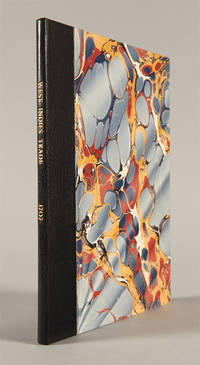
1707ref. 17560London. 1707. Very Early Tract on the West Indian Trade The author sets out the five most important advantages which he associates with trading with the Spanish West Indies and then proceeds to respond to the potential objections of others. He concludes by listing the conditions set out by the Spanish which he considers very reasonable as "This Trade is a Jewel." 8pp. Modern half morocco and marbled boards. Tanned. Very good. EUROPEAN AMERICANA 707/95. hardcover
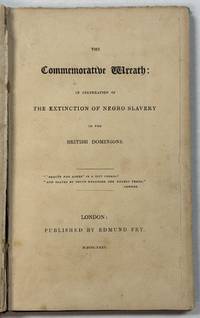
1835ref. 41420London: Published by Edmund Fry 1835. 2 viii 112 pp. Original cloth rebacked. Title stamped in gilt on upper cover. Frontis engraving with tissue guard of black children in school taught by elegantly dressed white teachers; and with several signs: "The Day of Our Freedom August 1st 1834" engraved by J. Crosland; "That Which I See Not Teach Thou Me"; "Shew Me Thy Ways O Lord Teach Me Thy Paths." Occasional foxing Good plus. A scarce work issued to celebrate the abolition of slavery in British colonies with the Slavery Abolition Act passed in 1833 and going into effect on 1 August 1834. "On the memorable day when British Colonial Slavery ceased the 'Peckham Negro's Friend and Instruction Society' held a special meeting with a view to 'signalizing the day of Negro Emancipation by some act of Christian benevolence" and accordingly came to the unanimous resolution of undertaking 'the charge of an Adult School to be established in the island of Jamaica. The necessary steps were taken to effect this design; and it is the hope of aiding the the extension of its practical usefulness which has prompted a few individuals who have long felt deeply interested in the Negro's cause to collect into a small volume such poems as may be within their reach written for the most part in special commemoration of the abolition of Slavery and to apply the profit if any to the furtherance of the object before described." The authors of most of these poems have signed with their initials only. This is the first edition. LCP 2587. Published by Edmund Fry unknown
1782ref. CA0094lii315 pages. Octavo 8" x 5 3/4" bound in full leather with gilt lettering to spine. Translated with notes by Pedro Varela y Ulloa. Palau 196692. First Spanish edition. A text that engaged the well-studied debates about the natural history of the Americas and Spain's colonial history. In 1780 in Venice Juan Nuix published Riflessioni imparziali supra l'umanita degli spagnuoli nell' Indie contro i pretersi filosofi e politici. Nuix a Catalan living in Italy since the expulsion of the Jesuits wrote the book to defend Spanish colonialism and historiography against the attacks of Robertson and Raynal. It sailed by the censors in the Council of the Indies and two separate translations appeared in succession one in 1782 edited by a member of the Royal Council Pedro Varela y Ulloa and another in 1783 by Joseph Nuix Juan's brother. The Spanish edition sponsored by the crown opened with an essay by Varela y Ulloa in which he first offered a searing Critique of traditional forms of colonialism not unlike that put forth by Raynal. After describing military campaigns in foreign lands from Alexander the Great to Genghis Kahn as butcheries Varela y Ulloa went on to claim that the Spanish colonialism was unique. The crimes attributed to Spain in the Indies had been committed by private individuals who did not represent the nation as a whole and who had acted as they did while surrounded by hungry cannibals. Moreover compared with the atrocities committed by other European colonial powers the actions of the Spaniards looked like misdemeanors. Varela y Ulloa's effort to portray Spanish colonialism as unique benign captured the essence of Nuix's thesis well. Nuix's defense of the record of Spanish colonialism opened with passages that sought to bolster his credibility by stressing that he was a Catalan and that Catalans had not really participated in the Spanish colonization of the Indies so that he could not be accused of being partisan. He then articulated a five-pronged defense of Castilian colonial behavior in America seeking to demonstrate the unreliability of the sources used by Robertson and Raynal and of their interpretations. Nuix First set out to prove that charges of Spanish cruelty to Amerindians were exaggerations originally put into circulation by writers such as Las Casas whose reports on the destruction of the Indies were at the root of most foreign criticisms of Spain. According to Nuix Las Casas was of Flemish origin which explained why he had sought to undermine Spain. Las Casas also often contradicted himself Nuix argued no impartial jury could trust such "an inept" witness. Foreign historians who had echoed Las Casas's allegations were not credible either not Robertson whose moderation had prompted him to dismiss Las Casas. Robertson had selected and reinterpreted the testimony of Spanish witnesses when recounting various colonial massacres. Instead of quoting them moreover Robertson had manipulated the testimony of witnesses to depict the Amerindians as passive victims of Spanish cruelty. History was not a matter of interpretation however but of faithfully presenting the testimony of witnesses and in that respect Robertson lacked credibility. In order to prove that Spaniards in America had not behaved like greedy barbarians Nuix argued that the alleged depopulation caused by the Conquest was the product of factors outside human control. The infantile susceptibility of the natives to disease for example was why epidemics had wiped them out. The barrenness of the Americas and the idleness of the originally small number of natives had moved the conquerors to create economies based on mining and large estates. Such economies along with the foreign monopoly on colonial trade not Spanish cruelty and greed Nuix contended were responsible for having slowed both markets and population growth. Condition: Provenance: Book plate of Alberto Parreño formerly president of the Cuban Chamber of Commerce in New York to front paste down. Spine head chipped rubbing to edges and corners very crisp internally else about a very good copy. Joachin Ibarra hardcover
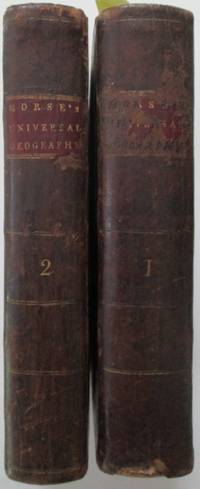
1793ref. 012721Boston: Isaiah Thomas and Ebenezer T. Andrews Printers 1793. Leather. Good. Full Calf leather. 696 552 pp. Eight fold out plates/maps in volume one three in volume two all present as called for. 1793 edition of this early geographical survey of the United States as well as the world containing maps relating to the United States at the time North America and the world. This work served to heavily influence the teaching of geography and education in the US. GOOD condition. Moderate to heavy scuffing to the leather covers and extremities with a few deep scrapes and scratches present. Minor soiling and staining. Interiors solid with moderate toning scattered foxing staining and soiling. Dampstaining present to the endpapers. Ownership signatures present. A few pages creased including dog ear creases. The Virginia map is very tattered torn and misfolded with a few other American maps also bearing tears ranging from small to long along the folds. Some creasing to the maps. Sabin 50926. Isaiah Thomas and Ebenezer T. Andrews, Printers unknown
ref. 019708Boston: B. Franklin Edmunds. Quarter Leather. Good. no date perhaps mid 1830s. Most likely appeared in an earlier London edition around 1828 as The Stolen Boy. Quarter leather with blue paper covered boards. Approximately 3 by 2 3/8 inches. Page edges gilt. 63 1 64 pp. With 10 full-page wood engravings including frontispieces. The first 63 pages comprise "Little Manuel" purporting to tell the true story of a young Spanish immigrant to Texas who was kidnapped by Native Americans Comanches and perhaps could be considered to fall into the "Indian Captivity Narrative" genre. Illustrated with 6 engravings. The last 64 pages contain a poem to a birthday boy by Felicia Hemans; one page of "Lines to a Young Lady; and "The Travelling Tin-Man: An American Story" by Eliza Leslie. This appears to be a moral tale for children. The book finishes with another short piece by Hofland "The Deserted Villagers; or the Confiding Boy." Eliza Leslie was perhaps best known as a cookbook author in the 19th century although she did write fiction and nonfiction. Barbara Wreaks Hoole Hofland was an English author primarily writing moral or instructive tales. Given this it is very possible Little Manuel was written as a moral tale. GOOD condition. Leather rather scuffed along the spine and hinges with moderate to heavy scuffing to the extremities. Small area of faint staining to the rear cover. Text block toned with scattered foxing and soiling. B. Franklin Edmunds unknown
1836ref. 022178Dover NH: J.T. Gibbs Publisher 1836. Quarter Leather. Poor. Folio. Quarter leather with marbled boards. Large folio. Bound volume of the Dover New Hampshire newspaper the Dover Gazette and Strafford Advertiser comprising of every weekly issue spanning from December 1 1835 to November 22 1836. Of particular note are many articles recounting events of the Battle of the Alamo in Texas. The first account appears in an early April issue of the paper reporting on what a New Orleans newspaper reported. After this short account longer articles appear documenting more of the battle the events and other news from fighting in Texas. These appear sporadically throughout the rest of the volume. For example the May 3 issue reports news from the Texas Telegraph which prints the names of those dead in the attack mentioning David Crockett James Bowie and many others. Many other articles on battles in the Texas Revolution also appear throughout as well as other news relating to it. Other news in the paper reports on a massacre of crew of the whaling ship Awashonks; the a brief account of the building of a Mormon temple in Kirtland Ohio; the Florida War with the Seminole; a massacre in Hawaii; news on insurrections of enslaved people in Kentucky and New Orleans; a piece on Sam Houston etc. POOR condition. Ex-library with minor stamping. Covers and first several blank endpapers DETACHED. Covers scuffed faded and worn especially along the extremities. Other than the first several endpapers the text block is solid and clean. One or two papers have an ownership signature in ink on the top of the page. J.T. Gibbs, Publisher unknown
1848ref. BB1404Brussels and Leipzig: Carl Muquardt 1848. First Edition thus. Near Fine. Translated into German by Dr. Heinrich Berghous. Imperial 8vo: x2382pp with 24 tissue-guarded hand-colored plates. Contemporary quarter calf flat spine in five compartments lettered and decorated in gilt stamped in blind; marbled covers edges and end papers. An excellent copy binding tight and unmarred moderate foxing mostly marginal to about half of text leaves but plates completely clean and richly colored. Continental editions of Catlin are quite scarce and this offers reduced-scale versions of the plates in the North American Indian Portfolio at a fraction of the cost. Howes C 243b. Sabin 11539. Pilling 684. Graff 630. First German Edition published originally in different form in London 1841 a hybrid of Catlin's two best known works Letters and Notes on the Manners Customs and Condition of the North American Indians 1841 and North American Indian Portfolio 1844. The text of this edition is an abridged version of Letters and Notes while most of the plates are scaled-down versions of the large folio plates of the Indian Portfolio. "As graphic delineations of Indian hunting and dancing scenes these plates rank next to those of Bodmer." Howes N. B. With few exceptions always identified we only stock books in exceptional condition carefully preserved in archival removable polypropylene sleeves. All orders are packaged with care and posted promptly. Satisfaction guaranteed. Carl Muquardt unknown
1841ref. 009470No Place: Notes on Gunpowder Percussion Powder; Cannon and Projectiles 1841. Half Leather. Fair/No Jacket. No place: 1841. Half leather with dark brown pebbled cloth. 75 pp. Black and white illustrations in text throughout. A technical discussion on gunpowder measuring ballistics cannons and their manufacture the use of metals in various projectiles etc. This includes a look at the composition of gunpowder and variations for different applications aspects of different metals and other substances an illustrated look at the manufacturing and testing of cannons ways of measuring ballistics with illustrations etc. Printed via lithograph from handwritten manuscript. Knowlton served as a professor at the United States Military Academy helping to teach mathematics as well as artillery. This particular copy bears pencil corrections pencil brackets and the word 'omit' next to several passages perhaps indicating this was a proof or editor's copy of some sort. FAIR/GOOD condition slightly ex-library bearing a 'torpedo station' stamp in the interior and in gilt on the spine with call numbers at the foot of the spine. Heavy scuffing and some gouging to the leather along the hinges spine and corners with superficial loss. General fading some staining and minor discoloration. Light soiling. Last name in large ink script on the title page with a few other ink notes spots etc. to the first two pages. Leaf 45/46 with heavy ink spots hatches slightly obscuring the text in places. Heavy foxing to the paper with a large dampstain affecting the lower corner. Several pages with tears and chipping along the edges with mostly minor loss. Large rice paper repair to the leaf 71/72 with the fore edge margins of the last 2 pages bearing extensive loss of paper. Notes on Gunpowder, Percussion, Powder; Cannon and Projectiles unknown
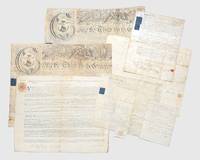
1796ref. 133528c. 1796-97. Where gain is the object bring into harbour all the loaded merchantmen you can An outstanding and unusually comprehensive archive documenting the British-built armed brig Swallow a Liverpool privateer operating in the Caribbean under the experienced prize-master John McIver. The papers trace in exceptional detail the purchase fitting out commissioning and deployment of a late 18th-century privateering vessel anchored by impressive original Letters of Marque. Privateering was in essence a form of licensed warfare. As the Oxford Companion to Ships and the Sea defines it a privateer was "a privately owned vessel armed with guns commissioned by letters of marque which licensed them to take prizes in time of war" 1979 p. 670. This archive shows the process in action. The owners' letters to McIver convey both urgency and anxiety as they navigate the risks of long-distance operations during wartime revealing the network of merchants agents and seamen supporting the Swallow. Early letters make clear that McIver was the driving force: his kinsmen purchased the vessel "solely with the View to make a profitt by a Resale" yet were "well pleased you have taken the Command." The brig was refitted with 10 new iron cannon and furnished with Letters of Marque against French Dutch and later Spanish vessels. In late 1796 the Liverpool partners press McIver to sail immediately for Caribbean waters "in search of Spanish Prizes" while repeatedly stressing the need for constant intelligence. Their concerns deepen over slow remittances from their agent in Jamaica and uncertainty over whether to continue privateering or sell the ship. Built at East Cowes and bought on the stocks by the Royal Navy in 1781 the Swallow was sold in 1795 to a Liverpool consortium including Samuel McDowall the Twemlow family and the McIvers with McIver himself later taking a one-third share. At his urging the vessel was strengthened rearmed and commissioned. Her first Letter of Marque 12 July 1796 authorized cruising against the French and Dutch; a second January 1797 targeted Spanish shipping prompting an increase to 20 guns and a crew of 80. As Gomer Williams notes the Swallow "was not an ordinary privateer but an armed vessel specially hired by Government." McIver enjoyed some success: off Léogâne he sent into Port-au-Prince a large brig and schooner with French property aboard took other vessels and saved the Fame of Liverpool from capture. The letters also record his ancillary government work transporting governors and army officers. By 1797 however the quasi-peace following Leoben and Campo Formio curtailed her privateering activities. The archive also preserves McIver's account of capturing a small American merchantman in 1793 - a case serious enough to draw the attention of Thomas Jefferson and the British envoy George Hammond. The later history of the McIver/MacIver family forms a notable coda: their descendants became central figures in the creation of the Cunard Line partnering with Samuel Cunard and Robert Napier in the 1830s and 1840s to establish what became the British and North American Royal Steam Packet Company. This archive offers a superlative and unusually granular record of British privateering at a moment when European conflict fuelled an upsurge of activity in the Caribbean - a milieu in which as N. A. M. Rodger observes "the letter of marque was often a slender cover for piracy." A full listing with commentary is available on request. Overall in remarkably good condition. N. A. M. Rodgers The Wooden World 1986; Gomer Williams History of the Liverpool Privateers and Letters of Marque with an Account of the Liverpool Slave Trade 1897; Rif Winfield British Warships in the Age of Sail 1714-1792: Design Construction Careers and Fates 2007 p. 314. unknown