Livre Rare Book

152 resultados
1908ref. ABE-1121068130120 PAGES FORMAT 29 CM X 38 CM-EN COUVERTURE "LE VOYAGE DU PRESIDENT DE LA REPUBLIQUE A DUNKERQUE, AVANT DE S'EMBARQUER, M.FALLIERES DECORE DE VIEUX MATELOTS"-EN COUVERTURE INTERIEURE "COPENHAGEN L'ARRIVEE DU PRESIDENT DE LA REPUBLIQUE LE ROI FREDERIC ET M.FALLIERES PRENNENT PLACE DANS LE LANDAU"-PAGES D'AUTREFOIS "LE MODELE DE LA CRUCHE CASSEE",1P PAR G.LENOTRE-LE VOYAGE DE M.FALLIERES,3P,8 PHOTOS-LA REVOLTE TURQUE,2P,7 PHOTOS-LA PREMIERE AUTOMOBILE AUX RUINES D'ANGKOR,2P,8 PHOTOS,DUC DE MONTPENSIER,HERVE DE BERNIS-LES CONCOURS DU CONSERVATOIRE,2P,12 PHOTOS-LES JEUX OLYMPIQUES,PHOTO CONCURRENTS FRANCAIS ET ITALIENS-LE DIRIGEABLE DU COMTE ZEPPELIN,2P,3 PHOTOS-LE DIRIGEABLE MIXTE MALECOT,PHOTO-LA FETE ARTISTIQUE DU COMTE ROBERT DE CLERMONT TONNERRE,PHOTO "LA BELLE ET LA BETE",NOZIERE,BLANCHE TOUTAIN-LE TOUR DE FRANCE CYCLISTE (DU 13 JUILLET AU 9 AOUT),PHOTO PETIT BRETON,PHOTO FRANCOIS FABER
ref. QWA-18714M. Molho Publications Greece, 1982, in-4 rel. cart. (22 x 28,5), 246 p., texte bilingue français-anglais, 249 ill. photos anciennes e noir et en coul., plans, traces de mouillure claire angulaires, sinon bon état.
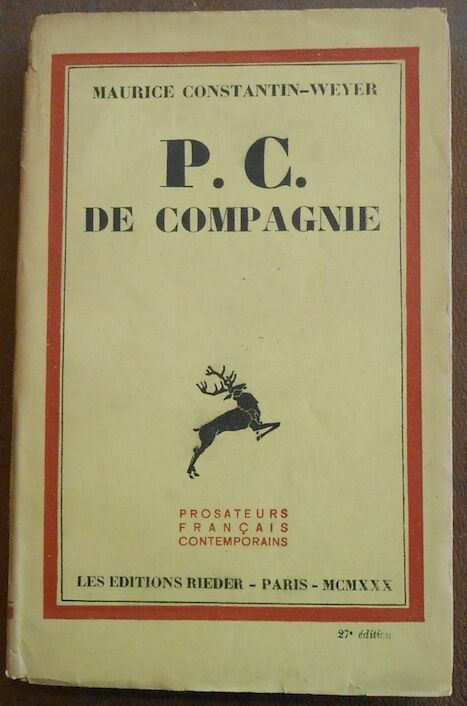
1930ref. 116731930. Paris éd. Rieder 1930 - Broché 12 cm x 19 cm 231 pages - Texte de Maurice Constantin-Weyer - Dos restauré sinon bon état
1964ref. LFA-126741377Revue de 82 pages, format 135 x 210 mm, illustrée, brochée, bon état
2005ref. SPN-646Paris : Publications de la Sorbonne, Série Histoire ancienne et médiévale, 2005. Broché 24x16cm, 284 pages illustrées en noir.
ref. GEO301C501920 / 64 pages. Broché. Editions Laurens.
1958ref. AUB-3967Paris, éd. B. Grasset 1958. Bon exemplaire broché, couverture ornée d'éd., 211 pages + planche.
2004150 p., très nbr. ill. coul. Inv. Th 88
18651180 columns, text printed in 2 numbered columns, 28cm., hardback (bound in nice cart.cover, marbled plates, spine in cloth with gilt lettering), original 1865-edition, in the series "Patrologiae Cursus Completus… Series Graeca. Patrologiae Graecae, latine tantum editae" Tomus LXXVII (77), some occasional foxing & vague water stains in corner of first pages, stamp on titlepage, Text in Latin, Good condition, [complete title: "Traditio Catholica. Saecula XIV-XV anni 1350-1439. Symeonis Thessalonicensis metropolitae Opera Omnia latine nunc primum ex interpretatione nostra edita. Praemittuntur Gregorii Palamae necnon Grigorii Acindyni, Barlaami de Seminaria, Gregorii Sinaitae, Scripta theologica, homelitica et ascetica"], R77753
PARIS, J de Gigord & Action Populaire - In-8 débroché - frontispice - 9 cartes - 545 pages
PARIS, Les Etincelles -1930 - In-8 broché - 2 Cartes dépiantes HT - 349 pages - Propre.y
PARIS, P.U.F. - Fondée en 1878 par Gabriel Monod, publiée avec le concours du CNRS et de la 6e section de l'Ecole des Hautes Etudes.- Revue historique N° 534, Avril, juin 1980 - In-8, 15,5 x24 cm - Broché - paginé 299-611 - Très frais, comme neuf - Envoi rapide et soigné La Revue historique, est une revue d’histoire française créée en 1876 par le protestant Gabriel Monod et le catholique Gustave Fagniez. Cette nouvelle revue s'inscrit en réaction contre La Revue des Questions historiques créée dix ans plus tôt et qui traduisait la pensée d'une droite ultramontaine et légitimiste. La Revue historique ne se réclame d'aucune religion, d'aucun parti, d'aucune doctrine Éditée à Paris par les Presses universitaires de France
PARIS, P.U.F. - Fondée en 1878 par Gabriel Monod, publiée avec le concours du CNRS et de la 6e section de l'Ecole des Hautes Etudes.- Revue historique N° 627, juillet 2003 - In-8, 15,5 x24 cm - Broché - paginé 475 à 734 - Propre - Envoi rapide et soigné La Revue historique, est une revue d’histoire française créée en 1876 par le protestant Gabriel Monod et le catholique Gustave Fagniez. Cette nouvelle revue s'inscrit en réaction contre La Revue des Questions historiques créée dix ans plus tôt et qui traduisait la pensée d'une droite ultramontaine et légitimiste. La Revue historique ne se réclame d'aucune religion, d'aucun parti, d'aucune doctrine Éditée à Paris par les Presses universitaires de France
1897Very Good Turkish, Ottoman (1500-1928) Original manuscript autograph letter signed 'Sadrazam Rifat' sent to Tophâne-i Âmire müsiri Mustafa Zeki Pasa [i.e. Grand master of Turkish artillery]. 38x24 cm. In Ottoman script. Folded. 1 p. It's an official celebration for Mustafa Zeki Pasha's achievements in the Turco-Greco War in 1897-1898. It's written in a beautiful riq'a script. Halil Rifat Pasha was an Ottoman statesman and a Grand Vizier for six years between 1895 until his death in 1901, during the reign of Abdul Hamid II. He was born in Serres (Serez) and received education in an Islamic type parish school in Salonica (Selanik), then continued to Mekteb-i Mülkiye in Constantinople. After his education years, he started to work as a mailing clerk in Vidin, then worked as secretary in the office of the Governor of Salonica. He advanced by degrees and was appointed to higher official positions by passage of time, including at Rustchuk. In 1882 he was appointed as mutasarrif of Vidin, then in 1886 he was appointed as governor of Sivas, where he started a road-building programme. He was subsequently appointed governor of Aidin (1889) and later of Monastir, where he fought brigandage units which was rife in the province. He was appointed as minister of internal affairs in 1893 . Then he was appointed as grand vizier in November 1895 . The most important events in his era as grand vizier were the riots of Sason (in 1895) and in Crete (in 1897), as well as the Greco-Turkish War of 1897 which ended with Ottoman victory. His motto in the road building campaign was "Any place where you can't go is not yours"! (Gidemedigin yer senin degildir!). Zeki Pasha was one of the most trusted Ottoman generals and statesmen of the Sultan Abdulhamid II. He served as Tophane Counselor for 18 years during the reign of Sultan Abdülhamid II. In 1899, Italian architect Alexandre Vallaury built the 'Tophane Müsiri Zeki Pasa Mansion (Yali)', one of the most valuable estates of Istanbul, on his behalf. In 1908, he fell out of favor with the declaration of the Second Constitutional Monarchy by Union and Progress Society (Ittihat ve Terakki Cemiyeti) and was deported first to Büyükada and then to Rhodes. (Source: Wikipedia). Slightly chipped. A very good manuscript paper.
1960Very Good Turkish, Ottoman (1500-1928) Original manuscript autograph letter signed 'Ortaç' by Yusuf Ziya Ortaç to an unknown friend of him. 2 p. Full. In Ottoman script. 'Akbaba' satiric magazine's letterhead with its address in its period, Klodfarer (Claude Farer) Street, Istanbul. It's written with an interesting satiric style of Ortaç and it mentions 50's Turkey. It starts as 'Aziz kardesim, dostum, efendim'. He told that he received his friend's letter and upon this he wrote 'after I've read your letter, I felt like I've seen and heard you, it was like a "fondness feast!'". And he mentions 'Turkish nation' by criticizing as 'This nation knows only just forgiveness! They forgive superabundant; they forget fabrics, chimneys; but never forget some things!'. A rare and very collectible autograph.
1909Very Good Turkish, Ottoman (1500-1928) Original manuscript autograph letter signed 'Birinci Ferik Nâzim' by Hüseyin Nazim Pasa sent to 'Yanya Vali-i Sâbiki Süvâri Ferikânindan saâdetlü [Ferik -i.e. General-] Hamdi Pasha. 37x23 cm. With letterhead of 'Hassa Ordu-yi Humâyûn Dairesi'. In Ottoman Turkish. 1 p. Slightly chipped on folded margins. Otherwise a good manuscript paper. It starts as in elkâb section "Saâdetlü efendim hazretleri" and it goes on as "Hâs Ordu-yi Humâyûna mensûb Birinci Süvâri Firkasi Kumandanligi deruhde olunduk ifâ-yi vâzifeye mübâseret buyurulmasi tevci olunur efendim., Fî sene 27 Rübu'l-evvel [1]327 / ve fî sene 5 Nisan [1]325. ". [i.e. Nazim Pasha wants to take over the task of First Army Commandership]. Hegira: 1325 = Roumi: 1327 = Gregorian: 1909. This letter written in Balkan Peninsula before Balkan Wars (1912-1913). Nazim Pasha was the Minister of War of the Ottoman Empire from 8 January 1912 to 23 January 1913. His father was Circassian Ismail Pasha (Çerkes Ismail Pasa). He joined the war ['93 Harbi = 1877-78 War] as a young officer. Afterwards, he held various positions in the Ottoman armies, especially in Rumelia. He participated in military maneuvers in Russia and France and was later included in the 'Fahr-i Yaverân'. He served as the 2nd Army Command in Edirne during the Constitutional Monarchy period and was briefly appointed as the 1st Army Command in March 31 period. During this period, he was close to Ahrar Party and Prince Sabahattin. Later, the First Balkan War, in which he commanded the Ottoman army as the Commander-in-Chief, failed.
1921Very Good Turkish, Ottoman (1500-1928) Original manuscript autograph letter signed 'Ziya Kutnak' sent to Mustafa Hilmi Pasha. 27x17 cm. In Ottoman script. 1 p. It mentions 'Divân-i Harb azaligina tayîn'. [i.e. Assignment to the Divan-i Harb membership]. (Divân-i Hârb was an assembly where high-ranking soldiers meet for work on war issues or war criminals). Çürüksulu Ziya Pasha or Ziya Kutnak is the last Minister of War in the Ottoman Empire. His father was Çürüksulu Osman Nuri Pasha who was Hedjaz (Hijaz) Governor. In 1908, he participated in military exercises in Russia. In 1911, he visited Rumelia with Sultan Mehmed Resad during Sultan's famous voyages to Rumelia. He was sent as a representative to the King of England ceremonies. He assisted the Turkish War of Independence during his war ministry. Mustafa Hilmi Pasha, (1840-1922), was a general of the Ottoman Army. He was the son of Ibrahim Pasha Sarim. In the early 20th century, he participated in the modernisation and unification of the Ottoman Army. In World War I, he commanded the VI. Army Corps, which was sent to participate in the campaign against Romania during the period October 1916 - February 1918. In the Turkish War of Independence, he fought against French forces around Aleppo. He died in 1922 in Istanbul. Original text: "Erkân-i Divân-i Harbiye Meclisi olan tayinleri hususuna bi'ilânindan fî sene 7 Eylül [1]337 tarihinde irâde-i seniyye-i cenâb-i pâdisâhî seref-müteallik buyurulmus olmakla hemen vazife-i cedidelerine mübâseret buyurmalari mütemennâdir efendim. Fî sene 14 Eylül [1]337. Harbiye Nâziri [Signature]".
1895Very Good Turkish, Ottoman (1500-1928) Original manuscript autograph berat for preferment of Hüseyin Hüsnü Pasha in '93 Harbi ( Risso-Turco War, 1877-1878). 41,5x24 cm. In jali-diwani Ottoman script. Signed and sealed. Preferment of Hüseyin Hüsnü Pasha on his achievements in the Russo-Turkish War between the years of 1877-78.
2016New Turkish Paperback. Demy 8vo. (21 x 14 cm). In Turkish. 204 p., ills. Yarim asirlik tutku, Türkiye ve ben. Vol. 1: Bereketli yillar.
1907Very Good Turkish, Ottoman (1500-1928) Original autograph letter handwritten signed by Mahmud Sevket. (33x21 cm). In Ottoman script. 1 p. Case and its response by Mahmud Sevket when he was the governor of Kosovo. Document has 17 lines including the case of 'comitadjis' in Gjilan region of Kosovo. Report says that several comitadjis have been arrested and for them the court was expected to issue a death sentence. In his response, Mahmud Sevket Pasha has ordered that the death penalty should be converted to life rowing (hard labour). Mahmud Sevket's text: "Mabeyn-i Humayun Cenâb-i mülûkâne-i bas kitâbet celilesinden (?) celileden teblîg buyurulan telgrafane-i âlîsi sureti bilâde nakl-i (?) müebbeden kürek cezasi ile mahkûm edilerek idamlari cihetine gidilmemenin azâ-yi muhakemeye ettirilmeyeek ve muamelât-i muhakeme-i te'dib etmekte olan memuriye mucibiince dahi anlasilamayacak surette muhakeme-i fevkalâde re'isine bizzat sifâhen teblîg buyurulmus ve isbu muharebenin nezd-i âlîsinde hifz-i (?) müsarinileyhin emriyle müstesnâdir. Yevm-i muhakeme gayr-i mâlûm ise de bunun yarisinin bile icrâ olunmasi mahtumun bulunduguna göre teblîgâtin ihtiyâten teblîgi (?) baskaca beyân olunur efendim. Kosova Vâlisi Birinci Ferik Mahmud Sevket.".
1908Very Good Turkish, Ottoman (1500-1928) Original autograph letter handwritten signed by Mehmed Semseddin Pasha addressed to 'Kütahya Evkâf-i Humâyûn' [i.e. Kütahya Imperial Foundations]. It starts with 'Huve' traditionally. (29x21 cm). In Ottomsn script. Letterhead 'Nezâret-i Evkâf-i Humâyûn' [i.e. Ministry of foundations]. 1 p. including eight lines with additional annotation. Mehmed Semseddin was an Ottoman / Turkish statesman with Circassin (Adige - Shapsig) origin, descended from Tletseruk (or Tleseruk) family. Mehmed Semseddin Pasha was the son of Hacizade Osman Bey who was a Circassian chieftain. In 1864, his family emigrated to Samsun and then to Istanbul in the Great Immigration of Circassians. He was graduated from Galatasaray High School. He was also groom of Egypt Extraordinary Commissioner Circassian Rauf Pasha, a member of the Society Circassian Charity (Çerkes Teavun -Yardim- Cemiyeti), the manager and author of Guaze newspaper published in Turkey which was first published journal in Latin letters in Turkey.
1909Very Good Turkish, Ottoman (1500-1928) Original paper autograph letter handwritten signed by Mahmud Sevket, Izzeddin Çalislar. (33x21 cm). In Ottoman script. 2 p. Repaired back side. Request of a surgical operation by 'Said bin Mehmed' (Siroz Redif Taburu Efrâdindan) and Mahmud Sevket Pasha and Izzeddin's confirmations. Signed by Mahmud Shevket Pasha as "commander of Turkish countercoup of 1909 (Hareket Army)" and by Izzeddin [Çalislar] as "Erkân-i Harb Kolagasi (Batallion commander)". The Ottoman countercoup of 1909 (13 April 1909) was an attempt to dismantle the Second Constitutional Era of the Ottoman Empire and replace it with an autocracy under Sultan/Caliph Abdul Hamid II. Unfortunately for the advocates of representative parliamentary government, mutinous demonstrations by disenfranchised regimental officers broke out which led to the collapse of the Ottoman government. Characterized as a counterrevolution, chaos reigned briefly and several people were killed in the confusion. It was instigated by some parts of the Ottoman Army in a large part by a certain Cypriot Islamic extremist. Dervish Vahdeti reigned supreme in Istanbul for 11 days. The Countercoup was put down in the 31 March Incident, on 24 April 1909 by the Army of Action (Hareket Ordusu) which was the 11th Salonika Reserve Infantry Division of to the Third Army (Ottoman Empire) commanded by Mahmud Shevket Pasha. Extremely rare.
1903Very Good Turkish, Ottoman (1500-1928) Original manuscript autograph document signed by Mehmed Said Pasha sent to Trabzon Vilayat, Ordu Kaza, Hasbamane Nahiya local manager, faziletlu 'Mehmed Ali Sevki Beyefendi'. 33,5x20 cm. Folded. 1 p. In Ottoman script. Mehmed Said Pasha was an Ottoman monarchist, senator, statesman and editor of the Turkish newspaper Jerid-i-Havadis. He supported the CUP, the political party which came to power after the Ottoman coup d'état of 1913. His origin comes from 'Sebazâde family' from Ankara. He became first secretary to Sultan Abdul Hamid II shortly after the Sultan's accession, and is said to have contributed to the realizations of his majesty's design of concentrating power in his own hands; later he became successively minister of the interior and then governor of Bursa, reaching the high post of grand vizier in 1879. He was grand vizier seven more times under Abdul Hamid II, and once under his successor, Mehmed V. He was known for his opposition to the extension of foreign influence in Turkey. n 1896, he took refuge at the British embassy in Constantinople, and, though then assured of his personal liberty and safety, remained practically a prisoner in his own house. He came into temporary prominence again during the revolution of 1908. On 22 July he succeeded Mehmed Ferid Pasha as grand vizier, but on the 6 August was replaced by the more liberal Kâmil Pasha, at the insistence of the Young Turks. Also during 1908, Mehmed Said Pasha bought the famed Istanbul arcade in the Beyoglu (Pera) district, today known as Çiçek Pasaji ("Flower Passage"). The modern name became common in the 1940s; during Mehmed Said Pasha's ownership in the 1900s and 1910s, the arcade was known as Sait Pasa Pasaji ("Said Pasha Passage"). During the Italian crisis in 1911-12, he was again called to the premiership. He was again removed from power by the Savior Officers (who backed the Freedom and Accord Party (Liberal Union) against the Committee of Union and Progress) and replaced by a new cabinet supported by the Officers and the Freedom and Accord Party. The CUP would return to power, however, the next year after the Ottoman coup d'état of 1913. (Source: Wikipedia). Seven lines on special paper with watermark 'Joynson Superfine'. Letter of request to provide teaching for some students in the region.
2003New New Turkish Original bdg. Dust wrapper. 4to. (31 x 23 cm). In Turkish. 392 p., color and b/w ills. With its CD. Imparatorluk'tan Cumhuriyet'e Selanik'ten Istanbul'a Terakki Vakfi ve Terakki Okullari, 1877-2000. Edited by Nuri Akbayar. [With a CD].
2019New Turkish Paperback. 4to. (28 x 20 cm). In Turkish. 184 p., b/w ills. Mübadil kentler: Türkçe konusan Rum Ortodokslar. Tarih, bellek, kimlik, kültür. Printed to 1000 copies.