Maurice Constantin-WeyerLivre Rare Book
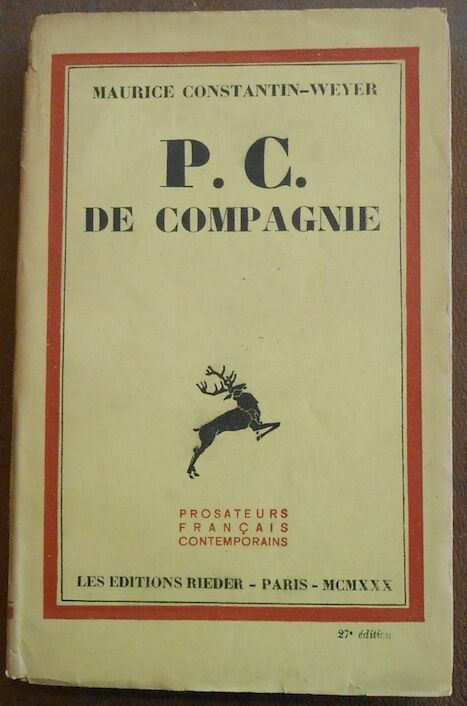
1930rif. 116731930. Paris éd. Rieder 1930 - Broché 12 cm x 19 cm 231 pages - Texte de Maurice Constantin-Weyer - Dos restauré sinon bon état
1987rif. 152819Stuttgart: Verlag Katholisches Bibelwerk 1987. 308 Seiten. Mit 35 Abbildungen im Anhang. 8° (17,5-22,5 cm). Illustrierte Orig.-Broschur. [Softcover / Paperback].
2005rif. SPN-646Paris : Publications de la Sorbonne, Série Histoire ancienne et médiévale, 2005. Broché 24x16cm, 284 pages illustrées en noir.
rif. ria9781032602080_inpPaperback / softback. New. New Book; Fast Shipping from UK; Not signed; Not First Edition; Whether you're new to statistical analysis or looking to enhance your analytical skills with the R programming language this textbook provides comprehensive and practical guidance for understanding fundamental statistical concepts thro paperback
1978Softcover, 8vo, xii, 203 pages, 21 cm. In Spanish. Biblioteca Nueva sefarad; volume 5. SUBJECT (S) : Proverbs, Ladino -- Greece -- Thessalonike. Light wear to binding. Lightly bumped corners. Excellent condition. (Sef-17-5)
rif. 27220PARIS, P.U.F. - Fondée en 1878 par Gabriel Monod, publiée avec le concours du CNRS et de la 6e section de l'Ecole des Hautes Etudes.- Revue historique N° 534, Avril, juin 1980 - In-8, 15,5 x24 cm - Broché - paginé 299-611 - Très frais, comme neuf - Envoi rapide et soigné
rif. 27227PARIS, P.U.F. - Fondée en 1878 par Gabriel Monod, publiée avec le concours du CNRS et de la 6e section de l'Ecole des Hautes Etudes.- Revue historique N° 627, juillet 2003 - In-8, 15,5 x24 cm - Broché - paginé 475 à 734 - Propre - Envoi rapide et soigné
PARIS, P.U.F. - Fondée en 1878 par Gabriel Monod, publiée avec le concours du CNRS et de la 6e section de l'Ecole des Hautes Etudes.- Revue historique N° 534, Avril, juin 1980 - In-8, 15,5 x24 cm - Broché - paginé 299-611 - Très frais, comme neuf - Envoi rapide et soigné La Revue historique, est une revue d’histoire française créée en 1876 par le protestant Gabriel Monod et le catholique Gustave Fagniez. Cette nouvelle revue s'inscrit en réaction contre La Revue des Questions historiques créée dix ans plus tôt et qui traduisait la pensée d'une droite ultramontaine et légitimiste. La Revue historique ne se réclame d'aucune religion, d'aucun parti, d'aucune doctrine Éditée à Paris par les Presses universitaires de France
PARIS, P.U.F. - Fondée en 1878 par Gabriel Monod, publiée avec le concours du CNRS et de la 6e section de l'Ecole des Hautes Etudes.- Revue historique N° 627, juillet 2003 - In-8, 15,5 x24 cm - Broché - paginé 475 à 734 - Propre - Envoi rapide et soigné La Revue historique, est une revue d’histoire française créée en 1876 par le protestant Gabriel Monod et le catholique Gustave Fagniez. Cette nouvelle revue s'inscrit en réaction contre La Revue des Questions historiques créée dix ans plus tôt et qui traduisait la pensée d'une droite ultramontaine et légitimiste. La Revue historique ne se réclame d'aucune religion, d'aucun parti, d'aucune doctrine Éditée à Paris par les Presses universitaires de France
2001Fine English Paperback. Pbo. Demy 8vo. (21 x 14 cm). In Turkish. 432 p. Sabatay Sevi: Mesih mi sahte peygamber mi? Translated by Selahattin Ayaz. First Edition of Sholem's 'Mystic mesiah'.
1967Book shows light wear with a small stain on back cover. Binding is solid and square, covers have sharp corners, exterior shows no blemishes, text/interior is clean and free of marking with previous owner's stamp and name at front endpaper. Small format hardback with full page color plates throughout. 80 pages, includes St. Christophorus, St. George, Seven Sleepers of Ephesus Florus and Laurus, St. Demeter of Salonica, Martyrs of Kosmas and Damian, Boris and Gleb, David, Throdore , Constantine, etc.
1919rif. 19932Genève, Fréd. Boissonnas, éditeur d'Art, Collection L'image de la Grèce, 1919. In-4 broché de [8] pages suivies des planches, couverture ornée à rabats.
2005New English Paperback. Pbo. Roy. 8vo. (24 x 17 cm). In English. 300 p. Contents: Foreword Part I: HISTORICAL OVERVIEW 1. Les Juifs en Grèce au XXème siècle 2. The Jewish Presence in Salonica 3. Germany?s Policy Against the Jews of Greece: The Annihilation of the Jewish Community of Thessaloniki, 1941- 1944 PART II: SOCIAL AND INSTITUTIONAL ORGANISATION 4. Etat de la recherche 5. Le renouveau de la communauté juive de Salonique entre 1856 et 1919 6. Les Juifs d?Istanbul avant et après les Tanzimat 7. Jewish Working-Class Neighborhoods Established in Salonica Following the 1890 and 1917 Fires 8. Education in the Jewish Community of Salonica in the Beginning of the Twentieth Century 9. Female Jewish Education in Salonica at the End of the 19th Century 10. Le Cercle de Salonique 1873-1958 : Club des Saloniciens PART III: THE POLITICAL ROLE OF THE JEWS FROM 1908 TO 1936 11. The Zionist Movement in Salonica up to the A?Panhellenic Zionist Congress 12. The Jewish Community of Salonica and Its Incorporation into the Greek State 1912-1919 13. Salonique après 1912. Les propagandes étrangères et la communauté juive 14. Popular Antisemitism and State Policy in Salonica during the City?s Annexation to Greece, 1912-1919 15. La législation anti-juive de Venizélos entre les deux guerres ou comment la République peut venir au secours de l?antisémitisme PART IV: JUDEO-SPANISH LANGUAGE AND CULTURE 16. The Judeo-Spanish, a Mediterranean Language in Daily Use in 20th Century Salonica 17. Le théâtre judéo-espagnol à Salonique: une source de l?histoire sociale des Juifs locaux 18. Judeo-Spanish Theatre Plays on the Themes of Tradition and Change in the Early Twentieth Century, CHRONOLOGY BIBLIOGRAPHY.
rif. 12515British Salonica Army; Balkans. 1917. 3pp. 4to. Bifolium. Mimeographed typescript in purple ink. In fair condition on lightly aged and creased paper. Title page reads: '738 M. T. Company A. S. C. 1917 Programme. Slip your Clutch. A Revue In Three Acts by 2nd Lt. J. A. Lincoln Reed.' The second page carries a 'Synopsis of Scenery': 'Act I A Village Green in Blightly Act II Scene I - Mikra Bay Scene II - Serres Road Act III Interior of the Follies Bergeres Night Cafe Salonique out of bounds'. Also the announcement: 'The entire production by members of 738 MET. COMPANY A.S.C.' Names of 'Musical Director and Pianist'; and 'Violinists' are given at the foot of the page with the whole of the third page carrying the 'Dramatis Personae' with characters including 'Seccotine Blake i.e. Sexton Blake from Scotland Yard' and 'Ivor the Dwiver' and with four soldiers playing the 'Village Girls' Phyllis Elsie Vera and Milly. The final character 'Fifi' is accompanied by a '' Seventeen soldiers are named all privates and corporals apart from 'Cpl. J. W. Boys' 'Cpl. W. C. Hardy' 'Sgt. J. E. Howard' and '2nd Lt. J. A. Lincoln Reed'. No copy on COPAC. From the papers of Captain George Malleson Butt of the Army Service Corps who informed his father on 18 August 1917 in a letter not included with this item that the performance 'was really most awfully good it is astonishing how well men make up as girls better than girls make up as men of course there was no plot all written & got up out here the scenery first rate & the drama & the acting really good electric light and all modern amenities including a bar the whole thing is self contained & is touring round it is an eyeopener to see how much can be done with small resources. Programme girls were a few Greeks brought in'. [British Salonica Army; Balkans.] 1917. unknown
2000New English Paperback. Roy. 8vo. (24 x 17 cm). In French. 136 p. Salonique a la fin du XIXe siecle.
2016New English Paperback. Pbo. Roy. 8vo. (24 x 17 cm). In French. 337 p. Salonique au XIXe siècle. Regards sur les gens ordinaires. Contents: Introduction 1ère Partie. UNE VILLE PLURICOMMUNAUTAIRE Les Grecs de Salonique à l¿aube des réformes ottomans L¿espace domestique des musul-mans Artisans et boutiquiers juifs Des Francs indigènes et étrangers 2e Partie. ASPECTS DE LA COMMUNAUTÉ MUSULMANE Immigrés et autres céli-bataires Possesseurs de livres Bibliothèques et univers intellectuel Anciens esclaves, nouveaux convertis 3e Partie. UNE MODERNITÉ DE FAÇADE ? Quadragénaires « fin de siècle » Le changement du cadre urbain Les cafés Les sports Un journal ottoman de province Épilogue: Salonique après 1912.
2000Very Good English Paperback. Pbo. Roy. 8vo. (23 x 16 cm). In Turkish. [xii], 70, 33 p., 7 b/w plates. 33 p. facsimile of Latin script. Chronicle of the last siege of Salonica, a Byzantine source belongs to Sultan Murad II, the Ottoman Empire. Selânik (Thessaloniki)'in son zapti hakkinda bir tarih. Sultan II. Murad dönemine ait bir Bizans kaynagi. Translated and prep. by Melek Delilbasi.
2011Greece, 1940. In the port city of Salonika, with its wharves and brothels, dark alleys and Turkish mansions, a tense political drama is being played out. "Spies of the Balkans" is a stunning novel about a man who risks everything to fight back against the world's evil. Set in Greece in 1940, this powerful WWII thriller from Furst (The Spies of Warsaw) focuses on Costa Zannis, a senior Salonika police official known for his honesty and ability to settle matters "before they got out of hand." As the Nazis' intentions for Europe's Jews becomes clear, Zannis goes out of his way to aid refugees seeking to escape Germany. When Mussolini's troops invade Greece, Zannis joins the army, where he meets Capt. Marko Pavlic, who as a policeman in Zagreb investigated crimes committed by the Ustashi, Croatian fascists. With their similar politics, Zannis and Pavlic soon become friends and allies. Subtle details foreshadow the coming crimes perpetrated by the Nazis in the Balkans. For example, Zannis learns from a colleague that someone has been taking photos of the contents of a synagogue so that the Germans can more easily identify what to plunder. Book
2011Greece, 1940. In the port city of Salonika, with its wharves and brothels, dark alleys and Turkish mansions, a tense political drama is being played out. "Spies of the Balkans" is a stunning novel about a man who risks everything to fight back against the world's evil. Set in Greece in 1940, this powerful WWII thriller focuses on Costa Zannis, a senior Salonika police official known for his honesty and ability to settle matters "before they got out of hand." As the Nazis' intentions for Europe's Jews becomes clear, Zannis goes out of his way to aid refugees seeking to escape Germany. When Mussolini's troops invade Greece, Zannis joins the army, where he meets Capt. Marko Pavlic, who as a policeman in Zagreb investigated crimes committed by the Ustashi, Croatian fascists. With their similar politics, Zannis and Pavlic soon become friends and allies. Subtle details foreshadow the coming crimes perpetrated by the Nazis in the Balkans. Book
rif. 0266345352.Ghardcover. Good. Access codes and supplements are not guaranteed with used items. May be an ex-library book. hardcover
rif. QWA-18714M. Molho Publications Greece, 1982, in-4 rel. cart. (22 x 28,5), 246 p., texte bilingue français-anglais, 249 ill. photos anciennes e noir et en coul., plans, traces de mouillure claire angulaires, sinon bon état.
2021New English Paperback. Roy. 8vo. (24 x 17 cm). In English. 320 p. The invisible commmunity: Bulgarians in Ottoman Salonica. List of Illustrations Introduction Preface Chapter 1. Formation and Consolidation of the Bulgarian Community Early evidence of Bulgarians in Salonica and Beginning of their Social Organization 1.2. Social Structure of the Bulgarian Population 1.3. The Bulgarian Church Community 1.4. Community Properties and Buildings Chapter 2. Salonica as an Education Centre of Bulgarians 2.1. Elementary schools. 2.2. High School Education of Young Bulgarians. 2.3. The Holy Annunciation Bulgarian Girls' High School. 2.4. Bulgarians and Non-Bulgarian Educational Institutions. Chapter 3. Bulgarians and the City: Social and Political Reflections 3.1. Bulgarian Participation in the Public Life of Ottoman Salonica. 3.2. Participation of the Bulgarians in the Political Life of the City. 3.3. National Confrontation and Annihilation of the Bulgarian Community. Epilogue Conclusion Illustrations Bibliography Index.
2014New English Paperback. Pbo. Demy 8vo. (21 x 14 cm). In English. 170 p. " As a result of the modernization process transforming much of the world in the nineteenth century, the changing structure and function of the state necessitated the development of a relationship between states and their subjects. In the context of this relationship, states used various instruments to monitor, control, and shape their subjects in order to ensure the survival of the state machinery. Education acquired a pivotal importance in shaping subjects according to state policies. In the Ottoman Empire its importance also began to be perceived in the first half of the century, but it was Hamidian era that such a policy manifested itself most clearly. Yet, for the people living in the villages, it was the agrarian economy that would continue to determine and shape their lives. Thus villages became a field of struggle between the state, which was attempting to penetrate rural life (and, by extension, the lives of the peasants) through education, and the realities of an agrarian existence and the economic and social relationships that it creates. For that reason, a history of education without a comprehensive analysis of the village conditions would be incomplete. This book aims to fill this blank in the history of education by focusing on the socio-economic structure in the villages that derives from agrarian economy. In doing so it also offers new sights to the field of social history through a close examination of the lives of peasants and the complex relationships between them.".
1962Comprehensive survey, with detailed statistics, of economic and development and post-war reconstruction in N. Greece. Covers agriculture, livestock, fishing, forestry, mining, industry & handicrafts, electricity, transportation, ports & trade, tourism.227p. illus maps, tables bibliography. Spine sun tanned else near fine. Book
2010New English Paperback. Pbo. 4to. (30 x 25 cm). In English. Ills. [x], 184 p. The intent of this study is multi fold: on the one hand it introduces and publishes a heretofore unknown annotated secere (genealogical tree), covering the Evrenosogullari (descendants of Haci Evrenos) from the beginning of the 14. through the third quarter of the 17. century, while on the other it presents a collection of seven inscriptions on stone (kitâbeler) relating to the early Ottoman March Lord (Uc Beg) Haci Evrenos, of which only one has been previously published.