Japan WWII US Army Katakana GuideBiblio.com
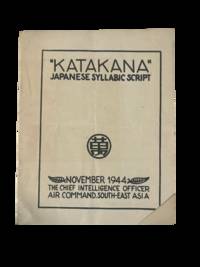
WWII Allied Forces Japanese Translation Guide Katakana: Japanese Syllabic Script 1945
1945réf. 226061945. WWII Japan Linguistics Katakana: Japanese Syllabic Script. Chief Intelligence Officer Air Command South-East Asia November 1944. First edition. Illustrated throughout with syllabary charts and pronunciation tables. Original printed wrappers. 6 pages. 8vo. Issued for Allied intelligence personnel during World War II this scarce pamphlet provided military staff with an introduction to katakana one of the two Japanese phonetic syllabaries. Prepared under the authority of the Chief Intelligence Officer for Air Command in Southeast Asia the manual emphasizes the script's military utility noting that "on account of its clarity katakana has been adopted by the Armed Forces of Japan for use in the spelling of foreign names and words in signals in maps etc." Explanatory text outlines the history of Japanese writing systems the role of katakana in phonetic transcription and its function in military communications. Pages feature full katakana syllabary charts "additional katakana groups" for voiced and combined sounds a section on Japanese numerals and examples of transliterated foreign names such as "Singapore" "Java" and "Sumatra." The pamphlet also instructs readers that katakana can be written "in almost any direction; left to right or right to left or from top to bottom and even diagonally." Light toning bottom right cover corner clipped interior clean and well-preserved overall very good condition. A rare wartime intelligence manual bridging linguistics and military history this ephemeral publication documents Allied efforts to train personnel in Japanese language recognition and highlights the central role of katakana in wartime communication systems. Particularly significant for institutions collecting on Japanese linguistics World War II intelligence and the history of language pedagogy in military contexts. unknown
Max Rambod Inc. · États-Unis285,00 $US≈ 254,62 €