1820 risultati
1869rif. 59086Paris Gauthier-Villars 1869. 4to. In: "Comptes Rendus Hebdomadaires des Séances de L'Academie des Sciences" Tome 68 No 7. Pp. 349- 408. Entire issue offered. Janssen's paper pp. 367-376. First printing of the paper in which Janssen announced the discovery of a new element. On August 18 1868 Janssen managed to do just that. He became the first person to observe helium an element never before seen on Earth in the solar spectrum. At the time though Janssen didn’t know what he’d seen"just that it was something new""Helium the second most abundant element in the universe was discovered on the sun before it was found on the earth. Pierre-Jules-César Janssen a French astronomer noticed a yellow line in the sun's spectrum while studying a total solar eclipse in 1868. Sir Norman Lockyer an English astronomer realized that this line with a wavelength of 587.49 nanometers could not be produced by any element known at the time. It was hypothesized that a new element on the sun was responsible for this mysterious yellow emission. This unknown element was named helium by Lockyer." unknown
1818rif. 43871Paris Crochard 18181819. No wrappers. In: "Annales de Chimie et de Physique Par MM. Gay-Lussac et Arago." tome 8 Cahier 3 a. 10 Cahier 2 pp. 225-336 and pp. 129-240. Entire issues offered. Pelletier & Caventou's papers: pp. 323-324 tome 8 and pp. 142-176 tome 10. A few scattered brownspots. First printing of these classic papers in chemistry in which the authors announced their discovery of Strychnine. This was the first alkali of vegetable origin to be discovered after morphine. This discovery and their discovery of chlorophyll brought them international fame. The first small paper contains the announcement of the discovery and the second long memoir contains the elaborate exposition of the discovery."Strychnine was only the second alkaloid to be extracted the first was morphine. Pelletier and Caventou wanted to name their new alkaloid vauqueline after Nicolas Vauquelin one of their associates who had refined the technique of ether extraction for use in isolating alkaloids. However the officers of the Académe des Sciences in Paris rejected the idea on the grounds that a respected scientist’s name should not be paired with a deadly poison. In addition to strychnine the pair isolated other important compounds from plants including caffeine chlorophyll and the anti-malaria drug quinine. Paul L. Burnham.Parkinson:"Breakthroughs" 1818 C. - Garrison & Morton: 1846.The first issue also contains their importent memoir "Examen chimique de la Cochenillee et de sa matière colorante" pp. 250-287 which describes how they obtained crotonic acid from croton oil and analyzed carmine in the cochineal. unknown
1801rif. 43492Halle Rengerschen Buchhandlung 1801. Without wrappers as published in "Annalen der Physik. Herausgegeben von Ludwig Wilhelm Gilbert" Bd. 7 Viertes Stück. The entire issue offered =Heft 4. Pp. 387-528. Ritter's announcement p. 525. With titlepage to volume 7. Clean and fine. Titlepage a bit shavedin inner margin. First printing of Ritter's announcement of his discovery of ultraviolet light in a halfpage letter addressed to Gilbert's Annalen. With that discovery it became clear that visible light represents no more than a fraction of a continous spectrum.A year earlier in 1800 William Herschel discovered infrared light. This was the first time that a form of light beyond visible light had been detected. After hearing about Herschel's discovery of an invisible form of light beyond the red portion of the spectrum Ritter decided to conduct experiments to determine if invisible light existed beyond the violet end of the spectrum as well. He had heard that blue light caused a greater reaction in silver chloride than red light did. Ritter decided to measure the rate at which silver chloride reacted to the different colors of light. He directed sunlight through a glass prism to create a spectrum. He then placed silver chloride in each color of the spectrum and found that it showed little change in the red part of the spectrum but darkened toward the violet end of the spectrum. Johann Ritter then decided to place silver chloride in the area just beyond the violet end of the spectrum in a region where no sunlight was visible. To his amazement this region showed the most intense reaction of all. This showed for the first time that an invisible form of light existed beyond the violet end of the visible spectrum. This new type of light which Ritter called Chemical Rays later became known as ultraviolet light or ultraviolet radiation the word ultra means beyond. - Parkinson Breakthroughs: 1801 P. unknown
1831rif. 43365Paris Crochard 1831. No wrappers as extracted from "Annales de Chimie et de Physique" 2. Series Tome 48. Titlepage to vol. 48. Pp. 113-157. A few brownspots but fine. Small stamps on verso of titlepage. First appearance of an importent paper in chemistry and medicine as it for the first time relates the finding of Chloroform which some years later was proved to have anaesthetic effects and was introduced in chirurgy in 1848 by Simpson.Justus von Liebig Souberain and Guthrie independently discovered Chloroform in 1831 but Souberain was the first to publish his results. - Garrison & Morton No. 1851. - Gedeon "Science and Technology in Medicine" 36.7. unknown
1866xxii, 638, 6 (ads) pages. Fold-out map. Occasional black and white illustrations. "It has been my object in this work to give as clear an account as I was able of tracts of country previously unexplored, with their river systems, natural productions, and capabilities; and to bring before my countrymen, and all others interested in the cause of humanity, the misery entailed by the slave-trade in its inland phases - a subject on which I and my companions are the first who have had any opportunities of forming a judgement." - from Preface. "There must be something in the appearance of white men frightfully repulsive to the unsophisticated natives of Africa; for, on entering villages previously unvisited by Europeans, if we met a child... he would take to his heels in an agony of terror, such as we might feel if we met a live Egyptian mummy at the door of the British Museum." - from page 199. Fold-out map measures 24" wide by 17" high and is entitled "The River Shire, The Lakes Nyassa & Shirwa, The Lower Courses of the Rivers Zambesi & Rovuma" - based on the Astronomical observations and sketches of Dr. Livingstone, Constructed by John Arrowsmith, 1865. The routes of Dr. Livingstone and the Officers of the expedition are indicated in red. Map bears one inch opening along left side. Book has been recased in red buckram with new beige endpapers. Binding sound. Average wear. Unmarked. Lettering upon spine rubbed but legible. A quality copy. Book
1977346 pages. Bibliography. Author index. Report of the Estuary Working Group, Department of Fisheries and the Environment, Regional Board Pacific Region. Contains 9 pages of memorial dedicated to Roderick Haig-Brown who passed away in 1976. Includes a full-page photo of Mr. Haig-Brown, a bibliography of his writings, copies of two letters written by RHB to Dr. M. Waldichuk, Director of the Special Estuary Series, and more. Contents include: Geology and Soils, Climatology, Hydrology, Oceanography, Fish, Invertebrates, Flora, Wildlife, Land and Water Use, Pollution and Water Quality, Effects of Development, and more. Average wear. Unmarked. Binding intact. Quality copy. Book
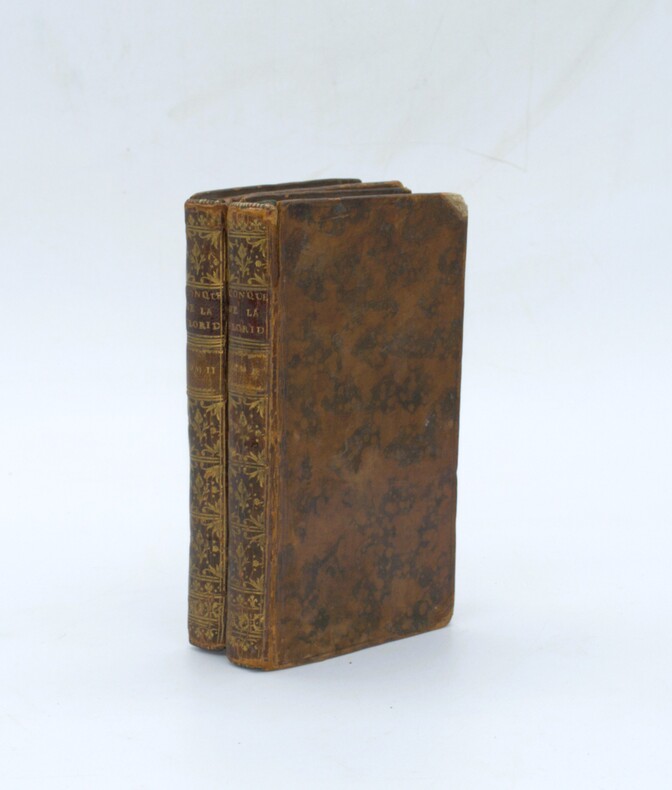
1731rif. PHO-2473Leiden, Chez Pierre Vander Aa, 1731, 2 volumes in-12 (17x10cm), 13ff.-290pp. et 293-582pp., veau marbré époque, dos lisse orné avec pièce de titre rouge et tomaison, tranches rouges, ex-libris gravé en page de garde (De Goderville). Frottements, coiffes arasées, coins usés, papier légèrement bruni, petits débuts de fentes. Illustré d’une carte, tirée de l’édition hollandaise de 1706 et de 9 planches dépliantes
1882rif. 47024(Paris, Gauthier-Villars), 1882. 4to. No wrappers. In: ""Comptes Rendus Hebdomadaires des Séances de L'Academie des Sciences"", Tome 95, No 22 a. Tome 104 No 21 (entire issues offered). Pp. 1017-1076 and pp. 1387-1462. Raoult's papers: pp. 1030-33 (tome 95) and pp. 1430-1433 (tome 104).
1882rif. 47024Paris Gauthier-Villars 1882. 4to. No wrappers. In: "Comptes Rendus Hebdomadaires des Séances de L'Academie des Sciences" Tome 95 No 22 a. Tome 104 No 21 entire issues offered. Pp. 1017-1076 and pp. 1387-1462. Raoult's papers: pp. 1030-33 tome 95 and pp. 1430-1433 tome 104. First appearance of Raoult's two importent papers in which described a method for finding the molecular weight of an organic compound by the determination of the lowering of the freezing point of water that resulted from dissolving that compound in water and the law governing the relation between solutes and vapor pressure."Then in 1882 F.-M. Raoult published his results on the effects of nondissociating organic solutes from which he deduced a general law controlling the lowering of freezing points the first paper offered. Four years later he extended this work to show the effect of solutes on vapor pressure the second paper offered. Having established the effect of nondissociating compounds he was in position to show that salts produced an eeffect which though anomalous could nevertheless be explained by the supposition that a dissolved molecule broke up into other molecules. This work was of great value in supplying a new method for determining molecular weights since the depression of freezing point and vapor pressure as well a the related rise in boiling point later discovered are proportional to the moleculat concentrations ofthe solutions; it was of equal value in supporting the ideas of van't Hoff on osmotic pressure. With the announcement of the dissociation theory of Arrhenius the anomalies were explained and the full significance of the generalizations of Raoult was recognized. Raoult published the formulations of his laws in the "Comptes Rendus" for 1882 and 1887 the papers offered" Leicester a. Klickstein "A Source Book in Chemistry" pp. 471 ff. unknown
1842rif. 44147(Leipzig, Johann Ambrosius Barth, 1842). Without wrappers. In ""Annalen der Physik und Chemie. Hrsg. von J.C. Poggendorff"", Ergänzungsband 1, Stück 2. Pp. 193-384 a. 1 folded engraved plate. (The entire issue offered). Henry's paper: pp. 282-312.
1842rif. 44147Leipzig Johann Ambrosius Barth 1842. Without wrappers. In "Annalen der Physik und Chemie. Hrsg. von J.C. Poggendorff" Ergänzungsband 1 Stück 2. Pp. 193-384 a. 1 folded engraved plate. The entire issue offered. Henry's paper: pp. 282-312. First German version of Henry's description of his discovery of self-induction. He missed the credit for the discovery of induction to Faraday but he had done the key experiment ahead of Faraday but Faraday was the first to publish. But he is credited for the discovery of self-induction 1832 and Faraday discovered it independently two years later 1834."In Henry's paper however he explained thet the electric current in a coil can induce another current not only in another coil but in itself. The actual current observed in the coil is then the combination of the original current and the induced current. This is called self induction."Isac Asimov.The issue contains further notable papers Michael Faraday's "Vierzehnte Reihe von Experimental-Untersuchungen über Elektricität" § 2o-22. Nos 1667-1748. Pp. 249-281. First German version. In this paper FARADAYamplifies his theory of electrostatic induction by making further use of the analogy with the induction of magnetism. Whittaker describes the paper as having "THE FUNDAMENTAL EQUATION OF ELECTROSTATICS" as modified in order to take into account the effect of the specific inductive capacity."Whittaker I pp.187-89. unknown
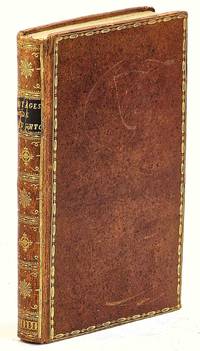
1797rif. 105650Paris: Chez Tavernier. 1797. 1st ed. An VI. Octavo full-leather binding with gilt-stamped decorations bands and title to spine gilt dec border to boards contemporary marbled endpapers pp viii 243 last page misprinted as 343. Three large folding engraved maps drawn up by Major James Rennell the leading British geographer of his time when Mungo Park returned from West Africa: all in very good condition. Spine rubbed minor scuffs to boards front free endpaper just starting to detach. Very good condition. First edition. Published in Paris in the revolutionary "An VI" 1797. Describes the explorations in the interior of Africa of Daniel Houghton 1740 - 1791 and Mungo Park 1771 - 1806. Daniel Houghton was sent by the African Association the Association for Promoting the Discovery of the Interior Parts of Africa; his instructions were to sail to the mouth of the Gambia navigate the river to the Barra Kunda falls and then to travel overland to the Hausa lands to the east. He was one of the first European explorers in the interior of Africa but after a successful visit in Bambouk territory he disappeared somewhere on his journey to Timbuctoo his last despatch being in July 1791. Mungo Park was then sent by the African Association and travelled more extensively in West Africa. He published the book "Travels in the interior districts of Africa" in 1799 i.e. this book precedes Park's publication. Uncommon. 1st Edition. Leather. Chez Tavernier hardcover
1743rif. WOC-1128Avec un Mémoire contenant des avis utiles à ceux qui voudront faire le même voyage. Cinquième édition, plus ample & plus correcte que les précédentes; & enrichie de nouvelles Figures. 79 planches, dont certaines dépliantes. A. La Haye, Chez Henry van Bulderen, Marchand Libraire, dans le Pooten, à l'Enseigne de Mezeray, 1731-1743. 3 volumes in-12 composite de (17,5x9,5cm) pour le 1 et 3 et de (16,8x9,5cm) reliés en plein veau, dos à nerfs ornés de caissons et de fleurons dorés, titre sur maroquin rouge, tranches rouges, fentes sur les charnières du tome 2 et coiffes supérieures faibles. ff-avis,339pp,ff-table + 364pp. + 414 ff-table.
1855rif. 47110Paris, Mallet-Bachelier, 1855 a. 1857. 4to. No wrappers. In: ""Comptes Rendus Hebdomadaires des Séances de L'Academie des Sciences"", Tome 41, No 13 and Tome 44, No 12 a. No. 26. Pp. 461-500, pp. 578-640 a. pp. 1293-1363 (3 entire issues offered). Bernard's papers: pp. 461-469, pp. 578-586 a. pp. 1325-1331. Some scattered brownspots to the first paper.
1850rif. 48830(Paris, Bachelier),1850. 4to. No wrappers. In: ""Comptes Rendus Hebdomadaires des Séances de L'Academie des Sciences"", Tome XXXI, No. 17. With titlepage to vol. 31. Pp. (561-) 592. (Entire issue offered). Bernard's paper: pp. 571-574. Titlepage with a faint stamp to top and a stamp in lower margin.
1921rif. 46992(London, Taylor and Francis), 1921. Blank wrapper. In: ""The London, Edinburgh, and Dublin Philosophical Magazine and Journal of Science"" Sixth Series, Vol.42, No. 252, December 1921. Pp. 873-1024, textillustr. a. 1 plate. (Entire issue offered). Chadwick & Bieler's paper: pp. 923-940, textillustr.
1880rif. 47008Paris, Gauthier-Villars, 1880. 4to. No wrappers. In: ""Comptes Rendus Hebdomadaires des Séances de L'Academie des Sciences"", Tome 91, No 5 (entire issue offered). Pp. 251-310. The Curie's paper: pp. 294-295.
1810rif. 42219(London, W. Bulmer and Co., 1810). 4to. No wrappers as extracted from ""Philosophical Transactions"" 1810 - Part I. Pp. 16-74 and 2 engraved plates showing Davy's electrochemical apparatus for decomposing substances. The plates dampstained. Text fine and clean.
1810rif. 45887(London, W. Bulmer and Co., 1810). 4to. No wrappers as extracted from ""Philosophical Transactions"" 1810 - Part I. Pp. 16-74 and 2 engraved plates showing Davy's electrochemical apparatus for decomposing substances, Davy's versions of the Voltaic-pile.. Plates a bit brownspotted, otherwise clean and fine, wide-margined.
1809rif. 50198Paris, Mad. Ve Barnard, 1809. Contemp. hcalf. Spine gilt. Wear to top of spine. A few scratches to binding. Small stamps on verso of titlepage.In: ""Annales de Chimie, ou Recueil de Mémoires concernant la Chemie"" Tome 70. 336 pp. (Entire volume offered). Davy's paper: pp. 189-254.
1825rif. 43119(London, W. Nicol, 1825). 4to. No wrappers as extracted from ""Philosophical Transactions"" 1825 - Part II. Pp. 440-466. Clean and fine.
1842rif. 42843(London, Richard and John E., Taylor, 1842.). 4to. No wrappers as extracted from ""Philosophical Transactions"" 1842 - Part II. Pp. 181-214 and one double-page folded engraved plate.
1875rif. 47271(Paris, Gauthier-Villars), 1875. 4to. No wrappers. In: ""Comptes Rendus Hebdomadaires des Séances de L'Academie des Sciences"", Tome 81, No 12 and No 23. Pp. (485-) 508 a. (1065-) 1148. (2 entire issues offered). Boisbaudran's papers: pp. 493-495 a. pp. 1100-1105.
1848rif. 47149(Paris, Bachelier), 1848. 4to. No wrappers. In: ""Comptes Rendus Hebdomadaires des Séances de L'Academie des Sciences"", Tome 26, No 21. Pp. (529-) 548. (Entire issue offered). Pasteur's paper: pp. 535-538.
1848rif. 49456(Paris, Bachelier), 1848. 4to. No wrappers. In: ""Comptes Rendus Hebdomadaires des Séances de L'Academie des Sciences"", Tome 26, No 21. Pp. (529-) 548. (Entire issue offered). Pasteur's paper: pp. 535-538. Clean and fine.