1819 risultati
1900rif. 51313(Paris, Gauthier-Villars, 1900). 4to. No wrappers. In: ""Comptes Rendus Hebdomadaires des Séances de L'Academie des Sciences"", Tome 130, No 15 a. No 18. Pp. (962-) 1044 a. pp. (1145-) 1220. Entire issues offered. Villard's papers: pp. 1010-1012 a. 1178-1182, textillustrations. Clean and fine.
1855rif. 47110Paris Mallet-Bachelier 1855 a. 1857. 4to. No wrappers. In: "Comptes Rendus Hebdomadaires des Séances de L'Academie des Sciences" Tome 41 No 13 and Tome 44 No 12 a. No. 26. Pp. 461-500 pp. 578-640 a. pp. 1293-1363 3 entire issues offered. Bernard's papers: pp. 461-469 pp. 578-586 a. pp. 1325-1331. Some scattered brownspots to the first paper. First printing of these two milestone-papers in physiology in which Bernard discovers and isolates glycogen from the liver shows that it is converted into blood glucose and discovers the process of gluconeogenesis. He further creates the concepts "experimental determination" and "local interieur"Bernard undertook the task of tracing out the various transformations of food stuffs within the animal organism beginning with the carbohydrates; and he not only found contrary to the accepted view that sugar was formed in the liver but he was also able to isolate a substance from the hepatic tissue which though not sugar was converted by fermentation into dextrose. He made a special study of its properties and called it "glycogen"."The culmination of Bernard's work on the glycogenic function of the liver. He invented the term "internal secretion" and can be said to have started the scientific investigation of the internal secretions although for 30 years the significance of his work was not generally realized. By his research on glycogene Bernard showed that the body not only can break down but can also build up complex chemical substances."Garrison & Morton .Claude Bernard 1813-78 was a key figure in French nineteenth-century science and one of the world's great physiologists. With good reason he has been called the ‘father of experimental medicine’.Garrison & Morton No. 1000 a. 999.1 unknown
1850rif. 48830Paris Bachelier1850. 4to. No wrappers. In: "Comptes Rendus Hebdomadaires des Séances de L'Academie des Sciences" Tome XXXI No. 17. With titlepage to vol. 31. Pp. 561- 592. Entire issue offered. Bernard's paper: pp. 571-574. Titlepage with a faint stamp to top and a stamp in lower margin. First appearance of the first exposition of the glycogenic function of the liver - one of the greatest physiological discoveries of the 19th century. Bernard showed that the liver builds up complex substances including glycogen from the nutriment brought to it by the blood and that these are subsequently modified for distribution to the body.Dibner "Heralds of Science" No 131 - Horblit "One Hundred Books famous in Science" No. 11a here listing "Nouvelle Fonction du Foie" from 1853 but with the remark "The work appeared earlier in abbreviated form in the "Comptes rendus" the paper offered. - Exhibition of First Editions of Epochal Achievements in the History of Science Berkeley 1934. No 107. unknown
1921rif. 46992London Taylor and Francis 1921. Blank wrapper. In: "The London Edinburgh and Dublin Philosophical Magazine and Journal of Science" Sixth Series Vol.42 No. 252 December 1921. Pp. 873-1024 textillustr. a. 1 plate. Entire issue offered. Chadwick & Bieler's paper: pp. 923-940 textillustr. First printingof this milestone paper in which the strong nuclear forces are mentioned for the first time."It was only in 1921 that Chadwick had first shown that at very small distances the interactions of alpha particles with the atomic nucleus did not follow exactly the inverse square law predicted from the repulsion of their positive electrical scharges. Chadwick concluded that his experiments showed that these nuclear forces are of "very great intensity". According to Pais this is THE FIRST PUBLISHED STATEMENT ABOUT THE EXISTENCE OF A STRONG NUCLEAR FORCE. This 'new force' interpretation was disputed untill well into 1920s."Hey & Walters."In any event Chadwick and Bieler's final conclusion avoid all reference to a possible electromagnetic cause for the deviations from the simple theory: "The present experiments do not seem to throw any light on the nature of the law of variation of the forces at the seat of an electric charge but merely show that the forces are of very great intensity. It is our task to find some field of force which will reproduce these effects." I consider this statement made in 1921 as marking the birth of the strong interaction."Pais in "Inward Bound" p. 240. unknown
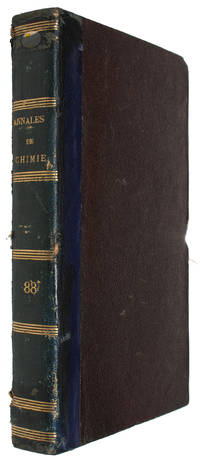
1813rif. 43081Paris, J. Klostermann, 1813. Contemp. hcalf. Spine gilt. A few scratches to binding. In: ""Annales de Chimie, ou Recueil de Mémoires concernant la Chemie"" Tome 88. - 336 pp. (the entire volume offered). Pp. 304-310, 311-318, 319-321 a. 322-329. Scattered brownspots.
1813rif. 43081Paris J. Klostermann 1813. Contemp. hcalf. Spine gilt. A few scratches to binding. In: "Annales de Chimie ou Recueil de Mémoires concernant la Chemie" Tome 88. - 336 pp. the entire volume offered. Pp. 304-310 311-318 319-321 a. 322-329. Scattered brownspots. First printing of this paper announcing the discovery of Iodine. Courtois found this substance which he suspected to be a new element while burning algae in order to obtain sodium and potassium compounds. Although Courtois discovered the element in 1811 the announcement of it was not made until two years later after he had turned it over to Charles Desormés and Nicolas Clément."The first publication on iodine are somewhat confusing. Courtois's research is found in a paper attributed to him the paper offered but actually the work of Clément. was followed by an anonymous article the second paper offered. Gay-Lussac. who repeated and extended Courtios's work was responsible for this paper. Courtois himself published nothing. These two articles were immediately followed by short contributions of Gay-Lussac and Humphry Davy on the new element third and fourth paper offered. Gay-Lussacs views none too flattering to Davy on the history ofthe discovery of iodine appeared in his "Mémoire sur l'iode" 1814."DSB III p. 455. - Weeks "Discovery of the Elements" pp. 257-262.The volume contains further importent papers in chemistry Guyton de Morveau "Sur la chaux maigre" "Sur le dissolvant des pierres biliaires" an importent paper by Chevreul on animal fats "Recherches chimiques sur plusieurs corps gras et particulierement sur leurs combinaisons avec les alcalis" Berzelius's papers "Mémoires sur la compositions des fluides animaux" first edition in French Suite first edition Parmentier etc. etc. unknown
1880rif. 47008Paris Gauthier-Villars 1880. 4to. No wrappers. In: "Comptes Rendus Hebdomadaires des Séances de L'Academie des Sciences" Tome 91 No 5 entire issue offered. Pp. 251-310. The Curie's paper: pp. 294-295. First apperance of the paper in which the two brothers announced their discovery of the Piezoelectric Effect as they observed how an electric potential appeared across crystals of quartza and of Rochelle salt when pressure was applied to them. The potential varied directly with the pressure and they named the phenomenon Piezoelectricity meaning "to press" Greek. Crystals with piezoelectric properties form an essential portion of sound-electronics devices such as microphones and record-players."The applications of piezoelectric crystals are innumerable; one of the most important is their use in frequency stabilization of oscillating electromagnetic cirasciots for radio broadcasting stations. They are used in most piezometers for measuring with great precision either very strong pressure variations such as those of a cannon at the moment of firing or very weak ones such as artery pulsations. These applications have led to the creation of a new industry the manufacture of large "mono" such as quartz obtained hydrothermally around 500°C. under high water pressures or crystals such as Rochelle salt obtained from aqueous solutions. These two substances were mentioned in the Curie brothers’ report announcing the discovery of piezoelectricity." DSB."The first experimental demonstration of a connection between macroscopic piezoelectric phenomena and crystallographic structure was published in 1880 by Pierre and Jacques Curie. Their experiment consisted of a conclusive measurement of surface charges appearing on specially prepared crystals tourmaline quartz topaz cane sugar and Rochelle salt among them which were subjected to mechanical stress. These results were a credit to the Curies' imagination and perseverance considering that they were obtained with nothing more than tinfoil glue wire magnets and a jeweler's saw." Piezo Systems Inc.Magee "A Source Book in Physics" p. 547 ff. unknown
1809rif. 50198Paris Mad. Ve Barnard 1809. Contemp. hcalf. Spine gilt. Wear to top of spine. A few scratches to binding. Small stamps on verso of titlepage.In: "Annales de Chimie ou Recueil de Mémoires concernant la Chemie" Tome 70. 336 pp. Entire volume offered. Davy's paper: pp. 189-254. First edition in French the first English 1808 of this importent historical paper in chemistry in which Davy shows that electricity is capable of decomposing some alkalies isolating two new substances and discovering potassium and sodium. Neville in his Historical Chemical Library vol. I p.340 writes about this paper "ONE OF THE GREAT CLASSIC RESEARCHES IN CHEMISTRY in which Davy announced in this his second Bakterian lecture the isloation of metallic potassium and sodium by the electrolytic decomposition of their fused oxides.""He Davy began his own electrical experiments.The results were spectacular. On October 6 1807 the current passing through molten potash liberated a metal which Davy called potassium. The little globules of shining metal tore the water molecule apart as it eagerly recombined with oxygen and the liberated hydrogen burst into lavender flame. Davy danced about in a delirium of joy. A week later he isolated sodium from soda."Asimow. The paper offered here describes these discoveries."Humphry Davy was one of the most brilliant chemists of the early nineteenth century. His early study of nitrous oxide brought him his first reputation but his later and most importent investigations were devoted to electrochemistry. Following Galvani's experiments and the discovery of the voltaic pile interest in galvanic electricity had become widespread. The first electrolysis by means of the pile was carried out in 1800 by Nicholson and Carisle who obtained oxygen and hydrogen from water. Davy began to examine the chemical effects of electricity in 1800 and his numerous discoveries were presented in his Bakerian lecture to the Royal Society on November 20 1806. A Source Book in Chemistry p. 243. unknown
1810rif. 42219London W. Bulmer and Co. 1810. 4to. No wrappers as extracted from "Philosophical Transactions" 1810 - Part I. Pp. 16-74 and 2 engraved plates showing Davy's electrochemical apparatus for decomposing substances. The plates dampstained. Text fine and clean. First appearence of this historical chemical paper Davy' fifth Bakerian Lecture in which he announced his discovery of hydrogen telluride."Mr. Davy having from the commencement of his electro-chemical researches communicated the several steps of his progress to the Society The Royal Society takes the present opportunity of reporting the results of his further inquiries under four principal heads. First on the nature of the metals of the fixed alkalis. Second on the nature of Hydrogen and composition of ammonia. Thirdly on the metals of the earth; and Fourthly he makes a comparison between the antiphlogistic doctrine and a modified phlogistic hypothesis."Abstract. He further gives arguments for considering potassium and sodium which he discovered in 1808 as a element."Humphry Davy was one of the most brilliant chemists of the early nineteenth century. His early study of nitrous oxide brought him his first reputation but his later and most importent investigations were devoted to electrochemistry. Following Galvani's experiments and the discovery of the voltaic pile interest in galvanic electricity had become widespread. The first electrolysis by means of the pile was carried out in 1800 by Nicholson and Carisle who obtained oxygen and hydrogen from water. Davy began to examine the chemical effects of electricity in 1800 and his numerous discoveries were presented in his Bakerian lectures." - Wheeler Gift: 2518. unknown
1810rif. 45887London W. Bulmer and Co. 1810. 4to. No wrappers as extracted from "Philosophical Transactions" 1810 - Part I. Pp. 16-74 and 2 engraved plates showing Davy's electrochemical apparatus for decomposing substances Davy's versions of the Voltaic-pile. Plates a bit brownspotted otherwise clean and fine wide-margined. First appearence of this historical chemical paper Davy' fifth Bakerian Lecture in which he announced his discovery of hydrogen telluride."Mr. Davy having from the commencement of his electro-chemical researches communicated the several steps of his progress to the Society The Royal Society takes the present opportunity of reporting the results of his further inquiries under four principal heads. First on the nature of the metals of the fixed alkalis. Second on the nature of Hydrogen and composition of ammonia. Thirdly on the metals of the earth; and Fourthly he makes a comparison between the antiphlogistic doctrine and a modified phlogistic hypothesis."Abstract. He further gives arguments for considering potassium and sodium which he discovered in 1808 as a element."Humphry Davy was one of the most brilliant chemists of the early nineteenth century. His early study of nitrous oxide brought him his first reputation but his later and most importent investigations were devoted to electrochemistry. Following Galvani's experiments and the discovery of the voltaic pile interest in galvanic electricity had become widespread. The first electrolysis by means of the pile was carried out in 1800 by Nicholson and Carisle who obtained oxygen and hydrogen from water. Davy began to examine the chemical effects of electricity in 1800 and his numerous discoveries were presented in his Bakerian lectures." - Wheeler Gift: 2518.Also with William Hyde Wollaston "The Croonian Lecture. Read November 16 1809.On Muscular Action - On Sea-Sickness - On the salutary Effects of Riding and other Modes of Gestation. Pp. 1-15. unknown
1825rif. 43119London W. Nicol 1825. 4to. No wrappers as extracted from "Philosophical Transactions" 1825 - Part II. Pp. 440-466. Clean and fine. First appearance of this remarkable paper in which Faraday announces his discovery of Benzene. Berzelius described this research as "without doubt one of the most importent which has enriched chemistry during 1825.""The first public announcement of the discovery of benzene the greatest chemical discovery made by Faraday. Originally named by him "bicaburet of hydrogen" benzene is the parent substance of all aromatic compounds. It constitutes the basis of thousands of organic compounds dyes perfumes and medicinal products as well as many polymers and structural materials. The discovery of benzene led to the creation of numerous chemical companies and the manufacture of materials previously unknown. This paper is a thourough study of the physical and chemical properties of benzene."Neville I p. 443. - Parkinson "Breakthrough" 1825 C. unknown
1842rif. 42843London Richard and John E. Taylor 1842. 4to. No wrappers as extracted from "Philosophical Transactions" 1842 - Part II. Pp. 181-214 and one double-page folded engraved plate. First appearance of a pioneer-paper in the history of early photography in which Herschel announced some of his importent discoveries of the photographic printing processes the process of photographic contact-printing in Prussian blue brought to light just three years after Louis Daguerre and Henry Talbot had announced their independent inventions of photography in silver using metal and paper substrates respectively. and the photographic properties of red ferro sesquicyanuret of potassium."This is the first recorded observation of Prussian blue being formed for a photographic purpose by the action of light on potassium ferricyanide so it represents the moment of discovery of the first cyanotype process although this name still lay in the future. The significance of this observation impressed Herschel sufficiently to mention it also in his general diary entry for 23 April 1842."Mike Ware in "John Herschel's Cyanotype. Invention or discovery ". unknown
1875rif. 47271Paris Gauthier-Villars 1875. 4to. No wrappers. In: "Comptes Rendus Hebdomadaires des Séances de L'Academie des Sciences" Tome 81 No 12 and No 23. Pp. 485- 508 a. 1065- 1148. 2 entire issues offered. Boisbaudran's papers: pp. 493-495 a. pp. 1100-1105. First printing of the paper in which Boisbaudran announced his discovery of Gallium together with the first printing of the paper in which he by a series of experiments proved that Gallium the metal that he had discovered amd named in honour of France is a true element. A larger paper on the discovery was published in 1877 in "Annales de Chimie et Physique". In 1879 Bausbaudran was awarded the Davy Medal for his discovery of Gallium. "In 1875 Boisbaudran spectroscopically discovered a new element gallium which he found in zinc blende from a mine in Hautes-Pyrénées. Continuing his work in Wurtz’s laboratory in Paris he was a able to obtain the free metal by electrolysis of a solution of the hydroxide in potassium hydroxide. Gallium Boisbaudran realized was the "eka-aluminum" predicted by Mendeleev and was the first of Mendeleev’s predicted elements to be isolated. Boisbaudran’s finding thus provided valuable evidence for the validity of Mendeleev’s periodic classification of the elements."DSB."Lecoq de Boisbaudran announced his discovery by spectroscopic analysis of the new element gallium. Mendeleev had first predicted its existence and had named it eka-aluminium. The discovery was made in the author's private laboratory in a specimen of zinc blende from the Pierrefitte mine in the Angelès Valley in the Hautes Pyrénées. He describes how on the evening of 27 August 1875 he detected the existence of this new element which he named "gallium" in honor of France Gallia. A month later he "performed in Wurtz's laboratory in Paris.a series of experiments to prove that gallium.is a true element"Weeks. he discusses how he eventually isloated small amounts of pure metallic gallium and determined its physical and chemical properties. The paper the paper offered first describes gallium compounds e.g. ammonium gallium alum chloride oxide and sulphate."Roy G. Neville II p. 29. unknown
1848rif. 49456Paris Bachelier 1848. 4to. No wrappers. In: "Comptes Rendus Hebdomadaires des Séances de L'Academie des Sciences" Tome 26 No 21. Pp. 529- 548. Entire issue offered. Pasteur's paper: pp. 535-538. Clean and fine. First appearance of the announcement of Pasteur's momentous and revolutionary discovery of "molecular assymetry" and founding the science of Polarimetry.The discovery was first announced by Pasteur in may 1848 by the printing of the preliminary report of only 4 short pages in order to establish priority the paper offered. A more full exposition was published the same year in "Annales de Chimie et de Physique" 3me Series - Tome XXIV."In 1848.Pasteur studied the crystals of tartrates one of the substances that exhibited the now-clockwise now-counterclockwise effect under the microscope and found that the xcrystasls were mirror images of the others. The two crystals resemmbled each other as a right-hand glove resembles a left-hand glove.This was a revolutionary discovery and it took some courage to announce it. A few years before the well-known chemist Mitscherlich had studies the same tartrate crystals and declared them all to be identical. Pasteur was only a twenty-sic-year-old unknown. neverthelless he announced his findings and went before Biot to repeat the separation ofthe crystals before the eyes of the aged authority in the field. Biot was convinced and Pasteur received the Rumford medal of the Royal Society for his work.Pasteur had thus founded the science of polarimetry in which the measurements of the manner in which the plane of polarized light was twisted could be used to help to determine the structure of organic substance to follow various chemical reactions and so on."Asimov. Leicester & Klickstein "A Source Book of Chemistry" p. 374-379. unknown
1848rif. 47149Paris Bachelier 1848. 4to. No wrappers. In: "Comptes Rendus Hebdomadaires des Séances de L'Academie des Sciences" Tome 26 No 21. Pp. 529- 548. Entire issue offered. Pasteur's paper: pp. 535-538. First appearance of the announcement of Pasteur's momentous and revolutionary discovery of "molecular assymetry" and founding the science of Polarimetry.The discovery was first announced by Pasteur in may 1848 by the printing of the preliminary report of only 4 short pages in order to establish priority the paper offered. A more full exposition was published the same year in "Annales de Chimie et de Physique" 3me Series - Tome XXIV."In 1848.Pasteur studied the crystals of tartrates one of the substances that exhibited the now-clockwise now-counterclockwise effect under the microscope and found that the xcrystasls were mirror images of the others. The two crystals resemmbled each other as a right-hand glove resembles a left-hand glove.This was a revolutionary discovery and it took some courage to announce it. A few years before the well-known chemist Mitscherlich had studies the same tartrate crystals and declared them all to be identical. Pasteur was only a twenty-sic-year-old unknown. neverthelless he announced his findings and went before Biot to repeat the separation ofthe crystals before the eyes of the aged authority in the field. Biot was convinced and Pasteur received the Rumford medal of the Royal Society for his work.Pasteur had thus founded the science of polarimetry in which the measurements of the manner in which the plane of polarized light was twisted could be used to help to determine the structure of organic substance to follow various chemical reactions and so on."Asimov. Leicester & Klickstein "A Source Book of Chemistry" p. 374-379. unknown
1895rif. 49284London arrison and Sons 1895. - Paris Gauthier-Villars 1895. 8vo. and 4to. Later full cloth gilt lettering to spine Ramsay and without wrappers Cleve. In "Proceedings of the Royal Society" Ramsay Vol. 58. Entire vol. offered. And in "Comptes Rendus Hebdomadaires des Séances de L'Academie des Sciences" Cleve Tome 120 No 15. Pp. 797- 850. Entire issue offered. Ramsay's papers: pp. 65-67 and pp. 81-89. - Cleve's paper: p. 834. Stamps tp edges and a few corners a bit bumped on vol. 58 otherwise clean and fine. First printing of both papers in which Ramsay and Cleve - independently - announced their discovery of Helium on the Earth. Although Ramsay announced the discovery of Helium before Cleve had completed his research the Swedish chemist was independent discoverer of the element.Helium was discovered in the sun already in 1868 by Jules Janssen and independently by Lockyer the same year. Janssen discovered helium in the sun when he observed a total eclipse in India by studying the spectra of the suns chromosphere and Lockyer also by spectroscopy found that the new line in the spectrum did not belong to any element then known and he named it Helium for the sun.In the same volume as Ramsays paper there are 5 papers by NORMAN LOCKYER dealing with the discovery of Helium on the earth examining Ramsay's and Cleve's findings.Parkinson "Breakthroughs" 1895. hardcover
1836rif. 43417Leipzig Johann Ambrosius Barth 1836. Without wrappers. In "Annalen der Physik und Chemie. Hrsg. von J.C. Poggendorff" Band 38 No. 6 = Zweyte Stück. Titlepage to Vol. 38. Pp. 241-450 a. 3 engraved plates.Entire issue offered Heft No. 6 Bd. 38. Schwann's paper: pp. 358-364. Clean and fine. First appearance of an importent paper in the history of biology in which Schwann describes his discovery and isolation of pepsin the substance in the stomach that aids digestion of eggwhite. It is the FIRST KNOWN ANIMAL ENZYME. The paper appeared at the same time in "Archiv für Anatomie Physiologie und Wissenschaftliches Medicin"Theodor Schwann 1810-1882 was a great German physiologist pathologist and experimenter. One of the founders of the cell doctrine and of the idea of the living nature of yeast. Born at Neuss near Düsseldorff. A catholic educated in the Jesuit Gymnasium in Cologne. Intended for the church but took to medicine. He was a pupil of Johannes Müller and a collegueand lifelong friend of J. Henle the anatomist. In Berlin Schwann was Johannes Müller's assistent for five years and it was then that he discovered pepsin in 1836 the paper offered.Parkinson "Breakthroughs" 1836 B.The issue contains other importent papers by Seebeck Matteucci Marchand G. Magnus "Ueber die Wirkung des Ankers auf Elektromagnete und Stahlmagnete" Schönbein J. Müller "Ueber die Structur und die chemischen Eigenschaften der thierischen Bestandtheile der Knorpel und Knochen" Nachtrag. Forchhammer "Der kopaische See und seine unterirdischen Abzugskanäle." with a map. unknown
1900rif. 51313Paris Gauthier-Villars 1900. 4to. No wrappers. In: "Comptes Rendus Hebdomadaires des Séances de L'Academie des Sciences" Tome 130 No 15 a. No 18. Pp. 962- 1044 a. pp. 1145- 1220. Entire issues offered. Villard's papers: pp. 1010-1012 a. 1178-1182 textillustrations. Clean and fine. First apperance of Villard's two papers in which he announced and described the discovery of a new type of radiation more powerfull and penetrating than alpha-and beta rays. The new type of rays was named by Rutherford as gammarays. unknown
rif. 67796aafRoma, 1869, in-4to, 50 gravures (planches) non reliées, brochure originale, non reliée, pages un peu cornées sinon bel exemplaire.
1831rif. 49604Paris, Crochard, 1831. Contemp. hcloth. Some scattered brownspots. ""Annales de Chimie et de Physique"", 2. Series, Tome 48. 448 pp., 1 engraved plate. (Entire volume offered). Soubeiran's paper: pp. 113-157. Scattered brownspots.
1831rif. 49604Paris Crochard 1831. Contemp. hcloth. Some scattered brownspots. "Annales de Chimie et de Physique" 2. Series Tome 48. 448 pp. 1 engraved plate. Entire volume offered. Soubeiran's paper: pp. 113-157. Scattered brownspots. First appearance of an importent paper in chemistry and medicine as it for the first time relates the finding of Chloroform which some years later was proved to have anaesthetic effects and was introduced in chirurgy in 1848 by Simpson.Justus von Liebig Souberain and Guthrie independently discovered Chloroform in 1831 but Souberain was the first to publish his results. Garrison & Morton No. 1851. - Gedeon "Science and Technology in Medicine" 36.7.The volume contains other notable papers by LIEBIG DUMAS DUTROCHET WÖHLER LECANU BECQUEREL etc. hardcover
1837pp. xliv, 479, (6) [Genealogies] + 18 Facsimiles, plates and maps. The frontis and engraved title may not have been issued with this large paper first edition. First fly leaves damp stained. Plates and some other leaves at end are also damped. The bulk of the text is brilliant white with extra wide margins. Large paper copy. Top edge gold gilt. Deckle edges. Early inked ownership of R. H. Lanerned(?). Early manuscript margin notations, and translation. Folio. Original full embossed morocco leather binding. Spine gold lettered with raised bands. Hardbound. "The pioneer and fundamental work on the Norse voyages to America, on which most of the subsequent literature has been based. This large folio contains the original text of the sagas in old Icelandic and translations into Danish and Latin, followed by critical discussions in Latin; extracts from ancient Icelandic geographical writings, descriptions of European relics in Greenland; descriptions and discussions of supposed Norse relics in New England and an elaborate identification of localities. A summary of the evidence and conclusions is given in English. Rafn was an enthusiast on this subject, and his enthusiasm make him over hasty and credulous in accepting the various alleged relics of the Northman." - Larned #750. "It is one of the most important contributions ever made to the study of the history and geography of our continent." (North American Review, No. xcviii, pp. 161-62.)." - Sabin 67470; Howes R13. First Edition of a landmark book. Our original price was $1250.00 **PRICE MUCH REDUCED! VOYAGES BOX 1
1895rif. 42221(London, Harrison and Sons, 1895). 4to. No wrappers as extracted from ""Philosophical Transactions"", Vol. 186 - I, Series A. Pp. 187-241 a. 8 textillustrations (apparatus). Fine and clean.
1895rif. 42221London Harrison and Sons 1895. 4to. No wrappers as extracted from "Philosophical Transactions" Vol. 186 - I Series A. Pp. 187-241 a. 8 textillustrations apparatus. Fine and clean. First printing of this importent paper in the history of chemistry Lord Rayleigh's most famous discovery announcing the discovery of this new gas the first finding of one of the rare gases inert gases having unusual properties and forming a distinct group in the periodic table and all with zero valency."The original paper in the "Philosophical Transactions" will undoubtly rank as a classic the investigation having been a particularly brilliant ine." Ernst von Meyer in History of Chemistry. For this discovery Lord Rayleigh and W. Ramsay received the Nobel Prize 1904.After having made several measuring of the densities of gases "Rayleigh came across a curious puzzle. With oxygen he always obtained the same density regardless of how the oxygen might be produced whether from one particular compound from a second compound or from the air. The situation was different with nitrogen. The nitrogen he obtained from air constantly showed a slightly higher density than the nitrogen he obtained from any of various compounds. Rayleigh could think of several ways in which the nitrogen obtained from air might be contaminated but none of the possibilities checked out experimentally. He was so frustrated that he went so far as to write to the journal "Nature" asking for suggestions. Ramsay a brilliant Scottish chemist asked permission to tackle the problem and received it. The upshot was that a new gas somewhat denser that nitrogen was discovered to exist in the atmosphere. It was named argon and it was the first of a series of rare gases of unusual properties whose existence had never been suspected."Asimow.Dibner Heralds of Science No. 50 - Neville Historical Chemical Library vol. II p.358. unknown
1781rif. 1099761781 Un volume In-16 (9,5 x 16cm environ), reliure pleine peau, filets, et fleurons dorés au dos, tranche marbrées en couleurs, reprenant le motif des gardes - Cinq ouvrages reliés en un volume intitulé "Recueil II" à l'aide d'une pièce de titre au dos, répartis comme suit : (1) A Amsterdam; et se trouve à Paris, Chez Méquignon l'aîné, Librairie, rue des Cordeliers - M. DCC. LXXIX. 1779 - 46 pages - (2) A Berlin, et se trouve, à Paris, Chez l'Auteur , Barrière de Reuilly; Fauxbourg Saint-Antoine. Et Chez Belin, Librairie, rue Saint-Jacques - M DCC LXXIX. 1779 - 35 pages - (3) A Paris, Chez l'Auteur, rue Croix des Petits-Champs, Maison de M. Bourdet, Chirurgien-Dentiste du Roi. et Chez Blaizot, Librire du Roi, rue Satory, à Versailles - Avec Approbation et Permission - M. DCC. LXXXI. 1781- 139 pages - Cul-de-lampe - (4) A Amsterdam; et se trouve à Paris, Chez Bastien, Libraire, rue du Petit-Lion, Fauxbourg Saint-Germain - M. DCC. LXXIV. 1774 - 56 pages - (5) A Paris, Chez Saugrain, Libraire, Quai des Augustins, près de la rue Pavée - M. DCC. LXXXI. 1781 - 116 pages