[Poster; Australia] Northfield, JamesBiblio.com

6.229 resultados
1930ref. 25919Melbourne: Produced by Northfield Studios and J.E. Hackett 1930. Very good condition. Color lithograph travel poster depicting a mother koala with a cub clinging to her back in the top of a gum tree by the noted Australian illustrator James Northfield. Signed in the image at the lower right. Northfield 1887 - 1973 was the subject of the 2006 volume by the National Library of Australia Michelle Hetherington titled 'James Northfield and the Art of Selling Australia'. Northfield's work is prized for its draftsmanship & design and a distinctly Australian sense of color and light. Window card size 13 1/2 x 19 1/2". One small mark in margin only upper left corner left by old sticky tape. OCLC: 910601564 locates one copy only at the Library of Congress same image larger format. Trove 54841871 locates one copy at the National Library of Australia same image larger format. Produced by Northfield Studios and J.E. Hackett unknown
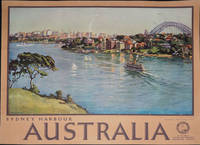
1935ref. 18842Australian National Travel Association 1935. Very good overall. Travel poster illustrated by Sydney Harbour centered on the harbour with a ferry and sailboats with the Sydney Harbour Bridge in the top right background. A color lithograph 20 x 24.75" 50.8 x 62.25 cm. Further text; "Painting by Will Ashton R.0.I. W.T. Baker & Co Ltd. Engravers and printers. Australian National Travel Association." Crinkles and some light creases with a couple of light marks in the sky above the Bridge. Australian National Travel Association unknown
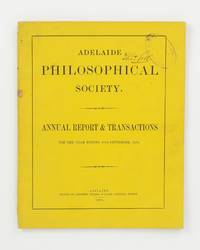
1871ref. 144583Adelaide: Printed by Andrew Thomas & Clark at the 'Register' 'Observer' and 'Journal' Offices 1871. First Edition. Paperback. Very Good. Adelaide Printed by Andrew Thomas & Clark at the 'Register' 'Observer' and 'Journal' Offices 1871. Quarto 42 pages with a diagram plus 7 plates 2 showing sunspot observations the remainder meteorological graphs numbered 1-5. Printed yellow wrappers lightly creased and marked with minor loss to the ends of the spine; small burst with minor loss to one leaf affecting a few words in a handful of lines of text in one column recto and verso; small light stains to the bottom edge of the five meteorological graphs at the rear; a few creases marks and other signs of age and handling; overall in excellent condition. The pamphlet comprises a title page list of office-bearers and members and the report for the year each one leaf verso blank followed by 11 papers read at the society's meetings during the year. The papers are: 'Irrigation' by C.S. Hare 2 pages with a small diagram; 'The Camel in South Australia' by J.S. Lloyd 4 pages; 'The Use and Properties of Plants. No. II' by Richard Schomburgk 2 pages; 'The Currents of the Air and the Ocean. No. III' by Benjamin Herschel 3 pages; 'The Importance of Silk Culture as a Branch of Colonial Industry' by T.S. Reed 2 pages; 'Remarks on Sun Maps' by D.B. Adamson 1 page plus 2 plates; 'Light Railway Construction' by R.C. Patterson 6 pages; 'The Influence of Forests on Climate' by Richard Schomburgk 2 pages being the leaf with minor loss; 'Light Railway Construction' by A.F. Lindsay 5 pages; 'The Cause of Disease in Silkworms' by Richard Schomburgk 1 page; and 'Some Observations on the Rainfall at Adelaide and the Connection between Meteorological Changes and the Yield of Wheat' by Benjamin Herschel 3 pages plus 5 plates containing meteorological graphs. Loosely inserted is a lengthy newspaper clipping from 'The Register' 19 May 1858 on 'Camels in Australia' based heavily on information supplied by Arthur Horrocks brother of the ill-fated explorer John Ainsworth Horrocks. The Adelaide Philosophical Society was founded in 1853 and in 1880 became the Royal Society of South Australia. This annual report lists the name of the 73 current members: the president His Excellency Sir James Fergusson 12 'Honorary and Corresponding Members' and 60 ordinary members. The final paragraph of the short report will sound familiar to anyone who has served on a committee: 'The Council wish to impress upon members the necessity of paying their subscriptions punctually; during the past year out of sixty-seven ordinary members it appears only thirty-nine have paid their annual subscriptions'. These extremely small numbers let alone the passage of 150 or more years must account for the utmost rarity of this publication. Provenance: Thomas Gill 1849-1923 the South Australian historian and bibliographer with his ownership signature on the front cover; later the Royal Geographical Society of Australasia South Australian Branch with its stamp ditto. 'Gill was also a governor of the Public Library Museum and Art Gallery of South Australia from 1896 until his death and a member of the Library Association of Australasia. He wrote "The History and Topography of Glen Osmond" 1905 for the Glen Osmond Institute. Gill was treasurer of the South Australian branch of the Royal Geographical Society of Australasia from its inception in 1885 until his death. The society's acquisition of the valuable York Gate Library was largely due to his energy and enthusiasm. His library was sold to the society for £300 as his will directed' but numerous items from his collection mainly duplicates of existing holdings in the RGSSA library were later sold. Printed by Andrew, Thomas, & Clark, at the 'Register,' 'Observer,' and 'Journal' Offices paperback
1845ref. 109128Adelaide: Andrew Murray Printer Rundle-Street Sold by C. Platts Bookseller Hindley-Street . 1845. First Edition. Paperback. Adelaide Andrew Murray Printer Rundle-Street Sold by C. Platts Bookseller Hindley-Street . 1845. Octavo xii last blank 106 pages plus a folding etching but lacking the folding frontispiece map noted by Ferguson. Original bright green wrappers with the full title page details repeated on the front cover with the date of publication now added; wrappers a little marked but expertly conserved the front cover is now lined on the verso stabilizing a long tear and filling in some minor loss to the edges; title page a little marked; occasional chips and dog-ear creases to the uncut edges; trifling signs of age and use but essentially a very agreeable copy. The State Library of South Australia has a copy of this item with the map and it's a beauty - a hand-coloured lithograph 322 × 213 mm produced in 'Goodwood nr Adelaide' in 1845. However reading between the lines a case may be made for stating that not all copies were issued with the map. Its absence here notwithstanding this is by any account a very rare publication and worthy of serious consideration on at least two counts. The folding plate is an etching paper size approximately 220 × 280 mm of 'Ridley's Reaping Machine. S. Australia' signed and dated in the plate 'NRF 1845'. The artist is Frederick Robert Nixon circa 1817-1860 who arrived in Adelaide in May 1838 to take up a position as assistant surveyor. In 1845 he published 'Twelve Views in Adelaide and its Vicinity South Australia. Drawn etched and printed by F.R. Nixon'; it was the earliest South Australian plate book. He was a self-taught artist who 'had to manufacture all his machinery for preparing and pressing his etchings . they are superior as works of art and accurately as well as pleasingly depict the scenes which they represent 'The South Australian' 21 February 1845. Nixon left Adelaide in May 1846 bound for Mauritius where he died in 1860. Kerr's 'The Dictionary of Australian Artists' 1992 records that the Ridley etching was the only other one he is known to have produced. There is a lengthy chapter 10 pages on the Aboriginal inhabitants and the chapter on horticulture contains seven pages on vines and wine-making with the information credited to M. Vaillant see page 58. Ferguson 4014. Andrew Murray, Printer, Rundle-Street (Sold by C. Platts, Bookseller, Hindley-Street ...) paperback
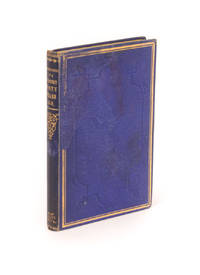
1880ref. 80022Adelaide: J. Williams Printer for the Author 1880. 2nd Edition. Hardcover. Very Good. Adelaide J. Williams Printer for the Author 1880 second edition/ 1879. Octavo viii 84; 80; and 23 pages plus 3 albumen paper photographs of 5 drawings on 3 unnumbered leaves. Blue cloth lettered in gilt on the spine with both sides ruled in gilt and decorated in blind; covers a little bumped and rubbed at the extremities with minor wear to the corners; spine unevenly sunned; light stains to the front cover removing some of the gilt from the left-hand border; rear free endpaper replaced with near-matching paper tanning the last page a blank; overall a very good copy internally excellent. A presentation copy inscribed in ink on the front free endpaper 'From G. Hamilton to Capt Dashwood with the Author's best wishes 22 Dec 1880'. George Frederick Dashwood 1806-1881 arrived in South Australia in the early 1840s; in 1843 he 'was appointed one of the four non-official nominees in South Australia's first Legislative Council. From 1847 to 1852 he was commissioner of police' 'Australian Dictionary of Biography'. George Hamilton 1812-1883 succeeded him in that role in 1867 retiring the year before his death. He arrived in Adelaide in 1839 when he overlanded cattle along Charles Bonney's southern route. A most satisfying association copy presented from one significant pioneer to another in the twilight of their lives. The particulars of the photographs match those given in Holden where the discrepancy in the number of plates present as against listed is explained. The plates are of drawings by Hamilton; he contributed similar sketches to the published journals of Grey and Eyre. The first edition was not photographically illustrated. Ferguson 10184 inadequately describing the plates; Holden 49. J. Williams, Printer [for the Author] hardcover
1853ref. 78787Adelaide: W.C. Cox Printer 1853. First Edition. Hardcover. Very Good. Adelaide W.C. Cox Printer 1853. Octavo 46 pages. Antique-style quarter calf and marbled papered boards; title page slightly dusty and a trifle marked with two tiny closed tears to the top edge; a few pencilled emphases to the margins; light vertical crease down the centre of the last six leaves; an excellent copy. The author Clerk of the Executive Council of South Australia was on board the vessel; this is his account of the first successful navigation of the Murray as far as Swan Hill by Captain Francis Cadell. Fellow-passenger James Allen also published his version of events. Captain William Randell and his paddle-steamer 'Mary Ann' left Goolwa at the Murray mouth ahead of Cadell and travelled much farther up the Murray but Cadell overtook him en route and reached Swan Hill first. However both men deservedly earned the bonus of 2000 pounds offered by the South Australian Government 'for each of the first two steamers to travel up the Murray as far as the Darling junction' 'Australian Dictionary of Biography'. W.C. Cox, Printer hardcover
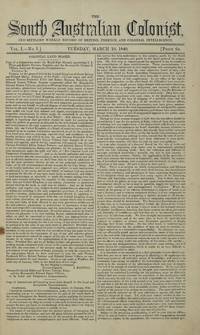
1840ref. 80314London: 'Printed for the Proprietor by William Cecil Huttmann' 1840. First Edition. Hardcover. London 'Printed for the Proprietor by William Cecil Huttmann' 1840. Folio 352 pages 16 pages each issue. Early binder's cloth recently rebacked retaining the top two-thirds of the original spine; cloth marked and mottled with some neat restoration to the corners; edges a little marked; very light tidemarks to the leading edge of the front flyleaf and an initial blank; leading edge of the first few leaves of Number 22 slightly chipped; bottom left-hand corner piece missing from the last leaf with the loss of about 15 words of text and a small amount of the colophon which is the same in each issue; overall an excellent run of the first 22 issues of this very rare weekly newspaper which ceased publication with Volume 1 Number 29 on Tuesday September 22 1840. The prospectus appears on pages 7 and 8 of the first issue; the proprietors' object is 'not mercenary but patriotic . they are not the organs of any party . they will offer a fearless and uncompromising opposition to every deviation from the self-supporting principle on which South Australia is founded'. Their aim in part 'is to present an impartial record of the colonial intelligence . 1st from the colonial papers; 2ndly from direct correspondents in the colony and other exclusive sources'. Accordingly it contains much original material. The editor was John Stephens 1806-1850; 'about 1838 George Fife Angas employed him to write emigration propaganda. Stephens's first notable work was "The Land of Promise" republished in 1839 as "The History of the Rise and Progress of the New British Province of South Australia". In that year his exposure of absurdities in T. Horton James "Six Months in South Australia" London 1839 ran to three editions. He also edited the "South Australian Colonist" on which Angas lost heavily; it was replaced in 1841 by the monthly "South Australian News" at a cheaper rate' 'Australian Dictionary of Biography'. The ownership signature of Robert Kyffin Thomas is pencilled onto the front flyleaf and the blindstamp of the 'Register & Observer Office Adelaide' appears on an early blank leaf. Sir Robert Kyffin Thomas 1851-1910 the grandson of Robert Thomas who arrived on the 'Africaine' at Holdfast Bay in 1836 with a printing press was himself an influential newspaperman in the state. 'In 1877 he became the principal joint proprietor of the "South Australian Register" and as chief of staff he also edited the "Adelaide Observer". A parliamentary reporter he was in charge of the Hansard branch until 1882 when he became general manager of the "South Australian Register" which became the "Register" in 1901' ADB. Ferguson 3082. 'Printed for the Proprietor, by William Cecil Huttmann' hardcover
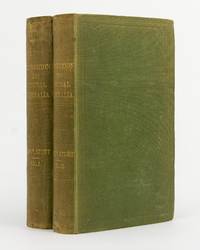
1849ref. 147230London: T. and W. Boone 1849. First Edition. Hardcover. Very Good. London T. and W. Boone 1849 first edition later issue. Octavo two volumes x iv 5-416 pages with 12 illustrations plus 8 plates 2 tinted 2 hand-coloured a folding map with rivers and Sturt's tracks in three colours; and vi 308 92 pages with 6 illustrations plus 8 plates 2 hand-coloured. As usual this later issue does not include the advertisements. Original blind-stamped green sand-grain cloth stamped in gilt and blind; edges uncut; recased with some minor restoration at the extremities; covers a little sunned and rubbed; ink ownership signature on the recto of each frontispiece see below bleeding through; edges roughly opened in places resulting in some minor edge loss to the margins of a few leaves; one opening spotted; occasional scattered light foxing elsewhere; occasional finger marks and other minor signs of age and handling; overall a very good set. 'The geographical results of Sturt's last expedition the first into the heart of the continent were significant. He determined the confluence of the Darling and the Murray settled speculation about a vast inland sea found no evidence of a large central river and determined that there was no central dividing range. The expedition was also responsible for major discoveries especially the discovery and exploration of Coopers Creek the Stony Desert and the Simpson Desert. For his labours in the cause of Australian discovery Sturt was awarded the gold medal of the Royal Geographical Society in 1847 and was honoured as a national hero' Wantrup 2023 page 252; see also 199a. The wood-engraved illustrations on page 158 in the first volume and on pages 194 and 195 in the second volume are not noted in the plate list; the hand-coloured plates three of birds and one of Mus conditor 'The Building Rat' are after John Gould and Henry Richter. The folding map 'Sketch Map of Captain Sturt's Tracks & Discoveries on his Various Expeditions into South Eastern & Central Australia' is by John Arrowsmith and contains text advertising the larger version of the map which was available for purchase separately in a matching case. Provenance: With the ownership signature of 'D. Woodfield Adelaide 1888' in each volume. This is likely the mining speculator Donald Woodfield a speculator in the 1880s minerals boom at Broken Hill who also appears to have had an address at Prospect. Sturt named the Barrier Ranges and Broken Hill during this last expedition which may explain Woodfield's interest. Wantrup: 'Thomas & William Boone's Library of Australian Travels' pages 109-110; this copy conforms to his variant E with a plainer binding 'This appears to be a remainder issue'. 2 items. T. and W. Boone hardcover
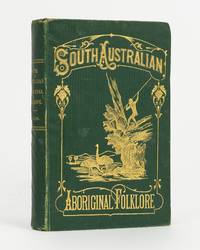
1879ref. 144271Adelaide: E. Spiller Acting Government Printer 1879. First Edition. Hardcover. Very Good. Adelaide E. Spiller Acting Government Printer 1879. Octavo viii 174 2 24 'The Grammar of the Narrinyeri Tribe' xii lithographed 'Facsimiles of Letters Written by Aborigines' one leaf folding 2 25-28 index pages including a page of lithographed music plus 9 lithographs from drawings by Aboriginal artists and 7 original albumen silver photographs 3 are approximately 105 × 145 mm; 4 are approximately 115 × 95 mm mounted on captioned leaves. Original green cloth attractively blocked in gilt on the front board and in blind at the rear; spine ruled and lettered in gilt; covers a little worn and marked with the binding a little shaken; acidic paper tanned with the folding facsimile document splitting at one fold; mounts a little cockled; trifling loss to the corner-tip of one photograph; page 29 printed close to the right-hand edge an imposition error during production; a few mild signs of age and handling; a very good copy of a rare and important work with the photographs in excellent condition. An early ownership signature on an initial blank is proving difficult to decipher Ruppard Sheppard. The original photographs that illustrate the book are almost certainly the work of Captain Samuel Sweet see Robert Holden: 'Photography in Colonial Australia. The Mechanical Eye and the Illustrated Book' 1988. We have handled a number of copies of this work and this copy conforms with what we suggest might be called the first and most desirable issue of these photographs. The substance of the book was derived from a 48-question circular compiled by George Taplin and 'distributed to all the keepers of aborigines' depots throughout the colony and to all persons who are known to be acquainted with the manners customs and languages of the aborigines'; the value of the work may be judged by the editor's remark in the introduction 'that much information has been elicited and that most of the papers show that the writers have used their powers of observation in an intelligent manner'. The untimely death of Taplin in June 1879 at the early age of 47 may account for the failure of further volumes in the series to materialize. Ferguson 16711; Holden 105 and pages 49-51. E. Spiller, Acting Government Printer hardcover
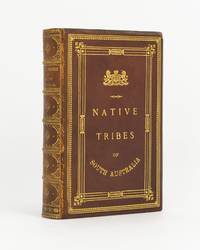
1879ref. 144282Adelaide: E.S. Wigg & Son 1879. Hardcover. Very Good. Adelaide E.S. Wigg & Son 1879 first thus. Octavo xliv 316 pages plus 8 tinted lithographs with tissue-guards. Full russet morocco extensively tooled in gilt; all edges gilt; spine lightly sunned; joints slightly cracked but firm; a few minor signs of age and handling internally; overall in excellent condition. The handsome colonial presentation binding has the ticket 'Bound at Government Printing Office Adelaide S.A.' on the rear pastedown; it was almost certainly executed by Emanuel Spiller the South Australian Government Printer at the time. An early binder's blank contains the inscription 'The South Australian Institute to Dr. Francis Reuleaux; Privy Councillor and Royal Professor; Chief Commissioner for the Empire of Germany at the Melbourne International Exhibition. Adelaide 1881'. Franz Reuleaux 1829-1905 was an influential German mechanical engineer who oversaw German machinery exhibits at the Sydney and Melbourne exhibitions 1879-81. He is best known as the father of modern kinematics. His armorial bookplate with manuscript inventory number is mounted opposite the inscription. Spiller's name appears as exhibitor and jury-member of competitions and exhibitions of binding and printing throughout the 1880s. The 'Sydney Mail and New South Wales Advertiser' for 27 March 1880 carries a lengthy article by John Plummer on colonial bookbindings displayed at the Sydney International Exhibition noting that '. in the South Australian Court Mr. E. Spiller the Government printer of Adelaide occupies the foremost rank'. The book itself is an important early collected reprint of works already scarce at the time; the lithographs and lengthy 34-page introduction by Woods were new to this edition. Not commonly known is that Taplin's substantial contribution 'The Narrinyeri' 156 pages plus 6 preliminaries is the text of the revised edition of 1878 see his informative preface dated 12 April 1878 at page xliii. The Wyatt contribution was not previously published as such; the text here was 'principally extracted from his official reports' stemming from his relatively short and unhappy time as the third South Australian Protector of the Aborigines from 1837 to 1839 'Australian Dictionary of Biography'. The contributions by Meyer Schuermann Gason and Bennett first appeared in 1846 1846 1874 and 1869 respectively. Ferguson 13095 noting blue sand-grain cloth and another binding in half leather but not an unillustrated edition we have identified. E.S. Wigg & Son hardcover
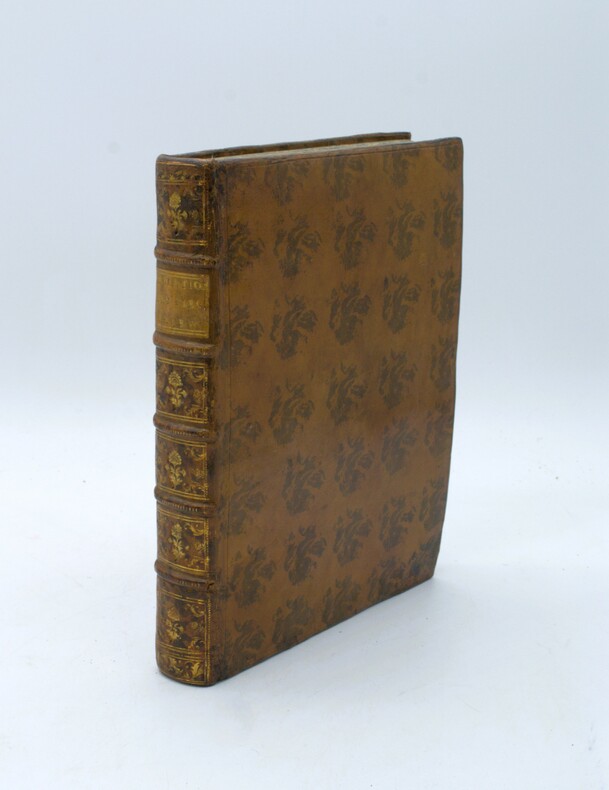
1774ref. PHO-1217Paris, Saillant et Nyon, Panckoucke, 1774. 4 volumes in-4, 2 ff., xviii, 1 ff., xxxii, 388; 3 ff., 536 ; 3 ff., 394, 1 ff.; 1 ff., viii, 367, veau marbré, triple filet doré, dos orné, pièces de titre et de tomaison , tome 1 , reliure différente (demi veau) , défauts de reliure ( charnières fendues , manques ,coins usés , coiffes absentes , etc),illustré de 47 planches et cartes (52), la plupart dépliantes , 1 planche déchirée avec manque , plusieurs déchirées sans manque , quelques feuillets détachés.
1832ref. PHO-1689Paris, J. Tastu, 1832, In-folio, demi-chagrin noir, dos orné de filets dorés à froid Atlas de botanique seul comprenant 76/80 pl. sur chine collé, liste des planches in fine, peu de défauts.
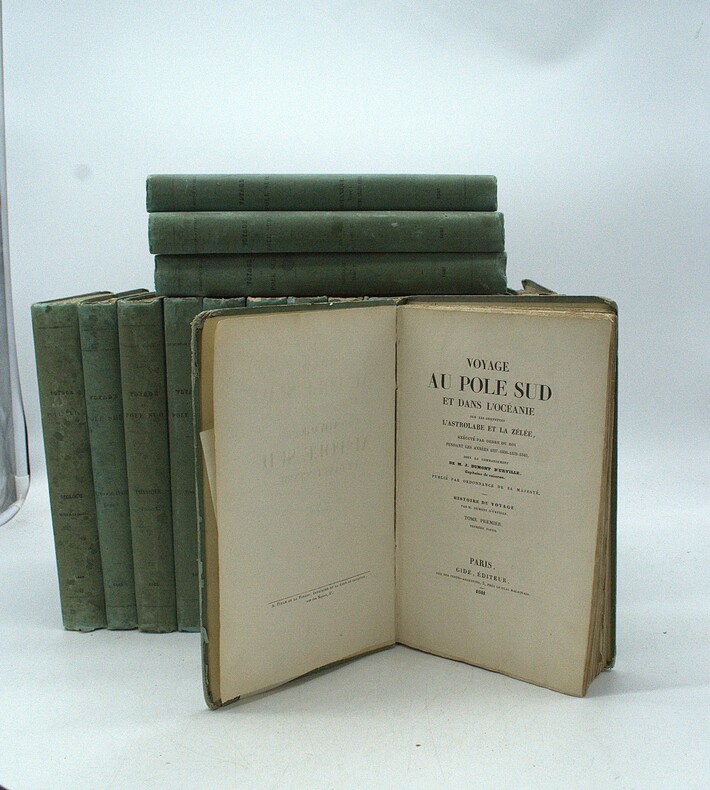
1841ref. PHO-1967Paris, Gide, 1841-1848, in-8, cartonnage éditeur, frottements, qlqs petits manques de matière, coins usés, qlqs coiffes usées, qlqs taches aux plats, T4 avec manque au dos et en haut du 1er plat 16 volumes de texte (sur 21) comprenant : Histoire du voyage, 1841-1846. 10 volumes en premier tirage, (1er tome, 1ère partie correspondant au 1er tome, 1er tome seconde partie correspondant au 2nd tome et 2nd tome, 1ère partie correspondant au tome 3), T2 mouillure en marge sur les derniers feuillets, T4 mouillure, T2 rousseurs, papier légèrement bruni aux tomes 3,4,5,6,7,8 et début tome 9. Zoologie, 1846, 2 volumes (sur 4, tome 1 et2) Botanique, 1845, 1 volume (sur 2), tome 1, plantes cellulaires, papier légèrement bruni Physique, 1842. 1 seul volume (en raison de la mort de Vincendon-Dumoulin) bien que d’autres annoncés, papier légèrement bruni Géologie, Minéralogie et Géographie physique du Voyage. 1848- 1 volume (sur 2, le second paru en 1854), 1 planche in-fine, papier légèrement bruni Hydrographie. 1843. 1 volume (sur 2), 1 planche in-fine, papier légèrement bruni.
1788ref. PHO-1658Paris, Le Jay & Maradan, 1788, in-4, relié plein veau moucheté époque, dos à nerfs avec pièce de titre, XIV-(1)-384 pp., illustré d’un frontispice ,1 gde carte h.-t. et 14 pl. h.-t., petit travail de ver en marge sur 3 feuillets.
1844ref. PHO-2326Paris, Artus Bertrand, 1844, 2 volumes in-8 (220 x 135 mm), xlvi-295pp.-2ff.-298p-1058p., Demi-chagrin et coins, dos lisse avec auteur, titre et tomaison, très légers défauts. Illustrée de 2 cartes dépliantes gravées par S. Jacobs, montées en fin du premier volume : "Carte de l’archipel Taïti par Vincendon-Dumoulin", 1844 et "Carte de l’île Taïti d’après Vilson et les travaux récents de la frégate l’Artémise".
ref. 218657Melbourne et Adelaide, 1865-1866 5 pièces en un vol. in-8, demi-veau blond, dos lisse, roulette dorée, filets à froid (reliure pastiche). Cachet (annulé). Bon exemplaire.
ref. 235576Paris, E. Plon, 1872 in-4, 641 pp., très nombreuses gravures dans le texte, 7 cartes en couleurs et 11 gravures hors-texte, demi-maroquin rouge à coins, dos lisse orné, tête dorée, couverture conservée (reliure de l'époque).
1774ref. PHO-2388Paris, Saillant et Nyon, Panckoucke, Hôtel de Thou, 1774-1785, 14 vol. in-8 (20x12,5cm). Basane porphyre poque, dos à nerfs avec pièces de titre, date du voyage et tomaison maroquin vert, triples filets aux plats, tranches cailloutées bleues. Coins usés, coiffes arasées, frottements, etc…, petite mouillure au t1. 2 tableaux dépliants au tome 3 du 3ème voyage.
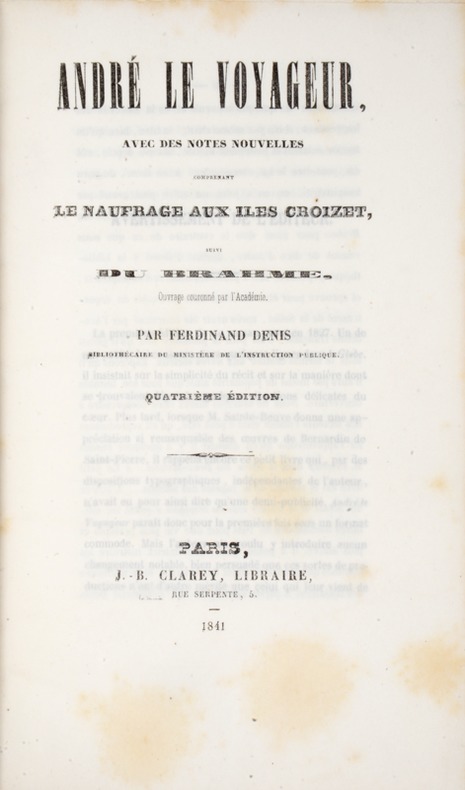
1841ref. 39808Paris, Clarey, 1841. In-8 de (4)-III-259 pp. maroquin vert, dos orné à nerfs, triple filet doré d’encadrement sur les plats, dentelle intérieure dorée, tranches dorées sur marbrure, non rogné (Brany).
ref. LBW-3945[1812]. 763 x 503 mm.
ref. LBW-3946[1812]. 501 x 748 mm.
ref. LBW-3958[1812]. 375 x 482 mm.
ref. LBW-3948[1812]. 754 x 495 mm.
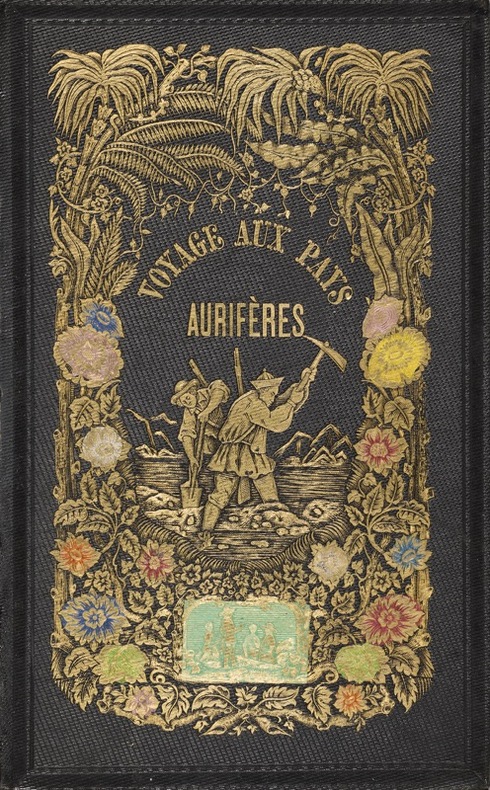
1855ref. 22345Paris A. Courcier [1855] in-8 (23 x 14,5 cm) percaline noire de l'éditeur, dos lisse et premier plat orné d'un décor polychrome, tranches dorées, dos passé, qqs rouss