6.444 resultados
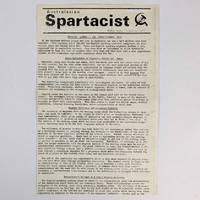
ref. 0034897Sydney and Melbourne: Spartacist League of Australia and New Zealand 1973-2011. Softcover Paperback. Very Good Condition. 43.5cm x 29cm. 236 volumes. Newsprint. A significant unbroken run of Australasian Spartacist: Organ of Revolutionary Marxism for the Rebirth of the Fourth International from No. 1 1973 through to No. 212 1986. Nos. 1 through 5 were published as mimeographed copies and here an original mimeograph of No. 3 together with 2 additional copies in facsimile and with Nos. 1 2 4 and 5 supplied as facsimiles in triplicate and also including the B versions of Nos. 2 and 5 the rest 6-212 as original tabloid newsprint except No. 125 and 136 supplied in facsimile. Also included is an original duplicate of No 143 and the original supplements for 7 June 1975 2 July 1975 24 June 1977 1 February 1980 8 September 1989 2 copies 2 September 1991 2 June 1993 December 1999 and November 2001 and A Spartacist Pamphlet: For a Workers Republic of Australia Part of a Socialist Asia! Sydney: Spartacist ANZ Publishing Co. 1998. In total Australasian Spartacist ran until No 240 2020 and in 2024 has re-emerged as Red Battler: Newspaper of the Spartacist League of Australia with 1 issue published to date. Old horizontal folds now having been stored flat for many years. Minor general wear and tanning a few issues around the 150s/160s with minor to moderate tanning to exterior. Occasional stamp of the New York Spartacist League. An extremely well preserved set of fragile newsprint. Category: Politics Government & Economics; Australia; 21st Century: 2000-2009; Inventory No: 0034897. BZDB407 Politics Government & Economics; Australia; 21st Century: 2000-2009; Unbranded Spartacist League of Australia and New Zealand Australasian Spartacist No. 1 - 212 1973-2011 Spartacist League of Australia and New Zealand paperback
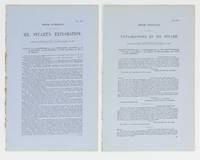
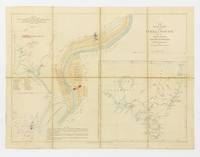
1858ref. 114206Adelaide: Government Printer 1858. Fine. Adelaide Government Printer 1858. Foolscap folio 8 pages last blank plus a large folding map 'Country explored by John McDouall Stuart. June to September 1858'; 600 × 510 mm with lakes and coastlines hand-coloured in outline; 'Richd Jno. Loveday Litho'. Drop-title; minimal residual glue to the spine and a few needle-holes to the inner margin previously bound now disbound; tiny sealed tear to the stub of the map; essentially a fine copy. South Australian Parliamentary Paper Number 119 of 1858. This is an account of Stuart's first independent expedition; he had previously travelled with Sturt's 1844-45 expedition into Central Australia. The party of three 'started out from the Northern Flinders Ranges in mid-May. They skirted the south end of Lake Torrens and then turned north and north-west until they reached the present site of Coober Pedy. They then followed a southerly course to Lake Gairdner passing it on the west side. After a strenuous march they arrived at Ceduna . By now the men had run out of provisions. They travelled along the coast to Streaky Bay and from there to the settled districts at Mount Arden in a state of semi-starvation' Feeken Feeken and Spate 1970. Offered with South Australian Parliamentary Paper Number 114 of 1858 'Explorations of Mr Stuart. Correspondence relative to Explorations . to the North of Port Augusta and West of Lake Torrens' foolscap folio 2 pages. The paper reprints three letters each from Stuart and Francis Dutton Commissioner of Crown Lands and Immigration written between 27 October and 2 November 1858. McLaren 15449 not recording the map and 15448. The first paper was reprinted by the Victorian Government see McLaren 15457; not only was the text reset the map was newly lithographed and issued without additional hand-colouring. The visual comparisons between the two versions are striking. 2 items. Government Printer unknown
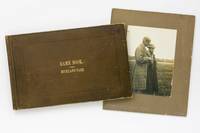
ref. 127784First Edition. Hardcover. Very Good. Oblong small folio 215 × 345 mm a bespoke shooters' register with each page ruled in blue with red columns headed 'Date' 'Place' 'No. of Guns' 'Names of Guns' 'Ducks' 'Swans' 'Plover' 'Stilts' 'Turkeys' 'Quail' 'Sand Piper' 'Hares' 'Rabbits' 'Snipe' blank 'Total' and 'Remarks'. The label of the manufacturer J.H. Sherring & Co. Adelaide is mounted on the front pastedown. On an early blank the following warning is written in ink: 'No shooter to have a drink after dinner until this book is entered up for the day. 9.11.97'. Full calf lettered in gilt on the front cover 'Game Book Buckland Park'; leather slightly marked and a little scuffed; in excellent condition. The gelatin silver portrait photograph 197 × 143 mm is on the original thick card mount 295 × 245 mm with the caption 'George V at Buckland Park' and the name of the photographer J. Gazard in white ink at the foot of the mount. Minor surface damage and creasing to the right-hand side of the mount; the photograph is in excellent condition. The Duke is pictured with Lord Richard Nevill private secretary to the Governor of South Australia. Buckland Park is a pastoral property near Port Gawler South Australia. George Frederick Ernest Albert The Duke of Cornwall and York and later King George V 1865-1936 was the second eldest son of King Edward VII who ascended the throne on Queen Victoria's death in January 1901. With the first Parliament of Australia set to open in early May the mourning King sent George now next in line to the throne to Australia as his representative. The Duke and his Duchess Mary 1867-1953 left England on 15 March aboard an Orient steamship specially chartered for the voyage. Two days after arriving in Melbourne on 9 May the royal couple drove through streets lined with cheering crowds to the Exhibition Building where the Duke declared the Parliament open before thousands of guests. 'The Duke and Duchess were kept busy with a program ranging from dinner and a University Commencement to the presentation of prizes to public schools. They also managed to visit briefly country Victoria. Nevertheless during their 10-day visit they still managed to fit in a day's shooting. The tour also included visits to other states New Zealand South Africa and Canada' Museums Victoria website. The official party made a short visit to South Australia 10-15 July not least to take up an invitation for another day's shooting . Alice Foster tells the story in the 'Salisbury and District Local History Newsletter' December 2019: 'Mr Leonard Browne the owner of Buckland Park and at the time in England invited the Royal party to a shooting excursion to his property. The Royal party consisted of HRH The Duke of Cornwall Prince Alexander of Teck Lord Wenlock Sir Charles Cust The Hon. Derek-Keppel Commodore Winsloe and Commander Faussett. On 3rd July 1901 a special meeting was held in the Salisbury Institute to make arrangements for welcoming their Royal Highnesses the Duke and Duchess of Cornwall who were to make a short stay on their journey to Buckland Park on Friday 12th July. There was a large attendance and Mr J.P. Swann was elected chairman on the motion of Dr E. Brookes seconded by the Rev. S. Moncrieff. It was decided to form a committee who were empowered to make the necessary arrangements. As Salisbury was the only town in South Australia to be visited by the Royal party there was great enthusiasm from the residents with suggestions for decorating the railway station. An orange arch consisting of branches blossoms and fruit would be formed and extended from the station gate to the spot where his Royal Highness's carriage would stand. The scholars of Salisbury and neighbouring schools would constitute a guard of honour to the Duke. The Royal train left North Terrace station a few minutes after 9 am driven by Mr Thomas Youll and sped swiftly on its way reaching Salisbury at 9.25 am. A crowd of townsfolk had assembled and church choirs and state school children united in singing the national anthem. The Hon. J. Stirling MLC drove His Royal Highness from Salisbury to Buckland Park arriving at 11 am. A good morning's sport was obtained in the swamps near the sea and luncheon was prepared in two marquees. A facsimile of the pigeongram sent by His Royal Highness follows: "We only got about 325 this should read 35 ducks this morning hope to get some peacocks this afternoon. G." . The special train left Salisbury at 6.08 pm and arrived in Adelaide at 6.20 pm' with all on board tired but happy. The game book saw little use with only the first three pages filled in. The first entry is dated 29 January 1898 and there are 20 separate entries in that year. There are ten parties in 1901 one in 1902 two in 1907 and the final one in 1936. However 1901 is the stellar year with numerous old South Australian names manning the guns: these include Baker Belt Hawker Jacob Matheson Phillipson Rounsevell and Stow. The names of the Duke's party are listed in a scribe's hand; only 40 peafowl were added to the aforementioned ducks and the remarks column has nothing remarkable to say 'One hour at ducks in morning only'. A fortnight later Messrs Hawker Phillipson Belt Belt Stow and Matheson had better luck bagging 41 ducks 2 stilts 1 avocet 1 sandpiper and 2 rabbits and reporting it was 'Cold & wet. Birds fairly plentiful but wary of new hides. Meat pies good'. 2 items. hardcover
1891ref. 114267Adelaide: Government Printer 1891. First Edition. Paperback. Very Good. Adelaide Government Printer 1891. Octavo ii 84 pages plus a very large folding colour geological chart 340 × 1060 mm and a folding map 340 × 620 mm. Original blue printed wrappers very slightly chipped or rubbed at the extremities; a few small light marks to the wrapper and geological map; one tear to each map and the rear wrapper expertly sealed; an excellent copy. Ferguson 17169; Wantrup 207 noting that James Dally had established a print run of only 600 copies. Government Printer paperback
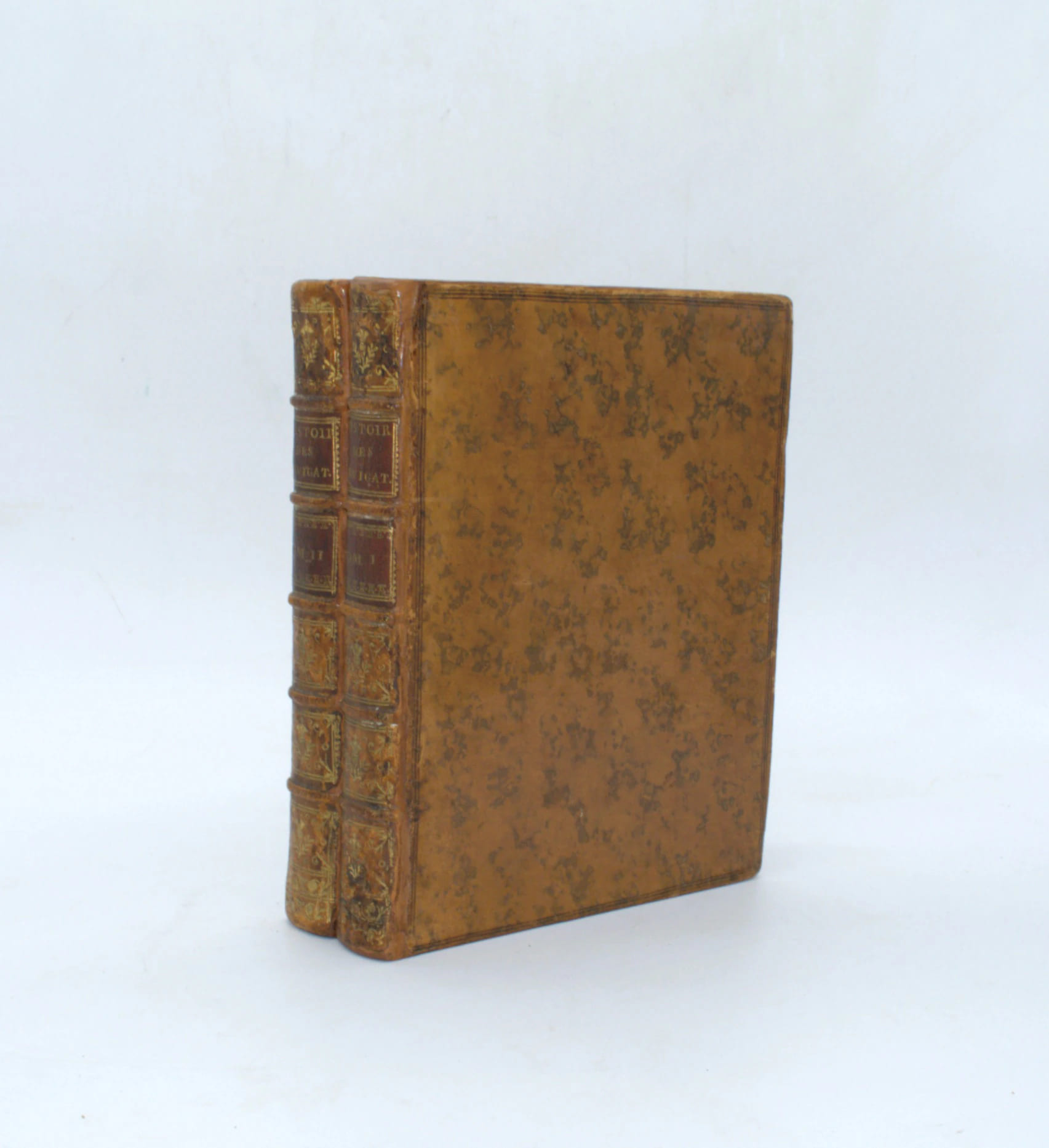
1756ref. PHO-2556Paris, Durand, 1756. 2 volumes in-4, veau marbré, dos à nerfs ornés, pièces de titre et de tomaison de maroquin rouge, tranches rouges (reliure de l'époque). Traces de réparations aux charnières, 1 feuillet (T1 p. 463) et titre T2 réparés en coin, frottements, quelques brunissures et petites rousseurs. Il manque les cartes qui n'ont pas été reliées à l'époque
1827ref. LBW-4433[1827]. 756 x 501 mm.
ref. LBW-3957[1812]. 492 x 344 mm.
1824ref. LBW-1064[1824]. 182 x 212 mm.
1820ref. P1-22ATLASP1-4E-0AVEC L'ATLAS: LA HARPE (J.F). Abrégé de l'histoire générale des voyages, contenant ce qu'il y a de plus remarquable, de plus utile et de mieux avéré dans les pays où les voyageurs ont pénétré; les mœurs des habitants, la religion, les usages, arts et sciences, commerce et manufactures; par J.F. LAHARPE. Nouvelle édition, revue et corrigée avec le grand soin, et accompagnée d'un bel Atlas In-folio. Paris, Etienne Ledoux, 1820. 24 volumes in-8° (205x135) reliés demi-maroquin olive, dos ornés, tranches marbrées, belle série. 500pp. par volume, le dernier (XXIV) étant la table des matières. TARDIEU A., Atlas pour servir à l'intelligence de l'histoire générale des voyages de LA HARPE. In-folio (455x295mm), couverture éditeur, coins écornés. Paris, Ledentu, 1825. 15 cartes géographique (595x460mm), contours couleurs dressés par AMBROISE TARDIEU. Mappemonde, Afrique, Asie (2), Indes, Océanie, Chine, Japon, Sibérie, Golfe du Mexique, Mexique, Amérique Méridionale, Pérou, Brésil, Amérique Septentrionale, Europe.
1833ref. LBW-1978Paris, 1833-1839. 268 x 358 mm.
1867ref. 80150Adelaide: David Gall 1867. First Edition. Hardcover. Very Good. Adelaide David Gall 1867. Duodecimo vi 82 52 'Chowla Advertiser' pages. Original flourescent green papered boards with expanded title page details repeated within a border on the front cover and with the contents listed on the rear; covers slightly marked and a little rubbed bumped and worn at the extremities with the hinges a little cracked; spine sunned lightly mottled and a little glue-stained; thin light tidemark to the top edge of the front endpaper; a very good copy of a scarce book rarely found with the spine intact and internally this copy is nothing short of fine. 'Storrie exhibits a keen sense of satire not only with regard to conventional tales whose perclivities are mercilessly ridiculed but also with regard to colonial society itself' Depasquale: A Critical History of South Australian Literature 1836-1930. Incidentally this is the first novel published in Adelaide. See Ferguson 16305 for confirmation of the Storrie/ McTavish connection. David Gall hardcover
2015ref. ASAP-9781626991323Studium Press India Pvt. Ltd. 2015. New. Studium Press (India) Pvt. Ltd. unknown
2015ref. ASAP-9781626991323Studium Press India Pvt. Ltd. 2015. New. Studium Press (India) Pvt. Ltd. unknown
19048vo [23 x 15 cm]; xxiv, 424 pp, frontis, 61 illustrations including many full-page, mostly from photos, 3 folding maps, some drawings, index. original pictorial cloth, gilt spine title lettering and gilt picture on front cover, top edge gilted, endpaper bookplate, no tears of maps, near fine and clean. A picture of this book is available upon request by email. An important book by one of the great botanical explorers and naturalists of the nineteenth century, the Italian botanist, spent time at Kew, where he met Charles Darwin, William Joseph Hooker and James Brooke, the Rajah of Sarawak. The latter lead him to spending 3 years from 1865 to 1868 undertaking research in Sarawak, Brunei and other islands off present-day Malaysia and New Guinea, where he discovered many new species of palms, and many other plants such as a phosphorescent fungus that was bright enough to read a newspaper placed by it. Beccari was in Sarawak during 1865-67 where he collected over 800 bird skins including 40 not previously discovered of unrecorded species. He describes nature, the people, Dyaks and their customs in some detail, prior to the major impacts of the twentieth century, and describes his return to Sarawak some 20 years later, where he formed a botanical garden. He discovered the titan arum, the plant with the largest unbranched inflorescence in the world, in Sumatra in 1878. This edition also contains the valuable and detailed appendix on the forests of Borneo, which are currently being logged to extinction. The preface is by naturalist F. H. H. Guillemard who also wrote a book of his travels in the area. The later reprint does not include the maps of the original.
1984ref. SBBIH-DGXWOY64X5MIAustralian Government Publishing Service 1984. unknown_binding. Good. Our good condition books are generally good for reading but not for gifting or collecting. They could have imperfections such as creasing fanning inscriptions margin notes yellowing staining on edge or cover or pages bumps scuffs etc etc sometimes multiple of these. It's a wide category that encompasses anything that isn't almost-new down to anything that is slightly better than poor. We would NOT recommend gifting Good books - these should be considered reading copies. Our books are dispatched from a Yorkshire former cotton mill. We list via barcode/ISBN so please note that the images are stock images and may not be the exact copy you receive furthermore the details about edition and year might not be accurate as many publishers reuse the same ISBN for multiple editions and as we simply scan a barcode or enter an ISBN we do not check the validity of the edition data when listing. If you're looking for an exact edition please don't order at least not without checking with us first although we don't always have time to check. We aim to dispatch prompty the service used will depend on order value and book size. We can ship to most countries see our shipping policies. Payment is via Abe only. Australian Government Publishing Service unknown
18008vo [21.5 x 14 cm]; 2 volumes, xxxii, [33] - 487; 344, 105, [vi, ads] pp, 45 engraved plates including frontis's, large folding map (short tear at stub), tables. contemporary half calf, marbled boards, red leather title labels, joints split, one board just holding, worn at edges, corners, bookplate of George Knight, light foxing on some leaves, but overall clean, text blocks tight, a very good set. A picture of th Hill p. 168: "Labillardiere was aboard the expedition under d'Entrecasteaux which was sent out to search for the missing Laperouse. Although unsuccessful in the search, the voyage was of considerable importance due to the scientific observations made and also for surveys of the coasts of Tasmania, New Caledonia, the north coast of New Guinea, and the southwest coast of Australia. Labillardiere's account of the Tongans is among the best contributions to the ethnology of that people." Cox 69: "of considerable importance. . . Labillardiere gives the first scientific description of the New Zealand flax and brought back several New Zealand plants." The plates include plants, birds, native peoples.
ref. carte34t11Dimension du cadre : 52 x 61,5 cm. Cum adjacentibus insulis nova delineatione ob oculos pofita per Matthaeum Seutter. Cum gratia et Privil. S.R.I vicarcatus in partibus rheni, suevioe et juris franconici. Royaume de l'Inde. Magnifique carte, en très bon état général, dans un cadre sympathique.
1852ref. 57668New York: Cornish Lamport & Co. Publishers 1852. First edition. Handcoloured folding map at front. iv 5-154 2 ads pp. 1 vols. 8vo. Brown blind-stamped cloth. Spine ends chipped else Fine. Ex-library stamps on map and title page card pockets removed. First edition. Handcoloured folding map at front. iv 5-154 2 ads pp. 1 vols. 8vo. Ferguson: "At this time the author was conducting an 'Australian Emigration Office' at 120 Wall Street New York." Ferguson 10892 2 copies P.L. N.S.W. Cornish, Lamport & Co., Publishers unknown
1852ref. 57668New York: Cornish Lamport & Co. Publishers 1852. First edition. Handcoloured folding map at front. iv 5-154 2 ads pp. 1 vols. 8vo. Brown blind-stamped cloth. Spine ends chipped else Fine. Ex-library stamps on map and title page card pockets removed. First edition. Handcoloured folding map at front. iv 5-154 2 ads pp. 1 vols. 8vo. Ferguson: "At this time the author was conducting an 'Australian Emigration Office' at 120 Wall Street New York." Ferguson 10892 2 copies P.L. N.S.W. Cornish, Lamport & Co., Publishers unknown books
1944ref. List3749US Australia and New Guinea 1944. Diary measuring 4 ¼ x 5 ½ inches containing 735 entries. With three letters two of which are facsimiles. Diary boards with debossed text reading "ARMY DAYS" and lock; worn especially at corners excellent. Contents Fine. Letters Fine. Overall Near Fine. A diary belonging to Dale F. Damitz 1920-1944 Company A of the 738th Military Police Battalion covering the time between his last day before leaving for service and about a month before his death in October of 1944. The 738th MPB stationed in the South West Pacific Area during the Second World War is best known during that time for its role in the Battle of Brisbane a two-day riot between US servicemen and Australian servicemen and civilians in which an Australian Gunner was killed and hundreds on both sides were injured. Australia was a critical station for housing troops on duty in the Pacific Theater. The arrival of US military personnel in Australia-80000 in Brisbane alone-overtaxed the capacities of its cities increased crime and strained relations between US troops and Australians. Americans had access to better rations including luxuries such as cigarettes and ice cream; received higher pay than their Australian counterparts; and were often criticized for consorting with Australian women. Though it does not figure in this diary race likely also contributed to animosity between the groups. Despite fairly strict Australian laws around the sale of alcohol drunkenness was rampant. Military police from both countries were tasked with keeping the peace in the major cities. Damitz arrived in Brisbane with the 738th in August 1942 where "Lt. Craddock" informed his company that "where we're going we'll have a chance to catch 200 lb bombs in our pockets" August 30 and "Cpt. Forbes" that he would "get some honor and glory if it costs him the whole company" August 31. Damitz's diary is fairly sparse at this time including during the Battle of Brisbane though he mentions an "air raid" that made "the ground shake" December 1. In Australia-"this land of forgotten men" February 15 1943 consisting of "Just heat and rain day after day. And insects" February 5 1943-Damitz's duties mainly consisted of being what he called "prisoner chaser" patrolling for and guarding "the drunks" who "make you so sick and disgusted you never want a drink again" March 29 1943. Damitz's duties took him across central and southeastern Australia from Adelaide River outside Darwin to Birdum and Alice Springs to Adelaide via Terowie-these along the Stuart Highway a critical military transport route-to Melbourne and then to Brisbane via Sydney. The central Australian route through the Northern Territory and South Australia is "just waste land" February 23 1943 and "flat desert country . Saw a lot of camels and a few abo camps" March 5. Damitz's then went from Brisbane to Adelaide River outside Darwin to Melbourne and back to Brisbane. In Melbourne and Brisbane he is on "prisoner chaser" duty: "Was prisoner chaser today. Got through at five. Went out on town patrol at six thirty. All troops were restricted as there was a big drive on to pick up all AWOL's. got one fellow over the hill." April 21 1943 And: "Was working with the Civilian Police tonight after sly-grog sellers. Caught one. Sure is a lot of excitement and dangerous" June 13 1943. Bootlegging was a persistent issue in Australia exacerbated by the presence of American GIs who were unused to Australia's strict liquor laws. Damitz's company left Brisbane for Milne Bay in New Guinea in November of 1943. The camp is "worse than a pig pen" November 11 and the "bastard of a Col. of the 801st" takes away his tent's floorboards for his own use leaving Damitz in the mud December 17. In a somewhat more upbeat letter to friends back home Damitz reports water "clear as crystal and cold as ice" with "plenty of banana trees and pineapples" and "natives here . called fuzzy-wuzzies. We give them a cigarette to climb the coconut trees and knock down coconuts for us" November 17. They arrived in Oro Bay in March of 1944 where Damitz "Just lays around" March 15 deals with the mud and casts his ballot-"the first time in my life I have voted. Voted straight Republican" July 23-on the controversial absentee ballot. By far Damitz's most persistent topic for the entirety of the diary is his overwhelming boredom the constant feeling of preparing for "something big" October 24 1943 that never materializes and the totalizing apathy that this produces. Damitz had been a reluctant enlistment in the first place-for instance mentioning an award as "another pipe dream of the old man's" June 5 1943-and had not expected to be sent overseas so quickly "it was said no untrained men would leave the states. Some joke!"; June 30 1942. He "Sure is sick of this shit!!!" March 15 1944 and writes throughout 1943: "February 4: Doesn't take long for a guy to get so you don't give a dam for anything. Almost get so you don't care what happens next. February 12: Saw a good movie here in camp last night. Rest of the day was just like any other day here. Often wonder if I'll ever have the happiness I once had April 14: This all seems like a bad dream. Sure wish it was over with. April 30: The months slowly go by. You feel like a condemned man who is waiting for the chair. August 19: Today makes fourteen months in the army. Seems more like years tho. Hate it more every day. November 13: Is raining again today the mud is about a foot deep right inside of the tents. Don't have any kitchen yet. Don't care. December 21: Just laid around all day. Don't have any life or pep anymore. Don't have any ambition to do a dam thing." After nearly two and a half years of "all this B.S." July 30 1943 Damitz's company was sent to the Philippines where he was killed in action a few days into the Battle of Leyte. The diary provides a humanizing look-in Damitz's distinctively hard-boiled writing voice-at US-Australian relations and law enforcement and at everyday life outside of combat for a US battalion infamous in Australian history.
1944ref. List3749US Australia and New Guinea 1944. Diary measuring 4 ¼ x 5 ½ inches containing 735 entries. With three letters two of which are facsimiles. Diary boards with debossed text reading "ARMY DAYS" and lock; worn especially at corners excellent. Contents Fine. Letters Fine. Overall Near Fine. A diary belonging to Dale F. Damitz 1920-1944 Company A of the 738th Military Police Battalion covering the time between his last day before leaving for service and about a month before his death in October of 1944. The 738th MPB stationed in the South West Pacific Area during the Second World War is best known during that time for its role in the Battle of Brisbane a two-day riot between US servicemen and Australian servicemen and civilians in which an Australian Gunner was killed and hundreds on both sides were injured. Australia was a critical station for housing troops on duty in the Pacific Theater. The arrival of US military personnel in Australia-80000 in Brisbane alone-overtaxed the capacities of its cities increased crime and strained relations between US troops and Australians. Americans had access to better rations including luxuries such as cigarettes and ice cream; received higher pay than their Australian counterparts; and were often criticized for consorting with Australian women. Though it does not figure in this diary race likely also contributed to animosity between the groups. Despite fairly strict Australian laws around the sale of alcohol drunkenness was rampant. Military police from both countries were tasked with keeping the peace in the major cities. Damitz arrived in Brisbane with the 738th in August 1942 where "Lt. Craddock" informed his company that "where we're going we'll have a chance to catch 200 lb bombs in our pockets" August 30 and "Cpt. Forbes" that he would "get some honor and glory if it costs him the whole company" August 31. Damitz's diary is fairly sparse at this time including during the Battle of Brisbane though he mentions an "air raid" that made "the ground shake" December 1. In Australia-"this land of forgotten men" February 15 1943 consisting of "Just heat and rain day after day. And insects" February 5 1943-Damitz's duties mainly consisted of being what he called "prisoner chaser" patrolling for and guarding "the drunks" who "make you so sick and disgusted you never want a drink again" March 29 1943. Damitz's duties took him across central and southeastern Australia from Adelaide River outside Darwin to Birdum and Alice Springs to Adelaide via Terowie-these along the Stuart Highway a critical military transport route-to Melbourne and then to Brisbane via Sydney. The central Australian route through the Northern Territory and South Australia is "just waste land" February 23 1943 and "flat desert country . Saw a lot of camels and a few abo camps" March 5. Damitz's then went from Brisbane to Adelaide River outside Darwin to Melbourne and back to Brisbane. In Melbourne and Brisbane he is on "prisoner chaser" duty: "Was prisoner chaser today. Got through at five. Went out on town patrol at six thirty. All troops were restricted as there was a big drive on to pick up all AWOL's. got one fellow over the hill." April 21 1943 And: "Was working with the Civilian Police tonight after sly-grog sellers. Caught one. Sure is a lot of excitement and dangerous" June 13 1943. Bootlegging was a persistent issue in Australia exacerbated by the presence of American GIs who were unused to Australia's strict liquor laws. Damitz's company left Brisbane for Milne Bay in New Guinea in November of 1943. The camp is "worse than a pig pen" November 11 and the "bastard of a Col. of the 801st" takes away his tent's floorboards for his own use leaving Damitz in the mud December 17. In a somewhat more upbeat letter to friends back home Damitz reports water "clear as crystal and cold as ice" with "plenty of banana trees and pineapples" and "natives here . called fuzzy-wuzzies. We give them a cigarette to climb the coconut trees and knock down coconuts for us" November 17. They arrived in Oro Bay in March of 1944 where Damitz "Just lays around" March 15 deals with the mud and casts his ballot-"the first time in my life I have voted. Voted straight Republican" July 23-on the controversial absentee ballot. By far Damitz's most persistent topic for the entirety of the diary is his overwhelming boredom the constant feeling of preparing for "something big" October 24 1943 that never materializes and the totalizing apathy that this produces. Damitz had been a reluctant enlistment in the first place-for instance mentioning an award as "another pipe dream of the old man's" June 5 1943-and had not expected to be sent overseas so quickly "it was said no untrained men would leave the states. Some joke!"; June 30 1942. He "Sure is sick of this shit!!!" March 15 1944 and writes throughout 1943: "February 4: Doesn't take long for a guy to get so you don't give a dam for anything. Almost get so you don't care what happens next. February 12: Saw a good movie here in camp last night. Rest of the day was just like any other day here. Often wonder if I'll ever have the happiness I once had April 14: This all seems like a bad dream. Sure wish it was over with. April 30: The months slowly go by. You feel like a condemned man who is waiting for the chair. August 19: Today makes fourteen months in the army. Seems more like years tho. Hate it more every day. November 13: Is raining again today the mud is about a foot deep right inside of the tents. Don't have any kitchen yet. Don't care. December 21: Just laid around all day. Don't have any life or pep anymore. Don't have any ambition to do a dam thing." After nearly two and a half years of "all this B.S." July 30 1943 Damitz's company was sent to the Philippines where he was killed in action a few days into the Battle of Leyte. The diary provides a humanizing look-in Damitz's distinctively hard-boiled writing voice-at US-Australian relations and law enforcement and at everyday life outside of combat for a US battalion infamous in Australian history. books
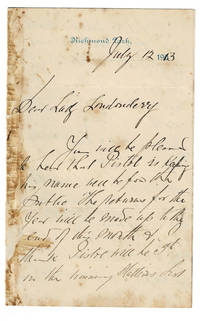
1913ref. 97593Richmond Park South Australia: July 12 1913. 1913. Good. - Approximately 300 words penned on 4 sides of a folded sheet of creamy white paper with each page measuring 8 inches high by 5 inches wide. "Richmond Park" is printed at the top of the cover page. Aldridge has altered the partially printed date from "1903" to "1913". Started on the cover page Aldridge has continued his letter on the last page to then conclude on the inner 2 leaves. Signed "J.H. Aldridge" on the inner leaf. Once apparently mounted along the inner edge with glue or tape there are heavy stains with remnants of glue to the inner edge of the first and last page. There is a tiny tear along the fold with some light brown stains or foxing to all four pages. Good. A RARE LETTER REPLETE WITH HORSE RACING ASSOCIATIONS. Aldridge writes to the Marchioness of Londonderry praising the horse he purchased from her and the Marquis of Londonderry. "You will be pleased to hear Pistol is keeping his name well before the public.I think Pistol will be 5th on the Winning.List in all Australia of course in this State 'South Australia' he is easily 1st.Londonderry by Pistol Antilles won the Broken Hill Cup a few days ago & the Chairman in presenting the cup to the winner referred to the fact that the horse got his name from his Breeder the Marchioness of Londonderry.Pistol is a most prolific father of winners & that is better than one good one & twenty duffers as some sires record. I believe there is only one sire in Australia which has produced more winners this year." He goes on to complain about the season as a whole mentions some "great loss" that she has had and he wishes the Marquis well and that "his illness worries will be settled ere long" Signed "J. H. Aldridge". James Henry "Jim" Aldridge 1849-1929 was a popular and highly respected Australian sportsman. he began his career as a hotelier in Adelaide. He managed the Globe Hotel in Rundle Street a hotel that was popular with sportsmen. He later took charge of the Grand Hotel Broken Hill and the Gresham Hotel. In 1890 with the intent of establishing a stud farm he purchased at a Sydney sale the Stallion Carlyon. Carlyon was to be the lord of the harem so to speak. In addition he purchased a richly bred brood of a half-dozen mares. Sometime between 1888 and 1890 Aldridge purchased Richmond Park in South Australia from its original owner John Chambers. With the Chester horse Carlyon and the stud established Aldridge rapidly became well-known as a breeder. Carlyon and the thoroughbreds he sired at the Richmond Park stud farm made Aldridge's name famous throughout Australian racing circles. Although still able to perform as a stud Carlyon was badly injured in 1905. As it happened however in 1904 Aldridge had purchased Pistol the son of the famous English sire Carbine. Pistol was foaled in 1899 and arrived in South Australia as a five year old. He was purchased from the Marquis of Londonderry for the large sum of 1250 pounds. As a stud Pistol performed into his 26th year and sired winners of more than 641 races out of 1423 competitions. Up until Aldredge's death in 1829 the Pistol progeny had won approximately 200000 pounds in stake money. In atribute after his death the Chairman of the S.A.J.C. South Australian Jockey Club Whitmore Blake Carr "Doc Carr" wrote: "For years Mr. Aldridge has been one of the best widely known and most popular identities of the turf in South Australia and one to whom the sport owed much of its maintenance and stability. When he ran horses he did so for the pure love of the sport and the applause which always attended the success of his colours was a fine tribute by the racing public to the popularity of the owner. He was an exceptionally fine judge of a horse. The gratifying results which have been achieved at Richmond Park making it stand today so high in the list of studs in the Commonwealth was due to his sound judgment and ripe experience." Richmond Park, [South Australia]: July 12, 1913. unknown
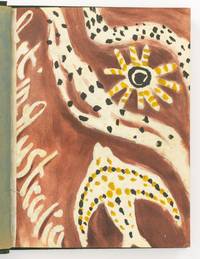
1941ref. 137250Sydney: 'Sydney Morning Herald' 1941. First Edition. Paperback. Very Good. Sydney 'Sydney Morning Herald' 1941 and 1942. Large quarto 84 to 88 pages each issue extensively illustrated in colour and black and white; bound-in in the first number is a small two-part perforated order-gift subscription form. Binder's cloth retaining the original colour-pictorial card covers with the rear cover now bound in immediately after the front cover in each case; cloth a little flecked; edges a little foxed; endpapers discoloured; light foxing to a few leaves adjacent to the boards; in excellent condition. The fourth and final series of 'Art in Australia' comprised only six quarterly numbers between March 1941 and August 1942. They were a marked departure in all respects from the previous 94 numbers of the journal which commenced publication in 1916: new editor new format new emphasis on international art. The editorial in the first issue spells this out succinctly: there will be 'a complete change in appearance and methods of production with a broadening of policy. In the past "Art in Australia" has been almost entirely devoted to the painting sculpture and architecture of this country. Luxurious productions from France England and other countries were available to inform the artist student and art-lover of the work and activities of the art world outside. But the barbarity unleashed in Europe is destroying much of the art of the past and present and has made it impossible for periodicals we prized so much to continue production. The countries of their origin have fallen under Hitler's yoke men responsible for their production - artists and writers - killed art galleries and elaborate printing and processing plants blown to bits. But Art cannot die and we in Australia can and will carry on our efforts to preserve encourage and foster the culture our enemies would destroy. In spite of paper shortages and many other difficulties "Art in Australia" will play its widened part by presenting the art of all countries all periods and all schools'. Peter Bellew modelled its visual excellence and intellectual content on 'Verve' and 'under his stewardship the art historian and director of London's National Gallery Sir Kenneth Clark declared it "unquestionably the best art magazine being published today anywhere in the world"' Harding and Morgan: 'Modern Love - The Lives of John and Sunday Reed' 2015. Notwithstanding the end came without warning: Series 4 Number 6 August 1942 the last one published with a strong and parochial editorial about the 'Need for War Artists' contained no hint of its fate. 'Sydney Morning Herald' paperback
1842ref. 144203London: John Arrowsmith 1842. First Edition. Hardcover. Very Good. London John Arrowsmith Published 18 May 1842. A hand-coloured engraved map printed surface 402 × 551 mm external dimensions 446 × 591 mm cut into eight uniform panels mounted on linen as issued folding down to approximately 225 × 150 mm. When folded the two outside surfaces of linen are lined with plain purple textured cloth; a long sealed tear runs though the two top right-hand panels containing the printed title and a centimetre into the next-left panel but the only printed surface affected is the thin right-hand border: in spite of its length it is inoffensive and unobtrusive and may well be a production fault; in very good condition complete with the publisher's original slipcase in matching cloth lettered 'Wellington' in gilt on one thin side worn at the corners of the closed end and a little marked. John Arrowsmith 1790-1873 'was an important English cartographer especially for Australians. A member of a family of geographers his production focused on mapping British colonies around the world at a scale that surpassed that of any other contemporary map maker. Additionally he had access to the very latest despatches received at the Colonial Office and the British Admiralty which formed the source for many of his productions. His work covers the period 1832 to 1862'. His lasting contribution is his 'London Atlas of Universal Geography' which went through at least eight editions between 1834 and 1858 Dorothy Prescott: 'Arrowsmith's Australian Maps' online resource. We have previously sold uncut examples of this map on paper sourced from copies of the atlas. This cased example produced from the same plate used for the atlases shows the original allotments along the River Murray at Wellington and the upper entrance to Lake Alexandrina. This copy has three of these allotments additionally hand-coloured with initials added in black ink. They are blocks 8 blue FB 51 blue JB and 90 red FB. The two inset maps show the south-eastern portion of Australia and a 'Sketch of the Country between the Gulf of St. Vincent and the Great Bend of the River Murray shewing the Position of the Two Special Surveys of the Secondary Towns Association on the River Light'. Tooley 115 b uncut version. John Arrowsmith hardcover