[MAY, Edgar Charles]Biblio.com

5 711 résultats
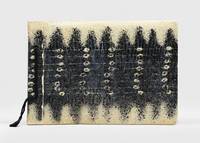
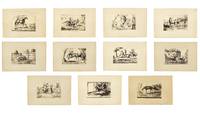
réf. 63186Gill's titles are 'Cradling Forest Creek 1852' 'The Claim Disputed' 'Mustering Cattle' 'Native Sneaking Emus' and 'The Bushranger Pursued'. Hamilton's titles in which the horse naturally enough features prominently are 'The Lost Bushman' 'The Found Bushman' 'Bushmen in Danger' 'Australian Bushmen' and 'The Bushman'. Unpublished but circa 1890 and based on original sketches from upwards of fifty years earlier. The images are printed in brown ink on light brown arch-topped backgrounds printed surface 150 × 205 mm on uniform sheets of cream paper 200 × 275 mm. This set is in fine condition in a modern custom-made portfolio covered in brown cloth lettered in gilt on the front panel 'Scenes of Australian Country Life'. The invaluable 'Dictionary of Australian Artists. Painters Sketchers Photographers and Engravers to 1870' edited by Joan Kerr has only this to say: 'MAY E.C. lithographer signed nine lithographs celebrating life in the bush and on the goldfields c.1855-60 ML. He may have been the May who was in partnership with George Walker q.v. at Melbourne in the early 1870s'. At least he appears on their radar . We have established the following facts. Edgar Charles May 1867-1920 was born at North Adelaide on 27 May 1867; his name later appeared in the local Sands and McDougall's directories with his occupation listed as artist. One published example of his work not noted at all by Kerr and not attributed to May by Ferguson is '14 Views of Old Adelaide from Sketches in 1840-1849 by S.T. Gill F.R. Nixon S. Calvert and O. Korn' Adelaide E.S. Wigg 1890; oblong quarto 19 leaves all rectos blank comprising the gilt-pictorial title page signed in the image by E.C. May 14 full-page tinted lithographic views with tissue-guards the 3-page list of 181 subscribers and the key to plate 5 between plates 4 and 5'. This is Ferguson 9924e which is essentially the same item as Ferguson 9807 apart from the different publishers. We have inspected numerous copies of 9924e the Wigg version and the odd Galbraith one and it is clear that the original Galbraith imprint is masked by the gold blocking carrying the later Wigg imprint. The nature of the contents reworked material from well-known earlier artists the medium tinted lithographs printed in brown and the style of the work leave us in no doubt that May is responsible for all the material in '14 Views of Old Adelaide'. We suggest that the ten lithographs offered here were prepared by him with the intention of putting out a companion volume to '14 Views of Old Adelaide'. The change of publisher after that book was printed leads us also to suggest that Galbraith or May or both lost money on the venture and who knows perhaps the Wigg issue was not a commercial success either. In any event one could see how enthusiasm for a sequel might be considerably diminished. All of these plates are rare; complete sets of them are exceptionally rare on the open market even Kerr's dictionary refers to only nine of them. Until now they have been poorly documented in the literature; fortunately some of them have survived to tell their own worthy tale. unknown
1880réf. 104852Adelaide: Goodfellow & Hele almost certainly the Author - James Dally was convinced 1880. First Edition. Hardcover. Very Good. Adelaide Goodfellow & Hele almost certainly the Author - James Dally was convinced 1880. Octavo 182 30 advertisements pages plus 6 lithographed plates of farm machinery by James Martin & Co. and 17 albumen paper carte-de-visite photographs individually mounted on tipped-in captioned leaves. Blind-decorated maroon cloth lettered in gilt on the front cover with a later gilt-lettered cloth title-label along the spine originally untitled; cloth a little flecked slightly sunned on the spine and a little rubbed and bumped at the extremities; some mounts lightly cockled as ever a production flaw; a few trifling signs of use; basically an excellent copy internally fine with the photographs in superb condition. A rare and desirable item attested to by the provenance of this copy: it has the armorial bookplate of Charles Glover on the pastedown and the blind-stamp of Sir Thomas Ramsay on the flyleaf 'T.M.R. Library of T.M. Ramsay'. Ferguson 11744; Holden 70. Holden's entry is more accurate and informative although the photographs may vary slightly between copies. The photograph facing page 16 in this copy is a portrait of Dr Nott rather than 'Frankel's Hotel' as called for in Holden facing page 17. Two other photographs are less-common variant images of the same subject: these are 'Fotheringham's Cordial Factory' facing page 57 and 'Stewart's Music Emporium' facing page 96. These variations notwithstanding two separate editions were produced: one in wrappers with advertisements on the verso of the front cover and on both sides of the rear cover without photographs but with the lithographs not noted by Ferguson; the other in gilt-lettered cloth without the cover advertisements containing 17 mounted photographs plus the lithographs. Both contain 30 pages of advertisements at the rear. Rare in any state and in our view the version on offer is one of the more important and interesting photographically illustrated books produced in Australia. 'The handbook is illustrated with a number of views by Mr J. Taylor the local photographic artist representing the most important edifices and establishments in town' Holden quoting a contemporary review. The frontispiece is a portrait of John McKinlay 1819-1872; there are 14 pages devoted to him he married a Gawler woman in the early 1850s and was based in the town until his death. Justice is not done to the other photographs in describing them prosaically as 'the most important edifices and establishments in town'. Without exception signs of life and day-to-day activities flesh out the images and most of the businesses - butcher shop photographic studio cordial factory furnishing warehouse music emporium - feature well-stocked windows or yards and numerous staff members or customers. Holden reproduces two interesting ones including perhaps the best the butcher shop captioned merely 'Hodgson & Clements' but there are wonderful vignettes in many others. Not least of these are the horse-drawn tram in front of the 'Commercial Bank' and the ornate hearse outside 'F. Fowler's Furnishing Warehouse'. While we are on the subject of death one chapter stands out. Among those to be expected say on 'Horticultural and Agricultural Progress. Gardens around Gawler' or 'The Humbug Society. Flam! Bam! Sham!' or 'The Streets - Number of Businesses - Description of Hotels' there is Chapter XI: 'The Neville and Adamson Tragedy'. Its thirteen pages describe in great detail the events surrounding the double suicide 'and its romantic accomplishment' of Neville and his partner Adamson. 'It is universally believed that Neville was the leading spirit in the suicide and so strong was Adamson's affection love friendship or whatever it may be termed for his companion that he consented to take that final leap in the dark in the wine cellar with him to visit that "bourne whence none return"'. Goodfellow & Hele [almost certainly the Author - James Dally was convinced] hardcover
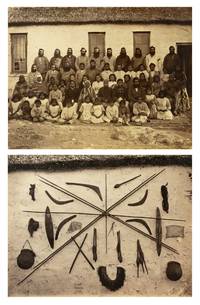
réf. 125425Original sepia-toned albumen paper photographs both 158 × 208 mm unmounted as issued; short sealed tear to the bottom corner of the photograph of weapons; essentially in fine condition. Captain Samuel White Sweet 1825-1886 sea captain surveyor and photographer: after he was censured when his ship ran aground in 1875 he 'retired from the sea opened a photographic studio in Adelaide and concentrated on landscapes. With his horse-drawn dark room he travelled through South Australia taking hundreds of skilful pictures of the outback stations and homesteads. The colony's foremost documentary photographer of the 1870s in the early 1880s he was one of the first to use the new dry-plate process' 'Australian Dictionary of Biography'. 'Point McLeay Mission was founded on the shores of Lake Alexandrina in 1859 by the Aborigines' Friends Association for the Aboriginal people of the Lower Lakes. George Taplin the Congregational minister was its first administrator. Following Government administration from 1916 Point McLeay was returned to the Ngarrindjeri people in 1974 and renamed Raukkan in 1982' State Library of South Australia. The group portrait depicts 55 Indigenous men women and children posed in five rows in front of one of the thatch-roofed residential cottages at Point McLeay. 'Sweet Adelaide 463' is inscribed in the negative; 'Native Mission Station Ponindie sic' is written in pencil and in error on the verso. The photograph of weapons and artefacts is inscribed 'Sweet Adelaide 462' in the negative and has an early caption in pencil on the verso 'Native Ornaments & Weapons'. The objects numbered 1 to 17 in the negative are displayed against a whitewashed wall of one of the cottages. We have traced only one example of the latter photograph in Trove in the National Library of Australia and none of the group portrait. 'Captain Sweet's Colonial Imagination - The Ideals of Modernity in South Australian Views Photography 1866-1886' by Karen Magee a 2014 University of Adelaide doctoral thesis accessible online notes that Sweet visited Point McLeay in 1878 and 1880. She reproduces the latter photograph in her extensive catalogue see number 811 '"Ngarrindjeri weapons and hunting implements" 1878 Point McLeay. Private Collection' but does not record the group portrait. 2 items. unknown
1822réf. 003091Leblanc, chez Abel Ledoux, (s. d.), 1822
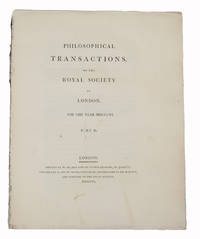
1806réf. 45128London, W. Bulmer and Co., 1806. 4to. No wrappers as extracted from ""Philosophical Transactions"" 1806 - Part II. Pp. 239-268. Having also the titlepage to the volume (Part II, 1806). A faint bit of soiling to outer right margin of the first 2 leaves, otherwise clean and wide-margined.
1806réf. 45128London W. Bulmer and Co. 1806. 4to. No wrappers as extracted from "Philosophical Transactions" 1806 - Part II. Pp. 239-268. Having also the titlepage to the volume Part II 1806. A faint bit of soiling to outer right margin of the first 2 leaves otherwise clean and wide-margined. First printing of this important paper relating Flinder's observations on the ship "Investigator" when exploring the coast of Australia. IN THE PAPER THE NAME "AUSTRALIA" APPEARS PROBABLY FOR THE FIRST TIME IN A SCIENTIFIC MEMOIR p. 247.The name Australia was popularised by Matthew Flinders who pushed for the name to be formally adopted as early as 1804. When preparing his manuscript and charts for his 1814 A Voyage to Terra Australis he was persuaded by his patron Sir Joseph Banks to use the term Terra Australis as this was the name most familiar to the public. Flinders did so but allowed himself the footnote:"Had I permitted myself any innovation on the original term it would have been to convert it to Australia; as being more agreeable to the ear and an assimilation to the names of the other great portions of the earth." In the paper offered he used the name "Australia" as early as 1806."Captain Matthew Flinders RN 16 March 1774 - 19 July 1814 was one of the most successful navigators and cartographers of his age. In a career that spanned just over twenty years he sailed with Captain William Bligh circumnavigated Australia and encouraged the use of that name for the continent which had previously been known as New Holland. He survived shipwreck and disaster only to be imprisoned for violating the terms of his scientific passport by changing ships and carrying prohibited papers. He identified and corrected the effect upon compass readings of iron components and equipment on board wooden ships and he wrote what may be the first work on early Australian exploration A Voyage to Terra Australis."Wikepedia unknown
réf. 32557Ninety-one numbers Volumes 23 and 24 were issued as one volume plus the separately issued paper envelopes of maps for Volumes 18 and 19 the second envelope is a little worn and stained; nine early numbers are bound as five volumes in publisher's half morocco and Volume 4 is bound in later binder's cloth; Volume 5 lacks the wrappers; those of Volume 10 are worn with a little loss with light stains to the front cover and the top corner of the title-leaf; the rear cover of the double issue is a little stained affecting slightly the top and bottom margins of the last ten leaves; a handful of volumes have trifling cover blemishes; all other volumes are in fine condition in the original wrappers. All subsequent issues are in print and can be supplied. A major repository of contemporary accounts of exploration frequently not published elsewhere with much on anthropology; complete sets are rarely offered for sale. unknown
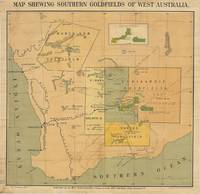
réf. 64089London: The West Australian Gold Fields Limited 29 St. Swithins Lane. Printers: Sir Joseph Causton & Sons Ltd. c.1895. Original colour-printed map overall 63 x 65 cm backed onto linen. Shows the Murchison Yilgarn Coolgardie and Dundas goldfields. With separate map of the Murchison goldfield with the addition of the Yalgoo goldfield on a separate slip 22 x 22 cm stating 'Whilst the map was in the press another goldfield - the Yalgoo - was proclaimed.and this slip has been prepared to show the new goldfield and the consequent subdivision of the Murchison field 30th March 1895'. Signs of old restored creases mainly to lower half and outer margins; the slip map browned and backed with archival tissue the top left corner clipped signs of old tears across the centre withal very good for such an ephemeral item. Shows the prospector's routes: Gregory 1846 Roe 1848 Dempster 1863 Giles 1875 Forest 1877 Lindsay 1891 Carnegie 1894 London: The West Australian Gold Fields Limited, 29 St. Swithins Lane. Printers: Sir Joseph Causton & Sons Ltd. [c.1895]. unknown
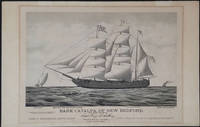
1876réf. 23907Boston: Forbes Lith. Mfg. Co. 1876. First edition. This scarce tinted lithograph was issued to commemorate the escape of Irish political prisoners from Fremantle W.A. on April 17th 1876. The Fenians are shown rowing towards the bark which is under full sail. The Catalpa is flying a flag with the initials "J T R" - for John T Richardson the ship's agent. A pennant with the letter C the Fenian flag and the American flag are also flying. The police boat is in hot pursuit and the British steamship "Georgette" is steaming in from a distance. Among the Fenians freed in this effort was John Boyle O'Reilly who became a leading citizen in Boston and was later to edit the 'Boston Pilot'. Captain George Anthony an American whaling captain out of New Bedford Massachusetts recruited a crew for this mission and set sail for Western Australia where two Fenian agents John Breslin and Tom Desmond had already established themselves with aliases. With several delays the day for the escape was set for the 17th of April when most of the convict garrison was distracted by watching the Perth Yacht Club regatta. Captain Anthony who refused to surrender the escaped prisoners to the British later sold his story to Zephaniah W. Pease who published the account in 'The Catalpa Expedition'. See also Laubenstein 'The Emerald Whaler'. On its arrival in New York in August of 1876 the Catalpa was met with great crowds; jubilant celebrations were held in the US and Ireland. 17 x 13" on paper 22 x 14 1/4". For information on the artist E. N. Russell see Blasdale Artists of New Bedford pp 160-161; Kendall Prints 28; Ingalls 318. OCLC: 191908718 1 copy at the Boston Athenaeum. Trove 45254 at the Australian National Maritime Museum; and 57714676 at the State Library of Western Australia. Professionally deacidified. In very good condition. A rare print important for its depiction of an important Western Australian colonial event. Forbes Lith. Mfg. Co. unknown
1940réf. 180936Adelaide: 20 July 1940. We're off to see the inland; the wonderful inland of Aust! A personal album kept by the Australian opera singer Una Rosalind Hale. It documents the trip she and 11 other schoolgirls took on 9 May 1940 travelling by train from Port Pirie to Alice Springs and the aboriginal community of Hermannsburg. They were given a tour of Alice Springs by Reverend Harry Griffiths who designed and opened the ANZAC Hill Memorial. Hale 1922-2005 was born in Adelaide to the Unitarian minister George Ernest Hale. This album dates from her education at Adelaide Methodist Ladies' College. As she describes on page 1 the girls were accompanied by their headmistress and four teachers on a train journey to the Australian inland. The photographs show their stopovers at Port Augusta Marree and Coward Springs where they posed for photographs outside the train and with aboriginal people. Hale moved to Britain in 1946 to study at the Royal College of Music. "On leaving the college she joined the Carl Rosa Opera Company and quickly established herself in such roles as Marguerite Faust Violetta La traviata Micaela Carmen Mimì La bohème and Donna Anna Don Giovanni invariably with success. Of a disastrous production of Tannhäuser The Times wrote: 'The one redeeming feature was the Elisabeth of Una Hale.'" The Times. She then joined the Covent Garden Company in 1954 and starred as Ariadne in the Australian premiere of Araidne auf Naxos in 1962. Once in Alice Springs the group were given a tour by Reverend Harry Griffiths and his wife Dorothy shown on pages 14 and 31. The album contains shots of the church and the manse where they stayed as well as the countryside and the missionary trips they performed. These include to Todd River Hermannsburg Palm Valley Standley Chasm and Simpson's Gap. One spread contains four photographs of a place they named "MLC Rock" and another contains a photograph of two girls riding a camel "with a steadfast and a strong intent fearful of the consequences". The two loose photographs show the Sydney Harbour Bridge and the AMP Building once Australia's tallest building completed in 1962. Oblong folio 190 x 276 mm. With 84 gelatin silver photographs mostly 63 x 85 mm snapshots landscape or portrait photographic postcard halftone photographic illustration colour newspaper clipping colour manuscript map all corner-mounted on card leaves with manuscript captions. Two additional gelatin silver commercial photographs loosely inserted. Contemporary crocodile skin-textured boards black string binding with tassle light brown textured lining. Binding a little worn photographs generally bright with some toning slight silvering to postcard: a very good example. "Una Hale: Australian lyric soprano who shone in the 1950s and 1960s" The Times 12 March 2005. hardcover
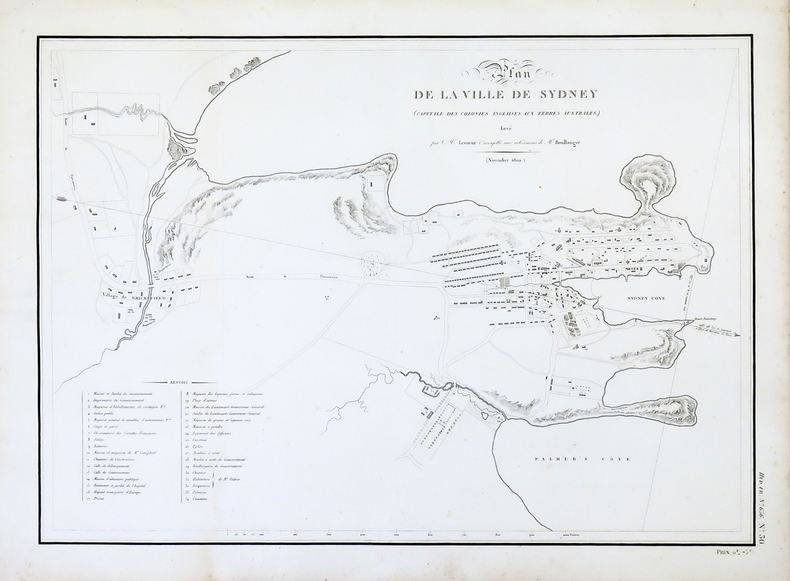
1800réf. PHO-1086Texte In-8 (200 x 130 mm) Relié demi-basane, dos orné pièce de titre et de tomaison ,T1 manque coiffe sup.,T2 ,manque coiffes, papier bruni. 440 pp et 332 pp suivi de 109 pp de vocabulaire et table des planches contenues dans l’atlas, table des chapitres du volume et errata. ATLAS Atlas pour servir à la relation du voyage à la recherche de La Pérouse, fait par ordre de l’Assemblée constituante, Pendant les années 1791, 1792, et pendant la 1ere et 2eme année de la République Française. Paris : H. J. Jansen, An VIII de la République (1800). — In-folio, 510 x 335 : titre, 1 carte, 43 planches. Demi toile , dos lisse avec titre , planches 6 détachée et 35 détachée et émargée , dédicace «à Mr V. Rey, secrétaire général de la Nouvelle Calédonie,1903»
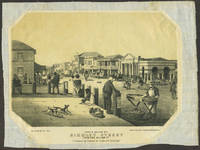
1851réf. 28279Adelaide: Penman & Galbraith 1851. Print. An extraordinarily rare set of four of S. T. Gill's Adelaide views no. 1-3 i.e. Views in Adelaide No. 1. Hindley Street from King William St.; No. 2. Hindley Street Looking East; No. 3 Rundle Street Looking East; with a variant second copy of No. 3 which is black & white. The images are held at the Art Gallery of South Australia; the State Library of New South Wales the National Library of Australia and some a the City of Adelaide. There are tinted lithographs some with a tinted border others not and black & white lithographs as well. The street images appear to be the same in all the recorded prints consistent with these four- there are some minor variations which are noted. The three tinted lithographs are mounted on polished cloth. The period cloth mounting is unusual. It is not known if these were a reference set or perhaps proofs. Views in Adelaide No. 1./ Hindley Street from King William St./ Published by Penman & Galbraith Adelaide/ On Stone by S. T. Gill/ Printed by Penman & Galbraith/ Signed in the stone S T G 1851. Tinted plate with no tinted border outline. Image 17.5 x 22.5 on paper 18 x 23.5 cm. AGSA 684G11; SLNSW nmQdoR5n. SLNSW image has tan border outline this copy does not. Mounted on cream cloth trimmed outside the catty corners with margins. Views in Adelaide No. 2./ Hindley Street Looking East/ Published by Penman & Galbraith Pirie St. Adelaide./ On Stone by S. T. Gill/ Printed by Penman & Galbraith/ Signed in the stone S T G indistinct date. Tinted plate with a faint tinted border outline. Image 18 x 23.1 cm on paper 18.3 x 24 cm. AGSA 684G12; SLNSW 9PQ8kDxn; Nat Lib ID 7566602 Rex Nan Kivell Collection NK3544/B. Slt. foxing on left lower margin. Mounted on saffron cloth trimmed outside the catty corners with margins. Views in Adelaide No. 3/ Rundle Street Looking East/ Published by Penman & Galbraith Pirie St. Adelaide./ On Stone by S. T. Gill/ Printed by Penman & Galbraith/ Signed in the stone S T G 1851 S inverted. Tinted plate with tinted border outline. Image 18 x 22.8 on paper 18.2 x 23.4 cm. AGSA B 2430; SLNSW Yj7djR39 for 3 print set which is colored and without border outlines. Mounted on saffron cloth trimmed outside the catty corners with margins. Views in Adelaide No. 3/ Rundle Street Looking East/ Published by Penman & Galbraith Pirie St. Adelaide./ On Stone by S. T. Gill/ Printed by Penman & Galbraith/ Signed in the stone S T G 1851 S inverted. Black and white plate with no tinted border outline. Image 18 x 22.2 on paper 20.9 x 25.8 cm. AGSA B 2430; NLA Lib ID 7566601 Nan Kivell NK3544/C. Printed on cream paper some watermarks. A rare set of images by one of the master artists of this period in Australia. Penman & Galbraith unknown
réf. 98413Babbage was 'engineer scientist and explorer . son of Charles Babbage Cambridge professor of mathematics and the first computer pioneer and his wife Georgina sister of W.W. Whitmore a founder of South Australia. In 1856 Babbage was sent north to search for gold as far as the Flinders Ranges. He found none but discovered the MacDonnell River Blanchewater and Mount Hopeful. He was the first to dispel the current idea of the impassability of the Lake Torrens "horseshoe" . In late 1857 he was appointed leader of a northern expedition. Babbage left in February 1858 to explore the country between Lakes Torrens and Gairdner and further to the north and west. His concept of exploration was based on thorough survey mapping and examination of the country ideals with which Francis Dutton commissioner of crown lands agreed in his instructions and early correspondence. With cumbrous and ingenious equipment Babbage carried out the first part hampered by bad terrain and lack of water. But he had no sense of urgency and was thus completely out of tune with the current concept of opening up new country for quick exploitation. His slowness led to public and parliamentary clamour to which Dutton later succumbed and sent Peter Egerton Warburton to supersede him. Meanwhile Babbage had moved north from the Elizabeth River discovered Hermit Hill and delineated the western shores of Lake Eyre South. There Warburton relieved him on 5 November. Based on his experiences of 1856 Babbage also believed in a gap in the "horseshoe" and at Hermit Hill confirmed his belief. He had actually crossed the gap but Warburton was the first to traverse it completely. On grounds of unfair treatment Babbage successfully petitioned for a parliamentary inquiry. In 1858-59 voluminous evidence was taken but no report issued. He then withdrew from public life until 1866. In 1870-72 Charles Todd employed Babbage as an assistant in planning and plotting the Overland Telegraph line and as a supervisor of contractors. His achievements as an explorer were notable but the accompanying controversy tended unduly to overshadow them and his attainments in other fields' 'Australian Dictionary of Biography'. Indeed 'the reports from the expedition were . a significant prelude to Stuart's successful crossing of the continent from south to north' in 1861-62 The Davidson Collection Third Sale July 2007 lot 565. This lengthy preamble should help explain the connection between the following eleven foolscap folio Parliamentary Papers relating to Benjamin Babbage published in Adelaide by the Government Printer in 1858 and 1859. 1 Northern Exploration. Reports &c of Explorations into the Interior by Messrs. Babbage Warburton Geharty and Parry. SAPP25/1858; 51 pages plus 2 large folding maps. 2 Northern Exploration. Further Correspondence respecting the Exploring Party under Command of Mr. Babbage. SAPP25/1858; 6 pages. 3 Cost of Northern Exploration. SAPP36/1858; 1 page. 4 Northern Exploration. Correspondence between the Hon. the Commissioner of Crown Lands and the Commissioner of Police Major Peter Egerton Warburton relative to the Progress of the Northern Exploring Parties. SAPP127/1858; 4 pages. 5 Northern Explorations. Reports from Messrs Babbage and Warburton and Police-Trooper Burtt on Exploration into the North and North-Western Interior of South Australia. SAPP151/1858; 19 pages plus 3 maps 2 folding. 6 Petition of B.H. Babbage. SAPP154/1858; 1 page. 7 Northern Exploration. Letter with Enclosure from Major Warburton relative to Exploration in the Neighborhood of Lake Torrens. SAPP159/1858; 3 pages. 8 Northern Exploration. Correspondence between the Honourable the Commissioner of Crown Lands and Major Warburton relative to the Northern Exploration. SAPP166/1858; 6 pages. 9 Cost of Northern Explorations. SAPP20/1859; 1 page. 10 Minutes of Evidence taken by the Select Committee appointed to enquire into and report on the Petition of B.H. Babbage. SAPP21/1859; 63 pages. 11 Northern Exploration. Correspondence between the Government and Messrs. Babbage and Warburton relative to Northern Explorations. SAPP37/1859; 2 pages. As often with these Parliamentary Papers relating to expeditions the maps are a constant source of pleasure. The best one in this group is one of the large folding maps in SAPP25/1858: 'Sketch of the Country North of the Gawler Ranges' 324 × 485 mm. It is a lithographed map printed in two colours in an unusual manner blue on the left red on the right: 'The portion in Blue is taken from a Plan supplied by Major Warburton. The portion in Red is taken from a Drawing supplied by Mr Babbage'. These parliamentary papers printed on blue stock have been neatly removed from several bound volumes; essentially they are in uniformly fine condition ideal candidates for preservation in a more appropriate binding. South Australian Parliamentary Papers Numbers 25 25 36 127 151 154 159 and 166 of 1858 and 20 21 and 37 of 1859 McLaren 4981-4983 16481 4984-4986 16485 16486 4987 and 4988 respectively. Items 16481 16485 and 16486 are listed under Warburton only and not Babbage as well. We suggest they should be there; we have called them 4983A 4986A and 4986B in our annotated copy of the bibliography. Offered together with a related item Victorian Parliamentary Paper Number 1 of 1859 'Report on the Plants collected during Mr Babbage's Expedition into the North-Western Interior of South Australia in 1858' by Ferdinand Mueller foolscap folio 21 pages stab-sewn and uncut as issued; a fine copy albeit with minor infill to the bottom corner of the first two leaves. McLaren 13749. The complete suite of Parliamentary Papers relating to Babbage's 1858 Northern Exploring Expedition and its aftermath is very rare; for example the exceptional collection of Rodney Davidson contained only six of the above twelve items which sold in four lots to the one buyer for $5360 in 2007. 12 items. unknown
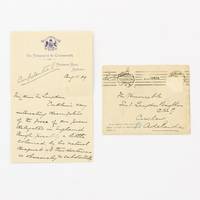
réf. 137300Fine. Octavo 4 pages a bifolium on the crested notepaper of Parliament House Melbourne in the original envelope marked 'Personal' and addressed in Deakin's hand to 'The Honourable Sir J. Langdon Bonython C.M.G. Carclew Adelaide' contemporary Melbourne postmark; stamp removed. Letter folded in half for posting; apart from a couple of ink blotches in fine condition; envelope with flap detached and with some pencilling on the verso. Deakin was sworn in as Prime Minister on 2 June 1909 after being elected leader of the Liberal Party which had recently formed from the 'Fusion' of his Protectionist Party with the Anti-Socialist Party. Sir Langdon Bonython a fellow Protectionist had sat with Deakin in the inaugural Parliament of Australia as a member for the Division of South Australia later for the Division of Barker. In this letter Deakin reflects on the difficulties confronted by his new government including preselections in South Australia but is generally optimistic about its progress. However his government would soon suffer a resounding defeat at the hands of Andrew Fisher's Labor Party in the federal election of 13 April 1910. The letter reads in full 'Aug 11.09. My dear Sir Langdon Cockburn's very interesting description of the prose of our press delegates in England though possibly a little coloured by his natural disgust at their doctrines is obviously & substantially true. It defines their attitude of old & new always the same as is proper in a party that does not change. He very clearly perceives their policy of playing to both sides & sees when they have obtained encouragement. Your allusion to the Division of Wakefield is obscure. I have not been asked to assist & have not assisted in any way in the selection of a candidate. He has been chosen entirely on your side & by your associations. When Paddy Glynn got in he found the whole matter so far advanced in making the selection in the constituency that nothing could be done. Up to date I have not been asked to endorse Foster though no doubt we shall have to do so if required. You must be aware of this though you poke fun at me. The time has not yet come for getting into touch with the constituencies. We have not discovered whom we can rely upon or at all events how far. We are making good progress here & in NSW but the other states are still out of hand or rather none have been in order. It is a long task to attempt to get an effective control of Australia. We are gradually getting it within our immediate spheres of influence. But this is written at the table during the debate to which I have to listen with one ear & half my attention. Kind regards. Yours very truly Alfred Deakin'. Deakin's entry in the 'Australian Dictionary of Biography' gives some important context to these final months of his political career. 'In May 1909 he agreed to the fusion of anti-socialists Liberal-Protectionists and Forrest's "corner" group. A bewildered Fisher was curtly dismissed. Close friends still believed in Deakin's integrity but to many others his actions seemed nothing but a naked grab for power a base move to regain office at any price by a man who thought he was indispensable. The political confusion produced some of the most dramatic scenes in Federal parliamentary history. Lyne - never a friend of Deakin and now a foe - denounced his former leader as a "Judas" a charge which the vindictive Billy Hughes believed slandered the disciple. Deakin was sworn in for the third and last time as prime minister on 2 June 1909. The Fusion government given its short span of life and the few points of agreement between the uniting parties was remarkably active . The Fusion government entered the election of April 1910 confident of victory but in the event it was routed. In a heavy poll Labor gained absolute majorities in both the House and Senate. Deakin who campaigned on a mainly negative anti-Labor platform barely escaped defeat in Ballarat. Only a handful of his personal followers survived.' Sir John Langdon Bonython 1848-1939 was an important South Australian editor newspaper proprietor philanthropist and parliamentarian. 'He became a follower of Alfred Deakin who wanted him to give his full time to politics; their friendship survived a sharp disagreement over the composition of Deakin's ministry of July 1905 and his disappointment that Deakin's recommendation of him for a K.C.M.G. in 1908 was not accepted. Bonython did not contest the 1906 election although the Labor Party proposed to grant him and other Protectionists immunity from opposition; he suspected that his party would soon be out of power and travelling to Melbourne for parliamentary sittings was becoming irksome' ADB. The Cockburn referred to at the beginning of the letter is presumably Sir John Alexander Cockburn 1850-1929 former Premier of South Australia delegate to the Constitutional Conventions unofficial ambassador in Britain and friend of Sir Langdon's ADB. unknown
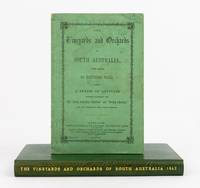
1862réf. 140418Adelaide: Printed and published at the 'Advertiser' and 'Chronicle' Offices 1862. First Edition. Paperback. Very Good. Adelaide Printed and published at the 'Advertiser' and 'Chronicle' Offices 1862. Octavo 78 xxii advertisements pages plus advertisements on both sides of the rear wrapper. Original green wrappers with the title page details repeated within a different border on the front cover; wrappers a little marked and creased with some slight wear at the corners affecting also the bottom corner-tip of the last few leaves; spine a little cracked but sound with minimal loss at both ends; minor signs of age and use but overall an excellent copy of a rarity seldom found in any condition - let alone as pleasing as this - now housed in a fine mid-green morocco Solander box by Sangorski & Sutcliffe. Descriptions 'are given of most of the most important vineyards and of some of the less important of them having due regard to age extent and quality of produce. South Australia will without doubt become one of the most important Wine countries of the world. The experiments of the past twenty years have proved the advantage of its soil and climate and enough practical knowledge has been acquired to enable its Vignerons to guard against the common errors which so frequently produced discouragement in the earlier days of the Colony'. The original articles are here supplemented 'by revision and some trifling annotations'. Ferguson 18189 noting only green cloth boards. Printed and published at the 'Advertiser' and 'Chronicle' Offices paperback
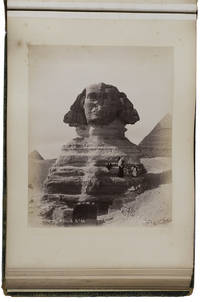
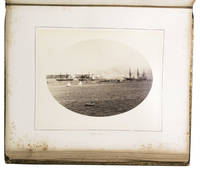
1895réf. ABC_475631895. Oblong folio 28 x 39 cm. Contemporary gold-tooled black morocco gilt edges. With 58 photograph prints ca. 21 x 25.5 to 13.5 x 20 cm. Mounted on both sides of the leaves in the album. 60 pp. The album contains 15 silver albumen photographs of Melbourne taken mainly from the series C. Rudd's new views of Melbourne 1886-1887 by Charles Rudd 1849-1901. They show Collins Street Melbourne town hall the public library Parliament House the Court of Law Government House and various other buildings and infrastructure as well as botanical gardens such as Fitzroy Gardens. The photographs of Sydney were the work of the renowned Australian photographer Henry King 1855-1923 born in England in 1855 who emigrated to Australia with his family in 1856. He worked as a photographer at J. Hubert Newman's studio in Sydney before opening his own studio in 1880. King gained recognition for his photographic studies of Australian Aboriginal people and his scenic views of Sydney. He died in 1923 leaving behind his wife son and three daughters. His glass negatives were acquired by J.R. Tyrrell after his death and are now held by the Powerhouse Museum. King is one of Australia's most significant early photographers. The album contains seventeen of Kings photographs of the harbour including Farm Cove and the Circular Quay Government House and interior and exterior photographs of the town hall King and George Street the Mutual Life Association Building the General Post Office and the Ferner Botanical Garden. Rural New South Was appears in nine photographs including images of Illawarra National Park the Hawkesbury River and a series of outdoor photographs taken along the coast at Blackwall and dated July 1895.This curious album of 58 photographs from France Egypt and most importantly Australia opens with a section with six photos from Marseille showing street views the city harbour the Avenue du Prado and the castles.The ten photographs from Egypt depict both the cultural highlights of the country such as the Pyramids the Sphinx the Citadel of Cairo and the Palace of Gizeh as well as ordinary Arabian villages and street scenes. They stemmed from the ateliers of the Abdullah brothers of Constantinople. The Abdullah Frères namely Viçen 1820-1902 Hovsep 1830-1908 and Kevork 1839-1918 Abdullahyan were three Ottoman brothers of Armenian heritage who gained international fame as photographers during the late Ottoman Empire. Some evidence suggests that he may have collaborated with the Zangaki Brothers and he may have been the official photographer for the Universal Company of the Suez Canal. Later he worked in partnership with the British-Italian photographer Antonio Beato.With an owners inscription in pencil "a appartenu Alfred Schmid" some photographs are captioned in black ink or pencil detailing the places. With a small label from the bookshop that sold the album: "Papeterie Sauwen-Jehotte" in Antwerp. The edges are somewhat bumped and some browning and foxing throughout. Otherwise in good condition. AFRICA ART ARCHITECTURE & PHOTOGRAPHY AUSTRALIA NEW ZEALAND & PACIFIC ISLANDS EUROPE Australia Egypt France North Africa Photography unknown
1756réf. PHO-4862 Volumes in 4°de 1 titre ,XIV pp, 463 pp, 4pp pour le tome I et 1 titre ,513 pp, 2pp, veau marbré époque, dos à nerfs ornés avec pièce de titre et de tomaison ,tranches rouges, coins usés,charnières fendues Édition originale. UN DES RARES EXEMPLAIRES CONTENANT LES 7 FEUILLETS SUPPLEMENTAIRES (437*- 450*) dans le premier volume intitulé Découvertes des Hollandois dans l'Australasie.
réf. LBW-3943[1812]. 355 x 497 mm.
1885réf. ABC_49517Australia 1885. Folio ca. 44 x 36.5 cm. Contemporary gold-tooled black morocco with the title lettered in gold on the front gold-tooled turn-ins gilt edges watered-silk end papers. With 65 albumen prints. 29 ll. Late 19th-century photo album with views of New South Wales. The album contains 65 albumen prints of highlights in the region primarily in Sydney and the Blue Mountains. It was bought by the civil engineer Clément van de Velde dates unknown who was born in Belgium and moved to Australia in 1884 where he attempted to set up a sugar-beet industry. He also served as the vice-consul for Belgium. He gifted the album to his friend Cobus in 1885 possibly as a keepsake for a trip they undertook together.At least a third of the photographs show important buildings and other landmarks in Sydney including the Government House the Town Hall the General Post Office the Australian Museum the different colleges of the University of Sydney the Department of Lands building and the public library in Bent Street that has been demolished in 1967. Most of these buildings were relatively new at the time these photographs were taken. Also included are photographs of Hyde park and the Captain Cook monument the Man O'War steps Argyle cut Mrs Macquarie's Chair and the botanic gardens. The other photographs in the album show the towns and nature surrounding Sydney such as the Katoomba Falls the Three Sisters Govetts Leap and Mount Victoria in the Blue Mountains the Zig Zag railway the Fitzroy Falls Fort Denison Broken Bay various views of the Nepean River as well as four portraits of Australian Aboriginals.With a contemporary French inscription on the verso of the first flyleaf "Mon cher Cobus Je prie de vouloir accepter cet album en souvenir de nos bons rapporte. Votre dévote Clément van de Velde. Sydney 10 may 1885.". The binding has been professionally restored the boards are somewhat scratched and dented. The leaves are warped and foxed the lower corners of some of the leaves are torn without affecting the photographs the photographs have somewhat discoloured. Otherwise in good condition.l Cf. McLennan N. T. "Henri van de Velde 1878-1947" in: Australian Dictionary of Biography 16 2002. ART ARCHITECTURE & PHOTOGRAPHY AUSTRALIA NEW ZEALAND & PACIFIC ISLANDS Australia Photography hardcover
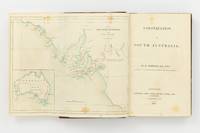
1835réf. 139494London: Longman Rees Orme Brown Green and Longman 1835. First Edition. Hardcover. Very Good. London Longman Rees Orme Brown Green and Longman 1835. Octavo xvi 304 xxii pages plus a folding frontispiece map 'Part of Southern Australia from the 132 to 141 degree of East Longitude' with an inset map of Australia both hand-coloured in outline 200 × 255 mm. Early blind-tooled calf rebacked to style; edges marbled; covers slightly worn; map a little offset; occasional foxing generally light; a few other trifling signs of age and handling; an excellent copy unopened in places. A presentation copy inscribed on the half-title to 'The Lord Durham from the Author'. John George Lambton 1st Earl of Durham 1792-1840 was a preeminent figure in early nineteenth-century British colonial policy and a sometime close colleague of the author. He was chairman of the New Zealand Company in the 1820s Torrens was a director helped draft the Reform Bill of 1832 earning the nickname 'Radical Jack' and was appointed Governor-General of British North America Canada in 1838. There he served alongside Edward Gibbon Wakefield who helped him prepare the important 'Report on the Affairs of British North America' London 1839 which was instrumental in delivering responsible government to Canada. Lord Durham's armorial bookplate and Lambton Castle library label are mounted on the front pastedown. Robert Torrens 1780-1864 'officer of marines political economist and colonization commissioner'; his 'economic writings are of much importance in the development of economic theory' DNB. In the preface to this book he writes: 'The art of Colonization is based upon the science of wealth; and the rules of the art are principles of the science naturally applied. In replying to objections and in explaining the plan and in unfolding the prospects of the New Colony the Author was naturally and indeed necessarily led into discussions upon some of the fundamental doctrines of Political Economy. In some of these discussions as it is believed new and not unimportant views have been opened'. Not least he was the father of Sir Robert Richard Torrens the lands title law reformer after whom the Torrens system is named. Ferguson 2056. Longman, Rees, Orme, Brown, Green and Longman hardcover
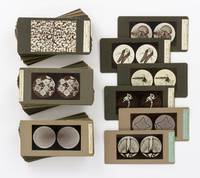
1905réf. 140504North Adelaide: The Photographer 1905. Very Good. North Adelaide The Photographer circa 1905. A collection of 87 stereo-microphotographs comprising original gelatin silver photographs with the pairs of images printed as one plate approximately 65 × 120 mm mounted on stiff card approximately 88 × 178 mm in various shades of grey. There are 21 with printed labels captioned 'Wm. P. Dollman John St. N. Adelaide S. Aus.' with numbered manuscript captions the numbers range from 2 to 228; there are 14 with unnumbered manuscript captions on plain labels; the remaining 52 are on plain cards. There are only six duplicates and none of them are an identical matching pair. Minimal signs of age and use; overall in excellent condition. The literature on the photographic history of Australia is singularly quiet on the life and work of William Parmeter Dollman 1846-1908. He is not to be found in Davies and Stanbury or Photohistory SA the pioneering research work of Robert Noye now on the website of the Art Gallery of South Australia. However he was definitely recognised in his own time. His obituary appears in the 'Evening Journal' on 7 October 1908: 'The death is announced from heart failure at the age of 63 of Mr. William Parmeter Dollman of North Adelaide. The deceased gentleman came to South Australia from England in 1853 and for about 30 years had been in the service of the proprietors of "The Register" and its associated journals as a printer and reader. He was sub-overseer of the newsroom for several years but relinquished that position to return to the reading room. Mr. Dollman was held in the highest respect for his integrity and ability and was much esteemed by his intimate friends. He was a member of the microscopical section of the Royal Society and conducted a great deal of microscopical research. He was an authority on the instrument itself a student of electricity and a skilful photographer'. We have traced a number of newspaper references to his photography not least in a list of prize-winners in connection with the 14th annual exhibition of the SA Society of Arts reported in the 'South Australian Register' on Thursday 15 December 1870. 'Six entirely untouched stereoscopic views . by W.P. Dollman' were awarded a cash prize of £1 1s. Given that the other prize-winners in the photography section were Bernard Goode and Townsend Duryea this is high praise indeed. An article by Dollman appeared in the 'Journal of the Royal Microscopical Society' in June 1906: 'A Simple Method of producing Stereo-Photomicrographs sic' 3 pages plus a full-page illustration of one of the stereo-microphotographs present in this collection 'Polyzoa Idmonea radians'. It was 'Read February 21 1906'. Dollman states 'I have made a hobby of stereoscopic photography since 1865 and as well have handled many Microscopes optical work being always an attraction to me. Some twelve or more months ago a friend called my attention to an article on stereo-photomicrography in the "British Journal of Photography Almanac" for 1894 by the then-editor . who therein explained several methods of producing stereograms of microscopic objects. I adopted what I thought the simplest method that of obscuring by a semicircular shield half of the objective in use. A good deal of my apparatus is makeshift - that is diverted from other uses - but is effectual. My optical outfit is the best both in low and high powers condensers etc.'. In addition to the 87 stereo-microphotographs there is a stereophotograph captioned on a plain label 'Photo-microscopic Apparatus' depicting an impressive set-up in Dollman's studio as described in the journal article. This card and two others with hand-written captions on plain labels have the following inscription in ink on the verso: 'Not for competition. Wm. P. Dollman North Adelaide'. Also included with the collection is a slightly damaged unmounted single microphotographic print 74 mm square. 89 items. The Photographer unknown
réf. 95220The Radfords were born in Devon emigrated to South Australia in October 1838 and lived in the Barossa Valley from the mid-1840s until their death. From the perceived ages of the subjects these images would appear to date from the 1850s. Other later images of the Radfords are held in the State Library of South Australia. They substantiate the identification and confirm that these daguerreotypes by an anonymous photographer are of rural South Australian origin as the Radfords did not leave the colony after they arrived here in 1838. Both images are in excellent condition with the original brass mats one a little tarnished preservers and glass but uncased as found. Any daguerreotype of Australian origin is rare rural South Australian ones excessively so in our experience. 2 items. unknown
1899réf. 111095London: Macmillan and Co. Limited 1899. Very Good. London Macmillan and Co. Limited 1899. Octavo xx 671 pages with 12 unnumbered line illustrations of churingas a map and 130 illustrations mainly after photographs plus 2 folding maps 3 folding charts 4 folding chromolithographic plates and an erratum slip tipped in at page 1 noting that on page 570 the tassel should be 'pubic' not 'public'. Olive-green gilt-pictorial buckram a little flecked and rubbed with the spine a little sunned; all edges uncut; scattered light foxing; minimal chipping to some uncut leading edges; an excellent copy. The head of the title page is signed in ink by both authors as 'W. Baldwin Spencer' and 'F.J. Gillen'. Inscribed in indelible pencil before the signatures in an unknown hand is 'With Kindest Regards from'. The 'Australian Dictionary of Biography' makes short work of the significance of the book and by extension this signed copy in its entry on Sir Walter Baldwin Spencer 1860-1929: 'The 1894 Horn scientific exploring expedition to central Australia recruited Spencer as zoologist and photographer. Because of friction between members and their sponsor Spencer later combined mediation with editorship of all four volumes of reports. His own seminal contribution included his classic biogeographic interpretation of Australian faunal distribution. This expedition rekindled his anthropological interest when he met F.J. Gillen the Alice Springs postmaster Francis James Gillen 1855-1912 ethnologist. What began as his offer to assist in publishing Gillen's ethnological notes matured into an enduring partnership and a landmark in anthropological history. In 1896 Spencer joined Gillen for the most intensive field-work then attempted in Australia. "The Native Tribes of Central Australia" 1899 which resulted was to influence contemporary theories on social evolution and interpretations of the origins of art and ceremonial. It impressed Sir James Frazer author of "The Golden Bough" who developed a lifelong friendship with Spencer'. Macmillan and Co. Limited unknown
1783réf. PHO-2039A Paris, Chez Barrois l’aîné, 1783. In-8° (195x120) Relié plein veau époque, pièce de titre rouge, dos lisse orné, tranches rouges. VIII, 290 pp, illustré de 2 cartes dont 1 repliée h.-t. et 5 pl. h.-t., Complet du dernier feuillet, extrait du privilège à la date du 11 mai 1782, établi par Condorcet secrétaire de l’Académie des sciences. Quelques frottements aux charnières.
1864réf. 142931Adelaide: The Author 1864. Fine. Adelaide The Author 1864. Eleven albumen paper photographs approximately 88 × 134 mm mounted on the recto of individual cards approximately 165 × 240 mm neatly captioned below the plate with the title at the head of the first one with all captions by George Hamilton himself. A few light spots and marks to some of the cards; essentially in fine condition with the photographs uniformly rich in colour. The Art Gallery of South Australia has all 11 original artwork - pen and ink with wash - in its collection. The 'Adelaide Observer' on Saturday 27 August 1864 contains a review of Hamilton's recently self-published book 'a well-conceived well-written neatly-printed and elegantly-illustrated brochure under the above title'. It describes at length the illustrations '11 in number photographed from the author's drawings by Colonel Biggs Mr. Baines and Professor Hall and they bear ample evidence of the artistic taste as well as the correct judgment displayed in the spirited originals'. Robert Holden 'Photography in Colonial Australia. The Mechanical Eye and the Illustrated Book' 1988 describes this book and one other Molesworth Jeffrey's 'Various Exercises and Fragments in Metre by Divers Authors' Hobart 1864 as being the 'first recorded use of original photographs as illustrations in commercially produced and dated books' in Australia. His descriptive bibliography records that the published work indeed contains 'Photographs of eleven drawings . by Colonel Briggs sic from rough sketches by the author. It would appear that these images were printed eleven to a sheet and then arranged in random order throughout the text'. His collation of the three copies in the State Library of South Australia indicates the individual print sizes range from 20 × 35 mm to a maximum of 40 × 60 mm. The present offering clearly predates the published use of these images and its presentation is much to be preferred. The first and most obvious difference is the superior size and quality of the prints. However the captions greatly enhance the images; when they are read and viewed in the intended order numbers 1-11 are lightly pencilled in the top right-hand corner of the cards this becomes a proto-photobook of the highest order . and far from being a prosaic account of how to look after a horse as the title might suggest it is a searing indictment of the widespread ill-treatment of horses. 'Mr. Hamilton proceeds with pen and pencil to describe and portray some of the trials a horse has to undergo from the time his liberty is first invaded in the bush until in the last scene of all that ends this painful history he is reduced to the drudgery of a hackney car'. See Ferguson 10180b and 10181a; Holden 50 and 51 plus pages 13-21. Both bibliographies contain errors. 11 items. The Author] unknown