[FISHER, James Hurtle]Biblio.com

6 212 résultats
1825réf. 80009London: William Darton 1825. First Edition. Hardcover. Very Good. London William Darton circa 1825. Octavo xii 64 pages plus 64 engraved portraits with tissue-guards. Early gilt-decorated half calf and marbled papered boards a little rubbed and bumped at the extremities; corners and the rear leading edge a little worn; 'Vol III' label missing from the spine; occasional scattered foxing and offsetting; a very good copy. Provenance: James Hurtle Fisher with his armorial bookplate on the pastedown and his signature in ink at the head of the engraved title page. Sir James Hurtle Fisher 1790-1875 'was one of the most important pioneers of South Australia' 'Australian Dictionary of Biography'. He commenced practice as a solicitor in London in 1816 and 'was drawn into the colonizing movement in 1835. He was selected as resident commissioner one of the most important offices under the South Australian Act . second only to the governor'. Fisher 'left England in July 1836 with the governor's party in the "Buffalo" arriving on 28 December 1836 at Holdfast Bay where the official oaths were administered a proclamation was read and a ceremony marked the beginning of settlement. In January 1837 Fisher erected his reed hut and Land Office near the survey camp of Colonel William Light at the north-western corner of the new capital site; the destruction of these temporary buildings by fire on 23 January 1839 caused both men serious loss. Fisher had been allowed to draft his own instructions which were not shown to Governor Sir John Hindmarsh. Disputes between the two men over their respective powers had begun on the voyage and were soon revived in the new Council of Government and more violently outside and led in February 1837 to the Resident Magistrate's Court binding the participants over to keep the peace towards each other. The new governor George Gawler was appointed both governor and resident commissioner a radical departure from the principles on which the colony had been founded'. Fisher returned to his profession and became a leader of the South Australian Bar. In October 1840 he was elected first mayor of Adelaide; in 1860 he became the first resident South Australian to be knighted. The destructive fire referred to above is described in detail in the biography of Light Dutton and Elder 1991. Light was living 'in the wood and reed surveyor's hut alongside Fisher's equally combustible house in the parklands on North Terrace. In his own account ". we discovered Fisher's house to be on fire. At the same time the breeze freshening up the destruction to both houses became inevitable. In less than ten minutes both houses were burnt to the ground mine catching fire at the roof by a lighted piece from Fisher's. We saved nothing of value"'. Accordingly personal mementoes such as this presumably brought by Fisher to South Australia on the 'Buffalo' must be of the utmost rarity. William Darton hardcover
1890réf. 108120Adelaide: Gresham Studio 1890. Very Good. Adelaide Gresham Studio 1890s. A gelatin silver photograph 135 × 93 mm including a facsimile signature of the subject mounted on textured card with the small inkstamp of 'Gresham Studio Adelaide' on the verso. Mount slightly marked at the foot of the recto; in excellent condition. 'The South Australian Register' 2 November 1891 featured a review of the recently published biography of George Fife Angas by Edwin Hodder London Hodder and Stoughton. It is described as having an 'etched portrait by H. Manesse'. We have identified several variant portraits used as the frontispiece; this unattributed one similar to Manesse's could well be another example. However this cabinet card was clearly produced as a stand-alone portrait. Gresham Studio unknown
19338vo., First Edition, on laid paper, with frontispiece and 8 other facsimiles; printed wrappers, sewed as issued, backstrip worn else a sound, clean copy. Among the printers represented are Caxton, De Worde, Rastell, Berthelot, Hawkins and Pynson.
pp. 12-74, 1 fold. map Large 8vo. Offprint, orig. wrs.
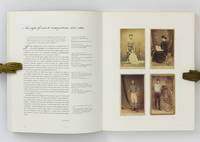
2007réf. 147723Adelaide: Art Gallery of South Australia 2007. First Edition. Paperback. Very Good. Adelaide Art Gallery of South Australia 2007. Quarto 232 pages with numerous illustrations many full-page with two gatefolds showing a panorama plus a CD-ROM in an endpocket containing 'Dictionary of South Australian Photography 1845-1915' by R.J. Noye. Pictorial card covers lightly scuffed; an excellent copy. The book was published in conjunction with the exhibition of the same name held at the Art Gallery of South Australia November 2007 to January 2008. Art Gallery of South Australia paperback
2001réf. 034348Toowoomba Qld.: Commonwealth Clydesdale Horse Society Queensland Branch 2001. 330pp tables charts lists num bw ills. Or card covers. Near new. Volume 1 only- a second volume was published in 2009. First Edition. Soft Cover. Fine. 4to. Commonwealth Clydesdale Horse Society, Queensland Branch Paperback
1999réf. 90276Plympton: The Author for the Adelaide and Suburban Cricket Association Incorporated 1999. First Edition. Hardcover. Fine/Dust Jacket Included. Plympton The Author for the Adelaide and Suburban Cricket Association Incorporated 1999. Quarto; cloth; a fine copy with the slightly rubbed creased and torn dustwrapper. Presentation copy inscribed and signed by the author. Also inscribed and signed by David Neil Cliff Keiley Joe Heptinstall and Ron Halliday. The Author for the Adelaide and Suburban Cricket Association Incorporated hardcover
1942réf. 116235Adelaide: Wakefield Press 1942. First Edition. Paperback. Very Good. Adelaide Wakefield Press 1942. Octavo 20 pages last blank plus the colophon. Plain card covers with attached overlapping wrappers lightly rubbed and bumped; small red X against six titles in the checklist; an excellent copy with the small name-stamp of Johannes Larsen on the front flyleaf. Number 76 of 250 copies signed by the author and the first publication of his Wakefield Press. Wakefield Press paperback
1942réf. 107838Adelaide: Wakefield Press 1942. First Edition. Paperback. Very Good. Adelaide Wakefield Press 1942. Octavo 20 pages last blank plus the colophon. Plain card covers with attached overlapping wrappers lightly sunned bumped and marked; an excellent copy. Number 170 of 250 copies signed by the author; the first publication of his Wakefield Press. Provenance: Edward Edgar Pescott 1872-1954 horticulturalist naturalist author and book-collector with his ownership signature. Wakefield Press paperback
1927322 pages. "The following letters were written by Hwuy-ung, one of the class of literati and a social reformer, to his (and my) friend Tseng between the years 1899 and 1912. They came into my possession through Tseng-Ching, a scholar, who urged me (and helped me) to translate them into English, so that the reforms suggested by his enlightened countryman might meet with due recognition and support from abroad. It was also his intention to have the Chinese version published and distributed among his countrymen, in order (under God's gracious will) that their eyes might be opened to their shortcomings and the race strengthened and rejuvenated." - from Introduction. Red front board attractively decorated in yellow and black. Card pocket inside back board. Library bookplate inside front board. No other markings. Minor lean to spine. Average wear and soiling. Binding intact. A sound copy of this interesting work. Book
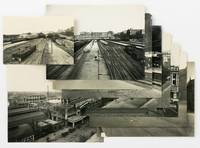
réf. 146428Very Good. Nine vintage gelatin silver prints eight approximately 220 × 285 mm one 138 × 206 mm all but two captioned or dated on the verso. Some prints with some residue on the verso from previous mounting; two with drawing pin-holes in some corners one of them with slight surface loss near a bottom corner the other with slight loss to a top corner; some with trifling chips or creases at the extremities; overall in excellent condition. The earliest image dated June 1926 shows the site on North Terrace before the commencement of construction; two show the station platforms in October 1926 and March 1927; two show the railway yards at the approach to the station one before construction one in December 1927; and four show the progressive construction of the western southern and eastern frontages of the station dated between April 1927 and March 1928. An interesting observation by Paul McGuire appeared in 'The New Triad' Volume 2 Number 7 1 July 1928: 'The Railway Department also has been showing its superiority to mere prettiness too. A magnificent station is nearing completion and the Assembly hall has already revealed itself as a splendidly conceived piece far superior to anything of its kind in Australia. The walls are scarcely finished and they are already blotted with posters dodgers and various advertising signs. The architects themselves have protested but in this case too we will be pleasureably sic surprised if the official mind sees beyond its balance sheets'. We have not identified the photographer or traced these particular images in institutional collections or elsewhere but they have the appearance of official photographs by a professional. 9 items. unknown
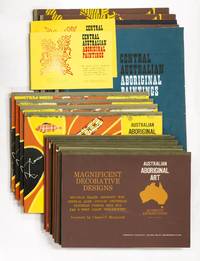
1967réf. 138977Melbourne: Newcraft Publicity 1967. First Edition. Paperback. Very Good. Melbourne Newcraft Publicity 1967 to 1969. Seventeen portfolios in various formats see below each containing a page or two of text and 5 colour serigraphs printed on card unless otherwise stated and interleaved with tissue-guards. Thick card covers with cloth spines; minor blemishes to some covers; minor damage to a bottom corner of portfolio B Volume 4 see below with loss of the corner-tip to the last three plates; overall the contents are in excellent condition. Two volumes are bound in portrait format; the others are presented in landscape format albeit with the spine along the top edge. The National Library of Australia catalogue states that this material was 'Available only in set of 24 portfolios at $310.00 . "Authentic reproductions ready for framing". Edition limited to 200 numbered copies' we have not traced the original source of this information. However we have incorporated below a number of pertinent details gleaned from Trove; in particular we found the relevant catalogue records provided by the State Library of Victoria to be the most informative. A Magnificent Decorative Designs. Melville Island Abstract - Map Central Aust. - Pintubi Churingas - Victorian Possum Skin Rug - Far N. West Coast Phallocrypt 375 × 505 mm; #13/116. B Australian Aboriginal Art. Primitive Traditional Decorative four volumes each 403 × 550 mm and all numbered #095; together with three larger-format volumes each approximately 550 × 795 mm respectively #1/086 #2/090 and unnumbered. The third volume without the subtitle 'Primitive Traditional Decorative' contains seven plates reproducing ones that appear in the smaller-format volumes; six are printed on paper the seventh is printed on the inside rear card cover. C Cave Paintings of Arnhemland Volumes 1 2 3 and 5; each approximately 385 × 500 mm; all #126. The title of the fifth volume is 'Ceremonial Cave Paintings of Arnhemland "Amazing Anthropomorphic Figures"'. D Central Australian Aboriginal Paintings. Brilliant Abstract Designs of the Pitjantjatjara two volumes bound portrait-format each 750 × 550 mm respectively #66 and #2/100. The first volume has a brown cover decorated in ochre and lettered in black; the second volume has a blue cover decorated in white and lettered in black. Both volumes contain seven plates. E Magnificent Bark Paintings of Arnhemland and the Islands Volumes 1 2 and 4; each approximately 380 × 500 mm; respectively #1/126 #2/116 and #101. The title of the fourth volume is 'Magnificent Bark Paintings of Arnhemland'. Offered together with three plates mounted as issued on thick card; these also appear in the volume of duplicated plates noted in B above. Also included are two copies of another Newcraft Publicity item 'Central Australian Aboriginal Paintings' by Winifred Hilliard wrappers oblong quarto with 7 colour plates; the second copy is numbered 153. Although the lengthy subtitles are different 'The Pitjantjatjara Abstracts. Designs in Vibrant Colours from Ancient Mythological and Totemic Motifs by Aboriginal Artists at Ernabella in the Musgrave Ranges' and 'Ancient Mythological and Totemic Motifs in Vibrant Colors by Finke River Aboriginal Artists' the contents are the same albeit in a different order and with minor variation to the introductory text. To complicate matters even more the same contents appear in the first very much larger-format volume in D above. We have identified five portfolios not present in this run cross-referenced with the descriptions above: A Magnificent Decorative Designs. Volume 1 Churinga Patterns Ground and Rock Paintings; C Cave Paintings of Arnhemland. Volume 4; E Magnificent Bark Paintings of Arnhemland. Volume 3: Oenpelli Portfolio; Australian Aboriginal Art: Bark Paintings - Angurugu Groote Eylandt Gulf of Carpentaria; and Australian Aboriginal Art: Decorated Shields of North Queensland. The SLV also identifies one related item we do not have: 'Australian Aboriginal Art' Melbourne Newcraft Publicity 1969. It is described as being a single volume 750 mm tall containing 'Colour prints on paper of items of aboriginal art miniaturised from the series of authentic reproductions of bark and cave paintings in the Newcraft collection of 23 portfolios'. 22 items. Newcraft Publicity paperback
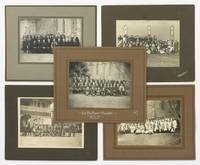
1920réf. 147359Port Pirie 1920. Fine. Port Pirie circa 1920s. Five original gelatin silver prints from 140 to 160 × 200 mm individually mounted on thick card all approximately 245 × 305 mm. Minor corner wear to one mount; all other mounts and all photographs are in fine condition. One item is captioned in white ink on the mount 'Port Pirie Pioneers' Association 28/6/24' and signed 'Mallyon'. The State Library of South Australia has a copy of this photograph in its collection B 2318 with the photographer identified as C.K. Mallyon in ink on the photograph and as C.M. Mallyon in the accompanying information. An account of the 16th anniversary gathering of members of the association with many of the members named appeared in the Adelaide newspaper 'The Chronicle' on Saturday 5 April 1924. The portrat appears to have been taken against the backdrop of the side wall of what is now the Anglican Cathedral Church of Saint Peter and Saint Paul. This is one of some 30 SA churches designed by self-taught architect William Kingsnorth Mallyon 1850-1933 between 1881 and 1912. Mallyon the photographer is presumably a relative. The second group portrait includes two bishops and numerous priests with the back row almost all women against the same backdrop possibly taken around the same time as the previous photograph. The verso has the inkstamp of 'Mallyon Studios Pirie' with 'Copyright J.L. Stanier' in ink above it. The substantial history of Port Pirie by Ken Bullock 'Port Pirie. The Friendly City' 1988 devotes half a page to 'One Shot Stanier': 'John served his apprenticeship with a Fleet Street news-agency before migrating to Australia in 1924. He caught up with Port Pirie soon afterwards when he took over Townsend Duryea's photographic business and later married Dorrie the daughter of well-known photographer George Rogers' page 425. The third photograph contains some of the same ministers of religion in a smaller group in a similar setting. The photographer is not identified. The fourth photograph features a large group of women and children with a priest in the centre. The corrugated iron building with lancet lead-light windows in the background suggests a Sunday School group. 'Duryea's Studio' is printed in white on the bottom right-hand corner of the mount. We have not identified the location in or even as Port Pirie but we have retained the item in the collection as found by association. The final photograph is perhaps the most interesting as it depicts a group of well-dressed men in front of two large trade union banners. The very large pictorial one is mounted on a horse-drawn wagon; the other one headed 'Trades & Labor Council Pt Pirie' has its message partially obscured but what is visible - 'Work' 'not' and 'six hour' - send a signal. All the men appear to be wearing aprons emblazoned with the Freemasonry's square and compasses symbol and the initials 'CMB'. 5 items. unknown
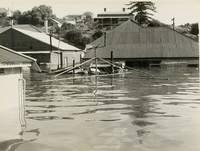
réf. 147222Fine. Eight gelatin silver photographs all approximately 160 × 215 mm or the reverse all with short captions in ink and pencil on the verso. The photographs are individually mounted behind photocorners and attractively presented on individual captioned cards; in fine condition. The four photographs of Renmark and two of Mannum were taken from the air; the other two also of Mannum were taken by a cameraman on the water. One of these is a view down the main street; the other shows a flooded backyard with water coming up to just under the eaves. 8 items. unknown
réf. 73309One item is quarto; one is 260 × 140 mm; the others are octavo nine of them are single-paged - five of which have conjugate blanks - and the others each contain two to four pages of text. The most interesting items are leaflets for the Annual Literary Competition in 1885 one page 1888 2 pages 260 × 140 mm and 1889 4 pages with one page announcing the sixth annual competition and another page devoted to reading clubs. The other items are notices of meetings some with agendas an 1888 questionnaire sent to member societies and an unused SALSU prize plate 100 × 80 mm mounted on a blank page of the only duplicate item in the group. George Hussey was general secretary for the entire period. The 1885 item above has a chipped creased and torn blank bottom margin and the 1888 item above is creased and folded with some mainly marginal splits along two folds; overall the condition is very good or better. Nothing if not rare and there is enough wheat among the chaff to get the literary taste and flavour of the times. 14 items. unknown
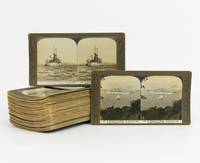
réf. 138959Very Good. The original gelatin silver photographs are uniformly mounted on 'The Rose Stereographs' cards with the pair of images printed as one plate 86 × 144 mm; card size 98 × 178 mm with printed captions within each image. All captions commence with the words 'The American Fleet in Australia'. The broken top right-hand corner of one card is held in place with clear tape just touching the top corner of the photograph; all other cards and photographs are in excellent condition. In August and September 1908 the American Grand Fleet which included 16 white-painted battleships visited Sydney and Melbourne during its 14-month world tour. 'George Rose visited both cities armed with his stereoscopic camera and went on board the USSs "Louisiana" and "Wisconsin" taking photographs. He produced exactly 100 views for sale #12800 to #12899 which were packaged as sets of 35 or 36 views in attractive green and gold boxes. Collectors find it difficult to find all the views as the box contents were a random selection with a bias towards the more attractive views and avoidance of shots that were similar' Ron Blum: 'George Rose Australia's Master Stereographer' 2022 fourth edition. This group comprises #12850 to #12899 with the exception of the following eight items: 12851 12854 12856 12860 12862 12863 12880 and 12887. 42 items. unknown
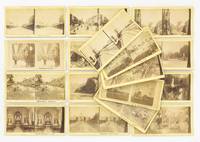
réf. 138947Very Good. Original gelatin silver photographs with the pairs of images printed as one plate 86 × 144 mm mounted on light yellow cards 98 × 178 mm uniformly printed and decorated on the verso 'Photographed by Edwin C. Thomas. Australasian Stereo Views'. Some have hand-written captions see below. Minimal signs of age and handling; overall in excellent condition. The 'Petersburg Times' on Friday 12 May 1893 contained a short article under the headline 'Photography'. 'It will be noted by our advertising columns that Mr Edwin C. Thomas has commenced business at Petersburg as a Photographer and thus another long felt local want has been filled. The Studio which is replete with the latest accessories to the photographic art is in Jervois Street opposite the Courthouse. Besides the ordinary work of the photographer Mr Thomas makes a specialty of stereoscopic views in which he is very successful. The prices quoted for photographs are extremely moderate whilst good work is assured. We believe there is a good opening for a photographer in the town and we hope Mr. Thomas may be successful in working up a thriving business. Farmers and others who would like their residences taken should communicate with him'. Thomas merely appears on the 'List of Names' compiled by Robert Noye AGSA. Davies and Stanbury simply note 'Edwin Thomas Petersburgh sic Peterborough South Australia 1894'. Institutional holdings of his works are almost non-existent: if Trove is any indicator the State Library of SA is the only location of any of his photographs with a grand total of two examples one of which is a battered stereo view of 'Stoney Creek near Quorn' B 78542. The 'Evening Journal' and the 'South Australian Register' both carry the following snippet on Tuesday 18 October 1892: 'From Mr. Edwin C. Thomas travelling photographer we have received six stereo views of South Australian scenes: two of the Burra Burra Mines and one each of the Kooringa State School Botanic Gardens Parkside Asylum and King William street. The workmanship is good and the pictures are attractive'. Ten of the stereographs in this collection have short captions in ink: nine are on the verso four of which have the same caption on the recto with the other five having some variant of it; one is captioned solely on the recto 'Mr Crocker's Farm'. In the main they confirm what is apparent from the scene and apart from a number in Adelaide King William Street Adelaide Arcade Parkside Lunatic Asylum several in the Botanic Gardens they depict scenes in Clare the interior of the Catholic Church at Seven Hills Orroroo Port Augusta Quorn Saltia Pichi Richi Pass and unidentified rural settings. One identifying S.A. Blondin walking a high wire in Quorn enables us to date it to the month and year. The 'Manning Index of South Australian History' online records that 'A photograph of "Blondin at Quorn" is in the Pictorial Australian on Monday 1st October 1894 page 169'. It is a slightly different image - Blondin seems to have taken a step or two forward and is now balancing on one leg - and the caption states 'With a Country Photographer - Blondin at Quorn. From a Negative by Mr. E. Thomas'. 17 items. unknown
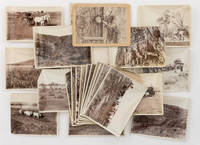
réf. 122043Original gelatin silver prints uniformly 122 × 165 mm but three have been trimmed a little all captioned in ink on the verso four are dated 1905. All prints are unmounted as produced; two have a short tear to one edge one of these and one other have a small piece missing from one or two corners; one is a little creased; two are a little marked; overall the condition is excellent. Yardea Station is a pastoral lease approximately 400 kilometres north-west of Adelaide; it was the first property taken up in the Gawler Ranges in the late 1850s. 'Lying on one of the main east-west corridors through the Ranges Yardea became the main postal depot during the late 1860s. A stone police station was erected in 1873 staffed by two police troopers who had been placed there a year earlier to keep order and to distribute rations to Aboriginal people who were increasingly attracted to Yardea. After the Yardea police were withdrawn in 1885 the building served as a post-office and telegraph station and then as a repeater station when a direct telegraph link to Western Australia was established in 1903. During the 1890s when most of the Gawler Ranges station leases including Yardea were abandoned due to a combination of high government charges drought and uncontrolled dingo numbers the building was still staffed by three telegraph station employees' Philip Jones in 'Naturally Disturbed' 2010 'an interdisciplinary collaboration between Sue Kneebone and Philip Jones. The exhibition engages with the complex history intersecting narratives and unexplained absences that relate to Yardea a pastoral property in the Gawler Ranges in South Australia once managed by Sue Kneebone's great-grandfather'. Elsewhere in her PhD thesis of the same name Sue Kneebone writes: 'In late 1903 at a time of high demand and high prices for sheep Yardea was taken up by James Grey Moseley with his station manager my great-grandfather Arthur Bailey . The Yardea lease . by then included Paney Yartoo and the old Pondana and Cacuppa stations'. A small number of these images have been located in the collection of the State Library of South Australia with some attributed to W.R. Evans who appears to have been on the staff of the Eucla Telegraph Station around this time. One of the present photographs is captioned 'A. Cole Post Master A. Bailey Manager Yardea'. Nearly all of the captions mention Yardea; Pondona Pondana and Paynea Paney are also noted. Pastoral pursuits are well-recorded: these include 'Mowing Crop' 'Hay-Stack' 'Stooking Hay' 'Hay Carting' all dated 1905 'Mustering Cattle' 'Bullock Team' 'Shearing' 'Wool Team' 'Woolly Sheep' and 'Horses'. There is also a fine image of a 'Camel Team en route for W.A. passing through Yardea'. Other scenes are 'Rock Hole Yardea' from above and below 'Dam Yardea Station' 'Stone Dam Paynea sic' and views of the Yardea Gorge Pondona Hills two views both with sheep 'Hills Gawler Ranges' and 'Deep Well Yardea' featuring a horseman and a stone hut. People are visible in seventeen of the photographs and in at least seven instances they are Indigenous men. Offered with a cabinet card photograph 145 × 105 mm mounted on plain card of the fresh grave site at Yardea of Sarah Cole wife of Alfred Cole. A notice of her death appeared in the Adelaide 'Chronicle' on Saturday 26 June 1897: 'COLE. On the 20th June at Yardea telegraph station Sarah Elizabeth Broughton née Garrett the dearly beloved wife of Alfred Cole and second daughter of C.J. and the late William Garrett late of Port Lincoln aged 33 years and 9 months'. She was the mother of six children. The presence of this poignant photograph in the collection suggests to us a Cole family provenance. 24 items. unknown
1989réf. 141344Hahndorf: The Author 1989. First Edition. Hardcover. Very Good. Hahndorf The Author 1989. Quarto 542 pages with numerous illustrations plus endpaper maps of Hahndorf 1860 and 1890-1900. Gilt-decorated synthetic cloth very slightly rubbed; bottom edge slightly marked; an excellent copy. The College was founded in 1857 and 'it quickly prospered to be one of the leading schools in the colony. For 55 years it provided high class tuition'. Not your average school history - this volume contains nearly 250 pages of biographies of over 700 old scholars and staff members an extraordinary feat when one realises many of the entries are potted family histories. The Author hardcover
1989réf. 137982Hahndorf: The Author 1989. First Edition. Hardcover. Very Good. Hahndorf The Author 1989. Quarto 542 pages with numerous illustrations plus endpaper maps of Hahndorf 1860 and 1890-1900. Gilt-decorated synthetic cloth; covers very slightly rubbed; edges slightly marked; an excellent copy. Signed by the author on the title page. The College was founded in 1857 and 'it quickly prospered to be one of the leading schools in the colony. For 55 years it provided high class tuition'. Not your average school history - this volume contains nearly 250 pages of biographies of over 700 old scholars and staff members an extraordinary feat when one realises many of the entries are potted family histories. The Author hardcover
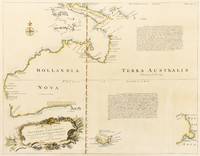
1744réf. 133907London: Printed for T. Woodward and others 1744. Very Good. London Printed for T. Woodward and others 1744. A hand-coloured engraved map visible image size 372 × 483 mm recently mounted and matted just outside the printed border using archival materials visible image size 372 × 483 mm external mat size 545 × 643 mm ready for framing or long-term storage in its custom-made Mylar sleeve. A long sealed clean tear to the blank area in the bottom right-hand corner mainly along the crease of the original fold; light central vertical crease; a few small insignificant light marks; in very good condition. The first dedicated English map of Australia originally issued as part of the second edition of John Harris's 'Navigantium atque Itinerantium Bibliotheca or a Complete Collection of Voyages and Travels' London 1744-1748; 'Vol. 1 page 325' is printed in the top right-hand corner. Clancy 'So They Came South' pages 136-37; Clancy 'Mapping of Terra Australis' page 91; Tooley 241: 'A reissue of Thevenot's map of 1663 but with title as above within cartouche bottom right. Bowen inserts the Tropic of Capricorn and two long legends. The first one is very exactly copied from the original . The second legend is a long laudatory account of the presumed riches of Terra Australis'. Printed for T. Woodward (and others) unknown
réf. 98413Babbage was 'engineer scientist and explorer . son of Charles Babbage Cambridge professor of mathematics and the first computer pioneer and his wife Georgina sister of W.W. Whitmore a founder of South Australia. In 1856 Babbage was sent north to search for gold as far as the Flinders Ranges. He found none but discovered the MacDonnell River Blanchewater and Mount Hopeful. He was the first to dispel the current idea of the impassability of the Lake Torrens "horseshoe" . In late 1857 he was appointed leader of a northern expedition. Babbage left in February 1858 to explore the country between Lakes Torrens and Gairdner and further to the north and west. His concept of exploration was based on thorough survey mapping and examination of the country ideals with which Francis Dutton commissioner of crown lands agreed in his instructions and early correspondence. With cumbrous and ingenious equipment Babbage carried out the first part hampered by bad terrain and lack of water. But he had no sense of urgency and was thus completely out of tune with the current concept of opening up new country for quick exploitation. His slowness led to public and parliamentary clamour to which Dutton later succumbed and sent Peter Egerton Warburton to supersede him. Meanwhile Babbage had moved north from the Elizabeth River discovered Hermit Hill and delineated the western shores of Lake Eyre South. There Warburton relieved him on 5 November. Based on his experiences of 1856 Babbage also believed in a gap in the "horseshoe" and at Hermit Hill confirmed his belief. He had actually crossed the gap but Warburton was the first to traverse it completely. On grounds of unfair treatment Babbage successfully petitioned for a parliamentary inquiry. In 1858-59 voluminous evidence was taken but no report issued. He then withdrew from public life until 1866. In 1870-72 Charles Todd employed Babbage as an assistant in planning and plotting the Overland Telegraph line and as a supervisor of contractors. His achievements as an explorer were notable but the accompanying controversy tended unduly to overshadow them and his attainments in other fields' 'Australian Dictionary of Biography'. Indeed 'the reports from the expedition were . a significant prelude to Stuart's successful crossing of the continent from south to north' in 1861-62 The Davidson Collection Third Sale July 2007 lot 565. This lengthy preamble should help explain the connection between the following eleven foolscap folio Parliamentary Papers relating to Benjamin Babbage published in Adelaide by the Government Printer in 1858 and 1859. 1 Northern Exploration. Reports &c of Explorations into the Interior by Messrs. Babbage Warburton Geharty and Parry. SAPP25/1858; 51 pages plus 2 large folding maps. 2 Northern Exploration. Further Correspondence respecting the Exploring Party under Command of Mr. Babbage. SAPP25/1858; 6 pages. 3 Cost of Northern Exploration. SAPP36/1858; 1 page. 4 Northern Exploration. Correspondence between the Hon. the Commissioner of Crown Lands and the Commissioner of Police Major Peter Egerton Warburton relative to the Progress of the Northern Exploring Parties. SAPP127/1858; 4 pages. 5 Northern Explorations. Reports from Messrs Babbage and Warburton and Police-Trooper Burtt on Exploration into the North and North-Western Interior of South Australia. SAPP151/1858; 19 pages plus 3 maps 2 folding. 6 Petition of B.H. Babbage. SAPP154/1858; 1 page. 7 Northern Exploration. Letter with Enclosure from Major Warburton relative to Exploration in the Neighborhood of Lake Torrens. SAPP159/1858; 3 pages. 8 Northern Exploration. Correspondence between the Honourable the Commissioner of Crown Lands and Major Warburton relative to the Northern Exploration. SAPP166/1858; 6 pages. 9 Cost of Northern Explorations. SAPP20/1859; 1 page. 10 Minutes of Evidence taken by the Select Committee appointed to enquire into and report on the Petition of B.H. Babbage. SAPP21/1859; 63 pages. 11 Northern Exploration. Correspondence between the Government and Messrs. Babbage and Warburton relative to Northern Explorations. SAPP37/1859; 2 pages. As often with these Parliamentary Papers relating to expeditions the maps are a constant source of pleasure. The best one in this group is one of the large folding maps in SAPP25/1858: 'Sketch of the Country North of the Gawler Ranges' 324 × 485 mm. It is a lithographed map printed in two colours in an unusual manner blue on the left red on the right: 'The portion in Blue is taken from a Plan supplied by Major Warburton. The portion in Red is taken from a Drawing supplied by Mr Babbage'. These parliamentary papers printed on blue stock have been neatly removed from several bound volumes; essentially they are in uniformly fine condition ideal candidates for preservation in a more appropriate binding. South Australian Parliamentary Papers Numbers 25 25 36 127 151 154 159 and 166 of 1858 and 20 21 and 37 of 1859 McLaren 4981-4983 16481 4984-4986 16485 16486 4987 and 4988 respectively. Items 16481 16485 and 16486 are listed under Warburton only and not Babbage as well. We suggest they should be there; we have called them 4983A 4986A and 4986B in our annotated copy of the bibliography. Offered together with a related item Victorian Parliamentary Paper Number 1 of 1859 'Report on the Plants collected during Mr Babbage's Expedition into the North-Western Interior of South Australia in 1858' by Ferdinand Mueller foolscap folio 21 pages stab-sewn and uncut as issued; a fine copy albeit with minor infill to the bottom corner of the first two leaves. McLaren 13749. The complete suite of Parliamentary Papers relating to Babbage's 1858 Northern Exploring Expedition and its aftermath is very rare; for example the exceptional collection of Rodney Davidson contained only six of the above twelve items which sold in four lots to the one buyer for $5360 in 2007. 12 items. unknown
1965192 pages, illustrated, bibliography, creased and repaired dust jacket. eng
1916réf. 117535Adelaide: Vardon & Sons Printers 1916. First Edition. Hardcover. Very Good. Adelaide Vardon & Sons Printers 1916. Octavo 48 pages. Full calf stylishly decorated with double blind rules on all surfaces and lettered in gilt on the front panel; extremities a little rubbed; spine slightly marked and a little sunned; inner hinges tender but holding; a very good copy in an attractive binding by an unidentified local craftsman. On the verso of the front flyleaf is an expansive thank-you note signed by the author 15 August 1916: 'Dear Mr Adey May I ask you to accept of this little booklet as a memento of the improvement which has already shown itself in the poetry book scheme through your kind interest and valuable suggestions'. The author was 'Teacher of Voice Production and Elocution Education Department South Australia'. At the time the recipient William James Adey 1874-1956 was the founding headmaster of Adelaide High School see the 'Australian Dictionary of Biography' for more on him. Vardon & Sons, Printers hardcover
1978réf. 105438Warradale: Pioneer Books 1978. First Edition. Hardcover. Very Good/Very Good. Warradale Pioneer Books 1978. Octavo viii 328 pages. Papered boards; top edge slightly marked; an excellent copy with the excellent dustwrapper lightly sunned on the spine. Number 15 of 1000 copies; this copy is signed. Number 2 in the Pioneer Books Monographs. Loosely inserted is a contemporary newspaper review of the book by Brian Elliot well worth reading. Pioneer Books hardcover