6.306 Ergebnisse
1910Best.-Nr. 2110502150402450Not Available 1910. Soft Cover. Fine. Volume: 1 Not Available paperback
1979Best.-Nr. 2081402109703360Saitama Prefecture Dowa Education Research Council 1979. Soft Cover. Fine. The book is in fine condition. Saitama Prefecture Dowa Education Research Council paperback
1962Best.-Nr. 2090602128805300Hyogo prefecture 1962. Soft Cover. Fine. Number of books: 3 Hyogo prefecture paperback
1995Best.-Nr. 2083002117401926Matsuno Shoten Reprint Edition 1995. Soft Cover. Fine. The book is in fine condition. Matsuno Shoten Reprint Edition paperback
2020Best.-Nr. 2081502111903787Southwest Jiaotong University Publishing House 2020. Soft Cover. Fine. The book is in fine condition. Southwest Jiaotong University Publishing House paperback
1978Best.-Nr. 2092902137703714Not Available 1978. Soft Cover. Fine. The book is in fine condition. Not Available paperback
1980Best.-Nr. 2092902144201222Kobun do shoten 1980. Soft Cover. Fine. The book is in fine condition. Kobun do shoten paperback
1940Best.-Nr. 2080502106911936Not Available 1940. Soft Cover. Fine. The book is in fine condition. Not Available paperback
1974Best.-Nr. 2091502135710205Hyogo Prefecture 1974. Soft Cover. Fine. The book is in fine condition. Hyogo Prefecture paperback
1975Best.-Nr. 2090202120407907Hiroshima Prefecture 1975. Soft Cover. Fine. Number of books: 1 Hiroshima Prefecture paperback
Best.-Nr. 73918vo 235 x 168 mm. orig. blue semi-stiff wrappers modern stitching. Japan: 1853-54. Silver was mined at the Ikuno Ginzan Ikuno Silver Mine from the 9th century until 1973 and was an important source of income for the central government. Lead copper zinc and gold were extracted along with silver. There were a number entrances to the mine and more than 20000 local residents were in some way involved in the mining industry. In the 19th century the mines were running deficits as they were not producing enough silver. This is a fascinating official record maintained by Chudayu or Chiwaki Shiraishi 1817-87 of the loans made by the bakufu to the Ikuno and nearby Ase silver mines to improve their efficiency and production levels. Shiraishi was at this time working for the bakufu employed as deputy officer of the two silver mines overseeing their operations and finances. Later during the Meiji Restoration Shiraishi became well known as a scholar of Wagaku Japanese studies and as a journalist. This manuscript written in a very beautiful hand contains detailed accounts of the series of loans made by individual members of the bakufu to each mine with names of lenders size of loans interest rates purpose of the loans apparently most of the money went to pay the salaries of the miners etc. The signature of Shiraishi appears on the first and final leaves. In fine condition; some well-repaired worming touching text. Preserved in a chitsu. Stamp with release stamp of the Nagoya Eirin Kyoku the Forest Management Division of the Nagoya City government. unknown
Best.-Nr. 73918vo 235 x 168 mm. orig. blue semi-stiff wrappers modern stitching. Japan: 1853-54. Silver was mined at the Ikuno Ginzan Ikuno Silver Mine from the 9th century until 1973 and was an important source of income for the central government. Lead copper zinc and gold were extracted along with silver. There were a number entrances to the mine and more than 20000 local residents were in some way involved in the mining industry. In the 19th century the mines were running deficits as they were not producing enough silver. This is a fascinating official record maintained by Chudayu or Chiwaki Shiraishi 1817-87 of the loans made by the bakufu to the Ikuno and nearby Ase silver mines to improve their efficiency and production levels. Shiraishi was at this time working for the bakufu employed as deputy officer of the two silver mines overseeing their operations and finances. Later during the Meiji Restoration Shiraishi became well known as a scholar of Wagaku Japanese studies and as a journalist. This manuscript written in a very beautiful hand contains detailed accounts of the series of loans made by individual members of the bakufu to each mine with names of lenders size of loans interest rates purpose of the loans apparently most of the money went to pay the salaries of the miners etc. The signature of Shiraishi appears on the first and final leaves. In fine condition; some well-repaired worming touching text. Preserved in a chitsu. Stamp with release stamp of the Nagoya Eirin Kyoku the Forest Management Division of the Nagoya City government. unknown books
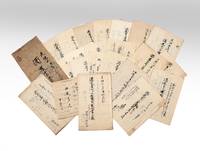
Best.-Nr. 11073Yamagata Prefecture: 1819-68. Ushu province today's Yamagata Prefecture has a long tradition of making sake. The region has abundant fresh water and the climate is well-suited for growing sake rice. This archive of 22 manuscript reports was produced for local tax collectors by two sake manufacturers in Higashine village Murayama Ushu province: GenshirÅ æºå››éƒŽ 20 reports and Hachizaemon 八左衛門 two reports. Neither is in business today. Sake was a heavily regulated industry in Edo Japan and a major source of tax revenue. The shogunate also controlled production levels in order to conserve rice in times of shortage and to regulate prices. The government also required manufacturers to brew only in winter time to improve quality. These official reports contain statements of amounts of sake-making rice used and production levels of sake by number of barrels. One report was prepared in 1819 one in the 1820s five in the 1830s four in the 1840s two in the 1850s and nine in the 1860s. Most of the reports consist of four folding leaves of text. In fine condition. The archive's original wrapper is present. unknown
Best.-Nr. 11073Yamagata Prefecture: 1819-68. Ushu province today's Yamagata Prefecture has a long tradition of making sake. The region has abundant fresh water and the climate is well-suited for growing sake rice. This archive of 22 manuscript reports was produced for local tax collectors by two sake manufacturers in Higashine village Murayama Ushu province: GenshirÅ æºå››éƒŽ 20 reports and Hachizaemon 八左衛門 two reports. Neither is in business today. Sake was a heavily regulated industry in Edo Japan and a major source of tax revenue. The shogunate also controlled production levels in order to conserve rice in times of shortage and to regulate prices. The government also required manufacturers to brew only in winter time to improve quality. These official reports contain statements of amounts of sake-making rice used and production levels of sake by number of barrels. One report was prepared in 1819 one in the 1820s five in the 1830s four in the 1840s two in the 1850s and nine in the 1860s. Most of the reports consist of four folding leaves of text. In fine condition. The archive's original wrapper is present. unknown books
1915Best.-Nr. 2091202132802490Not Available 1915. Soft Cover. Fine. Number of books: 1 book Not Available paperback
1986Best.-Nr. 2091502135710565Oka yamaken 1986. Soft Cover. Fine. The book is in fine condition. Oka yamaken paperback
Best.-Nr. 2090202118203293Not Available N.A. Soft Cover. Fine. The book is in fine condition. Not Available paperback
1962Best.-Nr. 2090502128301500Hyogo prefecture 1962. Soft Cover. Fine. Number of books: 3 Hyogo prefecture paperback
2002Best.-Nr. 2090202120101074Not Available 2002. Soft Cover. Fine. Number of books: 15 Not Available paperback
2002Best.-Nr. 2090202120301073Not Available 2002. Soft Cover. Fine. Number of books: 15 Not Available paperback
2002Best.-Nr. 2083002115801120Ehime Prefecture Assembly 2002. Soft Cover. Fine. Number of books: 7 Ehime Prefecture Assembly paperback
1964Best.-Nr. c230726k021xbvk(Tokyo, 1964). *) 25 double-sheets (folded folios, = 50 painted interior- + 50 blank exterior pages) on thin untrimmed Japan-paper: doublepage multi-colour brushwork, doublep. with col.-brushw. (monogrammed) and signed manuscript dedication page in japanese Calligraphy; 22 doublesh. with 2 pages of brushwork each, another doublepage multi-colour brushwork; each doublesheet loosely inserted in slightly stronger as untrimmed folded Japan-paper sheets. - Loose in folded plain-white cardboard; 4to.(ca. 32 x 24 x 2 cm).
1964Best.-Nr. c230726k022xbvk(Tokyo, probably before 1964; some of them were reprinted in the Olympic-Committee's official Book for the 1964 Olympic Games in Tokyo). 59 sheets of thin untrimmed Japan-paper ('Washi', ca. 32 x 23 cm), each with black-ink brushwork (some vertical, some horizontal) in Toki's famous pictographic manner, most of them monogrammed by the artist; loosely tipped-on slightly larger thin white cardboards (ca. 38 x 26 cm), often as folded double-sheets (unfolded ca. 38 x 52 cm).
1944Best.-Nr. 2092902141401697Not Available 1944. Soft Cover. Fine. Number of books: 7 Not Available paperback
2007Best.-Nr. 2083002115801450Ehime Prefecture Assembly 2007. Soft Cover. Fine. Number of books: 9 Ehime Prefecture Assembly paperback