Prefecture de la SeineBiblio.com

206 résultats
réf. 1391935705.Gpaperback. Good. Access codes and supplements are not guaranteed with used items. May be an ex-library book. paperback
réf. 1391674286.Ghardcover. Good. Access codes and supplements are not guaranteed with used items. May be an ex-library book. hardcover
1980réf. KOS01600435TBD 1980. Soft Cover. Fine. KOS01600435 TBD paperback
réf. 0483827568.Ghardcover. Good. Access codes and supplements are not guaranteed with used items. May be an ex-library book. hardcover
1892réf. 170411No details of publisher. Circa1892. 2 volumes. Volume I: Two leaves with black and white line illustrations showing a uniform 583pp prior owner's seal on first leaf. Volume 2: Folding table at rear variously paginated over 600 pages prior owner's seal on cover. Some light occasional soiling and corners trifle creased. Wrappers with string ties. These two thick volumes were published in the 1890s probably by Mie prefectural government for managing their prison system. The volumes give details of all the rules and legislation relating to prisoners and prison guards. They offer rare historical information on the Japanese prison system in the late 19th century at the time when Japan was in the process of westernisation. The prison system and related legislation was set up in Meiji Japan and followed two European systems French and German. Until 1900 prisons were run by both local and central governments when their management was transferred to the central government. These 2 volumes were published by Mie Prefectural government prior to the transfer to central government and reflect the local system as it was before transition. The Japanese prison system to this day is well known for its strict and detailed rules and regulations. The first of these volumes covers the treatment daily schedules and inspections of prisoners as well as the handling prisoners with infectious diseases. The volume also lists numerous regulations relating to prison guards' work. The second volume is a collection of relevant rules and legislation on prison and prisoner handling. An important detailed resource for anyone interested in the prison system in the late 19th century. We have been unable to find this handbook in any institutional holdings. . No details of publisher. unknown
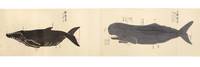
réf. 6620Scroll 273 x 13760 mm. At end in trans.: “All the images are of the whaling at Taiji…April 1857 Tennojiya Shinsuke owned.” A remarkable long and vividly rendered whaling scroll from Wakayama Prefecture depicting the whaling activities in unusual detail of the famous town of Taiji and its bay “Taiji ura” the site of the annual dolphin slaughter featured in the 2009 Oscar-winning documentary The Cove. Taiji has long been known as a whaling town and its history is essentially the history of whaling in Japan. In the 17th century whalers of the town developed a series of more sophisticated whaling techniques including the group hunting system 1606 a handheld harpoon and the whaling net technique 1675. The scroll begins with a quite detailed history of whaling in Japan written in a very legible hand describing the above-mentioned new methods of whaling with dates of introduction. There is information on when certain species of whales pass by during the year signaling systems other technical aspects of whaling etc. The first images depict six species of whales found off the coast of Taiji: Semi kujira North Pacific right whale Zato kujira humpback whale Nagasu kujira fin whale Katsuo kujira Bryde’s whale Koku kujira gray whale and Makko kujira sperm whale. Each of the dramatically and richly painted whales have notes regarding their most notable identifying features. The next scene takes place at Taiji: it shows the captured Semi kujira whales being winched onto shore and the highly specialized butchering of the carcasses. The slaughter area is fenced off and there are observation decks for government officials to review the work. We see a cross-section of the whale and the various products rendered from it in various stages of dismemberment: skin flesh bone intestines fins penis all displayed in large piles. Spectators stand to the side watching the work. A shrine is depicted in the background. This scene has been heightened with metallic pigments. All the harpoons in this scroll are depicted with metallic pigments. Following this is a scene of the different kinds of boats entering the greater bay towing a whale. The scenes of the houses on shore reveal what a prosperous community it once was. The subsequent scene depicts the specialized boats going out to sea passing two elevated signal posts “Kajitorizaki” & “Shomyozaki” which receive news of whales in the distance and sends signals by a flag system. Smoke is rising a signal to the boats. One of the boats is a “tool” boat containing special harpoons to kill the whale after it had been entangled in a net. Other boats are “net” boats each of which requires 81 sailors; they are seen spreading out the net. There are other boats — seko bune — which guide the whale into the net. Another vessel is fast-moving messenger boat giving directions to the others. In the following two scenes the sky and ocean are very beautifully depicted with delicate gradations of colors. The whale a humpback is shown caught in the net writhing and fighting for its freedom desperately spouting water. The enormous motion of the whale has caused the water to turn white with foam which is very expressively painted on the scroll with almost a 3-D Jackson Pollock splashed effect. A young whaler is seen climbing on the whale to stab it in the nose. The whalers all have special tasks to fulfill and the scroll provides the names of each special function. The next scene shows whalers catching a North Pacific right whale just off the Mikisaki peninsula. Following this we are on shore again at the enormous supply storage compound. The first scene shows government observers at the security gate of the compound with men shown mending and storing the whaling nets. The workers wear different head gear and colors of clothes denoting their jobs and ranks. One room has bundles of poles for harpoons. The next building shows men making boat paddles blacksmiths making harpoon heads barrel makers men assembling the harpoons and men making ropes. The subsequent scene depicts men painting three “leader” whaling boats in vivid colors and patterns. The designs on the boats have been highlighted with metallic pigments. The finished boats are stored in sheds which are shown behind. This is followed by a scene of the sheds where boats are constructed. We see a group of shipbuilders constructing a seko bune using saws planes and various other woodworking tools. The next scene depicts the tools of the whalers: various harpoons of different weights and lengths with different metal heads and large knives on long poles. Each harpoon’s specific purpose is mentioned. The ropes attached to the harpoons are contained in a series of bundles to avoid tangling. In fine and fresh condition. This is the finest whaling scroll we have yet encountered with a number of scenes of specific and well-known sites. Preserved in the original but rather decrepit wooden box with metal clasps. Accompanying the scroll is an original metal harpoon tip with the name “Eishichi” engraved. unknown
réf. 1144286506.Gpaperback. Good. Access codes and supplements are not guaranteed with used items. May be an ex-library book. paperback
réf. 1168470560.Gpaperback. Good. Access codes and supplements are not guaranteed with used items. May be an ex-library book. paperback
réf. A9781168470560New. unknown
réf. 1146447183.Gpaperback. Good. Access codes and supplements are not guaranteed with used items. May be an ex-library book. paperback
réf. 1146708718.Gpaperback. Good. Access codes and supplements are not guaranteed with used items. May be an ex-library book. paperback
réf. 1161213112.Gpaperback. Good. Access codes and supplements are not guaranteed with used items. May be an ex-library book. paperback
1848réf. 45544Boucquin imprimeur de la Préfecture de police 1848. Loose leaf. Vieux papier en français. - Par Ducoux représentant du peuple - Préfet de police. Une feuille 43 x 55 cm. Petits manques aux coins inférieurs. ref. 45544 Boucquin, imprimeur de la Préfecture de police unknown
1848réf. 45541Boucquin imprimeur de la Préfecture de police 1848. Loose leaf. Vieux papier en français. - 1200 affiches apposées dans Paris mention manuscrite au verso. Une feuille 44 x 56 cm. ref. 45541 Boucquin, imprimeur de la Préfecture de police unknown
1848réf. 45545Boucquin imprimeur de la Préfecture de police 1848. Loose leaf. Vieux papier en français. - Par Ducoux représentant du peuple - Préfet de police. Une feuille 43 x 55 cm. ref. 45545 Boucquin, imprimeur de la Préfecture de police unknown
1848réf. 45543Boucquin imprimeur de la Préfecture de police 1848. Loose leaf. Vieux papier en français. - Cachets de la préfecture au dos. Une feuille 43 x 55 cm. Légères rousseurs. ref. 45543 Boucquin, imprimeur de la Préfecture de police unknown
1848réf. 45546Boucquin imprimeur de la Préfecture de police 1848. Loose leaf. Vieux papier en français. - Par Ducoux représentant du peuple - Préfet de police. Une feuille 43 x 55 cm. ref. 45546 Boucquin, imprimeur de la Préfecture de police unknown
1848réf. 45547Boucquin imprimeur de la Préfecture de police 1848. Loose leaf. Vieux papier en français. - Par Ducoux représentant du peuple - Préfet de police. Une feuille 43 x 55 cm. Petits trous en marge inférieure. ref. 45547 Boucquin, imprimeur de la Préfecture de police unknown
1848réf. 45548Boucquin imprimeur de la Préfecture de police 1848. Loose leaf. Vieux papier en français. - Par Ducoux représentant du peuple - Préfet de police démissionnaire. Une feuille 43 x 55 cm. ref. 45548 Boucquin, imprimeur de la Préfecture de police unknown
1848réf. 45542Boucquin imprimeur de la Préfecture de police 1848. Loose leaf. Vieux papier en français. - Par Ducoux représentant du peuple - Préfet de police. Signatures et cachets de la préfecture au dos. Une feuille 44 x 56 cm. ref. 45542 Boucquin, imprimeur de la Préfecture de police unknown
réf. 1436, Brussel, Bank Brussel Lambert, 1989., Originele geillustreerde uitgeversomslag in kleur, 21x30cm, 169pp, geillustreerd z/w.
réf. 9264, Paris, l' Archipel, 2001., Broche, couverture d' editeur illustre n/b, 14x22,5cm, 356pp, bon etat.
1892réf. 82968Paris Imprimerie et Librairie Centrales des Chemins de Fer - Imprimerie Chaix, 1892, in-12, broché, 37p. Edition originale. Table : Transport des malades et désinfection. Instruction sur la fièvre typhoïde, la diphtérie (croup), la variole, la scarlatine, la diarrhée cholériforme. Services municipaux. Parfait état.
réf. 020357Raoul Rigault (1846-1871), journaliste, militant blanquiste, communard, franc-maçon, chef de la préfecture de police pendant la Commune de Paris, fusillé lors de la semaine sanglante. P.A., sd [entre 20 mars et 26 avril 1871], 1p in-12. 4 lignes sur un carton découpé (carton préimprimé servant déjà de laisser-passer). « Délivrer de suite un passe-porteur à la citoyenne porteur du présent ». Cachet « Préfecture de Police - Cabinet du Préfet ». Très rare autographe de ce communard mort à 24 ans. [488]
réf. 020461Pierre-Antoine-Augustin de Piis (1755-1832), écrivain, commissaire de police, secrétaire général de la préfecture de police. L.A.S., Paris, 28 janvier 1809, 1p in-4. Entête de la préfecture de police. « J'ai déjà eu, Monsieur, il y a quelques jours l'honneur de vous écrire pour vous prier de passer à mon cabinet relativement à une lettre que j'ai reçue vous concernant. Je serai obligé de la communiquer à Monsieur le Préfet, si vous ne venez pas en conférer avec moi lundi ou mardi au plus tard. Piis ». Le nom du destinataire, Jo., est difficile à déchiffrer. Adressé à l'hôtel Cerutti, rue de Cerutti. [493]