427 Ergebnisse
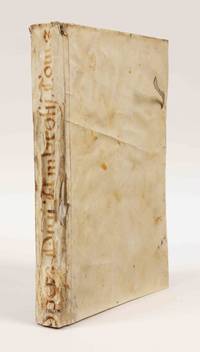
1554Best.-Nr. 54409Mexico: Ioannes Paulus Brissensis 1554. From the First Press in the New World and the Most Extensive Work Printed in the New World Up to This Time: The First Philosophical Works and the Second and Third Secular Works Published in the New World Printed by Juan Pablos the first printer in the New World these are two of the first major books published in the Western Hemisphere and the largest produced up to that time. Both titles are the work of Fray Alonse de la Veracruz and are the earliest works of philosophy and humanist thought published in the New World as well as the second and third secular works printed in the New World after the 1548 Laws which survives in only two copies. Moreover these are the earliest books printed in the New World still obtainable in the present market. Alonso de la Veracruz was a pioneering theologian philosopher author and Augustinian missionary. He accompanied Father Francisco de la Cruz on a mission in New Spain in 1536 remaining there for the rest of his life. His works here centered on an examination of the philosophy and ideas of Aristotle. His goal was to rid classical philosophy of vain and useless speculation and form a Renaissance of sorts in the new Spanish territories. Beyond instigating a school of thought previously unknown in the New World Veracruz sought to reform earlier scholastic and humanistic practices. He became a noted master of the Mexican and Tarascan languages making him an indispensable educator. In 1553 he became the first professor at the University of Mexico publishing these works his most important the following year. The two present works sprang out of Veracruz's studies shortly after his appointment to the University. The first Recognitio Summularum. is a compendium of Logic. This is supplemented by a commentary on the Aristotelian Categories and the Posterior Analytics. These two philosophical works were the first to be written and published in the New World as well as the first to address texts of the classics. Printing in the New World began in 1539 when printer Juan Pablos established a press in Mexico City a full century before printing began in British North America. The very earliest products of the Pablos press that have survived now reside almost entirely in institutions or are known only by inference of the two dozen earlier works listed by Wagner six are known only by inference. These are by far the most extensive works printed in the New World up to this time. Both works are major substantial pieces of printing handsomely laid out in two columns with well-executed presswork. The titlepage of the first work here in facsimile is printed in red and black the earliest color printing in the New World. The typography is also a breakthrough. Pablos now had Antonio de Espinosa later the second printer in the New World working in his shop as a punchcutter and assistant. Espinosa led a departure from the gothic types previously used by Pablos and these two books are the earliest use of roman and italic types in the New World. The text also contains numerous attractive woodcuts - on the titlepages as capital letters in the text and as illustrations in the text. Eleven other copies are known to survive of the Recognitio according to Wagner's census published in 1960 of which nine were then in public collections and several of those are imperfect. Wagner located twelve copies of the Dialectica eleven in institutions. In several instances the two books are found bound together as here. The annotations and marcas de fuego indicate that the present copies were once a part of the library at the Franciscan monastery in Puebla. Two extraordinary works of surpassing rarity from the first press in the New World comprising an impressive array of firsts for printing in the Americas. 888; 8810 leaves. Folio. Recased in slightly later vellum other manuscript title on spine remnants of fore-edge ties. First titlepage in facsimile mounted on a stub; first work lacking leaf H1; second titlepage detached but present. Two marcas de fuego on top edge; early manuscript inscriptions on first and final leaves of text; one leaf of manuscript bound in at rear. Moderate worming throughout somewhat affecting text. Light dampstaining at top edge moderate tanning and foxing. Good. In a half morocco box. ICAZBALCETA BIBLIOGRAFIA MEXICANA 1954 ed 21 22. MEDINA MEXICO 22 23. VALTON 45 46. PALAU 359140 359145. WAGNER NUEVA BIBLIOGRAFIA MEXICANA 20 21. Kurt Reinhardt "Alonso de la Vera Cruz and the Beginnings of Philosophic Speculation in the Americas" in The Americas Vol. 1 no. 2 October 1944 pp.207-14. hardcover
1554Best.-Nr. 54409Mexico: Ioannes Paulus Brissensis 1554. From the First Press in the New World and the Most Extensive Work Printed in the New World Up to This Time: The First Philosophical Works and the Second and Third Secular Works Published in the New World Printed by Juan Pablos the first printer in the New World these are two of the first major books published in the Western Hemisphere and the largest produced up to that time. Both titles are the work of Fray Alonse de la Veracruz and are the earliest works of philosophy and humanist thought published in the New World as well as the second and third secular works printed in the New World after the 1548 Laws which survives in only two copies. Moreover these are the earliest books printed in the New World still obtainable in the present market. Alonso de la Veracruz was a pioneering theologian philosopher author and Augustinian missionary. He accompanied Father Francisco de la Cruz on a mission in New Spain in 1536 remaining there for the rest of his life. His works here centered on an examination of the philosophy and ideas of Aristotle. His goal was to rid classical philosophy of vain and useless speculation and form a Renaissance of sorts in the new Spanish territories. Beyond instigating a school of thought previously unknown in the New World Veracruz sought to reform earlier scholastic and humanistic practices. He became a noted master of the Mexican and Tarascan languages making him an indispensable educator. In 1553 he became the first professor at the University of Mexico publishing these works his most important the following year. The two present works sprang out of Veracruz's studies shortly after his appointment to the University. The first Recognitio Summularum. is a compendium of Logic. This is supplemented by a commentary on the Aristotelian Categories and the Posterior Analytics. These two philosophical works were the first to be written and published in the New World as well as the first to address texts of the classics. Printing in the New World began in 1539 when printer Juan Pablos established a press in Mexico City a full century before printing began in British North America. The very earliest products of the Pablos press that have survived now reside almost entirely in institutions or are known only by inference of the two dozen earlier works listed by Wagner six are known only by inference. These are by far the most extensive works printed in the New World up to this time. Both works are major substantial pieces of printing handsomely laid out in two columns with well-executed presswork. The titlepage of the first work here in facsimile is printed in red and black the earliest color printing in the New World. The typography is also a breakthrough. Pablos now had Antonio de Espinosa later the second printer in the New World working in his shop as a punchcutter and assistant. Espinosa led a departure from the gothic types previously used by Pablos and these two books are the earliest use of roman and italic types in the New World. The text also contains numerous attractive woodcuts - on the titlepages as capital letters in the text and as illustrations in the text. Eleven other copies are known to survive of the Recognitio according to Wagner's census published in 1960 of which nine were then in public collections and several of those are imperfect. Wagner located twelve copies of the Dialectica eleven in institutions. In several instances the two books are found bound together as here. The annotations and marcas de fuego indicate that the present copies were once a part of the library at the Franciscan monastery in Puebla. Two extraordinary works of surpassing rarity from the first press in the New World comprising an impressive array of firsts for printing in the Americas. 888; 8810 leaves. Folio. Recased in slightly later vellum other manuscript title on spine remnants of fore-edge ties. First titlepage in facsimile mounted on a stub; first work lacking leaf H1; second titlepage detached but present. Two marcas de fuego on top edge; early manuscript inscriptions on first and final leaves of text; one leaf of manuscript bound in at rear. Moderate worming throughout somewhat affecting text. Light dampstaining at top edge moderate tanning and foxing. Good. In a half morocco box. ICAZBALCETA BIBLIOGRAFIA MEXICANA 1954 ed 21 22. MEDINA MEXICO 22 23. VALTON 45 46. PALAU 359140 359145. WAGNER NUEVA BIBLIOGRAFIA MEXICANA 20 21. Kurt Reinhardt "Alonso de la Vera Cruz and the Beginnings of Philosophic Speculation in the Americas" in The Americas Vol. 1 no. 2 October 1944 pp.207-14. hardcover books