427 résultats
1793réf. 28478Québec De l'Imprimerie de Jean Neilson 1793
8vo (225 x 140 mm), xxiii, [1], [3]-343, [1]pp.,, 8 lithographed plates (5 folding), later calf brown morocco, uncut, t.e.g. a nice copy. Scarce sale catalogue of the large celebrated collection of incunabula (mainly from German presses) and manuscripts gathered together by Professor Kloss, a physician from Frankfurt, built on the collections of Johannes von Dalberg, Bishop of Worms, Adelmann von Adelmannsted and the Church Library at Essligen. 4,682 lots. Provenance: From the reference library of E. P. Goldschmidt with initials stamped in gilt at base of spine. De Ricci, p.117.
1936Very Good Greek, Modern (post 1453) Original b/w city map of Byzantine Constantinople printed in 1936, Noemvrios (November). Oblong: 32x46 cm. In Greek (Modern). Folded. Scale: 1:2000. [GREEK MAP of BYZANTINE CONSTANTINOPLE] Byzantion Konstantinoupolis: To petrion kai ta peristh autou. Khartis topographikos - arkhaiologikos ikpointheis kai katartistheis upo Misn. It show Haliç (The Golden Horn) section and shores of Constantinople.
4to, [iv],10pp., 5 photographic plates, orig. printed wrappers bound-in, cloth-backed marbled boards. Illustrations of some examples of type used in incunabula attributed to the Press at Marienthal. Tipped-in at the back: HENNEN (Dr.) Unbekannte und Unzul?nglich Gew?rdigte Marienthaler... Otto Harrassowitz, Leipzig. 1887. 12pp., orig. upper wrapper.
1913Very Good Turkish, Ottoman (1500-1928) Full leather new bdg. Original illustrated cover saved inside. Roy. 8vo. (24 x 17 cm). In Ottoman script (Old Turkish with Arabic letters). [12], 166, [2] p., b/w and color plates of Ottoman warships and scenes from naval wars, seven maps of the earliest examples of Ottoman cartography. Very rare second edition of this book on the history of Ottoman naval wars against Venetians began with the Crete campaign (War of Candia) in 1645 and lasted for years until 1656. The book was published first in 1729 in Müteferrika Printing House which was the first printing house in the Islamic world as the third printed book. This is the second edition including five maps of almost the same size (two paged) titled world map, The Mediterranean, The Archipelago (Aegean), The Adriatic Sea, and the compass-like in its first edition as well as two maps and twenty-six plates (some of them are color) and small illustrations of Ottoman ships as head of some carriage returns. Additional maps depict the city of Venice (from Kitab-i Bahriye [i.e. Book of Navigation) and the travels of Ottoman Admiral Sidi Ali Reis through the Sea of Oman. The Cretan War or the Fifth Ottoman-Venetian War, was a conflict between the Republic of Venice and her allies (chief among them the Knights of Malta, the Papal States, and France) against the Ottoman Empire and the Barbary States because it was largely fought over the island of Crete, Venice's largest and richest overseas possession. This account of Ottoman maritime warfare in Turkish, written in Safer 1067/November 1656. This date places the book in a moment of utmost danger for the Ottoman capital following the defeat of the Ottoman navy at the hands of the Venetians at the Dardanelles (4 Ramadan 1066/26 June 1656) and the subsequent loss of the islands of Lemnos and Tenedos. It is also written shortly after the appointment of Köprülü Mehmed Pasha as grand vizier (25 Dhulqada 1066/14 September 1656). Thus it is suggested to read it as a program of reform of the navy intended for a person whom Hadji Khalfa might have seen as the "man of the sword" who might revert the fate of the Empire. Of the four ulemâ [i.e. scholars] who wrote endorsements for the book, two are closely related to the Köprülü family. The first part is a history of Ottoman maritime campaigns from the beginning to 1067/1656, while the second is a systematic description of naval affairs, from administration and offices to shipbuilding, culminating in a list of 40 suggestions for the organization and strategy of the Ottoman navy, including the use of recent scientific and technological innovations. Thus the juxtaposition with history provides an argument for reform. Suggestions are largely centered around the traditional qanun-i qadim; there is no reference to high-board ships. The final pages include an important discussion of historical causality, explaining how divine omnipotence creates the consequence of historical causes, in reward for the righteous rule, or punishment of injustice. (Source: Ottomanhistorians). Özege 21273.
Folio, [x],111,[3]pp., printed in Linotype Estienne with Civilite headings, Cockerell marbled paper boards, title label to spine, uncut. "This [library] was designed to be a guide and inspiration to a working printer and to illustrate the history of printing and all its adjuncts: types, pages, margins, woodcut and other decoration. The great names of Gutenberg, Fust and Schoeffer, Zel, Sweynheym and Pannartz, Wendolin of Speier, Jenson, Crantz, Gering and Friburger, and Caxton appear, and there are a number of examples of the fine borders and initials produced by the Zainers at Augsburg and Ulm and by Ratdolt at Venice."?Preface. Rogerson, 26.
1963In-4 gr., lussuosa legatura editoriale in piena pelle (abrasioni alle cerniere), dorso a cordoni, astuccio con cuffia in pelle, 54 cc.nn., con il bellissimo frontespizio figurato e 8 grandi tavole anatomiche di cui 1 a colori. Riproduzione in facsimile della seconda edizione (1493) del primo testo di anatomia con figure originali. E' l'anatomia di Mondino de' Luzzi (1270-1326), il primo insigne anatomista degno di questo nome, pubblicata per la prima volta a Venezia nel 1491 dal medico Giovanni de Ketham, alemanno, nel suo cosiddetto "Fascicolo di medicina". Cfr. Castiglioni "Storia della Medicina", pp. 340, 420. Bella edizione su carta a mano, in tiratura di 350 esemplari numerato. Ben conservato.
First Edition, 83pp., disbound.
First Edition, 83pp., orig. printed wrappers, unopened, uncut.
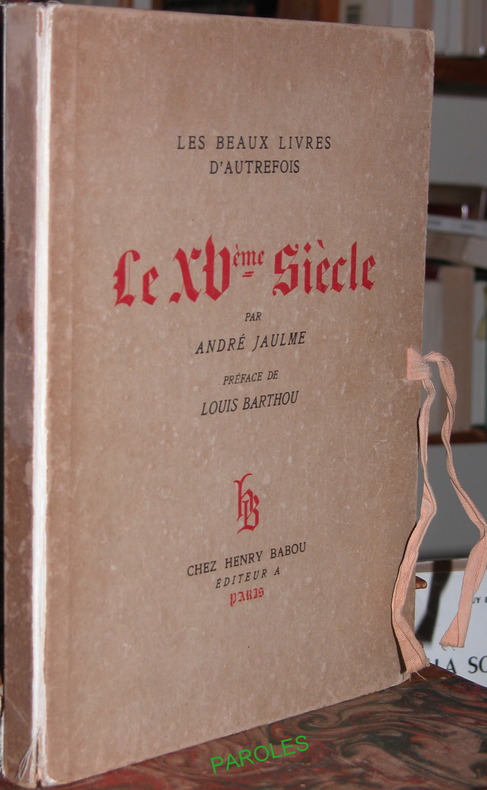
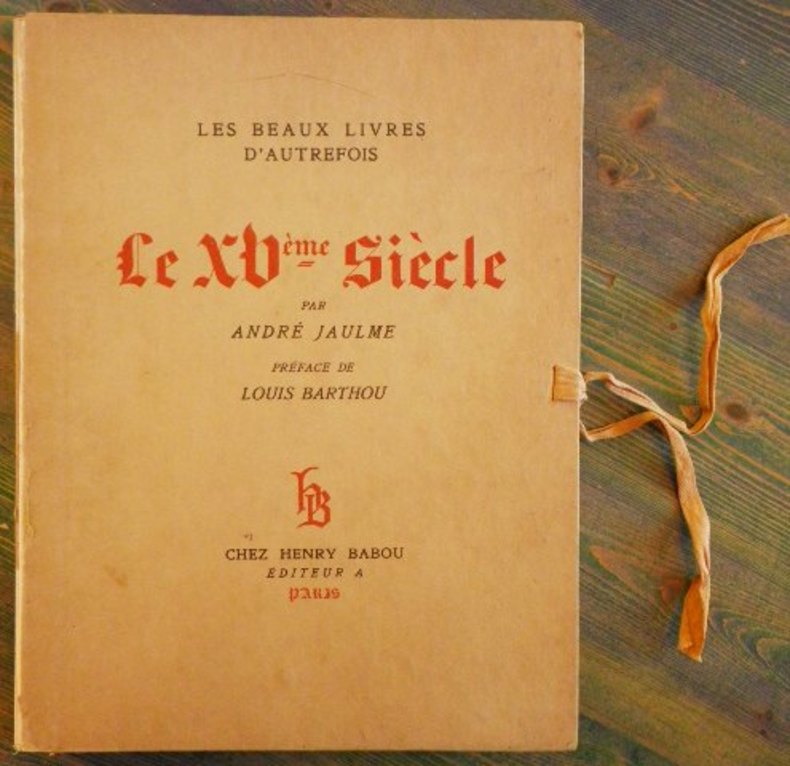
1929réf. 39439Couverture rigide. En cahiers. Sous chemise cartonnée de l'éditeur avec liens. Légères rousseurs.
réf. 795P., Chez Henry Babou, 1929, 1 petit in-4 en feuilles, sous chemise cartonnée (mors légèrement défraichis), de 36 pp + 40 planches H.T. tirées en héliotypie.
1929Texte d'André JAULME (1897-1940), bibliothécaire à la Bibliothèque Nationale, sur la typographie et les incunables européens, suivi de 40 planches tirées en héliotypie par Marotte d'après les originaux de la Bibliothèque Nationale; lettre-préface de Louis BARTHOU. 1er volume de la collection "Les Beaux livres d'autrefois" dirigée par Marcel Valotaire. Tirage à 1150 exemplaires; 1 des 1010 sur vélin Johannot, justifié n°426 (après 140 sur japon). Français
1929réf. 9815Paris, Henry Babou, "Les Beaux livres d'autrefois", Henry Babou, "Les Beaux livres d'autrefois", 1929 1 volume 20,2 x 26,2cm En feuilles en portefeuille à lacet. 1feuillet, 1titre imprimé en rouge et noir et orné d'une vignette, 36p., 40 planches dont 1 en couleurs, 2 feuillets. Feuilles en bon état (quelques petites rousseurs surtout aux gardes); petites fentes aux charnières du portefeuille, et papier de couvrure déchiré le long de ces charnières.
réf. 16006Ulm, Johann Zainer, sans date, [pas après 1478]. Petit in-folio gothique (20 x 29 cm) de (418) ff. à 40 lignes par page, sans foliotation, réclames ni signatures dont 2 feuillets blancs (1er et 371e), peau de truie sur ais de bois biseautés, dos à trois nerfs, décor géométrique estampé à froid dans un encadrement de médaillons, titre manuscrit en noir sur le dos, fermoirs, traces de cabochons (reliure de l'époque).
1851réf. 3126Première moitié du XIVe siècle 1851 Lettre ornée sur vélin (18,5x16,5 cm) extraite d’une page d’antiphonaire ou graduel, musique notée sur une portée à 4 lignes. Grande initiale F (17,3x10,5 cm) décorée aux gouaches et à l’encre à motifs abstraits bleus et vermillons pour la hampe et à l’encre vermillon verte et bleue pour les motifs ornementaux couvrant l’espace intérieur et les prolongation marginales.
Frontis., 25 plates, orig. printed wrappers, 225 items.
5 Parts bound in one, frontispieces, cont. cloth, 1,000 items.
4to, 56pp., orig. printed wrappers. A catalogue of Rattey's incunabula, collected over 20 years. This collection was later dispersed by Maggs.
First Edition, 4to, xi,[v],102pp., 16 facsimiles, orig. cloth, a fine copy. The collection dealt with in the present catalogue is not large, but is of considerable importance by reason of the extreme rarity of a number of the works which find a place in it. It describes 154 items. Of these 132 formed part of the famous Althrop Library.
232pp., numerous illustrs., orig. printed wrappers, torn and a little defective, uncut. Contains 1500 incunables, published on the occasion of the 500th anniversary of Gutenberg's birth.
4to, numerous coloured plates throughout, price list loosely inserted, orig. cloth, 97 items.
70pp., frontis., 16 plates, illustrs., in the text, orig. printed wrappers. 486 Items listed.
8vo (230 x 155 mm), viii, 274pp., 12 plates (mostly folding), cont. quarter morocco, marbled boards, lightly rubbed but a nice copy. 533 items described.
réf. 703Budapest, Magyar Helikon, 1978. Grand in-4° reliure pleine toile, jaquette illustrée. Avec 126 planches hors-texte en couleurs reproduisant les codex et les incunables de cette importante bibliothèque humaniste.
1496réf. 17350AB1496. Straßburg Grüninger I.XI. 1496 305 : 21 cm. One leaf with one woodcut. Leaf LXX 'Secundus actus' from the "Heautontimorumenos". The woodcut shows the two protagonists of the play. - With some old annotations. - Hain/Copinger 15431; Goff T-94; GW M45481. unknown