425 résultats
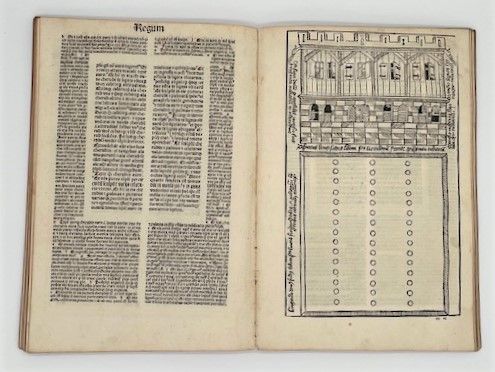
1493réf. D4438Venice: Johannes Rubeus 1493. Hardcover. Very Good. Venice: Johannes Rubeus 1 January 1493. Folio 315 x 225mm. 174 leaves. Collation: a 7; b-x 8; tabula 7. 61 lines Roman type capital spaces unrubricated. Contemporary notation and hand-drawn manicules indicating the text throughout many are whimsically flourished or holding objects. Final blank on watermarked paper of flying swan in pearled medallion. Content are in three parts the first is a revised and augmented version with excerpts taken from classical authors and Italian humanists and formulas for letter-writing. The second part consists of an anthology of prose writers including Cicero Lactantius Macrobuius Plutarchus etc. The third part contains selections from Petrarch dramatic poets Terence Seneca Plautus and a variety of humanist speeches by Renaissance copyists letter-writers and philosophers including Johannes Lamola Poggius Florentinus Galeatius Sforza and the author himself. Contents: Leaf 2a title: Oratorum omnium Poetarum: Hystoricorum: ac Philosophorum elegantes dicta: per Clarissimum iurum Albertum de Eiib in unum collecta faeliciter incipiunt. Leaves 120a-123b contain: Liber augustalis imperatorum Francisci Petrarchae Benvenuto Rambaldis continuation of Petrarchs Epitome vitarum virorum illustrium; Leaves 125a-129b: Francisci Petrarchae de aduersa fortuna Remedia; Leaves 129b- 132b: Francisci Petrarchae: de prospera fortuna remedia. Leaf 168b Colophon: Summa Oratorum omnium: Poetarum: Historicorum: ac Philosophorum Autoritates in unum collectae per clarissimum uirum Albertum de Eyb Vtriusque iuris doctorae eximium: quae Margarita poetica dicitur: faeliciter finae adepta est. M.CCCCLXXXXIII. Kalae. Ianuarii. Leaves 169a-175b: Tabula. totius . oprois. 18th-century three-quarter sheep over marbled pasteboards spine gilt with title silk book mark; wanting first and final original blank a few wormholes at the beginning and end some just affecting text; faint dampstaining in the upper margins few creased corners corner torn of m2 and marginal tear m8 very slightly spotted and soiled in places. From the Collection of Baron de Eyb his heraldic lithographed ex-libris dated 1899 to front pastedown an evident descendant of the author. Eyb is the name of an old Franconian noble family which is named after Eyb in Ansbach. It is likely this volume was owned by a contemporary with familial ties to the author and stayed within the family until the early 20th century. Eighth Edition of this important work of German Humanism. Albrecht von Eyb one of the earliest German Humanists was born in 1420 near Ansbach. Eyb went to Italy and devoted himself to humanistic study at the Universities of Pavia and Bologna. He returned to Germany in 1451 having been appointed Canon at Eichstätt and Bamberg. From 1452 to 1459 he was again a student at Bologna gaining the degree of doctor in 1459. That same year Eyb wrote Margarita poetica in honor of his mother Margarete von Wolmershausen. It was first published in Nuremberg by Johann Senschschmidt in 1472 and reprinted at least 13 times by 1503. It remained a popular manual of classical rhetoric by its three distinct focuses: letter-writing model orations and florilegia compilation of excerpts. The work is known for its vivid expression found within selected passages from classical and contemporary authors from Cicero to Petrarch. The Catholic Encyclopedia calls it a textbook of humanistic rhetoric consisting of a collection of passages in prose and verse from Latin authors to which are added specimens of humanistic eloquence. Of only about 40 in existence OCLC locates 13 copies of this edition in US collections. BMC V 417; Goff E177; GW 9536; HC 6824; Madsen 1547; Schmitt I 4233; Sheppard 4121; Proctor 5132 Johannes Rubeus hardcover books
1493réf. D4438Venice: Johannes Rubeus 1493. Hardcover. Very Good. Venice: Johannes Rubeus 1 January 1493. Folio 315 x 225mm. 174 leaves. Collation: a 7; b-x 8; tabula 7. 61 lines Roman type capital spaces unrubricated. Contemporary notation and hand-drawn manicules indicating the text throughout many are whimsically flourished or holding objects. Final blank on watermarked paper of flying swan in pearled medallion. Content are in three parts the first is a revised and augmented version with excerpts taken from classical authors and Italian humanists and formulas for letter-writing. The second part consists of an anthology of prose writers including Cicero Lactantius Macrobuius Plutarchus etc. The third part contains selections from Petrarch dramatic poets Terence Seneca Plautus and a variety of humanist speeches by Renaissance copyists letter-writers and philosophers including Johannes Lamola Poggius Florentinus Galeatius Sforza and the author himself. Contents: Leaf 2a title: Oratorum omnium Poetarum: Hystoricorum: ac Philosophorum elegantes dicta: per Clarissimum iurum Albertum de Eiib in unum collecta faeliciter incipiunt. Leaves 120a-123b contain: Liber augustalis imperatorum Francisci Petrarchae Benvenuto Rambaldis continuation of Petrarchs Epitome vitarum virorum illustrium; Leaves 125a-129b: Francisci Petrarchae de aduersa fortuna Remedia; Leaves 129b- 132b: Francisci Petrarchae: de prospera fortuna remedia. Leaf 168b Colophon: Summa Oratorum omnium: Poetarum: Historicorum: ac Philosophorum Autoritates in unum collectae per clarissimum uirum Albertum de Eyb Vtriusque iuris doctorae eximium: quae Margarita poetica dicitur: faeliciter finae adepta est. M.CCCCLXXXXIII. Kalae. Ianuarii. Leaves 169a-175b: Tabula. totius . oprois. 18th-century three-quarter sheep over marbled pasteboards spine gilt with title silk book mark; wanting first and final original blank a few wormholes at the beginning and end some just affecting text; faint dampstaining in the upper margins few creased corners corner torn of m2 and marginal tear m8 very slightly spotted and soiled in places. From the Collection of Baron de Eyb his heraldic lithographed ex-libris dated 1899 to front pastedown an evident descendant of the author. Eyb is the name of an old Franconian noble family which is named after Eyb in Ansbach. It is likely this volume was owned by a contemporary with familial ties to the author and stayed within the family until the early 20th century. Eighth Edition of this important work of German Humanism. Albrecht von Eyb one of the earliest German Humanists was born in 1420 near Ansbach. Eyb went to Italy and devoted himself to humanistic study at the Universities of Pavia and Bologna. He returned to Germany in 1451 having been appointed Canon at Eichstätt and Bamberg. From 1452 to 1459 he was again a student at Bologna gaining the degree of doctor in 1459. That same year Eyb wrote Margarita poetica in honor of his mother Margarete von Wolmershausen. It was first published in Nuremberg by Johann Senschschmidt in 1472 and reprinted at least 13 times by 1503. It remained a popular manual of classical rhetoric by its three distinct focuses: letter-writing model orations and florilegia compilation of excerpts. The work is known for its vivid expression found within selected passages from classical and contemporary authors from Cicero to Petrarch. The Catholic Encyclopedia calls it a textbook of humanistic rhetoric consisting of a collection of passages in prose and verse from Latin authors to which are added specimens of humanistic eloquence. Of only about 40 in existence OCLC locates 13 copies of this edition in US collections. BMC V 417; Goff E177; GW 9536; HC 6824; Madsen 1547; Schmitt I 4233; Sheppard 4121; Proctor 5132 Johannes Rubeus hardcover
réf. 3025Circa 1968 Tapuscrit in 4 broché de 64 ff portant en page de titre « MARGARET (titre provisoire) / Scénario original de D. Medveczki et R. Topor » .
réf. 65209[Basel, Michael Wenssler, nicht nach 1474]. Fol. 52 nn. Bll. (34 Z., Got. Typ.). - Angeb. - Ders. De morali lepra. [Ebda., nicht nach 1475]. 68 nn. Bll. (34 Z., Got. Typ.), Roter Maroquin-Bd. d. 18. Jhds. a. 5 Bünden m. goldgepr. Deckelfileten, Rückenverg., 2 goldgepr. grünen Rückenschildern, Steh- u. Innenkantenverg. u. dreiseitigem Goldschnitt.
réf. 601604, 585 mm x 780 mm. Rédigé sur une peau de vélin non taillée. Conservé dans son écrin de chêne rougi, 920 mm x 200 mm.
réf. 2767circa 1890, 500pp Charmant manuscrit illustré d’aquarelles originales, de lettrines et dessins, dans une reliure en velours ancien à l’imitation des reliures médiévales. Dans une petite écriture en premier jet.
1927réf. 98751927 Paris . Giraud-Badin, 1927, in 4, Broché couverture imprimée en bleu,, 82pp. + (1)f
réf. 27731869, Deux volumes in4 demi-vélin, dos plat pièce de titre en maroquin tabac, papier fin, abondemment truffé de courrier et documents originaux récoltés par l’auteur de cette recherche. TI : 322pp ; TII : 273pp
réf. 494(Québec, John Neilson ? 1794 ?) In-4 (24.9 cm) (1)f. [titre], 13p. [texte]. En feuilles. Fines rousseurs. Manque la page de titre et la p. 13 qui contient une Liste des Solennités, qui sont remplacées par des fac-similé. Vlach & Buono 520. Lande S 1096. Tremaine 875. [ Mandement de Monseigneur l'Évêque de Québec, qui révoque certaines dispositions de deux Mandements précédents et pourvoit à quelques autres objets. Sur la suppression de certains jours de fêtes. Incunable canadien qui d'après Tremaine a été tiré à 400 exemplaires.]
1920réf. 12291920 broché in-octavo, dos gris - manque de papier en haut et en bas, couverture illustrée, illustrations : 40 planches noires hors-texte, 372 pages, 1920 London Maggs Bros Dealers in Fine and Rare Books Prints and Autographs,
1806réf. 27526Quebec Imprimé à la Nouvelle Imprimerie 1806
8vo, 30, [2 blank]pp., lightly waterstained throughout, orig. drab paper wrappers, bound in patterned paper boards. First edition of a fascinating early monograph on printed signatures, foliation, registers and catch-words in 15th-century books. It is dedicated to the great Belgian collector Charles van Hulthem. Count Serna, who is here given the timely title of "Citoyen", was an important incunabulist and printing historian. He correctly attributes the first use of signatures to Johann Koelhoff the elder in Nider's Praeceptorium 1472, and of foliation to Arnold Ther Hoernen in Adrianus Carthusiensis' De remediis utriusque fortunae 1471. He agrees with Marolles (Recherches sur l'origine et le premier usage des registres 1783) that Sweynheym and Pannartz were the first printers to employ a register [the table in the 1469 Caesar], but it is now thought that the anonymous Hieronymus' Epistolae [Rome: probably Sixtus Riessinger, c. 1468--69] may be the first book to have been issued with one. The author rightly identifies Vindelinus de Spira (and not his brother Johannes) as the printer of Tacitus' Opera [now assigned a somewhat later date than Haebler's 1471], the first printed book with catch-words. Provenance: Bookplate of A. W. Barten. Bigmore & Wyman II, 352.
réf. 28069Genève, H. Trono 1937, 250x170mm, 439 + 576pages, reliure toile de l’éditeur. Bel exemplaire.
4to, one of 350 numbered copies, [66]pp., from the library of Dr H.A. Feisenberger with his signature, orig. paper covered boards, head and foot of spine slight chipped, unopened, uncut.
The auction catalogue of an unparalleled collection of books on the liturgy. 345 items thoroughly described. Numerous text facsimiles and full-page plates. Cross-references to Bohatta and Ales. 4to. Attractively bound in cloth by M. BUENO (signed), Spain's leading living binder. Original wraps and backstrip bound in. Morocco lettering-piece. Top edge gilt, other edges uncut. Fine and bright. Scarce.
réf. 2403cicra 1770., In 12 en plein maroquin rouge, dos plat orné de fleurons, pièce de titre, les plats supérieurs et inferieurs sont encadrés de dentelles et de fleurons dans les angles, tranches dorés, dentelles intérieurs, pages de gardes ornés d’un motif d’étoiles en or liquide. Manuscrit d’une fine écriture légèrement italique, soignée et régulière, d’une encre sépia. 1b, page de titre, 203pp, 6b
1940réf. 115321940 port-folio chemise éditeur (plates under paper jacket) in-quarto, dos marron muet (brown spine wihout text), première de couverture illustrée (front cover illustrated), sans pagination (unpaginated), les années 1920-30 à Lyon Association Guillaume Le Roy,
1926réf. 115331926 port-folio chemise éditeur (plates under paper jacket) in-quarto, dos marron muet (brown spine wihout text), première de couverture illustrée (front cover illustrated), 61 pages, 1926 à Lyon Association Guillaume Le Roy,
First Edition, 83pp., disbound.
First Edition, 83pp., orig. printed wrappers, unopened, uncut.
réf. 64450[Nürnberg, Anton Koberger, 1487]. Fol. Mit 10 (2 ganzs.) Textholzschnitten. Durchg. m. eingemalten Initialen in Rot u. Blau sowie rubriziert. 113 nn. Bll. (Got. Typ., 2 Kol., 72-73 Zeilen, Text von Kommentar umgeben), Geheftet (ausgebunden; ohne Einband).
Groot 8vo, pp. XVIII, 651, [4]. Uitgever's rood verguld linnen in het oorspronkelijk stofomslag. Geïllustreerd. Met 42 bijdragen, verdeeld over 5 hoofdstukken. Met bibliografie van Voets publicaties en een lijst van door hem georganiseerde tentoonstellingen. Omslag met transpar. plastiek overgedekt, stempel. [NV-7] Omslag met transpar. plastiek overgedekt, stempel.
réf. 64370[Nürnberg, Anton Koberger, 1487]. Fol. Mit 2 Textholzschnitten. Durchg. m. eingemalten Initialen in Rot u. Blau sowie rubriziert. 100 nn. Bll. (Got. Typ., 2 Kol., 72-73 Zeilen, Text von Kommentar umgeben), Geheftet (ausgebunden; ohne Einband).
1818réf. 22702Besançon, Vacherant-Tissot, 1818 ; in-4°, demi veau marbré, dos lisse à faux nerfs de filets dorés, pièce de titre rouge (reliure de l'époque) ; XVI, 216 pp., [1] f. d'errata et 4 lithographies originales hors-texte, dont une dépliante, lithographiées par F. Berthaux à Dijon, d'après les dessins de M. Aime Penhouët, garde national à Lyon, en 1817.