PELBARTUS DE THEMESWAR.Livre Rare Book

424 résultats
réf. 5759Haguenau, Henri Gran, pour Jean Rynman, 1500. In-folio gothique à deux colonnes de (264) ff., le dernier blanc [Collation: cahier signé de chiffres 8, a-g8, h6, i-k8, l6, m-n8, o6, p-q8, r6, s8, t6, cahier signé de chiffres 6, v-x8, y6, z8, A-B8, C6, D-K8]. Relié à la suite : PELBARTUS DE THEMESWAR. Sermões quadragesimales pomerii fratris Pelbarti de Themeswar diui ordinis sancti Francisci incipiut feliciter. Haguenau, Henri Gran, pour Jean Rynman, 10 juillet 1500. In-folio gothique à deux colonnes de (110) ff. [Collation: a-b8, c6, d-e8, f6, g-h8, c6, k-l8, m6, n10, o6, p6]. 2 ouvrages en 1 fort vol. in-folio, aies de bois recouverts de peau de truie estampée à froid de motifs de Vierge à l'Enfant, de lion, d'oiseau et de fleur, dans de grands croisillons, dos à quatre nerfs, fermoirs de cuirs avec attaches en laiton (reliure de l'époque).
in-4° 123 pp., broche, couverture illustree.- Tres bel ouvrage illustre de nombreux documents in- et hors texte (pages de titre anciennes, portraits, lettrines, ornements, ...). Bel exemplaire. [PLG-5/6]
1498réf. 3237Venise Bonetus Locatellus pour Octavianus Scotus 1498 In-folio, 157 sur 158 feuillets chiffrés (manque le f. 76), reliure en maroquin noir sur ais de bois, plats décorés à froid d'un double encadrement de fers répétés et soulignés d'une double paire de filets, au centre alignement de deux fers répétés, traces de fermoirs, dos à nerfs, gardes en vélin de réemploi d'un manuscrit liturgique (missel ou évangéliaire) du XIIème siècle.
réf. 2377Luzern, Schweizerischen Bibliophilen Gesellschaft. 1941; in-4, en feuilles, cartonnage à rabats, reproductions en noir et en couleurs. Un des 250 exemplaires numérotés.
1921réf. 23462Frankfort a. M. Joseph Baer / C.Lang 1921 -in-4- broché un volume, broché marron-clair in-quarto Editeur (paperback in-8) (28,8 x 22,4 cm), dos muet, 1ère de couverture imprimée en noir (petit manque de papier en tête et en pied (moins de 2 cm2) Couverture légèrement défraichie avec quelques rousseurs, manque de papier en coin de la 4ème de couverture, toutes tranches lisses, texte du Catalogue en Allemand, orné de 58 hors-texte à la sépia, VIII + 112 pages, 1921 Frankfort a. M., Joseph Baer / C.Lang Editeur,
1906In-4°: pp. XIII,(3), 510. 1 cart. di tav. con ritratto dell’autore, marca tipografica al fronte spizio. Brossura editoriale.
réf. 266Genève, (Braillard, 1970) ; 8°, reliure en parchemin avec le titre imprimé sur le premier plat.
réf. 200711018LVGDVNI, APVD SEB. GRYPHIVM, 1535 ; in-12, 294 pp., demi-cuir à caissons 19e et a coins tranches décorées en relief et dorées. Bon état général malgrès une mouillure ancienne.
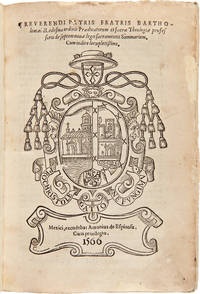
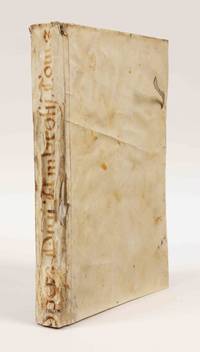
1566réf. WRCAM54413Mexico: Antonio de Espinosa 1566. 440416 leaves with several woodcut illustrations and woodcut initials throughout. Small thick quarto. Contemporary vellum with yapp edges remnants of vellum ties at fore-edge. Light wear and soiling to vellum endpapers renewed. Small marca de fuego on top edge. Moderate wear to initial leaves moderate worming in lower corner and occasionally along lower margin all expertly repaired slightly affecting only a few printed marginalia and catchwords. Light tanning and occasional foxing. A very good copy overall. A very rare complete and substantial example of early Mexican printing. This work was produced and published by Antonio de Espinosa the second printer in the New World after Juan Pablos and is one of the most considerable efforts of his career in Mexico. Espinosa was brought to Mexico by Juan Pablos as an assistant and type cutter in 1550 and he eventually broke Pablos' monopoly and began printing for himself in 1559. The present work printed in 1566 is one of only a handful produced in Mexico during that decade and is one of the initial books of the Mexican incunable period. The text itself is the first edition of a religious work by Bartholomé de Ledesma explicating church sacraments in great detail later reprinted in Salamanca in 1585. The work is split into six parts. The first discusses the sacraments generally and the ensuing five treat individual sacraments in depth. Ledesma was a key figure in the early Mexican church as a close advisor of the second Archbishop in the New World Alonso de Montúfar and the chair of theology at the nascent University of Mexico founded in 1551. He was also one of the foremost proponents of book censorship and prohibition in New Spain and vigorously investigated private libraries and booksellers for forbidden materials and was responsible for the destruction of many volumes. He later became the Bishop of Oaxaca a position in which he served until his death in 1604. Overall the work is a fine example of the sophistication which Espinosa brought to early Mexican printing. The titlepage contains a fine coat of arms that of Archbishop Montúfar and the section on marriage sacraments includes several finely executed woodcut diagrams of consanguinity. The text is printed elegantly in a Roman type which Espinosa had introduced to New World printing with printed marginal notes in italic and woodcut initials throughout. Below the colophon is an excellent example of Espinosa's printer's device the first used on any book produced in the Americas. In his 1940 census of Mexican imprints Wagner located twelve copies of this work and over seventy-five years later OCLC adds only three more. It appears just four times in auction records of which one copy was incomplete. A rare desirable Americanum printed by the second printer in the New World and one of the earliest Mexican incunabula still obtainable. ICAZBALCETA 47. MEDINA MEXICO 50. PALAU 134124. SABIN 39677. WAGNER NUEVA BIBLIOGRAFIA MEXICANA 47. Antonio de Espinosa hardcover books
1566réf. 54413Mexico: Antonio de Espinosa 1566. A Major Mexican Incunable A very rare complete and substantial example of early Mexican printing. This work was produced and published by Antonio de Espinosa the second printer in the New World after Juan Pablos and is one of the most considerable efforts of his career in Mexico. Espinosa was brought to Mexico by Juan Pablos as an assistant and type cutter in 1550 and he eventually broke Pablos' monopoly and began printing for himself in 1559. The present work printed in 1566 is one of only a handful produced in Mexico during that decade and is one of the initial books of the Mexican incunable period. The text itself is the first edition of a religious work by Bartholomé de Ledesma explicating church sacraments in great detail later reprinted in Salamanca in 1585. The work is split into six parts. The first discusses the sacraments generally and the ensuing five treat individual sacraments in depth. Ledesma was a key figure in the early Mexican church as a close advisor of the second Archbishop in the New World Alonso de Montúfar and the chair of theology at the nascent University of Mexico founded in 1551. He was also one of the foremost proponents of book censorship and prohibition in New Spain and vigorously investigated private libraries and booksellers for forbidden materials and was responsible for the destruction of many volumes. He later became the Bishop of Oaxaca a position in which he served until his death in 1604. Overall the work is a fine example of the sophistication which Espinosa brought to early Mexican printing. The titlepage contains a fine coat of arms that of Archbishop Montúfar and the section on marriage sacraments includes several finely executed woodcut diagrams of consanguinity. The text is printed elegantly in a Roman type which Espinosa had introduced to New World printing with printed marginal notes in italic and woodcut initials throughout. Below the colophon is an excellent example of Espinosa's printer's device the first used on any book produced in the Americas. In his 1940 census of Mexican imprints Wagner located twelve copies of this work and over seventy-five years later OCLC adds only three more. It appears just four times in auction records of which one copy was incomplete. A rare desirable Americanum printed by the second printer in the New World and one of the earliest Mexican incunabula still obtainable. Small thick quarto. Contemporary vellum with yapp edges remnants of vellum ties at fore-edge. Light wear and soiling to vellum endpapers renewed. Small marca de fuego on top edge. Moderate wear to initial leaves moderate worming in lower corner and occasionally along lower margin all expertly repaired slightly affecting only a few printed marginalia and catchwords. Light tanning and occasional foxing. A very good copy overall. ICAZBALCETA 47. MEDINA MEXICO 50. PALAU 134124. SABIN 39677. WAGNER NUEVA BIBLIOGRAFIA MEXICANA 47. hardcover
Second edition, [2 ads], [36]pp., with printed title-page and half-title, engraved headpiece, the advert leaf includes two editions of Beckford's Vathek and A Description of Fonthill Abbey. Small 4to (235 x 145 mm), 2 works in one, recent half calf to style, marbled boards, spine tooled in gilt. A survey of the principal public and private libraries in England, listing highlights of the collections and concluding with brief accounts of 30 important English book auctions from the 17th century onwards. William Beckford assisted in the compilation of this work, particularly in the description of his own library at Fonthill. The Dialogue in the Shades is a two-part pamphlet of satirical verse is a response to Dibdin's Lincolne Nosegay and the Bibliographical Decameron. The attribution varies from William Beckford to the Clarke brothers. This second edition is issued with an additional half-title, title-page with note from 'Mr. Wynkem' on the verso, and with the addition of The Diary of Roger Payne, a work in the same vein. A rare anti-Dibdinia item. Windle & Pippin, D9.
Main work 7 vols., orig. cloth, Reichling 7 parts, orig. printed wrappers, 14 volumes in total. This work is the basic bibliography to which anyone working on fifteenth-century books refers or is referred to, this set includes the important appendix by Reichling.
réf. 244136Berlin, Josef Altmann, 1925 4 forts vol. in-8, demi-veau gaufré, dos lisses ornés de filets dorés, têtes dorées (reliure de l'époque).
1471réf. 59416Rome: Adam Rot 1471. after 2 Oct. 1471. 8vo 12 leaves printed in black with red heading some marginal chipping in two columns good. Probably HC 14820; Pr 3433; BMC IV 42; BSB-Ink 447; GW M42586. Rules and constitution of the Apostolic Chancery. Notes on Benedict XII 1334-1342; Boniface VIII 1294-1303; Paul II 1464-1471; Calixtus III 1455-1458; Boniface VIII 1294-1303; Alexander IV 1254-1261; Gregory X 1271-1276; Clement VI 1342-1352. Adam Rot unknown books
1554réf. 54409Mexico: Ioannes Paulus Brissensis 1554. From the First Press in the New World and the Most Extensive Work Printed in the New World Up to This Time: The First Philosophical Works and the Second and Third Secular Works Published in the New World Printed by Juan Pablos the first printer in the New World these are two of the first major books published in the Western Hemisphere and the largest produced up to that time. Both titles are the work of Fray Alonse de la Veracruz and are the earliest works of philosophy and humanist thought published in the New World as well as the second and third secular works printed in the New World after the 1548 Laws which survives in only two copies. Moreover these are the earliest books printed in the New World still obtainable in the present market. Alonso de la Veracruz was a pioneering theologian philosopher author and Augustinian missionary. He accompanied Father Francisco de la Cruz on a mission in New Spain in 1536 remaining there for the rest of his life. His works here centered on an examination of the philosophy and ideas of Aristotle. His goal was to rid classical philosophy of vain and useless speculation and form a Renaissance of sorts in the new Spanish territories. Beyond instigating a school of thought previously unknown in the New World Veracruz sought to reform earlier scholastic and humanistic practices. He became a noted master of the Mexican and Tarascan languages making him an indispensable educator. In 1553 he became the first professor at the University of Mexico publishing these works his most important the following year. The two present works sprang out of Veracruz's studies shortly after his appointment to the University. The first Recognitio Summularum. is a compendium of Logic. This is supplemented by a commentary on the Aristotelian Categories and the Posterior Analytics. These two philosophical works were the first to be written and published in the New World as well as the first to address texts of the classics. Printing in the New World began in 1539 when printer Juan Pablos established a press in Mexico City a full century before printing began in British North America. The very earliest products of the Pablos press that have survived now reside almost entirely in institutions or are known only by inference of the two dozen earlier works listed by Wagner six are known only by inference. These are by far the most extensive works printed in the New World up to this time. Both works are major substantial pieces of printing handsomely laid out in two columns with well-executed presswork. The titlepage of the first work here in facsimile is printed in red and black the earliest color printing in the New World. The typography is also a breakthrough. Pablos now had Antonio de Espinosa later the second printer in the New World working in his shop as a punchcutter and assistant. Espinosa led a departure from the gothic types previously used by Pablos and these two books are the earliest use of roman and italic types in the New World. The text also contains numerous attractive woodcuts - on the titlepages as capital letters in the text and as illustrations in the text. Eleven other copies are known to survive of the Recognitio according to Wagner's census published in 1960 of which nine were then in public collections and several of those are imperfect. Wagner located twelve copies of the Dialectica eleven in institutions. In several instances the two books are found bound together as here. The annotations and marcas de fuego indicate that the present copies were once a part of the library at the Franciscan monastery in Puebla. Two extraordinary works of surpassing rarity from the first press in the New World comprising an impressive array of firsts for printing in the Americas. 888; 8810 leaves. Folio. Recased in slightly later vellum other manuscript title on spine remnants of fore-edge ties. First titlepage in facsimile mounted on a stub; first work lacking leaf H1; second titlepage detached but present. Two marcas de fuego on top edge; early manuscript inscriptions on first and final leaves of text; one leaf of manuscript bound in at rear. Moderate worming throughout somewhat affecting text. Light dampstaining at top edge moderate tanning and foxing. Good. In a half morocco box. ICAZBALCETA BIBLIOGRAFIA MEXICANA 1954 ed 21 22. MEDINA MEXICO 22 23. VALTON 45 46. PALAU 359140 359145. WAGNER NUEVA BIBLIOGRAFIA MEXICANA 20 21. Kurt Reinhardt "Alonso de la Vera Cruz and the Beginnings of Philosophic Speculation in the Americas" in The Americas Vol. 1 no. 2 October 1944 pp.207-14. hardcover
First Edition, [iv],vii,[i],492,[2]pp., one of 400 copies, facsimiles, orig. printed wrappers bound in, cont. quarter morocco, marbled sides, uncut. From the library of Pierre Ber?s.
1830FIRST AND ONLY EDITION of this early and important history of early printing in Spain and Portugal. 3, VIII, 67, 5 pp. Edition limited to 350 copies. Printed on good wove paper. 8vo (22 cm). UNCUT AND UNOPENED IN ORIGINAL WRAPS. Foxed (as always), some tears to extremities of wraps. Else a pristine copy of a rare book.
1820réf. 18391820, Détail des pièces imprimées : I. Le dévouement de Malesherbes (Paris, Didot, 1822) II. Discours prononcé dans la séance publique tenue par l’Académie française pour la réception de M. Villemain, le 28 juin 1821 III. Réponse de M. Roger à M.... 1 vol in-4, en demi-maroquin à grains longs, dos à 4 faux nerfs orné au petit fer et en à froid, signé en queue « Thouvenin ». Ex-libris armorié et tampon de bibliothèque de A.-H. Dampmartin.
1763réf. 16891763 In-4 en plein-veau usagé, dos à 5 nerfs portant mention "Blache tome II".
1480[400 incunabolo Vicenza](cm. 28.5 x 20.2) Ottima piena pergamena XVIII secolo, titolo manoscritto al dorso. -cc. 220 non numerate (di 224), carattere gotico, 58 linee 2 colonne, spazi per capitali con letterina guida. mancano solo le prime 2 carte di testo, non segnate, la successiva bianca A1, e l'ultima O6 anch'essa bianca. Seconda edizione stampata a Vicenza (prima 1478) di questa opera che ebbe uno straordinario successo, solo nel 400 si conoscono più di 30 edizioni!!! Descrive con cura la liturgia del tempo, il rito romano, spiega i vari significati allegorici ed è considerata una pietra miliare della liturgia del tardo medioevo; simbolismo, riti, paramenti ecc... L'"editio princeps" è uno dei libri più famosi al mondo, stampato nel 1459 a Magonza dal fust e Schoeffer, e considerato daH. P. Kraus, nella sua autobiografia, uno dei libri più belli e perfetti che esistono. Una copia straordinaria è apparsa in vendita nel 2012 a 750.000 euro, nel catalogo di una nota libreria antiquaria di londra che propone 75 incunaboli da sogno. Complessivamente alla nostra copia mancano 2 carte di testo e 2 carte bianche. Inizia con carta A2 presente, con 2 note manoscritte coeve al margine alto, e termina con la carta 223 che contiene il colophon; questa carta è stata rimessa, presenta bruniture e lievi fioriture. Il margine in alto, con alone a scomparire sulle prime carte, altrimenti esemplare molto bello, nitido e con buoni margini alcune note coeve a carta 213 e 214. provenienza: Asta Sotheby's Firenze 1982, lotto 34. * H.C. 6482; *IGI 3629; * Goff D 423 (solo 6 copie); * GW 9120; *Proctor 7159, * Oates 2679; *Polain 4342: Olschki "Monumenta" cat. 53 (1903) n° 1323 (scompleto); * Harvard libr. 3496. Questa nostra edizione di Vicenza manca al BMC. [f83] Libro
First Edition, 3 vols., 4to, xix, [i], 124; [viii], iv, 297, [1]; xiv, 161, [1], viii, 92, 11, [1]pp., a very good ex-library set, printed on thick Van Gelder paper, plates and illustrs., throughout (some coloured), orig. buckram, soiled, uncut, t.e.g. Describes many items acquired by Hodgkin from the Phillipps sales of manuscripts, also, the fine collection of incunabula. Volume three has an annotated bibliography of firework books. De Ricci, p. 187.
First Edition, 3 vols., 4to, xix, [i], 124; [viii], iv, 297, [1]; xiv, 161, [1], viii, 92, 11, [1]pp., printed on thick Van Gelder paper, plates and illustrs., throughout (some coloured), orig. buckram, uncut, t.e.g. a very nice set. Describes many items acquired by Hodgkin from the Phillipps sales of manuscripts, also, the fine collection of incunabula. Volume three has an annotated bibliography of firework books. De Ricci, p. 187.
réf. 3044Cicra 1860 Grand In-8 étroit à l’italienne (25x16 cm), relié en pleine percaline bleue marine dos à 4 nerfs titre frappé « Album de Plantes Marine », filet d’encadrement doré sur les plats, doré sur tranches. Traces de mouillures sur la reliure ainsi qu’à l’intérieur sur plusieurs pages. 74 ff avec sur chaque page une belle algue appliqué ainsi que son nom manuscrit indiqué à la plume bleue.
réf. 14618Genève, Nicolas Rauch, 1954. 1 vol. in-4° br., 146 pp., (1) p. et 28 planches h.-t. en photogravure.[C05]
8vo, 35pp., followed by 6 pages of facsimiles, presentation inscription from Guppy endpapers browned as usual, orig. vellum-backed boards, a little slightly soiled, uncut.