430 results
ref. 14617Bruxelles, 6 Novembre 1954. 1 vol. in-8° br., 71 pp. et 16 planches h.-t. en photogravure.[C05]
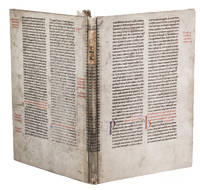
1486ref. 9BDEHOBV62VDWürzburg: Georg Reyser 1486. Later bound in two leaves from a 13th-century vellum theological manuscript rubricated and decorated with alternating red and blue initials with penwork. Folio. Printed in red and black in rotunda type 32 lines; printed area: 18 x 12 cm; type: 112a. With illustrations cut from 19th- or 20th-century reproductions of early woodcuts ca. 21 x 14 cm pasted on the front Annunciation and back pastedown Christophorus with the year "cccc xx tercio". Interesting example of the study of early printing in 19th-century England. The 12 leaves come from the library of the 19th-century collector Dr C. Inglis whose father boasted an impressive collection of early printed books. Inglis believed that the leaves came from an unknown work titled De vita et honestate clericorum ex consilio Moguntinum printed in 1453 by Gerhardus Episcopus. Tipped in is a letter to Inglis by the well-known bibliographer William Blades discussing this matter. Although the text opens with "De Vita et honestate clericorum ex consilio Maguntinensis Gerhardi Archiepiscipi" it was in fact part of Statuta synodalia herbipolensia printed at Würzburg by Georg Reyser in ca. 1486. The first 6 leaves are 2-d7 and the final 6 leaves are quire g.With owner's inscription of Sir Edward Coates bookplate with initials "CC" Clifford Coates the bookplate of Dr. C. Inglis and some annotations on front pastedown; an autograph letter signed by Wiliam Blades to C. Inglis tipped to flyleaf. 12 well-preserved leaves.l Cf. BMC II 572; Goff S-741; Hain 15036; Hubay Inc. Universitätsbibl. Würzburg 1953; ISTC is00741000. Georg Reyser, hardcover
1493[Incunabolo] (cm. 33) mz. pelle d' epoca, 3 nervi e assicelle in legno. Dorso con difetti, un piatto rimesso in epoca successiva.-- carte 310 numerate (di 313) + carte 5 non numerate. Caratteri gotici di differenti grandezze, due colonne, 66 linee. Bei capolettera ornati e figurati grandi e piccoli a fondo nero. Uno particolarmente bello a carta 239. Incunabolo molto bello e importante per il prezioso commento ai quattro vangeli scritto dal 1261 in poi dal grande aquinate, filosofo e dottore ufficiale della chiesa cattolica. L' ultima carta (oo6) contiene il colophon, il registro e la bella marca tipografica a fondo nero dello Scoto per la quale vedi Kristeller n° 281. Incunabolo particolarmente raro. Secondo Goff nessun esemplare in America, manca a Polain, Harvard, Cat. Harper (1930) e al grande Cat. 24 di rosenthal che nel 1900 mette in vendita a Monaco ben 3500 incunaboli. Purtroppo mancano solo 3 carte iniziali numerate 1,3 e 4 con segnatura a1, a3, a4. Le ultime sei hanno lievi macchie e aloni sempre ai margini. Le prime carte presenti, numerate 2,5,6,7,8 sono staccate e difettose, la n° 2 ha un buco con perdita di testo, meritano di essere restaurate. Tutto il resto del volume da carta 9 segnata b1 a carta 313 segnata oo è in esemplare veramente bello nitido fresco e marginoso. Il verso dell' ultima carta è bianco e porta un ex libris manoscritto dell' epoca: "ad usum fratris Raphaelis de Urbino...ipse liber". * Hain 1336; * I.g.i. 9519; * Proctor 5043; * Oates 1669; * Pellechet 909; * Olschki "Monumenta" 891; * Olschki " Inc. Typ." 23; * Walters "Inc. Typ." p. 32; * Bmc V 441.[f80] Libro
1815ref. 3015Vers 1815 1815 Inventaire manuscrit vers 1815 d’une bibliothèque privée sans doute de la région de Limoge.Feuillets de différents formats assemblés en désordre, 18ff« Voici donc en abrégé et par ordre des matières le tableau sommaire en différents genres des ouvrages (…) tels qu’ils sont classés et placés par doubles rangées de chacune des tablettes de ladite grande armoire. »« De main gauche, dixième tablette deuxième rangée de livre mélange de vieilles brochures et imprimés, première rangée sur le fond et l’arrières, vieux ouvrages en parchemin.Deuxième tablette : inventions, secrets et jeux récréatifs, sept volumes en parchemin.« Magasin des modes françaises et anglaises. Plan généalogique de fortifications de guerre (plus loin) collection informe et dévastée (aujourd’hui sans ordre), mais considérable et précieuse en ce qu’elle est composée d’un très grand nombre d’estampes et gravures anciennes et de différents genres de la main d’hommes alors célèbres dans l’école. Les unes et les autres enfermées comme enfouies pèle et mêle sous des cartons multipliés et de différentes grandeurs et formats. "
ref. 3018Naples, 10 mai 1850. Très belle lettre écrite sur un petit bi-folium, agrémenté en marge d’une grande composition à l’or et de trois aquarelles dans le style troubadour : Un personnage en prière devant une église, un ange et une sainte femme (pochoir et aquarelle). Une charmante lettre adressée à sa « chère Grum », le climat de Naples n’est pas clément, « Le Roi a ete bon pour eux il a permis a Adinolphe de porter l’uniforme de Husard de la garde vous pensez sa joie », suivent quelques nouvelles domestiques. Très beau document dans l’esprit néo gothique cher à la Duchesse.