[ELLINGTON (Duke)]Livre Rare Book

4 816 résultats
réf. 29592Plaquette in-8 carré agrafée de 12 p. Programme de la tournée de Duke Elington organisée par Norman Granz en janvier-février 1967. Texte de Godo Remszhardt en anglais et en allemand. Nombreuses photos de Norman Granz. E.O.
1946réf. 8972Bruxelles, Les Editions du Hot Club, 1946. In-8 broché de 63 pages, couverture imprimée en deux tons ornée d'une photographie en noir, dos muet.
1924réf. 47496Dayton OH: The Comer Manufacturing Co. 1924. Tall 8vo. 5.5 x 10.5 in. 36 pp. Numerous illustrations 4 colour plates 4 sepia-tinted plates 64 wool wool blend canvas linen leather cotton and patterned fabrics some treated w/ coating tipped-in occasional offsetting from samples either surrounding the sample or on facing leaves. Dark red printed softcovers decoration & lettering in orange & blue minor soiling some creasing still a VG- copy. First edition of this scarce salesman sample catalogue for men and women’s Jazz Age raincoats and overcoats in the mid-1920s. The company was founded before World War I by Charles E. Comer b. 1887 who quickly established the company as one of the largest manufacturers in Ohio of raincoats. The colour fashion plates are quite striking for the period and offer invaluable historical reference for the styles and weight of raincoats sold during the Flapper Era. Comer produced rubber-lined coats offered deals if you ordered two coats at once and also offered Mackinaws General Purpose coats Rubber rain slickers reversible coats and even waterproof aprons for housewives. This catalogue notes that they had just completed their new 40000 square foot and even offered waterproof luggage and garment bags. They were well known for advertising in labor magazines trade magazines and professional magazines constantly promoting their product and recruiting new salesmen. Worldcat locates only 1 copy Vol. 166. The Comer Manufacturing Co., paperback
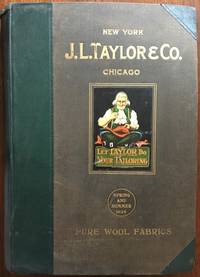
1926réf. 58100New York & Chicago: J.L. Taylor & Co. 1926. Thick elephant folio 17 x 23.25 x 2.5 ins. 75 3 pp. printed on thick card stock each mounted on linen hinge. With 17 colour fashion plates illustrating Taylor styles of the period verso of almost all pages with 364 of 375 mounted textile samples in wool wool-rayon blends some felt backed silk moleskin corduroy cashmere waistband sample and more -- all samples clearly marked with prices and availability some of the 12 missing samples are indicated in pencil as being “Out” as well as a few present 1 additional pinned-in numerous illustrations throughout in blue-green colour tinting including Chicago & New York factories some diagrams charts and graphs. Original half-green cloth over gray green cloth corners gilt lettering on front cover colour plate w/ J.L. Taylor tailor mounted front cover some wear & minor bumping to fore-edges corners some minor soiling & occasional foxing to interior leaves -- some of it dust from the wool samples 10-15 samples with minor deterioration and evidence of old predation still a very good unsophisticated and remarkably complete example w/ original 9 x 21 in. double-sided stock list in red & black laid-in. First edition of this scarce and unusually complete salesman sample catalogue for Jazz era men’s suits in 1928-1929. J.L. Taylor maintained a huge tailoring operation in both Chicago and New York until after World War II employing hundreds of tailors and seamstresses to fill orders. The catalogues were very expensive to produce and so were most often found in department stores mercantiles and men’s stores which would have these catalogues on the sales floor for two years or more. The catalogue offers invaluable illustrated historical reference for the colours styles and fabrics during the era of F. Scott Fitzgerald and the Flappers. Most of the colour fashion plates illustrating the available styles have elegantly dressed women and settings in the background including with an emphasis on sporting in summer so golf tennis croquet canoeing boating and swimming all make an appearance. Of particular interest is the wonderful dress chart indicating styles needed clothes accessories and shoes which one would need for Day Wedding Matinee Reception Evening Dress and many others offering an excellent marketing opportunity for the store to sell the customer items to compliment his suits overcoats and other fashion wear ordered from J.L. Taylor. The final plate focuses on the lightweight “Palm Beach” & “Mohair” suits at the height of the 1920’s boom in Florida featuring snappily dressed models in Panama straw hats and a lightweight fedora. Worldcat locates 1 partial copy Preserved at the Library of Congress stripped of samples and used as scrapbook for Wilbur’s Drug Store prescriptions of Portland ME -- not an unusual occurrence. J.L. Taylor & Co., hardcover
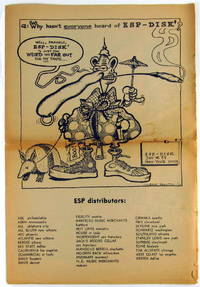
1971réf. 38867NY: ESP Disk 1971. Tabloid format 8 pp. printed on newsprint illustrated with a Gilbert Shelton character on the front. Paper tanned as would be expected with some loss to the folds and edges small light stain to middle front else a very good example. While we've had a few copies of the 1967 catalog and the more uncommon 'Special Complete Catalog" this one is new to us and were not aware of its existence until it threw itself over our transom. Though it originally existed to release Esperanto-based music starting with the release of Albert Ayler's Spiritual Unity ESP became the most important exponent of the burgeoning free jazz music scene of the time releasing records by such future greats as Sun Ra Frank Wright and Sunny Murray among others. Along with free jazz the label also produced music by Ed Sanders' band the Fugs the Lower East Side folk of the Holy Modal Rounders and the primitive proto-noise of the Godz. While never much of a commercial success for the musicians the label's philosophy of "The artists alone decide what you will hear on their ESP-Disk" led to the creation of a musical output that to this day wields a heavy influence. ESP Disk unknown
1971réf. 38867NY: ESP Disk 1971. Tabloid format 8 pp. printed on newsprint illustrated with a Gilbert Shelton character on the front. Paper tanned as would be expected with some loss to the folds and edges small light stain to middle front else a very good example. While we've had a few copies of the 1967 catalog and the more uncommon 'Special Complete Catalog" this one is new to us and were not aware of its existence until it threw itself over our transom. Though it originally existed to release Esperanto-based music starting with the release of Albert Ayler's Spiritual Unity ESP became the most important exponent of the burgeoning free jazz music scene of the time releasing records by such future greats as Sun Ra Frank Wright and Sunny Murray among others. Along with free jazz the label also produced music by Ed Sanders' band the Fugs the Lower East Side folk of the Holy Modal Rounders and the primitive proto-noise of the Godz. While never much of a commercial success for the musicians the label's philosophy of "The artists alone decide what you will hear on their ESP-Disk" led to the creation of a musical output that to this day wields a heavy influence. ESP Disk unknown books
réf. GF14965Dessin original à l'encre de chine sur calque signé - format 13,5 x 10,5 -
1981réf. 5108Messine 1981 In-8 broché. Illustrations en noir. 223 pages. Bon état d’occasion.
in-8 etroit, XL-112 pages, illustrations, broche, couv. Tres bel exemplaire. [MI-9] Textes de Alain Bosquet, Caillois, Cocteau, René Crevel, Pierre Mac Orlan, Jules Romains, Jean Rousselot, etc.
réf. 84869Roosevelt NJ: by the Author c.1956. Quarto 37cm. Printed card portfolio holding twelve lithographic plates loose as issued. All lithographs are signed in plate; Martin has inscribed the portfolio "Jean and Sol Libsohn / David" undated. Very mild external toning and soil; Near Fine. Inside of portfolio is printed with a holiday sentiment and also a brief blurb from Alan Lomax commenting on the illustrations. Scarce portfolio of lithographic prints reproducing Martin's illustrations for Alan Lomax's Mr. Jelly Roll a biography of jazz pianist Jelly Roll Morton published in 1956. Issued without imprint presumably printed as a Christmas gift to friends of the artist. This copy is inscribed to the photographer Sol Libsohn and his wife Jean who were Martin's neighbors in Roosevelt New Jersey a WPA town founded in 1939 which by the Fifties had become a destination for artists writers and musicians seeking refuge from but proximity to the New York art scene. Martin 1913-1992 was a noted mid-century illustrator known best for his many jazz album covers for Folkways and Blue Note in the Fifties and Sixties. Of the present portfolio we locate only a single copy in OCLC Pitt with no other example traced in commerce. unknown
réf. 84869Roosevelt NJ: by the Author c.1956. Quarto 37cm. Printed card portfolio holding twelve lithographic plates loose as issued. All lithographs are signed in plate; Martin has inscribed the portfolio "Jean and Sol Libsohn / David" undated. Very mild external toning and soil; Near Fine. Inside of portfolio is printed with a holiday sentiment and also a brief blurb from Alan Lomax commenting on the illustrations. Scarce portfolio of lithographic prints reproducing Martin's illustrations for Alan Lomax's Mr. Jelly Roll a biography of jazz pianist Jelly Roll Morton published in 1956. Issued without imprint presumably printed as a Christmas gift to friends of the artist. This copy is inscribed to the photographer Sol Libsohn and his wife Jean who were Martin's neighbors in Roosevelt New Jersey a WPA town founded in 1939 which by the Fifties had become a destination for artists writers and musicians seeking refuge from but proximity to the New York art scene. Martin 1913-1992 was a noted mid-century illustrator known best for his many jazz album covers for Folkways and Blue Note in the Fifties and Sixties. Of the present portfolio we locate only a single copy in OCLC Pitt with no other example traced in commerce. unknown books
2008réf. 29212New York:: Oxford University Press 2008. First Printing of the First Edition. A Fine tight unread copy in a Fine bright dust jacket. This volume is a mixture of travelogue detective story and personal narrative tracing the history of Gypsy Jazz from its beginnings with Django Reinhardt in Paris in the 1930s up to the present practitioners capturing the history and culture of this elusive music that has grown in popularity in recent years. Illustrated with historic photographs. Oxford University Press, unknown
1969réf. 81807New York: Macmillan 1969-70. Second and fifth volumes are first printings; remainder are second or later printings. Six octavo volumes. Uniform cloth hardcovers in dustjackets; 255223290246288287pp; illustrated with photographic plates halftones. All in Very Good or better condition in the original dustwrappers; jacket to 4th volume slightly ragged along upper edge else all Very Good or better. An indispensable set compiling reviews interviews profiles and critical articles with reading lists and selected discographies. Macmillan unknown
1969réf. 81807New York: Macmillan 1969-70. Second and fifth volumes are first printings; remainder are second or later printings. Six octavo volumes. Uniform cloth hardcovers in dustjackets; 255223290246288287pp; illustrated with photographic plates halftones. All in Very Good or better condition in the original dustwrappers; jacket to 4th volume slightly ragged along upper edge else all Very Good or better. An indispensable set compiling reviews interviews profiles and critical articles with reading lists and selected discographies. Macmillan unknown books
1938réf. 33168Tokyo: Symphony Publishing Company 1938. Very Good. Tokyo: Symphony Publishing Company 1938. Presumed First Edition. 12mo 15.5 cm; publisher's pictorial yellow and orange card wrappers lettered in black; 1923pp.; brief illus. sheet music throughout. Moderate wear and dust-soiled to wrappers small loss mid-spine briefly affecting text textblock a bit browned and foxed else Very Good bright and sound. Evidently unrecorded Japanese guide to popular jazz music the first half almost entirely in Japanese the latter half bilingual primarily in Japanese and English. Includes the music for classics by Jerome Kern like "Ol' Man River" and "Can't Help Lovin' Dat Man"; Romberg and Hammerstein's "Lover Come Back To Me"; Moises Simons' Cuban rumba foxtrot "The Peanut Vendor"; instantly recognizable classics like "Blue Moon" and "La Cucaracha"; and songs by Mabel Wayne and Irving Berlin. The compilation also includes songs in Spanish French and German accompanied by its Japanese translation. A fascinating and beautiful little guide documenting the rise in popularity of Jazz music in Japan and Tokyo in particular issued between the devastating earthquake of 1923 and the beginning of World War II. The import of Jazz to Japan was first heralded with the rise in trans-Pacific luxury liners. A Japanese version of "My Blue Heaven" reproduced here became available as early as the 1920s and the popular 1929 Japanese film "Tokyo March" employed Jazz in its soundtrack. The genre was popular enough that Columbia and Victor records formed subsidiary companies in Japan. The popularity of jazz in Japan continues to this day touted by one of the country's most prominent public and literary figures Haruki Murakami who first opened his Jazz club right out of college after falling in love with the genre at an Art Blakey and the Jazz Messengers show in Kobe in 1964. No copies of this work located in OCLC as of June 2025. References: "How Japan Came To Love Jazz" online interview with historian E. Taylor Atkins author of "Blue Nippon" "Jazz Messenger" by Haruki Murakami available online. Symphony Publishing Company unknown
1938réf. 33168Tokyo: Symphony Publishing Company 1938. Very Good. Tokyo: Symphony Publishing Company 1938. Presumed First Edition. 12mo 15.5 cm; publisher's pictorial yellow and orange card wrappers lettered in black; 1923pp.; brief illus. sheet music throughout. Moderate wear and dust-soiled to wrappers small loss mid-spine briefly affecting text textblock a bit browned and foxed else Very Good bright and sound. Evidently unrecorded Japanese guide to popular jazz music the first half almost entirely in Japanese the latter half bilingual primarily in Japanese and English. Includes the music for classics by Jerome Kern like "Ol' Man River" and "Can't Help Lovin' Dat Man"; Romberg and Hammerstein's "Lover Come Back To Me"; Moises Simons' Cuban rumba foxtrot "The Peanut Vendor"; instantly recognizable classics like "Blue Moon" and "La Cucaracha"; and songs by Mabel Wayne and Irving Berlin. The compilation also includes songs in Spanish French and German accompanied by its Japanese translation. A fascinating and beautiful little guide documenting the rise in popularity of Jazz music in Japan and Tokyo in particular issued between the devastating earthquake of 1923 and the beginning of World War II. The import of Jazz to Japan was first heralded with the rise in trans-Pacific luxury liners. A Japanese version of "My Blue Heaven" reproduced here became available as early as the 1920s and the popular 1929 Japanese film "Tokyo March" employed Jazz in its soundtrack. The genre was popular enough that Columbia and Victor records formed subsidiary companies in Japan. The popularity of jazz in Japan continues to this day touted by one of the country's most prominent public and literary figures Haruki Murakami who first opened his Jazz club right out of college after falling in love with the genre at an Art Blakey and the Jazz Messengers show in Kobe in 1964. No copies of this work located in OCLC as of June 2025. References: "How Japan Came To Love Jazz" online interview with historian E. Taylor Atkins author of "Blue Nippon" "Jazz Messenger" by Haruki Murakami available online. Symphony Publishing Company unknown books
1926réf. 61473New York: Grosset & Dunlap 1926. 8vo. 350 pp. plus 2 pp. publisher’s ads. Dark-blue publisher’s cloth red lettering & ruling embossed News Service ownership stamp at lower right corner title w/ d.j. vivid cover art of flapper “Joanna” in red by Charles Wrenn minor chip & closed tear to lower fore-edge minor chipping head of spine VG/VG- copy. First Grosset edition this novel was released along with the First National flapper silent film now lost and directed by Edwin Carewe co-wrote screenplay with Lois Zellner and starred Dorothy Mackaill Jack Muluall and Paul Nicholson. Grosset & Dunlap, hardcover
1999réf. 26915University Park:: Penn State Press 1999. First Printing of the First Edition. A Fine tight copy in a Very Good plus dust jacket with light sunning to the spine that is common wtih this title. In Le Tumulte noir Jody Blake focuses on the impacts of African sculpture and African-American music and dance on Parisian popular entertainment and modernist art literature and performance. Blake discusses the reception of ragtime-era and jazz-age entertainment as well as other African visual and performing art forms to provide new ways of understanding the development of modernist primitivism from Matisse and Picasso to Futurism Dada Surrealism and Purism. But the influence of art nÈgre went well beyond the avant-garde art world. Starting with the cakewalk of the 1900s and culminating with the Charleston of the 1920s the book studies the African-American idioms that were involved in larger cultural social and political developments. As an illustration Blake argues that performers such as Josephine Baker and Sidney Bechet of Revue nÈgre fame were thought to affect the political balance between Africa and Europe during the colonial period. Le Tumulte noir is divided into six chronological chapters each a well-researched well-conceived and well-written synthesis of the histories of art literature music and dance. Penn State Press, unknown
1922réf. 53307Beaver Dam WI: Malleable Iron Range Co. 1922-23. Three works in one. Oblong 4to. 38; 3-24; 34 pp. 35-39A leaves 39-66 i.e. 68 pp. 1st -- Colour-illustrated title in gray black orange & light blue printed and illustrated throughout with each black & white illustration of stove w/ orange & gray border; 2nd -- numerous plates in black & white black printed borders text illustrations diagrams; 3rd -- illustrated title numerous plates 5 linen-backed colour-tinted photographs w/ linen hinges text illustrations. Tan softcovers bound w/ two brass screw-posts at upper margin w/ Monarch Malleable range instructions cooking times and thermometer instructions preserved in original printed envelope laid-in minor shelfwear very minor thumbing rubbing still VG copy w/ ownership stamp of J.ohn Y. Hicks b. 1881 Malleable Iron Range sales rep who worked as railroad messenger and then machinist and salesman following World War I. First edition thus of these nicely illustrated salesman sample catalogues of Jazz Age electric stove appliances with electric cook tops insulating blocks an electric appliance plug-in on the side as well as automatic timer and temperature controls. These beautiful stoves could be purchased with enamel finish and as one oven cabinet ranges two oven cabinet ranges one oven square ranges one oven H type cabinet range with built-in kitchen heaters and more. The nicely executed colour-tinted linen-backed photographs showing Malleable stoves provide excellent contemporary visual documentation of the actual colours of the popular stoves folloowing World War I. Malleable Iron Range Company existed from 1896-1985 and at its height after World War I employed over 1200 employees producing a variety of stove and oven appliances which were coal & wood burning electric and gas. No copies located in Worldcat. Malleable Iron Range Co., paperback
1922réf. 51291Chicago: Olson Rug Company 1922. 8vo. 32 pp. Colour-illustrated throughout numerous black & white text illustrations. Colour-illustrated softcovers slight shelfwear NF copy. First edition of this lavishly illustrated and scarce Jazz Age flooring catalogue for the famed Chicago rug manufactuer. Found in 1874 by Walter E. Olson this beautiful catalogue includes a number of interior designs showing the rugs fitted into Arts & Crafts homes and Flapper Era homes with decor window treatments and furnishings. The Olson Rug Company was a pioneering recycling firm detailing how they used old carpets rugs and old clothing to produce velvety rugs which would rival in appearance and wearing high grade Wiltons and Axminsters. The Olson Company is perhaps best remembered for the Olson Park and Waterfall which was a popular local tourist attraction located outside the factory until sold to Marshall Field in 1965 which subsequently plowed the gardens under and created a parking lot. Olson Rug Company, paperback
1925réf. 54342Philadelphia PA: Otto F. Schumann Philadelphia Textile School ca. 1925. Small 4to. 8.25 x 9.2 in. 75 leaves unnumbered including 32 leaves with detailed colour charts on weave formations producing various kinds of cloth 3 tipped-in textile samples together w/ weaving instructions in manuscript. Original limp leather 3-ring binder gilt lettering stamped on front cover ink lettering & association of Otto F. Schumann on front cover some soiling dustsoiling edgewear still VG exemplar. This Jazz Age weaving manuscript notebook complete with weave formation design plates fabric samples and instructions offer a remarkable and invaluable artifact of how a young American textile designer and weaver received training at the famed Philadelphia Textile School now Philadelphia University during the 1920s. These course books were judged on completeness and the aspiring weaver’s skill in presenting the details about the instruction as well as their abilities in running the machinery required to produce the cloth. This manuscript notebook includes Schumann’s detailed plates and notes on producing color effect on the plain weave creating Broken Twills Crowfoot Satins Checked & Figured Broken Twills Entwining Twills Basket Weaves and Broken Satins. The extensive manuscript notes detail the loom instructions how many lines are required composition and more in producing the assorted effects. Because of the poor quality of United States textiles exhibited at the Centennial Exhibition in 1876 the Philadelphia Textile Manufacturers pushed for a formalized vocational school to train weavers designers and textile workers. In 1884 it became part of the Pennsylvania Museum and School of Industrial Art with 81 students enrolled by 1885 and by 1894 the School of Textiles added a Department of Wool Carding & Spinning and a Department of Cloth Finishing and Design. By the 1920s the Philadelphia Textile School was offering extensive three-year textile courses chemistry and dyeing courses as well as design courses in cottons woolens worsteds silks Jacquard design and more. Schumann 1906-1967 was the son of Hugo Schumann founder and owner of the Maid Hosiery Mills in Reading PA through the opening decades of the 20th century for whom he worked with until after World War II as designer and sales executive. Otto F. Schumann, Philadelphia Textile School, hardcover
1925réf. 48049Chicago: Rothschild Brothers 1925. Tall 8vo. 100 pp. Over 100 colour illustrations 100s of black & white text illustrations & photos. Blue & silver printed softcovers elegant design on front cover w/ blue border and simulated silver mirror very minor soiling some shelfwear still VG copy w/ original order form & price change notice tipped-in. First edition of this beautifully illustrated catalogue of Flapper Era toiletry ware including dresser sets in beautiful Bakelite and celluloid cases men’s military sets with varieties of brushes perfume bottles manicure instruments shoe horns jewelry boxes clocks and much more. Rothschild Brothers, paperback
1925réf. 59963Chicago: Olson Rug Company 1925. Oblong 4to. 9.75 x 7.8 in. 2 48 2 pp. Colour-illustrated throughout numerous black & white decorative border illustrations. Colour-illustrated softcovers vivid wraparound Orientalist cover art of scene depicting bedouin camels & tents in the desert seated upon Oriental rugs minor shelfwear slight bumping to couple corners still VG bright copy including order blank in red & black w/ pictorial map on verso of Olson Rug railroad time deliveries. First edition of this lavishly illustrated and scarce Jazz Age flooring catalogue for the famed Chicago rug manufacturer filled with striking Orientalist inspired Persian carpets Middle Eastern Central Asian and East Asian patterns intended to brighten any Craftsman home. Found in 1874 by Walter E. Olson this beautiful catalogue includes a number of interior designs showing the rugs fitted into Arts & Crafts homes and Flapper Era homes with decor window treatments and furnishings. The Olson Rug Company was a pioneering recycling firm detailing how they used old carpets rugs and old clothing to produce velvety rugs which would rival in appearance and wearing high grade Wiltons and Axminsters. The Olson Company is perhaps best remembered for the Olson Park and Waterfall which was a popular local tourist attraction located outside the factory until sold to Marshall Field in 1965 which subsequently plowed the gardens under and created a parking lot. Worldcat locates 1 copy Winterthur. Olson Rug Company, paperback
1930réf. 58329New York: Jacobsen Publishing Co. Inc. 1930. 8vo. 335 5 pp. Tan cloth black Art Deco lettering black ruling uniform interior toning as usual w/ d.j. Art Deco fadeaway cover art of woman in print dress on red background artist initial “H” minor edgewear creasing still VG/VG copy. First American edition of this Flapper Era romance novel set against the backdrop of contrived marriages land swindles and more in the new British suburbs. Wilson 1878-1965 wrote over 30 romance novels following World War I through World War II most under the name “Diana Patrick” and is perhaps best remembered as mother of Romilly Cavan Isabel Wilson who published her debut novel Heron at 21 years old. Jacobsen Publishing Co., Inc., hardcover
1924réf. 53221New York: The Charles William Stores Inc. 1924-1925. Two vols. 4to. 548 8; 518 8 pp. With numerous colour plates colour-tinted text illustrations over 1000 black & white text illustrations diagrams. Colour-illustrated softcovers minor soiling wear slight sunning front cover of vol. 1 creasing to spine; minor creasing shelfwear vol. 2 light uniform interior toning as usual still VG- set. First edition of the complete year of Jazz Age catalogues from the Charles William Stores which offered a treasure trove of everyday fashions work clothes and household and consumer goods during the Roaring 20s offering the glamour and style of New York to the rest of the country. Their fashions were intended for the average American with emphasis on the more “endowed” woman and “stout” man during the Jazz Age emphasizing chic styles and well-woven fabrics. These catalogues detail the high grade work pants riding breeches denim jeans corduroy work pants along with triple-sewed work denim overalls and coats which could be purchased as well as those made out of Wabash Stripe Stifel denim cloth noted for its durability. No copies located in Worldcat of Spring & Summer 1925; 3 copies located of Fall & Winter 1925 Henry Ford Harvard American Textile History Museum. The Charles William Stores, Inc., paperback