[GLUCK, Christoph Willibald 1714-1787]Biblio.com

806 résultats
réf. 40422Paris 19th century. 61 x 47.3 cms with frame 69.5 x 56 cms. The composer is depicted bust-length turned 3/4 left facing forward wearing a red jacket blue waistcoat white collared blouse with lace and wig. For a fine full-page color illustration of the original held at the Louvre see MGG Vol. 5 plate 15. "Gluck was recognized as an extraordinary phenomenon in his lifetime as is evident from Burney's deferential treatment of the composer during his visit to Vienna in 1772. Shortly afterwards the controversy stirred in French journals resonated well beyond the capital to other countries. The daily cultural discourse of Paris concerned Gluck's 'musical revolution' a catch-phrase taken up by Gluck's opponents such as Jean-François Marmontel as well as by his defenders; in 1781 the 'revolution worked in music by M. le Chevalier Gluck' later dubbed the 'German Orpheus' was used as the title of a collection of pamphlets for and against Gluck with a heavy editorial bias in favour Lesure c1984. Although operas by Piccinni Salieri and especially Sacchini as well as French contemporaries such as Grétry continued alongside Gluck in the French repertoire beyond the Revolution and Empire revivals of Gluck constituted the principal touchstone of dramatic music into the 1820s when the last routine revivals were acclaimed by Berlioz. Opera composers including Salieri Lemoyne and Vogel in Paris were presented or presented themselves as his legitimate successors; elsewhere Mozart especially in Idomeneo and J.M. Kraus were strongly affected by Gluck's example in constructing scenes applying a dramatically motivated admixture of lyricism and more direct and declamatory vocal expression and sometimes in modelling as when the statue in Don Giovanni adopts the tone of the oracle in Alceste. After his death his direct effect can still be heard in Die Zauberflöte and in several French operas including those of Méhul Cherubini and Spontini. Among the Romantics he continued to inspire respect and from Berlioz and Wagner emulation. Berlioz supervised productions of Orphée and Alceste in Paris 1859 and 1866. In Orphée Berlioz created the basis for the version most used over the next century at least by restoring the Italian key-scheme in several scenes to accomodate the tessitura of the title role to a female singer; Pauline Viardot was the first in a line to include Giulia Ravoli Kathleen Ferrier Janet Baker and others although the French version with tenor retained some currency. Musicians close to Berlioz began to realize his ideal of a complete critical edition although only a handful of 'reform' operas were published. Wagner wrote about Gluck in Oper und Drama having learned much from deep study of Iphigénie en Aulide of which he made a modernized performing version Dresden 1847. In 1890 for Weimar Richard Strauss similarly adapted Iphigénie en Tauride. Such orchestrational revision and the melding of recitative and aria to blur Gluck's structure of closed forms represented a style of musical archaeology from which Handel and Mozart also suffered or in terms of public exposure benefited. The later 20th century witnessed not only numerous revivals of the reform operas some in musically authentic form and including the Vienna Orfeo but also a less one-sided critical view of Gluck became possible with the publication of a new critical edition and a revival of interest in works in other genres especially opéra comique and with Don Juan ballet. Winton Dean has observed that Gluck's compromise between the demands of words and music 'was one of the most satisfying and successful of all and has placed his greatest works beyond the reach of time' Grove6. None of Gluck's operas except Orfeo/Orphée is likely to become a staple work in the repertory; however to the extent that every production has the aspect of a revival continued interest in his achievement and consequently revival of an increasing proportion of his output is guaranteed so long as opera continues to occupy a central place in Western musical culture." Julian Rushton in Grove Music Online. unknown
1932réf. 93639Anton Schroll & Co. New. 1932. Hardcover. FREE UPGRADE to Courier/Priority Shipping Upon Request - IN STOCK AND IMMEDIATELY AVAILABLE FOR SHIPMENT - Flawless copy brand new pristine never opened -- Text in German. 102 pages; 41 illustrations. Gemälde Gemalde Catalogue Raisonne Catalog Raisonné Complete Works Leben Und Werk Oeuvre-Katalog Kritischem Oeuvrekatalog Raisonnee Anton Schroll & Co. hardcover
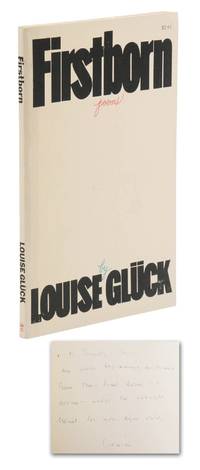
1968réf. 140949674New York: The New American Library 1968. First Paperback Edition. Near Fine. First paperback edition first printing of Louise Gluck's first book. Association copy signed by her on the dedication page inscribed to the poets Sandra McPherson and Henry Carlile the latter's address stamp to first page: " to Sandy Henry My crude beginnings reclaimed From their final home - source - under the suburb. Meant for your eyes only. Louise" iv 53 pp. Bound in publisher's printed white wraps. Near Fine with light wear and soiling to covers slight bump to upper right corner. Very tight binding. A lovely signed copy of the Nobel Prize-winner's first poetry collection which was issued simultaneously in cloth and wrappers. From the estate of Henry Carlile in Portland. The New American Library unknown
1968réf. 185099New York: The New American Library 1968. Her first book of verse inscribed to a poet she esteemed First edition inscribed by the author on the front free endpaper "August 4. For Hugh: Only great fondness could keep my admiration admiration & not envy from Louise". The recipient was the poet Hugh Seidman whom Glück greatly admired. "I know few collections so lacking in complacency so adamant in their refusal to charm or console so fiercely intelligent" she wrote of his Collecting Evidence 1970. "If Seidman has less conspicuous virtuosity than Plath to fix on the obvious contemporary example he has to my mind greater subtlety an inclination to prefer recalcitrant mystery to hallucination". Tall octavo. Original grey cloth spine lettered in dark blue grey endpapers. With dust jacket. Spine slightly sunned stain at foot a few faint marks to contents; jacket unclipped toned a few short closed tears at edges tape repair at head of spine: a very good copy in like jacket. Louise Glück Proofs & Theories: Essays on Poetry 1994. hardcover
1864réf. 404171864. Height 26.75" 68 cms. With the artist's name "Francin" to truncation of left arm; integral base inscribed "Gluck." Some wear and soiling; age-toned. In quite good condition overall. Provenance Catalogue of the Collection Musicale André Meyer 1961 Vol. I p. 97 and plate 122. Auction catalogue of Pescheteau-Badin Godeau et Leroy Collection Musicale André Meyer et a divers Paris July 2 1998 Lot 101 including color photograph. Auction catalogue of Bonhams London The Roy Davids Collection London 3 October 2005 Lot 246 illustrated. Houdon: An Exhibition of Sculpture from the Collection of Michael Hall esq. Catalogue by Christine Defazio Karl Fugelso and Philip Mezzatesta. New York: Salander-O'Reilly Galleries 1998 pp. 12-15. Poulet et al.: Jean-Antoine Houdon - Sculptor of the Enlightenment. Exhibition Catalogue. The National Gallery of Art Washington D.C. 2003 pp. 102-108. Exposition du Centenaire de Houdon Paris: Galleries Buvelot 1928 pp. 40-41. Vitry: Une Liste d'oeuvres de J.-A. Houdon p. 9. The present sculpture exists in two versions: the present scarcer version with full shoulders and partial torso and a second version with partial shoulders and reduced torso "Following Houdon's plaster bust of Gluck shown in the Salon of 1775 . the marble was exhibited in 1777 . and destroyed in the fire at the Paris Opera 28-29 Oct. 1873. A faithful reproduction ordered in 1798 by Alexandre Lenoir for the Musée des monuments français and executed in marble by Guillaume Francin is in the Musée national du chateau de Versailles. The Louvre's plaster cast workshop distributed copies of this reproduction beginning in 1864." Poulet et al.: Jean-Antoine Houdon - Sculptor of the Enlightenment. Exhibition Catalogue. The National Gallery of Art Washington D.C. 2003 p. 107. "The present bust is probably one of the Louvre's copies. . It was in his depiction of Gluck that Houdon first showed the ravages of smallpox on a subject - it was a common affliction in eighteenth-century France but artists were expected to flatter their subjects in this respect at least." Bonhams catalogue "Gluck was an artist a great musician and therefore must be given the attributes of a genius. His face was deeply pockmarked and the sculptor used this fact to establish his theme. He clothed him in a heavy coat whose texture is an overall pattern of slashed grooves free and direct in their expressive impact. Here there was no attempt to stimulate the appearance of the actual material but rather in a manner almost Rodinesque to bring out the quality of the clay. The open shirt the unbuttoned vest the short disheveled hair and the alert titled pose of the head all emphasize the impact of genius." Arnason: The Sculptures of Houdon p. 34. unknown
réf. SBBI-L-BBD00340-RAG-20241Max Hueber Verlag. perfect. Good. Our good condition books are generally good for reading but not for gifting or collecting. They could have imperfections such as creasing fanning inscriptions margin notes yellowing staining on edge or cover or pages bumps scuffs etc etc sometimes multiple of these. It's a wide category that encompasses anything that isn't almost-new down to anything that is slightly better than poor. We would NOT recommend gifting Good books - these should be considered reading copies. Our books are dispatched from a Yorkshire former cotton mill. We list via barcode/ISBN so please note that the images are stock images and may not be the exact copy you receive furthermore the details about edition and year might not be accurate as many publishers reuse the same ISBN for multiple editions and as we simply scan a barcode or enter an ISBN we do not check the validity of the edition data when listing. If you're looking for an exact edition please don't order at least not without checking with us first although we don't always have time to check. We aim to dispatch prompty the service used will depend on order value and book size. We can ship to most countries see our shipping policies. Payment is via Abe only. Max Hueber Verlag unknown