1833 risultati
rif. DADAX0128157925New unknown
rif. DADAX0128172363New unknown
rif. DADAX0128499060New unknown
rif. SONG3642100961Used: Good unknown
2009Fine English Original bdg. Dust wrapper. In special box. Folio. (31 x 23 cm). In English and Turkish. 188 p., richly b/w and color ills. In collaboration with the Ministry of Culture and Tourism of the Republic of Azerbaijan, Dd created an exhibition "The Nobels and Baku Oil" that was displayed at the Baku Museum Centre. The exhibition was dedicated to the 15th anniversary of the Contract of the Century and the 130 years since the Nobel Brothers opened their business in Baku. It told the story of the Nobel Company's accomplishments in Azerbaijan from 1874 to 1920 and its role in the economic, technological and social development of the region. The Nobel brothers - Alfred, Ludvig and Robert - once had with Baku. In fact, when the Nobel Prizes were established more than a century ago (1901), roughly 12 percent of the prize money was drawn from Alfred's shares in the Nobel Brothers' Petroleum Company in Baku. The Petroleum Production Company Nobel Brothers, Limited, or Branobel ("Nobel Brothers" in Russian), was an oil company set up by Ludvig Nobel and Baron Peter von Bilderling. It operated mainly in Baku, Azerbaijan, but also in Cheleken, Turkmenistan. Originally established by Robert Nobel (who contributed 25,000 rubles) and the investments of barons Peter von Bilderling (300,000 rubles) and Standertskjöld (150,000 rubles) as a distillery in 1876, it became, during the late-19th century, one of the largest oil-companies in the world. The Nobel Brothers Petroleum Company was an oil-producing company that had its origins in a distillery, founded by Robert and Ludvig Nobel in Baku in 1876, which, in 1879, turned into a shareholding company headquartered in St. Petersburg. The share capital of three million rubles was divided as follows: 53,7% Ludwig Nobel, 31,0% Baron Peter von Bilderling, 4,7% I.J. Zabelskiv, 3,8% Alfred Nobel, 3,3% Robert Nobel, 1,7% au Baron Alexandre von Bilderling. Pipeline transport was pioneered near Baku by Vladimir Shukhov and the Branobel company in 1878-1880. On 10 April 1902, the company signed a contract for the purchase of oil fields in Romany, which were owned by the oil producer Isabey Hajinsky. On 17 October 1905, in accordance with the Committee of Ministers, the company purchased the oil fields owned by oil producer A. Adamov. The company's fixed capital in 1914-1917 was 30 million rubles. By 1916, it was the largest oil company in Russia, producing 76 million poods of oil. Between 1877 and 1901, the company drilled over 500 wells, produced 150 million barrels of oil, and employed 12,000 workers.
rif. SONG0813026393Used: Good unknown
rif. DADAX0792379063New unknown
1980rif. 225511980. Arabian American Oil Company. Aramco and Its World: Arabia and the Middle East published in 1980 documents the corporate information system through which Aramco interpreted Saudi history Islamic culture petroleum technology and national development for employees and a broader English-language audience. Revised and expanded from the company's earlier handbook series the volume explains how Aramco oriented foreign personnel through a coordinated program of historical narrative cultural instruction industrial diagrams maps and photography. It therefore provides primary-source evidence for the study of petroleum administration expatriate training United States-Saudi relations corporate cultural diplomacy and institutional representations of modernization. Its publication coincided with a decisive transfer of authority: the Saudi government increased its participation interest in Aramco's concession rights production and facilities to 100 percent in 1980 although the Saudi Arabian Oil Company was not formally established to assume Aramco's responsibilities until 1988. Arabian American Oil Company. Aramco and Its World: Arabia and the Middle East. Washington D.C.: Arabian American Oil Company 1980. First edition. Edited by Ismail I. Nawwab Peter C. Speers and Paul F. Hoye with principal research and writing by Paul Lunde and John A. Sabini. Printed in the Netherlands. Profusely illustrated with color photographs maps diagrams and reproductions of Arabic calligraphy. Bound in dark green leatherette with gilt lettering and ruling accompanied by a matching gilt-lettered slipcase. 4to. The preface traces the work to Aramco's postwar need to prepare large numbers of American employees for residence in Saudi Arabia where unfamiliar language and social practices created practical challenges for company operations. A section on Arabic writing reproduces Kufic forms Ottoman tughras zoomorphic designs and ornamental monograms interpreting calligraphy for readers largely unfamiliar with Islamic visual culture. Landscape photographs record the Hijaz escarpments desert dunes Red Sea shallows and Jabal Tuwaiq while a color-coded map titled "The Growth of the Modern Saudi State" charts Ibn Saud's territorial expansion from 1902 to 1932. Industrial sections show offshore rigs desert drilling sites workers handling drilling equipment refineries shipping installations and petrochemical facilities. A gas-operations diagram traces ethane propane butane and natural-gasoline flows between processing plants and the industrial centers of Yanbu Ju'aymah Ras Tanura and Jubail demonstrating how extraction separation transportation export and industrial development operated as an integrated petroleum system. The volume's substantial documentary content is shaped throughout by Aramco's institutional perspective. Its industrial photography and diagrams preserve detailed evidence of drilling gas processing refining shipping and infrastructure expansion while its historical and cultural sections position the company as a mediator between Saudi Arabia and the industrialized West. The book acknowledges the need to explain Saudi society to foreign employees but gives less emphasis to the contemporary transfer of petroleum ownership to the Saudi state preserving the language and visual conventions of an earlier American corporate order even as that order was being restructured. Official Aramco histories confirm that Saudi participation reached 100 percent in 1980 making the volume especially valuable as a corporate publication issued at the boundary between American consortium control and full Saudi ownership. Minimal handling wear affects the volume and slipcase with no significant defects reported; binding and contents remain clean and sound. Fine. A richly illustrated record of the technical cultural and administrative knowledge Aramco used to explain its operations and institutional authority during a pivotal year in Saudi petroleum history. unknown
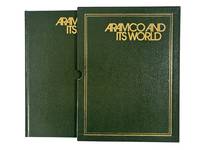
1980rif. 225511980. Arabian American Oil Company. Aramco and Its World: Arabia and the Middle East published in 1980 documents the corporate information system through which Aramco interpreted Saudi history Islamic culture petroleum technology and national development for employees and a broader English-language audience. Revised and expanded from the company's earlier handbook series the volume explains how Aramco oriented foreign personnel through a coordinated program of historical narrative cultural instruction industrial diagrams maps and photography. It therefore provides primary-source evidence for the study of petroleum administration expatriate training United States-Saudi relations corporate cultural diplomacy and institutional representations of modernization. Its publication coincided with a decisive transfer of authority: the Saudi government increased its participation interest in Aramco's concession rights production and facilities to 100 percent in 1980 although the Saudi Arabian Oil Company was not formally established to assume Aramco's responsibilities until 1988. Arabian American Oil Company. Aramco and Its World: Arabia and the Middle East. Washington D.C.: Arabian American Oil Company 1980. First edition. Edited by Ismail I. Nawwab Peter C. Speers and Paul F. Hoye with principal research and writing by Paul Lunde and John A. Sabini. Printed in the Netherlands. Profusely illustrated with color photographs maps diagrams and reproductions of Arabic calligraphy. Bound in dark green leatherette with gilt lettering and ruling accompanied by a matching gilt-lettered slipcase. 4to. The preface traces the work to Aramco's postwar need to prepare large numbers of American employees for residence in Saudi Arabia where unfamiliar language and social practices created practical challenges for company operations. A section on Arabic writing reproduces Kufic forms Ottoman tughras zoomorphic designs and ornamental monograms interpreting calligraphy for readers largely unfamiliar with Islamic visual culture. Landscape photographs record the Hijaz escarpments desert dunes Red Sea shallows and Jabal Tuwaiq while a color-coded map titled "The Growth of the Modern Saudi State" charts Ibn Saud's territorial expansion from 1902 to 1932. Industrial sections show offshore rigs desert drilling sites workers handling drilling equipment refineries shipping installations and petrochemical facilities. A gas-operations diagram traces ethane propane butane and natural-gasoline flows between processing plants and the industrial centers of Yanbu Ju'aymah Ras Tanura and Jubail demonstrating how extraction separation transportation export and industrial development operated as an integrated petroleum system. The volume's substantial documentary content is shaped throughout by Aramco's institutional perspective. Its industrial photography and diagrams preserve detailed evidence of drilling gas processing refining shipping and infrastructure expansion while its historical and cultural sections position the company as a mediator between Saudi Arabia and the industrialized West. The book acknowledges the need to explain Saudi society to foreign employees but gives less emphasis to the contemporary transfer of petroleum ownership to the Saudi state preserving the language and visual conventions of an earlier American corporate order even as that order was being restructured. Official Aramco histories confirm that Saudi participation reached 100 percent in 1980 making the volume especially valuable as a corporate publication issued at the boundary between American consortium control and full Saudi ownership. Minimal handling wear affects the volume and slipcase with no significant defects reported; binding and contents remain clean and sound. Fine. A richly illustrated record of the technical cultural and administrative knowledge Aramco used to explain its operations and institutional authority during a pivotal year in Saudi petroleum history. unknown books
rif. A9780128140017Paperback / softback. New. paperback
rif. DADAX0367350874New unknown
rif. DADAX0415464846New unknown
1845rif. fremont1845houseFirst House edition of this famous report. 1845. Complete in original binding except for the gigantic map which is available in full size color thick glossy paper professional reproduction $25 extra if desired. Pagination: 583 pages 22 plates 4 maps all blanks present. Includes fascinating pencil diagram of oil rig on back of map. Oil rig drawing titled "Sheffield Oil Company. Warren Co. Pa." That pencil drawing is the only interior writing or ownership marking anywhere in the book. Condition is a mixed bag. Original half leather marbled boards show heavy wear and looks like they were professionally rehinged in the distant past. Binding is sound. Pages show moderate to heavy toning and foxing. Some plates have weird 'dot' foxing I have never seen elsewhere see scan. Marbled endpapers. A nice well maintained copy suitable for reading and research with a cool drawing. Howes F372; Wagner-Camp 115:2; Graff 1436. House Doc. No. 166. Feel free to inquire. Please see scans of the book you will receive. Note: the large map published in 1845 was the road map people used in the gold rush of 1849. It was routinely extracted hence its rare nature. Map is 52 x 32 inches. Furthermore I do not believe map was issued with all House editions which contributes even more to its scarcity. Map is sufficiently large that if it had ever been present there would be evidence of removal. No evidence it was ever in this volume. House of Representatives. Blair and Rives. hardcover
rif. SONG1787423980Used: Good unknown
rif. 115991sd Publié par V. F. Aromatique et Arco, Charabot - Sans date - Grand in-folio, feuillets sous pochette cartonnée verte dans un coffret de l'éditeur - 16 pages + 16 planches de reproductions photographiques en couleurs + 1 carte en N&B - Envoi (dédicace) de William Pécout en première page
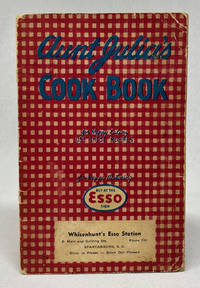
1940rif. 10977no place: ESSO / Standard Oil Company 1940. Staplebound. Fair-good. Octavo 32pp. illustrated. A fair to good copy in the publisher's stapled wraps. Page block while intact is separated from the wrappers and laid in. Some stains juvenile pencil writing and chips and short tears to extremities but a complete readable copy. A volume of recipes purportedly by "Aunt Julia" an "Aunt Jemima"-style stereotype of a Black female cook this volume was almost certainly written or compiled by white staff of the Standard Oil Company. A ehite box on the front wrap contains the details of Wisenhunt's Esso Station in Spartanburg South Carolina. Likely these kinds of cook books were sold at various Esso stations throughout the American south and elsewhere. Though probably produced in large numbers we located just a handful of separately listed holdings in OCLC. Though undated there are a few advertising images of automobiles whhich were cetainly produced before World War II. Uncommon. [ESSO / Standard Oil Company] unknown
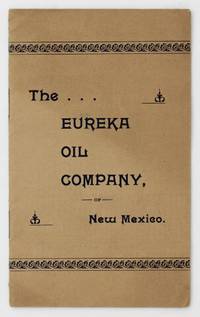
1901rif. 4229N.p. 1901. About very good. 12pp. Original printed wrappers stapled. Minor edge wear. Light toning and dust soiling. Scarce promotional for this early 20th-century New Mexico oil venture. The text contains an amusing if dangerous sounding origin story for the company in which the founding officer ignites a brook covered in a "peculiar scum" and spooks his horse. The remainder of the text contains the usual inducements to invest including various descriptions statistics analyses and endorsements. The first commercial well in New Mexico was drilled in the early twenties and we find little additional information on the Eureka Oil Company. One other copy located at SMU. unknown
1901rif. 4229N.p. 1901. About very good. 12pp. Original printed wrappers stapled. Minor edge wear. Light toning and dust soiling. Scarce promotional for this early 20th-century New Mexico oil venture. The text contains an amusing if dangerous sounding origin story for the company in which the founding officer ignites a brook covered in a "peculiar scum" and spooks his horse. The remainder of the text contains the usual inducements to invest including various descriptions statistics analyses and endorsements. The first commercial well in New Mexico was drilled in the early twenties and we find little additional information on the Eureka Oil Company. One other copy located at SMU. unknown books
rif. DADAX1535261528New unknown
rif. DADAX0415637546New unknown
rif. DADAX0367254409New unknown
rif. DADAX1904931286New unknown
1928rif. 785DG1928. Farbige Ölkreidezeichnung. 25 x 18 cm.
1931rif. 793DG(1931?) Ölgemälde auf Spanplatte, unten rechts monogrammiert. 51 x 37 cm.
rif. DADAX1578050464New unknown