9,307 results
1903ref. 60341Flint & Detroit MI: General Motors 1903-1938. Twelve vols. Oblong folio. 19 x 12.5 x approx. 2-3 in. per vol. 30 linear inches. 251; 278; 228; 84; 233; 312; 264; 140; 158; 160; 208; 212 leaves 11 of 12 vols. unnumbered. all silver gelatin Photostatic photo print positives on inconsistent quality papers either due to processing or washing process after being shot with the Rectigraph camera reproducing through a prism an image some w/ borders all featuring nine 4 x 6 in. data cards on recto of each leaf all identified w/in the original images some from photographs containing well over 20000 illustrations diagrams photographs and technical details roughness to some of the fore-edges photo textblock not cut or trimmed to size so rough cut at fore-edges occasional lifting from old wicking at fore-edges faint tidemark to lower fore-edges of a couple volumes. Uniformly bound in three-quarter maroon-coloured calf over black pebbled cloth on beveled boards Broun-Green Co. Safety Minute Book McMillan Patented post-binders with three metal posts and ring locking mechanism all leaves perforated at gutter margin for loading into the binders decorated endpapers thumb tabs at fore-edges demarcating the front of the binder gilt lettered title stamped on front covers of all some scuffing edgewear couple hinges starting or weakened occasional scuffing to back covers or to spines former owner’s labels attached to spines of a couple vols. still a VG set originally acquired by a collector when most of Harrah’s automobiles and other material were auctioned off in three separate sales in the mid-1980’s after efforts to preserve the collection failed following the acquisition of Harrah’s casino and hotel empire by Holiday Inns with their ownership stamps on flyleaves. Since Harrah mechanics had to maintain a fleet of over 1425 automobiles many of them exceedingly rare early Brass Era and foreign models these volumes provided invaluable mechanical details. This immense and unique reference set reproduces over 22000 well-illustrated index research cards on 2525 leaves prepared by General Motors for their engineering and technical staff tracking and recording the myriad of manufacturers and suppliers for automobiles trucks aircraft and marine craft from the Brass Era through the Great Depression. These prepared by the GM in-house technical periodical “Motor Vehicle Digest” provide essential visual and technical historical data for the development patent history engineering inventions of most of the major and minor national and international automobile manufacturers and parts suppliers for over three decades prior to World War II. Basically serving as the automotive industry’s equivalent of the National Union Catalogue or Acta Sanctorum these gigantic volumes trace the origins mechanical development devices and equipment on 1000’s of different manufacturers most having been lost now to the passage of time and the many shake-ups during the 20th Century. Not only do they serve as original reference from contemporary technical journals in German French Italian Norwegian Dutch and Danish all neatly translated into English but also offer a means to visually trace the development of the automobile. The four “Engine Parts” volumes include extensive sections on magnetos gasoline pumps accessory drive chains camshaft gears water pumps pistons crank shafts water pumps fuel systems fuel gauges carburetors throttle controls air filters fuel injection and even the 1937 introduction of the Down Draft Carburetor. Of notable interest is the extensive section on radiator badges or mascots and Motometer ornaments for the radiators including winged Gods & Goddesses animals and grille ornaments. The myriad of manufacturers represented is dizzying ranging from Mercedes to Packard Bugatti to Lejeuene Wolsely to Zenith with Napier Thornycroft Solex Rateau Mercedes Rickenbacker Stromberg & Locomobile thrown in. Electrical systems transmissions gears steering systems suspension shocks and more are all minutely detailed. The “Roadwheels” volume encompasses a wide range of companies and developments attempting to deal with the rough roads prior to the Good Roads Movement including spring types with internal springs against the axle tension types compression types and those specifically developed for electric vehicles and companies building electric motors for each wheel hub. The two “Internal Combustion Engines” volumes encompass not only 4-cylinder and 6-cylinder engines for automobiles but also diesel or modified engines stationery engines submarine diesel engines ocean liner and locomotive engines rotary engines for aircraft and marine applications two-cycle or two-stroke engines developed for early motorcycles and motorcycle cars and even the innovative sleeve valve motors from Willys-Knight. Engine manufacturers range from Delahaye to Bentley Buda to Humboldt-Deutz along with Mianus Alpha Northill out of Los Angeles California Coventry-Victor Tuxham Plenty & Son and Brooke. The “Final Drives or Transmissions” volume examines drive axles front brakes and other systems for Tatra Bugatti Benze & Lorelei while “Electrical Systems & Parts” details nearly 35 years of spark plug priming plug and ignition apparatus from early Brass Era and efforts of Champion Milla Strumpell Helwig Mosler and others. Interestingly the volumes focus primarily on GM competitors inventions technology & development and much of the data drawn from often obscure contemporary automakers’ journals would have proven invaluable especially as before the internet global searches and other digital reference guides there would have been nearly no comparable cross-reference to foreign technology. Lord 1858-1929 was a Princeton alumni having graduated 1879 worked in cattle ranches and gold mining in Arizona spent several years as an insurance broker in New York and Spain worked for the US Secret Service and served during the Spanish-American War in the Army Commissary Dept. in Cuba. After working in advertising and newspapers in Seattle and assistant to the Univ. of Washington he was contracted by General Motors to oversee and compile their in-house “Motor Vehicle Digest” until his death. The GM MVD should not be confused with the many different “Motor Vehicle Digest” laws and subject volumes issued by various states in the first half of the 20th Century and the only extant set of the original in-house printed journal NOT these unique volumes is recorded at the General Motors Institute Collection in Flint MI. The Rectigraph Co. was bought out by Haloid in 1937 and later became Haloid-Xerox in 1958 and their process was also used by Photoclerk and Dexigraph of Remington Rand. These still offer essential technical reference as frequently many of the magazines in the collection have never been digitized for use or are largely unavailable other than through in-person visit to special collections libraries or museum references. No copies located in Worldcat the GM Institute or Henry Ford; See: George P. Hanley The Collection of Industrial History The Society of Automotive Historians Newsletter Issue No. 63 June 1979 pp. 3-5; Frank Howard Lord Obituary The Princeton Alumni Weekly Vol. XXX No. 1 1929 pp. 40-43. General Motors, hardcover
1995ref. 2091202133204358Omatsu-do 1995. Soft Cover. Fine. Number of books: 38 books in total Omatsu-do paperback
1928ref. ABC_50475Iran 1928. Oblong album 24.5 x 29.6 cm. Mid-19th-century bright blue faux-leather the front board features a pictorial on-lay within a rectangular frame the illustration depicts a young woman in traditional costume holding a large ceramic vessel. The joints are laced through onto 2 supports. With 19 black and white photographs ca. 23.1 x 17.1 cm on thick dark blue/black paper. 9 ll. Collection of 19 engineering photographs taken in Iran dating from ca. 1928 to 1930 CE. The majority of the images are annotated with the year 1308 AH 1929-1930 CE while only photograph 7 is dated 1307 AH 1928-1929 CE.The album documents large-scale engineering works and urban modernisation in Iran during the early years of the Pahlavi dynasty 1925-1941 under Reza Shah Pahlavi 1878-1944. In this period cities such as Tabriz underwent significant restructuring and infrastructural development as part of broader state-led reforms.The photographs depict surveying activities including measuring instruments mounted on tripods uniformed officials and extensive reconstruction works. Several photographs are identifiable as views of Tabriz including the development of the Gaji Gate Darb-e Gajil in December 1929 Ahrap Ahrab Street and Munjam Street under construction. Other views show street levelling and widening works illustrating the transformation of older urban quarters into broader modern thoroughfares.Further noteworthy subjects include railway works and one photograph taken in Jafarabad shows several men wearing a combination of traditional clothing including papakha-style headgear and Western clothing reflecting the broader cultural transition of the period. The present work therefore stands as an informative visual record of early 20th-century Iranian engineering urban renewal and state modernisation.With some glue staining to the dark blue paper on several pages. A few photographs show minor marginal wear not affecting the images themselves. The final photograph is not mounted on the album paper but on a separate piece of card and is loosely inserted. Otherwise in good condition.l Cf. Tofigh Kouzehkanani & Zelef "Towards extroverted urbanism: Haussmannization and building a new urban identity in Tabriz 1925-1942" ITU AZ 22 3 2025 pp. 559-577 ART ARCHITECTURE & PHOTOGRAPHY MIDDLE EAST & ISLAMIC WORLD SCIENCE & TECHNOLOGY City Plans Topography & Views Iran / Persia Photography Technology hardcover
1866ref. 010620London: Office for Advertisments and Publications 1866. A near complete run from 1866 to 1994. 231 volumes. Lacking July-Decenber 1948 & January-June 1949. Books measure 36x26.5 last 31 volumes measure 30x21.5. Illustrated throughout. Most volume bound in modern black cloth with gilt lettering others bound in quarter calf. The calf volumes are faded on spines. Generally all bindings in very good clean firm condition. Internally very occasional library mark stamp. Pages and illustrations in very good clean condition. . Cloth. Very Good. Small Folio. Office for Advertisments and Publications Hardcover

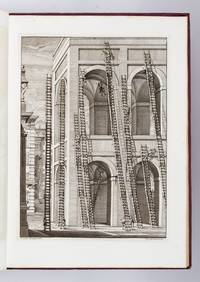
1824ref. ST19673Rome: Crispino Puccinelli 1824. Second Edition with the Addition of Later Machines and Premises. 520 x 370 mm. 20 1/2 x 14 1/2". 4 p.l. XXIX 1 46; 4 48 pp. Two volumes bound in one. Edited and with notes on the life and work of Zabaglia by Filippo Maria Renazzi. SPLENDID CONTEMPORARY RED MOROCCO VERY ATTRACTIVELY GILT covers with frames formed by thick and thin gilt rules filled with alternating fleuron tools above an undulating ribbon roll central panel framed by multiple gilt rules connecting ornate floral corner- and sidepieces flat spine divided into panels by multiple plain and decorative rules these panels with rectangular centerpiece composed of volutes arabesques and floral tools marbled endpapers. Engraved portrait of Zabaglia by Girolamo Rossi after a drawing by Pietro Leone Ghezzi engraved vignettes on both title-pages and 62 FINE ENGRAVED PLATES 10 OF THEM FOLDING after designs by Francesco Rostagni. Berlin Katalog 2755; Brunet V 1515 ; Graesse VII 501; Cicognara 968 all citing the first edition. Trivial signs of use to the binding and contents with insignificant imperfections only: AN EXCEPTIONALLY FINE COPY the attractive binding lustrous and virtually unworn and THE PLATES REMARKABLY CLEAN FRESH AND BRIGHT with especially ample margins. This is a remarkably beautiful copy inside and out of the second enlarged edition of a fundamental work for the history of engineering and the construction of buildings expanding the original 1743 edition for educational use with text in academically appropriate Latin in addition to the original Italian. Niccola or Nicolò Zabaglia 1667-1750 began working as a day laborer on the construction of St. Peter's Basilica in 1686 and was employed full time on the project by 1691. According to Dizionario Biografico degli Italiani "by 1696 he was able to demonstrate his ability as a mechanic moving the large porphyry cup and the bronze statues placed in the Vatican baptistery." Although illiterate he was an ingenious practical engineer. DBI notes that "the preparation of scaffolding and exceptional castles and the transport of extraordinary weights" were his strongest skills. For the Vatican he organized the removal transportation and installation of several obelisks at St. Peter's and other churches figured out a way to move a large marble altar and prepared the scaffolding needed to construct maintain or restore areas of St. Peter's. He was involved in strengthening its famed dome after the earthquakes of 1703 and 1730 inventing the necessary machines to do the work and training the construction crew. This volume's splendid oversized engravings illustrate the machinery and instruments used for the restoration of the dome—elaborate hoisting devices construction tools pulleys scaffolding ornamental tiles etc.—as well as the craftsmen at work. The transportation of the Vatican obelisk by Domenico Fontana in 1590 is represented by a fine selection of plates from Carlo Fontana's work on St. Peter's "Templum Vaticanum" published in 1694 and derived from Domenico's original "Delle transportazione dell'obelisco Vaticano". This undertaking may be compared with the plates depicting Zabaglia's methods for transporting and erecting obelisks. The greatest honor conferred on the unofficial "Engineer of the Vatican" in his lifetime was the first edition of this work published at Rome by Niccolò & Marco Pagliarini in 1743 with a total of 55 plates. The present second edition is enlarged with a biography of Zabaglia written by jurist Filippo Maria Renazzi 1742-1808 and with eight more plates which are among the very best and largest in the book; it is less commonly encountered than the first edition. This may be due to the fact that if put to the intended use in educational settings copies of the 1824 edition would have seen far more wear and tear than the earlier printing. Crispino Puccinelli unknown
1911ref. 14938Chatham: School of Military Engineering May 1911. 765 by 1075mm. 30 by 42.25 inches. Colour lithographed map 40-section canvas-backed folding map at a scale of one inch to one mile This map of Hong Kong and the New Territories is one of the earliest maps to show the topography of Lantau Island and adjacent islands in detail. Hills are shown with contours and hachure shading with heights given in feet and villages are named. Cheung Chau called "Chung Island" is detailed but Lamma appears to have been only partially surveyed. The "Mouth of the Canton or Pearl River" runs along the left margin. Mountains of interest include Lin tau Lantau Peak at 3064 feet Victoria Peak at 1774 feet Ma On Shan at 2261 feet and Tai Mo Shan at 3130 feet. Part of the new single-track Kowloon Canton Railway which opened in 1910 is depicted between Tsim Sha Tsui and Sham Chun Sum Chun. This map is an early example of the topographical maps of areas of British political and commercial interest compiled by the Geographical Section General Staff of the War Office throughout the twentieth century. School of Military Engineering, unknown
ref. 000150126 × 59 cm. Paper mounted on thick cloth. Text in Ottoman Turkish printed in a European-style typeface. Depicting the northern Ottoman territories extending from the Caspian Sea to the eastern regions of Austria. An early wall map printed under Ottoman authority in Üsküdar Scutari. the Imperial engineering ground forces, Muhendishane