12.783 Ergebnisse
Best.-Nr. SONG0521070171Used: Good unknown
Best.-Nr. SONG056608662XUsed: Good unknown
Best.-Nr. SONG0521893348Used: Good unknown
Best.-Nr. SONG0309033985Used: Good unknown
Best.-Nr. SONG0415052173Used: Good unknown
Best.-Nr. SONG087912170XUsed: Good unknown
Best.-Nr. SONG0070211760Used: Good unknown
Best.-Nr. SONG0865542899Used: Good unknown
Best.-Nr. SONG090358509XUsed: Good unknown
Best.-Nr. SONG0566086956Used: Good unknown
Best.-Nr. DADAX0190267445New unknown
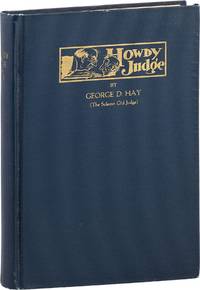
1926Best.-Nr. 80739Nashville: The McQuiddy Press 1926. First Edition. First printing. Inscribed on front endpaper: "To Nettie Spielman / with best wishes from / Geo. D. Hay "Solemn Old Judge" dated 1933. Tight Near Fine copy lacking the dustwrapper. Hay 1895-1968 started his career in print journalism but made his name as a radio personality primarily in Nashville where he was the originator and long-time Master of Ceremonies of the Grand Ole Opry program on WSM from which the venerable live stage variety show at the Ryman Auditorium drew its name. Between musical acts Hay would intersperse comic interludes in the character of "The Solemn Old Judge" a character he had first invented for his column "Howdy Judge" in the Memphis Commercial Appeal. These columns are reproduced here; they are mostly in the form of racist caricature very much drawn from the minstrel show tradition the typical premise being an African-American character appearing in court before a white judge with much white-supremacist hilarity to follow the Black voices written in exaggerated dialect. Hay adapted his "Solemn Old Judge" persona to radio along the way establishing the basic character of the popular American "hillbilly" music industry - white southern and racially segregated - that placed country music in direct opposition to the race-mixing socially "degenerate" music of the northern cities especially New York. In the words of sociologist Richard Peterson: "The down home rural card was a good card to play.because there was such fear of what was happening in the cities. There was so much race mixing there was so much jazz there was all kinds of degradation in music. Here was a way of finding a pure unadulterated American music that came out of an Anglo-Saxon background. They Hay and the Grand Ole Opry made up a whole bunch of stuff." quoted in American Public Media "New York Clashes With the Heartland" audio documentary. An historically important book despite its racially offensive underpinnings somewhat scarce and seldom found signed. The McQuiddy Press unknown
Best.-Nr. ANAIS-0898520649Tappi Pr. hardcover. Good. 6.5x0.8x9.5. Buy with confidence. Excellent Customer Service & Return policy. Tappi Pr hardcover
Best.-Nr. ANAIS-0025284703Macmillan Pub Co. hardcover. Good. 0x0x0. Buy with confidence. Excellent Customer Service & Return policy. Macmillan Pub Co hardcover
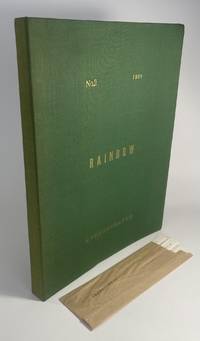
1969Best.-Nr. 262Ojiya Japan: Ojiya Textile Industry Association 1969. 10.75" x 14" pp. 12 bound concertina-style in green cloth boards with gold stamping. 5 fabric swatches are included on each page making 60 samples presented in a "rainbow" style. Labels are applied on a few pages; included are the other labels that are inserted into the pages in their own brown paper bag presumably for adhering to the sample book. Very good; samples have some fraying but bright and lively. Boards have slight color fading but maintain a lively kelly green. Sample book was likely used for Japanese children's clothing or school uniforms. . Ojiya Textile Industry Association unknown
Best.-Nr. DADAX0415727839New unknown
Best.-Nr. DADAX0231159056New unknown
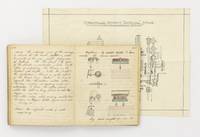
1886Best.-Nr. 142150Lancashire: unpublished 1886. First Edition. Hardcover. Very Good. Lancashire unpublished 1886. Small quarto 245 pages of a 288-page notebook with numerous manuscript diagrams one coloured. Quarter roan and sand-grain cloth; covers rubbed and a little worn about the spine with slight loss; traces of childish scribbling in pencil to the front endpaper; a few signs of age and handling with a small hole in one leaf; overall in excellent condition. The neatly-written notes and well-executed drawings appear to relate to a technical education course covering cotton processing with particular emphasis on the types and configurations of machines for ginning carding spinning and weaving cotton. More broadly subjects include the planting picking pests and diseases of the cotton plant the characteristics of different kinds of cotton recipes for size and the assessment of cloth. The latter part of the notebook includes questions from examination papers and what are perhaps model answers. The front pastedown is inscribed 'Joseph A. Prescott June 7th 1886' father of South Australian soil scientist and climatologist James Arthur Prescott CBE. A biographical memoir of the latter includes some scanty but pertinent details about his father: 'Joseph Prescott began adult life as a fitter of textile machinery at the site of installation. This work took him to Italy Alsace then part of Germany and northern France. His special line of expertise was in machinery for fine spinning the comber and spinning mule. He rose from fitter to maintenance engineer to foreman and to manager in charge of development' see below for source. This notebook must date from near the beginning of his career. Offered together with a copy of 'James Arthur Prescott 1890-1987' by C.G. Stephens and J.P. Quirk an offprint from the 'Biological Memoirs of Fellows of the Royal Society' Volume 34 1988 and two later related ephemeral items. unpublished] hardcover
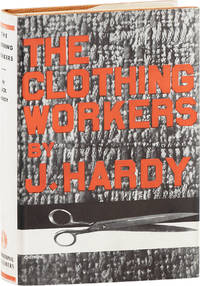
1935Best.-Nr. 81892New York: International Publishers 1935. First Edition. Octavo 20cm. Orange cloth boards lettered in black; dustjacket; 256pp. Tight Near Fine copy in a very bright crisp dustwrapper - minutely chipped along bottom edge else close to Fine and most uncommon thus. An entirely pro-Communist account of unionization in the ILGWU and the Furrier's Union with the expected attacks upon the "reactionary" policies of the Socialist and AFL factions. Dale Zysman is identified in Bella Todd's autobiography as a Vice-President in the Teacher's Union widely referred to as the "Stalin of the Union" for his habit of holding his pipe at precisely the same angle as appeared in Stalin's official portraits. SEIDMAN H54. International Publishers unknown
Best.-Nr. SONG0737757442Used: Good unknown
Best.-Nr. DADAX1785043765New unknown
Best.-Nr. DADAX0859898903New unknown
Best.-Nr. SONG1501339001Used: Good unknown
Best.-Nr. DADAX3640445511New unknown
Best.-Nr. DADAX3639308417New unknown