1875réf. 33711Somverville MA 1875. Broadside 5" x 10". A few old folds. Signed in type by A.T. Small Jas. E. Crawford Able Jones Sarah J. Price and J. Campbell as the Committee on Charges. Official Council blindstamp at the bottom right corner. Very Good. The Sovereigns of Industry established in 1874 grew out of the Patrons of Husbandry a mutual aid society for farmers. The Sovereigns sought members among all workingmen not just farmers. Its purpose articulated by its founder William H. Earle of Massachusetts was "elevating the character improving the condition of and as far as possible perfecting the happiness of the laboring classes" through the establishment of consumer cooperatives. The cooperative network would allow workers to "control the whole of what they produce and exchange it as near as may be even with other hand-workers thus saving to themselves the fortunes which those who are devoted to manipulating other people's labour and to getting rich thereby have heretofore taken by extortion." Commons John R. et al.: HISTORY OF LABOUR IN THE UNITED STATES: NATIONALISATION 1860-1877 VOLUME II New York: 1921 Pages 172-173. A scandal occurred in Union Council No. 71 Somerville Massachusetts. A conspiracy to usurp the authority of the Council majority on the location of a new Hall was charged. The conspirators allegedly were guilty of self-dealing by choosing a Hall for their own personal gain. "Riotous disorderly and disgraceful proceedings" erupted. Not located on OCLC as of May 2017. unknown books
1875réf. 33711Somverville MA 1875. Broadside 5" x 10". A few old folds. Signed in type by A.T. Small Jas. E. Crawford Able Jones Sarah J. Price and J. Campbell as the Committee on Charges. Official Council blindstamp at the bottom right corner. Very Good. The Sovereigns of Industry established in 1874 grew out of the Patrons of Husbandry a mutual aid society for farmers. The Sovereigns sought members among all workingmen not just farmers. Its purpose articulated by its founder William H. Earle of Massachusetts was "elevating the character improving the condition of and as far as possible perfecting the happiness of the laboring classes" through the establishment of consumer cooperatives. The cooperative network would allow workers to "control the whole of what they produce and exchange it as near as may be even with other hand-workers thus saving to themselves the fortunes which those who are devoted to manipulating other people's labour and to getting rich thereby have heretofore taken by extortion." Commons John R. et al.: HISTORY OF LABOUR IN THE UNITED STATES: NATIONALISATION 1860-1877 VOLUME II New York: 1921 Pages 172-173. A scandal occurred in Union Council No. 71 Somerville Massachusetts. A conspiracy to usurp the authority of the Council majority on the location of a new Hall was charged. The conspirators allegedly were guilty of self-dealing by choosing a Hall for their own personal gain. "Riotous disorderly and disgraceful proceedings" erupted. Not located on OCLC as of May 2017. unknown
1947réf. LFA-126715337Un ouvrage de 533 pages, format 165 x 255 mm, illustré, broché, publié en 1947, bon état
1875réf. 728751875 Lyon, Pitrat, 1875, grand in 8° broché, VII-233 pages ; non coupé.
1894réf. 826581894 Lyon, Mougin-Rusand, 1894, grand in 8° broché, VIII-149 pages ; cachet-ex-libris ; couverture rempliée (traces de renfort au dos).
réf. 72876Lyon, Rey, 1894, grand in 8° broché, 173 pages ; dos renforcé au ruban adhésif.
1873réf. 754161873 Lyon, Papeterie Chavent, 1873, in 12 relié pleine percaline de l'éditeur, 99 pages ; un cahier est relié à l'envers. BEL EXEMPLAIRE.
1870réf. 279011870. Very good condition. An early albumen photograph of two young women working a loom and spinning wheel in the silk industry. Hand color of detail on the women's kimono. 13 x 9 1/2" in a 14 x 12" mat. unknown
1723réf. 13086Paris La veuve et M. G. Jouvenel 1723 in-folio, plié en 7 pp.
réf. 16140Paris, Fontaine et Cie, s.d. In-folio, 54-530 pp., cartonnage originale bleu, dos de toile bleu foncé, pièce de titre rouge (petits frottements).
réf. 16154Paris, Maison Sterlin, s.d. In-4, [12] pp., 179 pl., bradel de demi-toile brune, plats de papier chagriné lavallière, un médaillon doré au centre (très légers frottements)
réf. 21788P., Masson, 1905, du n°1671 (3 juin 1905) au n°1696 (25 novembre 1905), soit 26 numéros en un volume in 4° broché, 428pp. ; très importante iconographie ; bien complet de la Table des Matières ; qq. petites déchirures à qq. pp. ; couverture défraichie avec petits manques, dos cassé.
réf. 22373P., Masson, 1875, un semestre en un volume in 4° relié demi-basane, dos muet ; importante iconographie ; bien complet de la Table des Matières ; rousseurs ; menus défauts.
1921réf. 880591921 Chambéry, Imprimerie Nouvelle, 1917, plaquette grand in 8° brochée, 31 pages ; couverture illustrée. On joint un guide annexe de publicité industrielle de 34 pages, retenu par un ruban de soie.
réf. 42530Sans llieu, Direction Générale des Mines de la Sarre (P., Draeger), 1953, in 4°, reliure à spirale de l'éditeur, couverture noire "souple" ; très nombreuses illustrations.
1858réf. 38668Providence: Knowles Anthony & Co. Printers 1858. First edition. Stitched paper wrappers. A good copy with chipped spine front wrapper detached edges toned contents clean and bright. 131 pp. 8vo. Provides great detail on agricultural and industrial activity in Rhode Island was well as reviews of technology and agricultural methods. Some biographies. Knowles, Anthony & Co., Printers unknown books
1855réf. 38667Providence: Knowles Anthony & Co. Printers 1855. First edition. Stitched paper wrappers. A very good copy with small chips and creases to front wrapper spine worn contents bright. xvi 135 pp. 8vo. Includes: ""The Agricultural Wealth of Rhode Island and the Duties it imposes upon her Citizens. An Address before the Rhode-Island Society for the Encouragement of Domestic Industry and the Rhode-Island Horticultural Society at their Fifth Industrial Exhibition in Providence; Delivered September 14 1854 by Rev. William Clift Stonington Ct." with a separate title page. Provides great detail on agricultural and industrial activity in Rhode Island was well as reviews of technology and agricultural methods. Some biographies. William Clift 1817-1890 Amherst graduate pastor of the Stonington Congregational church rote much on agriculture and "was a bold and valiant enemy of rum and tobacco." Sabin 70736n. Knowles, Anthony & Co., Printers unknown books
1859réf. 38669Providence: Knowles Anthony & Co. Printers 1859. First edition. Stitched paper wrappers. A fair copy lacking rear wrapper and last 16 pages of biographies edge worn chipped bottom fore edge corner for first several leaves wrappers lightly soiled and toned. 182 of 199 pp. 8vo. Provides great detail on agricultural and industrial activity in Rhode Island was well as reviews of technology and agricultural methods. Some biographies. Sabin 70736n. Knowles, Anthony & Co., Printers unknown books
1855réf. 38667Providence: Knowles Anthony & Co. Printers 1855. First edition. Stitched paper wrappers. A very good copy with small chips and creases to front wrapper spine worn contents bright. xvi 135 pp. 8vo. Includes: ""The Agricultural Wealth of Rhode Island and the Duties it imposes upon her Citizens. An Address before the Rhode-Island Society for the Encouragement of Domestic Industry and the Rhode-Island Horticultural Society at their Fifth Industrial Exhibition in Providence; Delivered September 14 1854 by Rev. William Clift Stonington Ct." with a separate title page. Provides great detail on agricultural and industrial activity in Rhode Island was well as reviews of technology and agricultural methods. Some biographies. William Clift 1817-1890 Amherst graduate pastor of the Stonington Congregational church rote much on agriculture and "was a bold and valiant enemy of rum and tobacco." Sabin 70736n. Knowles, Anthony & Co., Printers unknown
réf. 79435Soit 12 numéros réunis en un volume in 4° relié pleine percaline bleue, dos lisse ; les plats supérieurs illustrés des couvertures ont été conservés.
1977réf. 110143Pierre Lherminier Editeur, FilmEditions 1977 In-8 broché 20,5 cm sur 20,5. 227 pages. Illustrations en noir et blanc in-texte. Tranches poussiéreuses sinon bon état d’occasion.
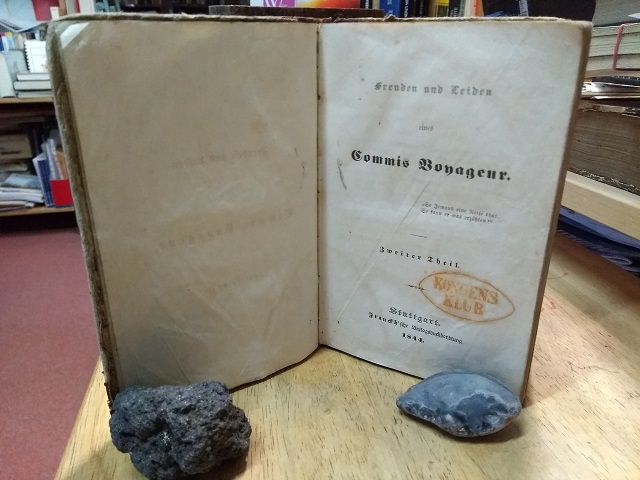
1844réf. 33548ABStuttgart, Franckh'sche Verlagsbuchhandlung, 1844. Klein-8°. S. 3-234 S., IV Seiten Inhaltsverzeichnis, hier fehlt das letzte Blatt (Seite V). Stark zerlesener Halblederband der Zeit. Namen auf Innendeckel (Martens und Voß, Prerow), Titelblatt gestempelt ("Kongens Klub"). Teils stark fleckig u. abgegriffen, zwei Blätter bzw. stark randrissig. Einband stark berieben u. bestossen u. mit Fehlstellen im Bezug.
1926réf. 80739Nashville: The McQuiddy Press 1926. First Edition. First printing. Inscribed on front endpaper: "To Nettie Spielman / with best wishes from / Geo. D. Hay "Solemn Old Judge" dated 1933. Tight Near Fine copy lacking the dustwrapper. Hay 1895-1968 started his career in print journalism but made his name as a radio personality primarily in Nashville where he was the originator and long-time Master of Ceremonies of the Grand Ole Opry program on WSM from which the venerable live stage variety show at the Ryman Auditorium drew its name. Between musical acts Hay would intersperse comic interludes in the character of "The Solemn Old Judge" a character he had first invented for his column "Howdy Judge" in the Memphis Commercial Appeal. These columns are reproduced here; they are mostly in the form of racist caricature very much drawn from the minstrel show tradition the typical premise being an African-American character appearing in court before a white judge with much white-supremacist hilarity to follow the Black voices written in exaggerated dialect. Hay adapted his "Solemn Old Judge" persona to radio along the way establishing the basic character of the popular American "hillbilly" music industry - white southern and racially segregated - that placed country music in direct opposition to the race-mixing socially "degenerate" music of the northern cities especially New York. In the words of sociologist Richard Peterson: "The down home rural card was a good card to play.because there was such fear of what was happening in the cities. There was so much race mixing there was so much jazz there was all kinds of degradation in music. Here was a way of finding a pure unadulterated American music that came out of an Anglo-Saxon background. They Hay and the Grand Ole Opry made up a whole bunch of stuff." quoted in American Public Media "New York Clashes With the Heartland" audio documentary. An historically important book despite its racially offensive underpinnings somewhat scarce and seldom found signed. The McQuiddy Press unknown books
1926réf. 80739Nashville: The McQuiddy Press 1926. First Edition. First printing. Inscribed on front endpaper: "To Nettie Spielman / with best wishes from / Geo. D. Hay "Solemn Old Judge" dated 1933. Tight Near Fine copy lacking the dustwrapper. Hay 1895-1968 started his career in print journalism but made his name as a radio personality primarily in Nashville where he was the originator and long-time Master of Ceremonies of the Grand Ole Opry program on WSM from which the venerable live stage variety show at the Ryman Auditorium drew its name. Between musical acts Hay would intersperse comic interludes in the character of "The Solemn Old Judge" a character he had first invented for his column "Howdy Judge" in the Memphis Commercial Appeal. These columns are reproduced here; they are mostly in the form of racist caricature very much drawn from the minstrel show tradition the typical premise being an African-American character appearing in court before a white judge with much white-supremacist hilarity to follow the Black voices written in exaggerated dialect. Hay adapted his "Solemn Old Judge" persona to radio along the way establishing the basic character of the popular American "hillbilly" music industry - white southern and racially segregated - that placed country music in direct opposition to the race-mixing socially "degenerate" music of the northern cities especially New York. In the words of sociologist Richard Peterson: "The down home rural card was a good card to play.because there was such fear of what was happening in the cities. There was so much race mixing there was so much jazz there was all kinds of degradation in music. Here was a way of finding a pure unadulterated American music that came out of an Anglo-Saxon background. They Hay and the Grand Ole Opry made up a whole bunch of stuff." quoted in American Public Media "New York Clashes With the Heartland" audio documentary. An historically important book despite its racially offensive underpinnings somewhat scarce and seldom found signed. The McQuiddy Press unknown
1882réf. 60948Wien, J. Löwy k. k. Hof-Photograph, 1882. Orig.-Fotografie nach einer Zeichnung von Sporner (24,7 x 58,1 cm), auf starkem Untersatzkarton (37,5 x 60,2 cm) montiert.