1682[Figurato Agrimensura-Matematica] (cm.20,5) ottima piena pergamena molle sec. XVIII, titolo al dorso. -- cc. 6 nn., pp. 551 + 1p. con marca tipografica. Molte illustrazioni n.t. in xilografia di strumenti, schemi, figure ecc. Seconda edizione definitiva più completa della prima del 1603. Molto rara e importante per la vastità di argomenti e notizie. Vedi Riccardi I 478: "Opera interessantissima per la storia dell' aritmetica, ampiamente sviluppata ed applicata anche alla mercatanzia; e per quella della geometria pratica, trovandovisi la descrizione e l' uso degli strumenti allora conosciuti, fra i quali sono notevoli quelli che ora direbbersi celerimensura". Cat. Libri n° 2878-79: "This work is so scarce that it has escaped professor De Morgan. It contains solutions of several indeterminate problems. Amongst the authors quoted by Forestani we find Galigai, Calandri, Lazzisio, Pagani, ecc.". Vecchio restauro al margine del frontis con le prime 5 lettere di (Pratica) ridisegnate. Qualche lieve alone al margine delle prime carte ma esemplare bello nitido e marginoso. * Autori Italiani del '600 1551; * Sotheran Primo Suppl. 1150; * Graesse VIII 309.[f72] Libro
Best.-Nr. 8279P., Courcier, 1806, un volume in 4 relié en demi-basane, dos orné de filets dorés (reliure de l'époque), 2 feuillets non chiffrés (faux-titre + titre), 111pp., (1pp.), 3 PLANCHES DEPLIANTES
1578Un volume (15x20,5 cm) di (2)-36 pagine con 14 figure nel testo. In lingua latina. Margini corti in alto. Timbretto di possesso e data di acquisto (30 gennaio 1815) al retro della prima carta bianca. Titolo con marca tipografica di Gorbin: Pandora, donna scoperchia un'anfora da cui escono animali. Motto: Sola remansit intus spes. Legatura moderna in tutta pergamena rigida con titolo manoscritto al dorso. Qualche fioritura, ma conservazione molto buona per questo raro trattato che De Merliers aveva pubblicato in francese nel 1573.
Best.-Nr. 37410P., Bachelier, 1827, un volume in 4 relié en demi-basane, dos orné de fers et filets dorés, étiquette de titre rouge, tranches jaspées (reliure de l'époque), 20pp., 188pp., 28 PLANCHES DEPLIANTES
1579Formato cm 21x15 La sfera del mondo: pagine (12), 252 De le stelle fisse: pagine 30, 48, 25 - 93, (2). Rilegatura in piena pergamena coeva con titolo manoscritto al dorso. Legatura leggermente allentata. Manca il frontespizio sostituito da una riproduzione in fotocopia. All'interno lievi tracce di tarlatura, macchie, bruniture ed alcune annotazioni di antica mano. Le due opere sono rilegate insieme. Stato di conservazione complessivamente buono. Raccolta di due rare opere di astronomia del Piccolomini, stampate entrambe a Venezia dal Varisco nel 1579, riccamente corredate da figure ed illustrazioni geometrico - astronomiche.
Best.-Nr. 41762Paris Chez Jacques Rollin - Charles-Antoine Jombert, Libraire 1753 in 4 (28,5x22) 2 volumes reliures plein veau fauve de l'époque, dos à nerfs ornés, pièces de titre de maroquin rouge, tranches teintées rouge, coiffes légèrement usées, petite restauration ancienne sur des mors. Tome 1: XXVII et 483 pages, avec 50 planches gravées dépliantes in fine. Tome 2: [1] 495 pages [1], avec 50 planches gravées dépliantes in fine. Alexandre Savérien, 1720-1805. Edition originale. Exemplaire bien complet des 101 planches dépliantes. Bel exemplaire ( Photographies sur demande / We can send pictures of this book on simple request )
1859Best.-Nr. 42296(London, Richard Taylor and William Francis, 1859). 4to. No wrappers as extracted from ""Philosophical Transactions"" Vol. 149 - Part I. Pp. 61-90. Clean and fine.
1859Best.-Nr. 42296London Richard Taylor and William Francis 1859. 4to. No wrappers as extracted from "Philosophical Transactions" Vol. 149 - Part I. Pp. 61-90. Clean and fine. First appearance of this pathbreaking paper in which Cayley unites 'Metrical Geometry' and 'Projectice Geometry' by introducing "imaginary" elements to metrical properties."The fundamental notions in metrical geometry are the distance between two points and the angle between two lines. Replacing the concept of distance by another also involving "imaginary" elements Cayley provided the means for unifying Euclideangeometry and the common non-Euclidean gemoetries into one comprehensive theory."Bell in "Men of Mathematics".In non-Euclidean geometry prepared the way for Klein's splendid discovery that the geometry of Euclid and the non-Euclidean geometries of Lobatchewsky and Riemann are all threee merely different aspects of a more general kind of geometry which includes them as special cases.Dealing with the relations between metrical and projective geometry Klein remarks In "Entwicklung der Mathematik" Teil I p. 148: "Vor allem kommt für uns sein Cayley's berühmtes 'A Sixth Memoir upon Quantics" im betrachtt. Quantioc heisst soviwel "Form" d.h. homogenes Polynom von zwei drei oder mehr Variablen wonach man binäre tertiäre usw. Formen unterscheidet." unknown
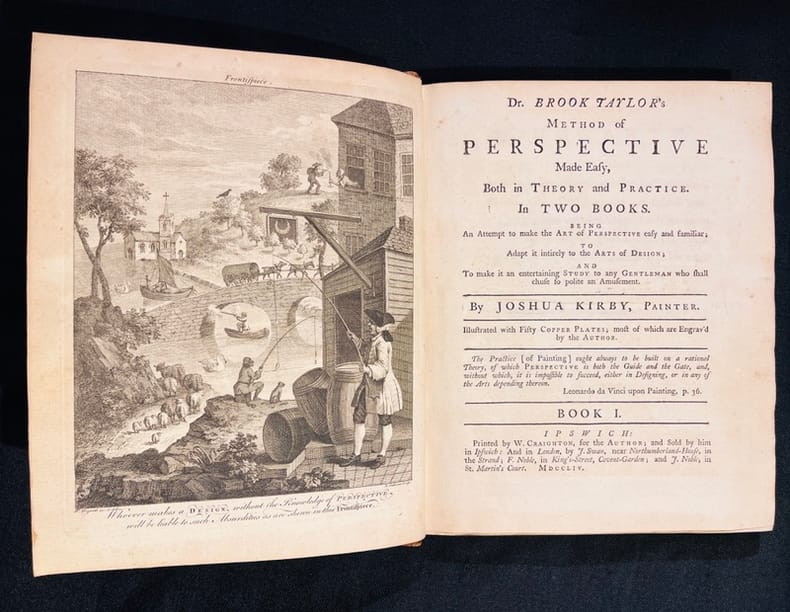
1754Best.-Nr. 21201Ipswich, W. Craighton for the author, 1754. In-4 de [4]-IV-XVI-[2]-78-[2]-84 pages, plein veau brun, dos à nerfs orné de filets dorés, pièce de titre en maroquin rouge, double filet d'encadrement doré sur les plats, roulette à froid sur les coupes.[]4; A4-[a4]-errata-B-L4; A-K4; L2.
Best.-Nr. 240053S.l., s.d. (janvier-avril 1828) 7 parties en un vol. in-4, titre, [111] ff. n. ch., dont certains vierges entre les cahiers, écriture fine, cursive, mais lisible, environ 30 lignes par page, biffures et ratures occasionnelles, avec des figures géométriques dans le texte, demi-basane fauve modeste, dos lisse orné de filets dorés, titre poussé sur le dos "Analyse & mécanique I", coins en vélin rigide (reliure de l'époque). Dos très frotté.
1675Formato cm. 20,5x16. Pagine (3), 285 (ma 185), (2), 104, (2), 38. Bella rilegatura in piena pelle coeva con nervi e motivi dorati al dorso. Tre opere rilegate insieme. All'interno 29 tavole alcune delle quali più volte rilegate. Prima edizione in ottimo stato di conservazione.
Best.-Nr. 8077P., Duprat, 1803, un volume in 4 relié en demi-basane, dos orné de fers et filets dorés (reliure de l'époque), (petit accroc sans gravité à une coiffe, petites auréoles dans la marge supérieure d'une dizaine de feuillets), (2), 38pp., 1 feuillet non chiffré, 489pp., 15 PLANCHES DEPLIANTES
Best.-Nr. ORD-2947Suite de la Mesure des Surfaces et des Solides. Paris. Jombert. 1741. In-4 (205 x 262mm) pleine basane brune, dos à 5 nerfs orné, pièce de titre maroquin brun, tranches rougies, gardes peignées (reliure de l'époque), 4ff.n.ch., XXXIV, (II), 632 pages, bien complet des gravures et des planches. Coiffes lgt émoussées, rousseurs éparses mais bon exemplaire.
1788…esposte al pubblico in due distinti esami. -Un volume (12,5x20 cm) di 41-(3) pagine. Le ultime 3 bianche. Brunitura diffusa; timbro di proprietà al titolo. Brossura muta moderna. Raro. Vedi esemplare digitalizzato della Biblioteca Museo Galileo di Firenze.
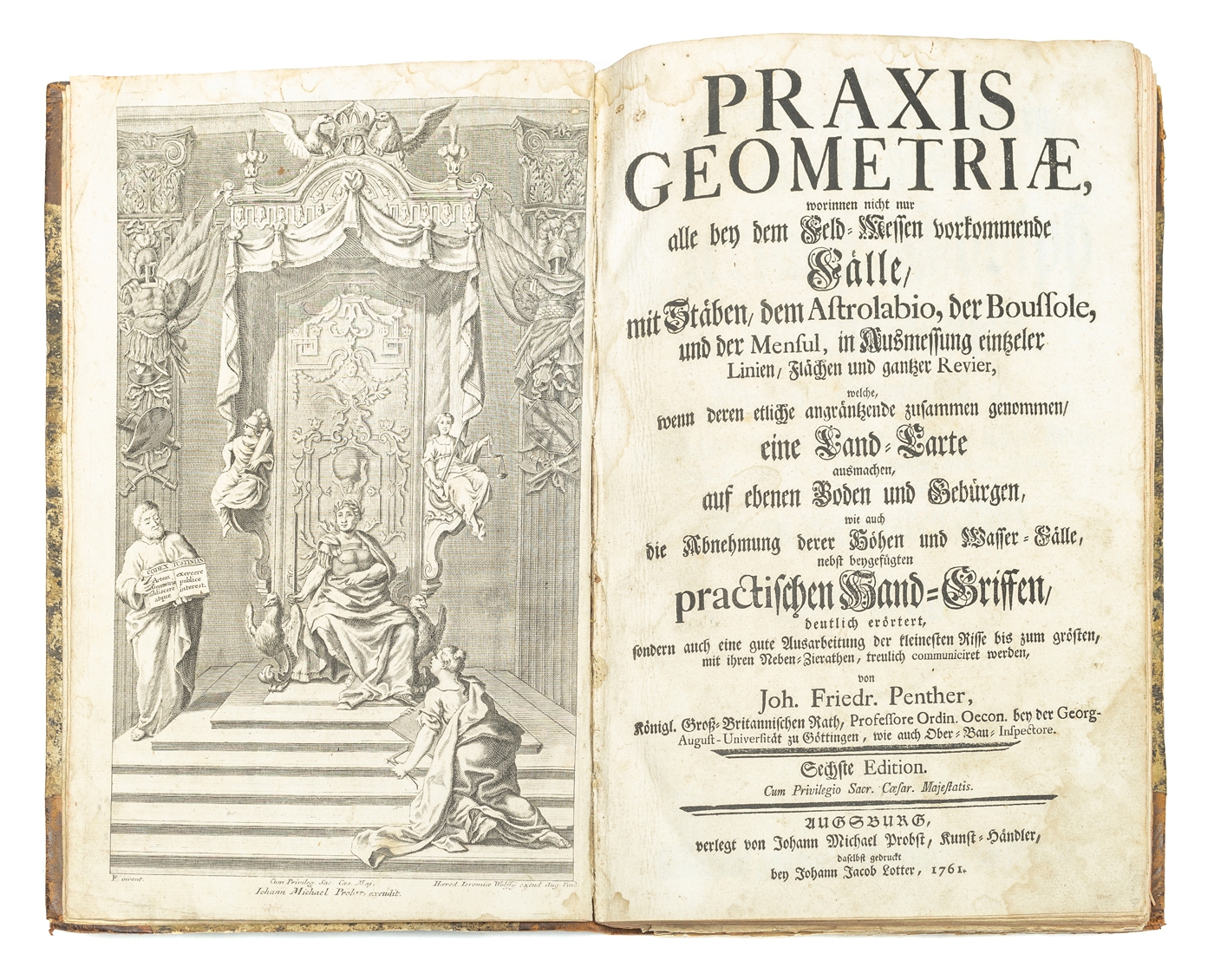
1761Best.-Nr. 0448-10Augsburg, Johann Michael Probst u. Lotter 1761. 6. Edition 4°. Gest. Frontisp., 5 Bll. 97 (5) S., 25 gefalt. Kupfertaf. Mit Titelkupfer u. zahlr. Vign. HLdr. d. Zt. Einige Taf. wasserrand. Letzte beschäd. [4 Warenabbildungen]
5 titoli legati in un volume, in-8 piccolo, legatura settecentesca in mezza pelle con punte (mancanza alla parte superiore del dorso). Per quanto riguarda il Saladini, in prima edizione, l'esemplare qui presente corrisponde alla variante censita in ICCU al n. IT\ICCU\VIAE\005878. Il Del Papa è in prima edizione. Il teatro alla moda del Marcello ha la metà inferiore del frontespizio ricostruita con perdita dei dati tipografici originali da noi desunti da IT\ICCU\VEAE\010674.
1673Best.-Nr. 28681Cremona: Per Gio. Pietro Zanni 1673. Mit zahlr. Abb. i. Text u. z.T. ganzsseitig. 9 Bll., 162 S. Pappbd. d. Zeit. 24x17 cm. [5 Warenabbildungen]
1955Best.-Nr. 6710New York: Robert S. Beard 1955. 14 Posters/Blueprints 12 are printed in white on blueprint paper and 2 are printed in black on white paper generally 13x19." One is trimmed along top edge few others with fading and corner wear. generally very good. Ownership signature and address of Margaret Sutton on verso of one manuscript sketch of parallel lines on another. Robert S. Beard's stamp appears on the verso of another and few have manuscript captions or corrections on the front. Beautiful and intriguing set of designs owned by New York artist Margaret Sutton 1905-1990 who had a long and varied career in engineering art and design. These blueprints were created by an interesting figure in his own right Col. Robert S. Beard 1883-1974 author of many articles and a book Patterns in Space 1973 on aspects of geometric design. The influence of Beard's work is seen in a wide variety of disciplines from mathematics and cosmology to art and economics. His designs made a great impact on American mathematician Magnus Wenninger who wrote the first book on constructing polyhedron models. Dr. Jerome Baumring of the Institute of Cosmological Economics who is said to be the first known person to crack the complete esoteric trading system of W.D. Gann cites Beard's book as "one of the greatest cosmological treatises ever written." Patterns in Space is also listed alongside books by Mandelbrot in the study of fractals. Margaret Sutton likely became acquainted with Beard's works in the New York arts scene Beard teaching at Yeshiva University and Sutton receiving degrees at Columbia University where a set of Beard's models were on permanent display as of the publishing of his book in 1973. Included in this set are: The Golden Rectangle The Pentacle The Nesting Squares; Key of the Cosmos and Numbers; The Five Pointed Star series of 2; The Value of 2π; Patterns for Segments of Cubes; The Rhombic Dodecahedron; Patterns for the Honeycomb Dodecahedron; Seven Polyhedron Families Having 5" Cube Members; Table showing Face Polygons and Solids trimmed; Geometrical Construction for Regular Polygons; and Drawing the Polygons series of 3. What is so fascinating about this set is it shows a clear influence on Sutton's career and artistic trajectories. After taking drafting and engineering classes at Columbia she worked for Grumman Aircraft and then as a technical illustrator for the Merganthaler Linotype Company. She studied art at the Arts Students League likely with George Grosz and with Hans Hofmann at his school. She completed some 4000 paintings and drawings in her lifetime. In 1993 her friend and partner painter Alfred Levitt gave her body of work to the University of Mary Washington where it is now on display. The online exhibition from 2020 Margaret's Menagerie: The Animal Imagery of Margaret Sutton gives a good look at her varied works many of which use geometric patterns lines and shapes often in combination with her other love of animals and nature. The final photo in this listing is one of Sutton's works for reference not included in the sale. As of cataloguing we have not been able to locate any Beard designs elsewhere other than those mentioned in the preface of his book at Columbia and Berkeley. This set is a trove of beautiful design that blurs the lines between art and math showcasing the career path of a woman artist of the Greenwich Village scene who should be more well known. . Robert S. Beard unknown
1955Best.-Nr. 6710New York: Robert S. Beard 1955. 14 Posters/Blueprints 12 are printed in white on blueprint paper and 2 are printed in black on white paper generally 13x19." One is trimmed along top edge few others with fading and corner wear. generally very good. Ownership signature and address of Margaret Sutton on verso of one manuscript sketch of parallel lines on another. Robert S. Beard's stamp appears on the verso of another and few have manuscript captions or corrections on the front. Beautiful and intriguing set of designs owned by New York artist Margaret Sutton 1905-1990 who had a long and varied career in engineering art and design. These blueprints were created by an interesting figure in his own right Col. Robert S. Beard 1883-1974 author of many articles and a book Patterns in Space 1973 on aspects of geometric design. The influence of Beard's work is seen in a wide variety of disciplines from mathematics and cosmology to art and economics. His designs made a great impact on American mathematician Magnus Wenninger who wrote the first book on constructing polyhedron models. Dr. Jerome Baumring of the Institute of Cosmological Economics who is said to be the first known person to crack the complete esoteric trading system of W.D. Gann cites Beard's book as "one of the greatest cosmological treatises ever written." Patterns in Space is also listed alongside books by Mandelbrot in the study of fractals. Margaret Sutton likely became acquainted with Beard's works in the New York arts scene Beard teaching at Yeshiva University and Sutton receiving degrees at Columbia University where a set of Beard's models were on permanent display as of the publishing of his book in 1973. Included in this set are: The Golden Rectangle The Pentacle The Nesting Squares; Key of the Cosmos and Numbers; The Five Pointed Star series of 2; The Value of 2π; Patterns for Segments of Cubes; The Rhombic Dodecahedron; Patterns for the Honeycomb Dodecahedron; Seven Polyhedron Families Having 5" Cube Members; Table showing Face Polygons and Solids trimmed; Geometrical Construction for Regular Polygons; and Drawing the Polygons series of 3. What is so fascinating about this set is it shows a clear influence on Sutton's career and artistic trajectories. After taking drafting and engineering classes at Columbia she worked for Grumman Aircraft and then as a technical illustrator for the Merganthaler Linotype Company. She studied art at the Arts Students League likely with George Grosz and with Hans Hofmann at his school. She completed some 4000 paintings and drawings in her lifetime. In 1993 her friend and partner painter Alfred Levitt gave her body of work to the University of Mary Washington where it is now on display. The online exhibition from 2020 Margaret's Menagerie: The Animal Imagery of Margaret Sutton gives a good look at her varied works many of which use geometric patterns lines and shapes often in combination with her other love of animals and nature. The final photo in this listing is one of Sutton's works for reference not included in the sale. As of cataloguing we have not been able to locate any Beard designs elsewhere other than those mentioned in the preface of his book at Columbia and Berkeley. This set is a trove of beautiful design that blurs the lines between art and math showcasing the career path of a woman artist of the Greenwich Village scene who should be more well known. . Robert S. Beard unknown books
1647Best.-Nr. 62212ABAmstelodami, Janssonius, 1647. 2o. 50 Textseiten, 73 doppelblattgrosse Kupfertafeln m. perspektivischen Darstellungen von Räumen, Gebäuden, Formen und Köpern, incl. Ansichten aus Rom. Kupfer No. 1-31, 41- 80, Halbleder, Kanten berieben, Seiten tls. wasserrandig, altersgemäßer, guter Zustand.
1595[Figurato Geometria-Scienza] (cm.21) bella legatura recente in pieno vitello, nervi, filetti a secco ai piatti e al dorso con titolo. -- cc. 4 nn., pp. 132 (ma 131) + 1c. bianca. Con oltre 50 figure xilografiche a mezza pagina che contengono anche architetture e strumenti. Prima edizione collettiva con una nuova prefazione. A pag. (8) compare l' elenco delle "Opere che con l' aiuto de iddio darà in luce l' auttore" ma purtroppo non furono mai stampate. Le tavole rappresentano l' uso pratico degli strumenti per misurazione delle profondità marine. Cicognara: "Le opere di Silvio Belli sono pregiatissime per la scienza.le tavole sono benissimo disegnate". L'autore, vicentino fu tra i fondatori dell' Accademia Olimpica di Vicenza, e come ingegnere curò restauri ed edifici della sua città. Frontis con vecchie ottime integrazioni al margine bianco, lievissime ombreggiature a qualche carta per lo più marginali, altrimenti esemplare molto bello e fresco con xilografie in ottima tiratura. * Riccardi I 108: "Raro"; * Adams B 521; * Bm. Stc. 79; * Index Aureliensis 116.193; * Graesse I 329; * Smith "History of Mathematics" II 286; * Smith "Rara Aritmetica" 343.[f71] Libro
1586[Fig. Matematica] (cm.21,2) piena pergamena originale con unghie e tracce di lacci, con vecchi restauri per strappi e difetti reintegrati. Sguardie antiche.-- cc. 315 (mal numerate) + 1 c. nn. con al verso il registro e il leone rampante in xilografia. Marca tipografica al frontis e centinaia di figure geometriche nel testo. importante contraffazione dell' edizione del 1585 e di questa assai più rara, manca a Graesse, Capponi, Bm. Stc. ed Adams. Celebre trattato che contiene i teoremi fondamentali della geometria tradotta e commentata per la prima volta dal Tartaglia. Le due traduzioni riferite nel titolo sono quelle del Campano e dello Zamberto. Taglio al margine bianco di due carte interne che in una intacca all' angolo il testo, e taglio di due millimetri vicino alla cerniera in alto e in basso a scomparire nell' ultimo quaterno. Peraltro esemplare molto bello e genuino con antica nota di possesso al frontis manoscritta e una chiosa a c. 175. Al taglio inferiore titolo elegantemente calligrafato d' epoca. * riccardi II 498; * Riccardi " Saggio di bibliografia Euclidea " p.425; * Thomas-Stanford 45.[f52] Libro
1566[ARCHITETTURA] (cm. 24,7) buona mz. pergamena recente, tassello al dorso in pelle e oro.-- cc. 207 numerate (di 219) e cc. 7 (di 52) moltissime belle incisioni in xilografia. i libri hanno frontis proprio compreso nella numerazione. Prima edizione in ottavo dell' opera del Serlio, le incisioni di Krugher sono copie ridotte dall' edizione originale in folio, il testo risente dell' influsso di Piero della Francesca, Durer, Peruzzi e Viator ed ebbe un immediato successo internazionale con ristampe in tedesco francese inglese e fiammingo. Purtroppo scompleto: il primo libro è costituito solo da 8 carte numerate da 9 a 16, seguono da carta 17 gli altri libri fino a carta 219 e mancano solo 4 carte numerate (185-6-7-8). Il libro "Estraordinario2 è legato all' inizio dell' opera ed è costituito solo dal frontis architetonico con luogo tipografo e data e da altre 7 carte con le celebri porte. opera sempre importante per lo straordinario apparato iconografico. Alcune macchiette a due carte interne, qualche pagina un pò ombreggiata peraltro esemplare molto bello fresco e nitido con xilografie in ottima tiratura. FOWLER 327; CICOGNARA 668; BERLIN CATALOG 2570; RICCARDI II 441; SCHLOSSER-MAGNINO 418; BRUNET V 305; GRAESSE VI 370.[f40] Libro
1803E.O. Prima edizione di entrambe le opere. Due opere riunite in un volume (21x28 cm) in mezza pelle coeva, dorso liscio con fregi e titoli dorati; piatti con carta marmorizzata (qualche usura ai margini e piccola mancanza alla carta del piatto anteriore). 1- Paginazione: (4)-XXXVIII-(2)-489 pagine con 11 (su 15) tavole incise ripiegate in fine (le tavole mancanti, da 7 a 10, sono presenti in fotocopia). 2- Paginazione: (4)-111-(1) pagine con 3 tavole incise ripiegate in fine. Esemplari a grandi margini; una firmetta di possesso al titolo della seconda opera del matematico italiano, di Corfù, Giovanni Carandinò. In lingua francese. -- La mancanza delle quattro tavole nella Géometrie de Position è l'unico difetto di questa importante riunione in unico volume delle Edizioni originali delle due opere più importanti di Carnot, uno dei “fondatori della geometria moderna”.
1710Best.-Nr. 61400ABLa Hague, Moetjens, 1710., 1710 (und 1705 für Teil 1). 13,2x8,5 cm. (6) Bl., (12) Bl., 163 S., (5) S., 294 S. Mit vielen Fig. im Text und 9 (5 gefalt.) Tafeln. HPgt. der Zeit mit hs. Rückentitel. 4 Teile in 1 Band. 4ème éd. (und 5ème éd. für Teil 1).