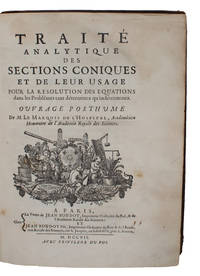
1707Best.-Nr. 48217Paris Jean Boudot et Jean Boudet fils 1707. 4to. Contemporary full calf. A bit of cracking to front hinges so that cords are seen but cover not loosening. Spine with 6 raised bands richly gilt compartments. Wear to top of spine. Two small old paperlabels one to upper compartment one to frontcover. Covers slightly rubbed. 44595 pp. Large woodcut vignette on titlepage 2 other vignettes one engraved one in woodcut. 32 folded engraved plates and one smaller folded plate Fig. A. An old owners stamp on flyleaf. Internally clean and fine. A few tiny brownspots. Wide-margined and printed on good paper. Scarce first edition of l'Hôspital's second book - his second successfull textbook - the manuscript of which was left completed at his death in 1704. His first book "Analyse des infiniment petits pour l’intelligence des lignes courbes" 1696 was the first textbook of the differential calculus and his name lives on in the name of the rule for finding the limiting value of a fraction whose numerator and denominator tend to zero. His mathyematical teacher was Jean Bernoulli.The year in which Newton published the anti-Cartesian "Arithmeticus" there appeared in France a conspicuously successfull textbook on Cartesian geometry along the lines of that of Guisnée. This was the "Traité Analytique des Sections Coniques". a book which contains less original material than that of Guisnée but which is more extensive and closer to the modern manner of treatment. The work had been intended for publication at the time the authors famous calculus textbook appeared in 1696 but l'Hospital's illness apparently led to delay and it appeared posthumously in 1707. It is Cartesian in emphasis and although it consists of but one volume follows generally the tripartite plan of Lahire and Ozanam: first an algebraic quasi-analytic treatment of the Conic Sections along the lines of Apollonian theory; then an analytic study of the loci and finally a long section on the customary construction by conics of the roots of cubic and quartic polynominal equations. LHospital sometimes used two axes and seems to have recognized the interchangeability of these but he betrays some hesitation. In general L'Hospital like Descartes was more interested in analytic geometry as a measure of ecpressing loci algebraivcally than as a method of deriving the properties of a curve from its equation." Carl B. Boyer "History of Analytic geometry" pp. 150-154. hardcover
1563Best.-Nr. 23194Dillingen, Sebaldus Mayer, 1563. 8 (1 weißes) Bll., 121 num. Bll.mit zahlr. Textholzschnitten. Gr.-8°. Blingeprägtes braunes Ldr. der Zeit (ohne die Bindebänder, etw. berieben und bestoßen). [5 Warenabbildungen]
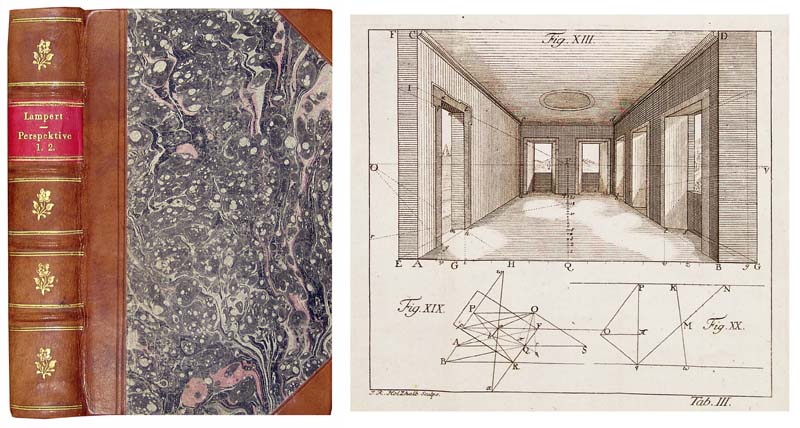
1759Best.-Nr. 0243Zürich, Heidegger, 1759. Erste deutsche Ausgabe. - Steck I, 3 u. I, 26; Poggendorff I, 1355; vgl. ADB 17, 552. - Titelblatt gestempelt. - Stellenweise etwas gebräunt oder braunfleckig. Der elsässische Physiker und Mathematiker Johann Heinrich Lambert (1728-1777), der sich sein Wissen vorwiegend autodidaktisch angeeignet hatte, gilt als bedeutendster Vertreter des deutschen Rationalismus nach Leibniz und vor Kant, mit dem er auch im Briefwechsel stand. Mit der "Perspektive", seiner ersten mathematischen Veröffentlichung, berücksichtigt Lambert als Mathematiker auch die Bedürfnisse der praktischen Anwendung und er begründet mit diesem Werk, noch vor Monge, die beschreibende Geometrie als eigenständige mathematische Disziplin. - Der 1. Teil dieser wichtigen Schrift zur Perspektivlehre, hier vorliegend in der seltenen 1. Ausgabe, angebunden der erst 15 Jahre später erschienene 2. Teil. - Gut erhaltenes Exemplar in einem dekorativen Einband im Stil der Zeit.
1667in-4 gr., ff. 57 n.n. compreso il magnifico titolo figurato con armi del cardinale Iacomo Nini al quale l'opera è dedicata da Matteo Gregorio de'Rossi. Leg. moderna in p. pergam. rigida. Completo di 51 tav. geometriche incise in rame n.t., testatine, finalini e titolo entro elaborata bordura architettonica e figure allegoriche. Sesta edizione (prima Roma, Paulini 1599) di questo celebre trattato sulla geometria euclidea e le sue applicazioni, di G. Pomodoro, astronomo e matematico veneziano (XVI secolo). "La geometria pratica del Pomodoro con le aggiunte dello Scala è un trattato d'agrimensura che trovo assai ben fatto" (Riccardi). Scala (1547-1599), matematico, ingegnere militare e architetto friulano, curò e ampliò il lavoro di Pomodoro. Bell'esemplare (antico timbro abraso al secondo f.).. Cat. Vinciana 1599. Riccardi, II, 201. Graesse V, 399. Olschki 7562..
1627Best.-Nr. 21055Nürnberg, Simon Halbmayer, 1625, 1623, 1626, 1627 (laut Chronogrammen am Schluß der Dedicationen). 4 statt 6 Bll., 296 SS., 8 Bll, 198 SS., 3 Bll., 6 Bll., 101 SS., 1 Bl., 83 SS., 2 Bll. mit 1 gest. Porträt, gestochene Titel (2 x in Holzschnitt wiederholt) und ca. 200 Holzschnitte im Text (Messinstrumente, Zirkel, Messungslinien in Landschaften und Städten sowie zahlreiche Diagramme und Schemata. Es fehlen im 1. Buch der Titel und ein Blatt der Dedikation. 4° (ca. 15, 5 x 19, 5 cm), Pergament der Zeit über 4 Bünden, Initialen "FIVG" und die Jahreszahl 1630 auf dem Vorderdeckel, blindgeprägte Wappensupralibros auf beiden Deckeln. Wappen der Familie von Grünthal. Einband etwas angegraut und leicht knittrig.
1873Best.-Nr. 53254London and New York, Macmillan and Co., 1873. 4to. Orig. full brown cloth, gilt spine, pictorial gilt frontcover. Near mint condition. Small embossed stamp at upper corner of title-page (David Dunlop ObservatoRy Library). In: ""Nature, a weekly illustrated Journal of Science."", Volume VIII, May 1873 to October 1873. XII,562 pp. (Entire volume offered). Riemann's paper: pp. 14-17 a. 36-37. Internally clean and fine, no traces of use.
1873Best.-Nr. 53254London and New York Macmillan and Co. 1873. 4to. Orig. full brown cloth gilt spine pictorial gilt frontcover. Near mint condition. Small embossed stamp at upper corner of title-page David Dunlop ObservatoRy Library. In: "Nature a weekly illustrated Journal of Science." Volume VIII May 1873 to October 1873. XII562 pp. Entire volume offered. Riemann's paper: pp. 14-17 a. 36-37. Internally clean and fine no traces of use. First English translation of this milestone work on the foundations of geometry. It "is one of the key work from which derives the modern study of differential geometry and especially the study of manifolds of dimension greater than two. It was to prove central to the overthrow of Euclidean geometry as the source of geometrical ideas and to Einstein's general theory of relativity after 1915." Grattan-Guiness "Landmark Writings in Western Mathematics 1640-1940.It is a translation of Riemann's famous Habilitationsvortrag held in 1854 in secondary literature it is often misidentified as his Habilitationsschift but that was concerned with Fourier series and was delivered the year before. Riemann begins his lecture with a remark about a certain darkness that lies at the foundation of geometry. This darkness obscures the relations between that which geometry assumes i.e. the notion of space and the first principles of constructions in space. In Riemann's oponion one must take another approach towards this problem than the usual axiomatic method used ever since Euclid. The approach taken by Riemann is to a large extent guided by Gauss's work on the intrinsic geometry of surfaces; 'Disquisitiones generales circa superficies curvas' 1828. In this work Gauss showed that the curvature of a surface can be determined without reference to the ambient Euclidean space in which it lies i.e. that the curvature is an intrinsic property of the surface. Based on this Gauss showed several fundamental theorems about figures on the surface by referring only to the surface itself i.e. indicating that the surface itself is a space with its own geometry independent of the geometry of the ambient Euclidean space. Riemann argues that the true objects and properties of geometry are those which can be studied within the space itself and he defines a general n-dimensional space in a similar manner to the parametric representation of a surface. Riemann believed that we know space only locally he therefore bases his study of the geometry of such a general space or manifold as they are known today on the infinitesimal methods of calculus. This choice is a crucial departure from the classical axiomatic methods used by Euclid Lobachevsky and Bolyai. The notion of distance or metric on a manifold is a generalization of the usual Euclidean distance formula in n-dimensions. Particular choices of space and metric reveal both the hyperbolic geometries of Lobachevsky and Bolyai and elliptic or Riemannian geometry. Riemann's approach to geometry is of paramount importance this work "did more to change our ideas about geometry and physical space than any work on the subject since Euclid's Elements." Landmark Writings in Western Mathematics p.507. "The importance of this treatise is not confined to pure mathematics. Without it Einstein would not have been able to develop his general theory of relativity." Printing and the Mind of Man p.177. hardcover
1586in-4, fogli 316 numerati, impressi in carattere corsivo, Illustrati con con centinaia di figure tecniche e geometriche nel testo. Legatura coeva p.pergamena flessibile, titolo manoscritto al dorso. Le due traduzioni delle quali Tartaglia si servì per la presente edizione sono quelle di Campano e di Zamberto. Euclide visse nel IV e III sec. a.C, fu discepolo di Platone e celebre matematico in Alessandria, detto ''il padre della geometria''. Stimata edizione, la cui prima versione apparve nel 1543. (Esemplare genuino, lievi arrossature della carta in qualche margine).. Thomas-Stanford, n. Manca ad Adams..
1758In-4°; 1 cb, pp.(14), 340, (36), antiporta calcografica; un rame al frontespizio, legni nel testo. Legatura coeva in piena pergamena con titolo in oro al dorso, tagli spruzzati in azzurro. Dorso parzialmente restaurato. Buon esemplare. Edizione originale delle sue lezioni di geometria cge Lecchi fece stampare nel periodo in cui insegnava matematica a Brera; l’intento didattico e quello storico sono svolti insieme, con il supporto di molte spiegazioni e esercizi. Lecchi (Milano 1702-1776 Milano) studiò nel collegio dei Gesuiti di Brera, insegnò filosofia e matematica. DBI ad vocem.
Best.-Nr. 1405Genève, Cramer & Philibert, 1750, un fort volume in 4 relié en plein veau marbré, dos orné de fers dorés, tranches rouges (reliure de l'époque), (quelques feuillets uniformément jaunis, 2 cachets de bibliothèque dans les marges de la page de titre), 23pp., (1pp. blanche), 680pp., 11pp., (1pp. - errata), 33 planches dépliantes numérotées 1 à 33 + 1 planche non numérotée - SOIT 34 PLANCHES DEPLIANTES
1646[Figurato Architettura-Cortona] (cm. 35) ottimo cartonato originale con nervi in cuoio esterni e tracce di coloritura.-- cc. 4 nn., pp. 119 + 1 p. con il colophon. Frontis inciso + ritratto di Odoardo Farnese + ritratto dell' autore + 3 tavv. f.t. più volte ripiegate. Nel testo molte figure incise in rame con piante di fortificazioni, schemi, figure geometriche, calcoli ecc. Alcune firmate da Camillo Congi, G.B. Zampa, Sodi. Edizione originale ed unica della massima rarità citata da D' Ayala con data errata e Cockle replica l' errore. Choix e Mugnaini hanno esemplari scompleti. L' opera manca a Piantanida, Michel-Michel, Pollak, Graesse, Brunet, Comolli e a molta bibliografia consultata. Alcune notizie sull' autore di Parma, sono in Manzi assieme ad una ampia descrizione dell' opera. un lievissimo alone in alto su alcune carte altrimenti esemplare molto bello e a grandi margini con incisioni in ottima tiratura. Esemplare particolare appartenuto all' architetto Antonio Jannelli (1652-1731) di Cortona (Arezzo) del quale si legge l' ex libris manoscritto al frontis e in fine datato 1682. * Marini p.93; * D' Ayala 104; * Cockle n°826; * Manzi " Architetti e Ingegneri Italiani " 1976 n°133; * Riccardi II 44; * Bm. Stc Italian 499.[f55] Libro
1545in-8, pp. 107, (5, le ult. 2 bianche), leg. poster. in p. perg. antica. Figura di Euclide sul titolo, una iniz. silogr., testo in corsivo. Dedica del traduttore ad Antonio Altoviti. Prima edizione di questa traduzione in volgare, solo di due anni posteriore a quella di Niccolò Tartaglia (Venezia, Rossinelli, 1543). Rarissima traduzione in una lingua moderna del testo di geometria più importante al mondo, d'uso comune ancor oggi. Questa scienza, che prima di Euclide era considerata uno degli aspetti della filosofia, acquista per la prima volta una propria indipendenza e, grazie anche alle traduzioni in volgare, maggior diffusione e pratica applicazione. Bell'esempl., puro e marginoso (antico timbro sul f. di colophon), conservato in elegante scatola in m. marocchino e tela con tit. oro sul dorso.. Smith pp. 236-7. Thomas-Stanford n. 35. Riccardi I, 208. BMC 239..
1586in 4°, 22x16,5 cm, elegante legatura inizio settecento in piena pergamena, titolo in oro su tassello, filetti dorati e 3 antiche etichette al dorso; pp. (8), 514, (2); (2 carte sono invertite per errore del rilegatore). Al frontespizio e al colophon grande monogramma dei gesuiti silografato; diversi capilettera animati, numerosissimi disegni geometrici e tabellenel testo
1586In 8 (cm 16 x 21), pp. (8) + 514 + (2). Legatura coeva in piena pergamena con rinforzo in pergamena al dorso. Carte uniformemente brunite, qualche sporadica lieve gora ma nel complesso esemplare in buone condizioni. Annotazioni manoscritte al frontespizio. Stemma della Compagnia di Gesu' impresso al frontespizio e ripetuto all'ultima carta, capilettera, figure geometriche xilografate nel testo, numerose tabelle. Edizione originale del Commento del Clavio a Sphericae (Sphairikon biblia III), l'opera di Teodosio Triopolita (di Bitinia). Clavio non solo spiega compiutamente i tre libri della teoria della sfera dello scienziato tripolita, con sue nuove dimostrazioni e con laggiunta di numerosi scolii, ed espone anche una sua teoria completa della trigonometria piana e sferica.
1754Due opere in un tomo. In 4°(210x160mm); pagg. VIII, 189, (3 bianche), con 4 tavv.; pagg. (8), 225, (3 bianche) con 5 tavv. Capolettera entro grandi vignette istoriate e finalini incisi in legno. Mezza pelle di fine settecento con piatti blu in tela decorata con fiori impressi a secco; titolo e fregi al dorso in oro, tagli gialli. Prima edizione non comune della Trigonometria, come riporta Riccardi " Sono commendevoli in questo libro l'ordine e la chiarezza di materie contenutevi." Rara prima edizione dell'Horographia, importante opera matematica in cui l'autore, in particolare nel settimo capitolo, tratta dei quadranti catrottici e diottrici, da cui si deduce la grande conoscenza dell'autore dell'ottica. Queste non comuni opere qui rilegate insieme, sono il frutto del valente frate Gabriele Bonomo (Nicosia, 1694 - Palermo, 1760) che fu teologo, matematico e filosofo appartenente all'Ordine dei Minimi. Fu il fondatore dell'Accademia delle Matematiche nel convento di Sant'Oliva a Palermo, a cui aderirono anche lo Spedalieri e l'Abati. Fu di sua invenzione un orologio automatico. La Trigonometria plana è suddivisa in quattro libri mentre l'Horographia trigonometricae in sette capitoli, Ottimo esemplare fresco e genuino. Firma autografa di possesso "Corrado Lancia" in testa del frontespizio, di nobile famiglia siciliana. Lievi abrasioni agli spigoli della legatura. Trigonometria: Mira I, 119; Riccardi I - 155/2; Moncada Lo Giudice 284; Poggendorff I -235. Horografia: Mira I, 119; Riccardi I - 155/3 e I - 456; Poggendorff I -235.
1668In-folio; (54)-356-(1)-(1)-303-168 pp.; occhietto, antiporta allegorica riccamente incisa che illustra la rifrazione della luce attraverso le lenti e l'insegnamento del disegno con il compasso, grande marca tipografica dell'editore incisa sul frontespizio, titolo in rosso e nero, numerose illustrazioni e figure su 87 tavole incise; legatura coeva in pelle con filetti in oro, medaglione centrale con stemma rimosso, tagli spruzzati rossi.
1578In 8, cm 15,5 x 21, pp. (1o opera, 1578): (16) + 326 + (2) con 60 xilografie ca. nel testo raffiguranti strumenti astronomici. Manca la pagina 89/90 manoscritta nel sec. XIX; (2o opera, 1573): (8) + 110 + (2) + (16) + (18) + (4 bianche). Piena pelle del XVIII secolo con doppio filetto in oro ai piatti e fregi agli angoli. Nervature e fregi al dorso. Riparazioni alle cerniere e a parti del dorso. 1o opera: Seconda edizione dopo quella del 1569 ma, in realta', parzialmente originale, in quanto accresciuta di circa 100 pp. rispetto alla prima . Sono stati aggiunti infatti i trattati della: Sfera armillare; Torquetto astronomico; Astrolabio armillare; Gran regola astronomica; Quadrante astronomico; Armilla equinoziale; Diottra d'Hipparco; Gnomone astronomico et geometrico; Anemoscopio verticale. Danti, frate domenicano, fu in particolare matematico e astronomo. Fin a partire dal 1567 fu chiamato a corte da Cosimo De Medici, fu nominato cosmografo granducale e lavoro' ai dipinti cartografici che decorano la Sala delle Carte di Palazzo Vecchio. Si applico' in particolare alla realizzazione di sfere armillari, gnomoni e altri strumenti scientifici che proprio in questo testo vengono illustrati nelle loro costruzione e, in particolare, nel loro utilizzo. Ebbe anche la cattedra di matematica presso lo studio di Firenze. Alla morte di Cosimo dovette trasferirsi a Bologna dove, in pochi mesi, ebbe la cattedra di matematica. Grazie agli strumenti da lui realizzati, nel 1577 riusci' in soli 28 giorni a realizzare il rilievo del contado perugino e della citta'. Negli anni successivi rilevo' anche buona parte della Romagna, la Sabina e parte dell'Alto Lazio. Nel 1580 venne chiamato a Roma da Papa Gregorio XIII come cosmografo pontificio e partecipo' alla riforma del calendario
Best.-Nr. 114244India Jumadi 1284 AH 1867 AD. . Single volume illuminated manuscript on thin polished Indian laid paper text-block sprinkled in red and pink in Farsi Persian manuscript on paper black ink on paper 34 leaves 268 x 160 mm; 16 lines bold nasta'liq verging on shekasteh text-block ruled in gilt numerous diagrams in the text and adorning the margins most of these in gold some contemporary annotations to margins a few spots to preliminary leaves gilt ruling to text-block oxidised and caused closed tears in come instances mostly to inner ruling close to gutter some margins repaired; contemporary red sheep over pasteboards covers ruled in blind with central stamped motifs also in blind rebacked and edges repaired new endpapers and pastedowns covers rubbed. An attractive treatise on geometry and astronomy likely copied in India for a certain Alim al-Din Hussayn bin Abd'Allah al-Ansari in 1867 AD. The work includes many diagrams in the text showing various geometrical shapes diagrams of stars and planets and diagrams of various eclipses and spheres in orbit. India, Jumadi 1284 AH (1867 AD). hardcover
1631Best.-Nr. 21158Rom, Grignani, 1631. 4 Bll., 108 S. mit 29 Textkupfern. 1 Kupfertitel. Gr.-8°. Mod. flex. Pgmt. [5 Warenabbildungen]
1640In-4°, (8), 80pp, mancante della carta ripiegata, le ultime 4 carte non sono in sequenza ma tutto il quaderno è stato stampato in maniera diversa dall’usuale, il volume è ben completo ma con questa variante tipografica probabilmente della primissima tiratura o delle prove di stampa. Seconda edizione. Capilettera, finalini, illustrazioni xilografiche, legatura in cartoncino bruno. Marca tipografica al frontespizio (Minerva che tende il braccio destro verso un ulivo e tiene con la sinistra uno scudo. Motto sul nastro: Pacis opus). Buona copia. Nell'estate del 1606 Galileo stampava a Padova Le operazioni del compasso geometrico et militare, un testo di matematica pratica che rappresentava il suo esordio nel campo dell'editoria tecnico-scientifica. Pur essendo concepito come uno "scherzo matematico" per l'istruzione del giovane principe Cosimo de' Medici, l'opuscolo descriveva le operazioni di uno strumento raffinatissimo: il primo vero strumento di calcolo multifunzionale dell'età moderna. Il libro fu stampato in sole 60 copie che venivano vendute in casa dell'autore insieme ad altrettanti esemplari del già famoso compasso. Le ragioni di tanto interesse vanno ricercate nel particolare indirizzo pratico attribuito alle scienze matematiche nel corso del Rinascimento, soprattutto in risposta alle nuove esigenze maturate in campo militare. Come si legge nel proemio, il compasso svolgeva «operazioni per lo più attenenti al soldato» e dunque le istruzioni furono scritte in volgare. Tra le varie operazioni consentite dall’uso del compasso, la misura delle distanze era un'operazione fondamentale per il corretto puntamento delle artiglierie. Una volta stabilita la distanza del bersaglio, l'artigliere era in grado di giudicare l'alzo del cannone in rapporto anche al peso dei proietti. In-4 °, (8), 80pp, missing the folded table, the last 4 leaves are not in sequence but the whole gathering has been printed in a different way from the usual, the volume is complete but with this typographical variant probably of the very first issue or print proofs. Second edition. Initial letters and tail ornaments, woodcut illustrations, brown cardboard binding. Printer’s mark on the title page (Minerva stretching her right arm towards an olive tree and holding a shield in her left hand. Motto on the ribbon: Pacis opus). Good copy. In the summer of 1606 Galileo printed in Padua The operations of the geometric and military compass, a text on practical mathematics that represented his debut in the field of technical-scientific publishing. Although conceived as a "mathematical joke" for the instruction of the young prince Cosimo de 'Medici, the booklet described the operations of a very refined instrument: the first true multifunctional calculation tool of the modern age. The book was printed in only 60 copies which were sold in the author's house together with as many copies of the already famous compass. The reason for such interest is to be found in the particular practical orientation attributed to mathematical sciences during the Renaissance, above all in response to the new needs matured in the military field. As we read in the preface, the compass involved "operations mostly related to the soldier" and therefore the instructions were written in the vernacular. Among the various operations allowed by the use of the compass, the measurement of distances was a fundamental operation for the correct aiming of the artillery. Once the distance to the target was established, the gunner was able to judge the gun lift in relation to the weight of the projectiles.
1708In-4°, (2), (8), 168, legatura in pergamena rigida, molteplici illustrazioni nel testo, buona copia, prima edizione. Il nome del gesuita Girolamo Saccheri viene comunemente, quando non esclusivamente, associato alla nascita delle geometrie non euclidee di cui è considerato giustamente il precursore. Tra i matematici che si impegnarono nella dimostrazione del quinto postulato di Euclide, Saccheri non cercò di sostituire il quinto postulato con un asserto simile, ma seguì un procedimento logico diverso dagli altri, ipotizzando la sua negazione, sicuro di pervenire ad un assurdo. In realtà, inconsapevolmente, creò a livello elementare due nuove geometrie in seguito definite Geometrie non Euclidee proprio perché in esse si negava la validità del quinto postulato. Fondamentale per lui fu l'incontro con Tommaso Ceva, (1648-1737), matematico e poeta, fratello del più famoso Giovanni Ceva, e con Vincenzo Viviani (1622-1703), matematico che lavorò con Galileo e Torricelli. Saccheri ebbe corrispondenza con tutte e tre queste grandi figure. Molto accurata anche la Neo-statica, del 1708, di argomento fisico che tratta di oggetti in quiete o soggetti a forze in equilibrio. Riccardi II, 405, Sommevogel VIII, 106 In-4 °, (2), (8), 168, hard vellum binding, multiple woodcuts in the text, faircopy, first edition. The name of the Jesuit Girolamo Saccheri is commonly, if not exclusively, associated with the birth of non-Euclidean geometries of which he is rightly considered the precursor. Among the mathematicians who engaged in the demonstration of Euclid's fifth postulate, Saccheri did not try to replace it with a similar assertion, but following a logical procedure different from the others, assuming its denial, sure to arrive to an absurdity. In reality, unknowingly, he created at an elementary level two new geometries which were later called non-Euclidean geometries precisely because they denied the validity of the fifth postulate. Fundamental for him was the meeting with Tommaso Ceva, (1648-1737), mathematician and poet, brother of the more famous Giovanni Ceva, and with Vincenzo Viviani (1622-1703), mathematician who worked with Galileo and Torricelli. Saccheri corresponded with all three of these great figures. Also very accurate is the Neo-statica, written in 1708, on a physics topic which deals with objects at rest or subject to forces in balance. Riccardi II, 405, Sommevogel VIII, 106
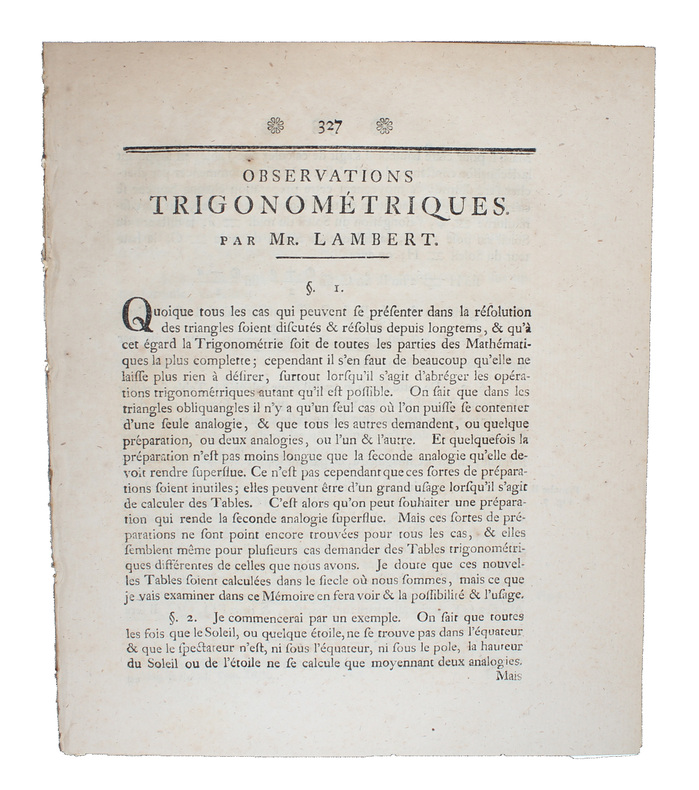
1770Best.-Nr. 31785(Berlin, Haude & Spener, 1770). 4to. No wrappers, as issued in ""Mémoires de l'Academie Royale des Sciences et Belles Lettres"", tome XXIV, pp. 327-354 and 1 engraved plates.
1770Best.-Nr. 31785Berlin Haude & Spener 1770. 4to. No wrappers as issued in "Mémoires de l'Academie Royale des Sciences et Belles Lettres" tome XXIV pp. 327-354 and 1 engraved plates. First edition. Lambert's work on non-Euclidean geometry is among the most important in the field. Carl Boyer writes "No one else came so close to the truth without actually discovering non-Euclidean geomtry." History of Mathematics pp. 504. Lambert wrote his famous book 'Theorie der Parallellinien' in 1766 but it was not published until 1786 nearly a decade after his death. Lambert originally set out to prove Euclid's parallel postulate in a similar way to that which Saccheri had used in his 'Euclides Vindicatus' but in contrast he did not interpret the consequences of non-Euclidean geometry as absurd. The offered paper 'Observations Trigonometriques' is the only work by Lambert on non-Euclidean geometry which was published during his life-time. Here he made the important discovery of the duality between spherical and hyperbolic geometry i.e. that hyperbolic trigonometries can be deduced from spherical trigonometries by using imaginary angles and consequently he introduced the hyperbolic functions for the first time. By illustrating this duality Lambert gave strong evidence of the consistency of non-Euclidean geometries. See Kline's Mathematical Thought from Ancient to Modern Times pp. 404 & 868. unknown
1626deux parties en 1 volume, [18]-120-248 pages vélin de l'époque, dos lisse avec titre manuscrit à l'encre à l'époque, traces de liens 1626, 1626, in-8, deux parties en 1 volume, [18]-120-248 pages, vélin de l'époque, dos lisse avec titre manuscrit à l'encre à l'époque, traces de liens, Au colophon : "Achevé d'imprimer en Décembre 1625, par Fleury Bourriquant, rue Daulphine, aux fraiz du sieur Henrion, professeur ès mathématiques, demeurant en l'Isle du Palais". Nombreuses figures sur bois dans le texte. La seconde partie, comportant les Tables elles-mêmes, a son titre propre, orné d'une représentation du système de Ptolémée et portant la date de 1625. Première édition française des Tabulae directionum de l'astronome et mathématicien franconien Regiomontanus (1436-1476) données par Henrion et augmentées de nouvelles tables. Les 31 problèmes de Regiomontanus sont très longuement commentés par l'éditeur français, qui introduit l'ouvrage par une longue préface adressée aux "lecteurs", dans laquelle il explicite la lecture et l'utilisation de ces tables hétérogène et homogène, ainsi que la manière de les utiliser pour rendre compte des triangles rectangles. Les Tables de direction, établies avec l'aide de l'astronome polonais Martin Bylica, furent initialement composées pour un usage astrologique. Elles furent imprimées pour la première fois en 1490 et connurent onze éditions jusqu'en 1626. Regiomontanus y inclut également une table des tangentes, qu'il ne désigne par sous ce nom, pour les angles supérieurs à 90°, et fournit ainsi le modèle qui a encore cours aujourd'hui. De Regiomontanus, on ne sait rien avant qu'il ne rejoigne, en 1450, l'université de Vienne. Il fut l'ami et le compagnon d'étude de Peuerbach, dont il reprit, à sa mort en 1461, le travail commandé par le cardinal Bessarion, destiné à rendre en latin la grande syntaxe mathématique (Almageste) de Ptolémée : l'Epitome ainsi achevé ne sera pourtant pas publié avant 1496. Regiomontanus fut un calculateur brillant et prolifique ; il publia de nombreux éphémérides et tables, à l'instar des présentes Tables de direction. Bel exemplaire de cette oeuvre rare, dans condition d'origine, provenant de la bibliothèque du cartographe des Alpes Paul Helbronner, avec son étiquette ex-libris au contreplat. Au titre, cachet de la bibliothèque de l'astrologue Juevno, "Paris 1891". Page de titre agrémentée, au XIXe siècle, d'une singulière composition arrangée autour de l'ornement typographique de la sphère armillaire : elle comprend des rehauts à l'encre et à l'aquarelle, ainsi que des petits collages, l'ensemble étant en partie destiné à masquer deux cachets ronds. Contrecollée au verso du titre : une carte gravée de la Lune provenant d'une édition de la Connaissance du temps. Manque en tête du dos, petite tache sur le plat supérieur et un léger accroc au plat inférieur. Lalande, p. 188. DSB XI, p. 349 et suiv
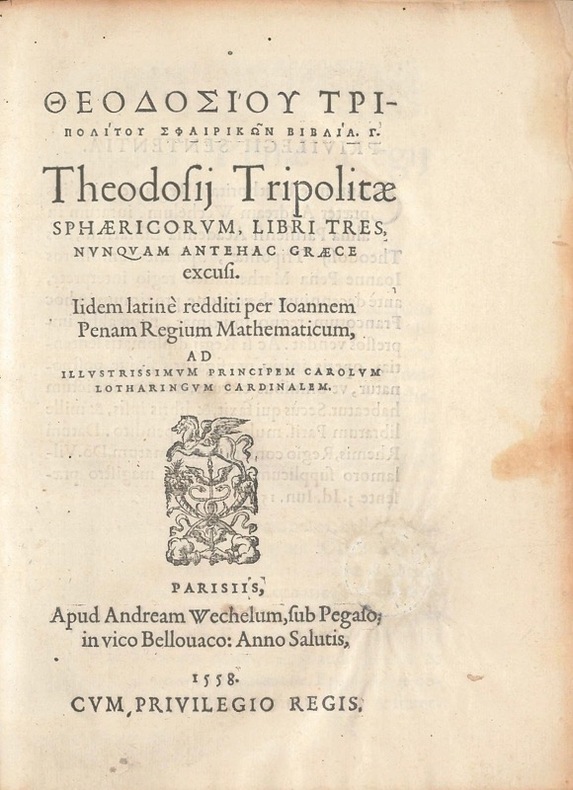
1558Best.-Nr. 11535Paris Andréas Wechel 1558 in-4 demi-veau marron, dos à faux nerfs, orné, pièce de titre rouge [Rel. mod. à l'imitation], légères mouillures et restaurations intérieures, accroc au titre