4,805 results
1709ref. 45238Paris Jean Boudot 1709 a. 1711. 4to. Without wrappers. Extracted from "Mémoires de l'Academie des Sciences. Année 1708" and Annèe 1709. Pp. 339-365 a. 1 folded engraved plate pp. 320-350 a. 1 folded engraved plate. First printing of two importent papers in the further development of Cartesian analytical geometry."The irrepressible Michel lRolle.in the Memoires of the Academie des Sciences for 1708-1709 the papers offered raised doubts about the correctness of the Cartesian graphical solution of equations as he had about the validity of the calculus of L'Hospital. He pointed out that to solve fx= 0 one arbitrarily chooses a curve gxy = 0 and on combining it with fx = 0 one obtains new curves hxy = 0 the intersection of which with gxy = 0 furnish the solution of fx = 0; and he realized that in this way extraneous solutions may be introduced. Imaginary branches further comp0licated the problem and although Rolle sawthe difficulties he was unable to solve them."Boyer "History of Analytical Geometry" p. 155. unknown
1834ref. 41598Berlin G. Reimer 1834. 4to. No wrappers. In "Journal für die reine und angewandte Mathematik. Hrsg. von A.L. Crelle" Bd. 12 Heft 1 IV88 pp. the whole issueHeft 1 offered with titlepage to volume 12. Jacobi's paper: pp. 1-69. a. 1 engraved plate. First edition of a main paper dealing with n-dimensional geometry."Of the papers devoted to n-fold integrals Jacobi's 1834 paper "De binis quibuslibit." is of crucial importence in this connection the theory of algebraic forms of variables. Here besides the problem of computing multiple integrals an importent problem of the theory of algebraic forms is solved." Andrei Nik. Kolmogorov. unknown
1829ref. 41605Berlin G. Reimer 1829. 4to. No wrappers. Extracted from "Journal für die reine und angewandte Mathematik. Hrsg. von A.L. Crelle" Bd. 4. - Plücker's paper pp. 349-370 First edition of a major paper in the arithmetization of geometry introducing the so-called triangular coordinates. "In 1829 Plücker contributed to Crelle's Journal the paper offered here with a revolutionary point of view that broke completely with the old Cartesian view of coordinates as line segments. The equation of a straight line in homogenous coordinates has the form ax by ct=0.Plücker saw that one could modify the usual language and call abc the homogenous coordinates of a line.Plücker had discovered the immidiate analytic counterpart of the geometric principle of duality about which Gergonne and Poncelet had quarreled; it now became clear that the justification that pure geometry had sought in vain was here supplied by the algebraic point of view." Boyer History of Mathematics. unknown
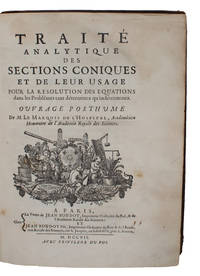
1707ref. 48217Paris Jean Boudot et Jean Boudet fils 1707. 4to. Contemporary full calf. A bit of cracking to front hinges so that cords are seen but cover not loosening. Spine with 6 raised bands richly gilt compartments. Wear to top of spine. Two small old paperlabels one to upper compartment one to frontcover. Covers slightly rubbed. 44595 pp. Large woodcut vignette on titlepage 2 other vignettes one engraved one in woodcut. 32 folded engraved plates and one smaller folded plate Fig. A. An old owners stamp on flyleaf. Internally clean and fine. A few tiny brownspots. Wide-margined and printed on good paper. Scarce first edition of l'Hôspital's second book - his second successfull textbook - the manuscript of which was left completed at his death in 1704. His first book "Analyse des infiniment petits pour l’intelligence des lignes courbes" 1696 was the first textbook of the differential calculus and his name lives on in the name of the rule for finding the limiting value of a fraction whose numerator and denominator tend to zero. His mathyematical teacher was Jean Bernoulli.The year in which Newton published the anti-Cartesian "Arithmeticus" there appeared in France a conspicuously successfull textbook on Cartesian geometry along the lines of that of Guisnée. This was the "Traité Analytique des Sections Coniques". a book which contains less original material than that of Guisnée but which is more extensive and closer to the modern manner of treatment. The work had been intended for publication at the time the authors famous calculus textbook appeared in 1696 but l'Hospital's illness apparently led to delay and it appeared posthumously in 1707. It is Cartesian in emphasis and although it consists of but one volume follows generally the tripartite plan of Lahire and Ozanam: first an algebraic quasi-analytic treatment of the Conic Sections along the lines of Apollonian theory; then an analytic study of the loci and finally a long section on the customary construction by conics of the roots of cubic and quartic polynominal equations. LHospital sometimes used two axes and seems to have recognized the interchangeability of these but he betrays some hesitation. In general L'Hospital like Descartes was more interested in analytic geometry as a measure of ecpressing loci algebraivcally than as a method of deriving the properties of a curve from its equation." Carl B. Boyer "History of Analytic geometry" pp. 150-154. hardcover
ref. DADAX0387947345New unknown
ref. DADAX144192339XNew unknown
ref. DADAX1461464811New unknown
ref. DADAX1461284767New unknown
ref. DADAX1461440416New unknown
ref. DADAX1461287561New unknown
ref. DADAX3642864996New unknown
ref. DADAX1436769469New unknown
ref. DADAX1436562481New unknown
ref. DADAX1436645301New unknown
ref. DADAX1436906113New unknown
ref. DADAX1436955246New unknown
ref. DADAX143692748XNew unknown
ref. DADAX1436982510New unknown
ref. DADAX1849969337New unknown
ref. DADAX0130625604New unknown
ref. DADAX012185860XNew unknown
ref. DADAX0120887355New unknown
ref. DADAX0195104951New unknown
ref. DADAX0201711125New unknown
ref. DADAX0387903577New unknown