4,199 results
1835pp. 160, 112. Illustrated with diagrams and drawings. Some damp stain and age stain. Early Lititz ownership. Small loss on front paste down. 12mo. 190 mm. Original full roan binding. Original gold lettered leather spine label. Hardbound. Very good copy. SCIENCE BOX 1
ref. 4847aafHaarlem, Joh. Enschede, 1946, in-4°, II + 121 p., with 26 figures and 3 maps, and bibliography of 202 titles + 1 leaf (Stellingen), original wrappers.
1859ref. 42296(London, Richard Taylor and William Francis, 1859). 4to. No wrappers as extracted from ""Philosophical Transactions"" Vol. 149 - Part I. Pp. 61-90. Clean and fine.
1859ref. 42296London Richard Taylor and William Francis 1859. 4to. No wrappers as extracted from "Philosophical Transactions" Vol. 149 - Part I. Pp. 61-90. Clean and fine. First appearance of this pathbreaking paper in which Cayley unites 'Metrical Geometry' and 'Projectice Geometry' by introducing "imaginary" elements to metrical properties."The fundamental notions in metrical geometry are the distance between two points and the angle between two lines. Replacing the concept of distance by another also involving "imaginary" elements Cayley provided the means for unifying Euclideangeometry and the common non-Euclidean gemoetries into one comprehensive theory."Bell in "Men of Mathematics".In non-Euclidean geometry prepared the way for Klein's splendid discovery that the geometry of Euclid and the non-Euclidean geometries of Lobatchewsky and Riemann are all threee merely different aspects of a more general kind of geometry which includes them as special cases.Dealing with the relations between metrical and projective geometry Klein remarks In "Entwicklung der Mathematik" Teil I p. 148: "Vor allem kommt für uns sein Cayley's berühmtes 'A Sixth Memoir upon Quantics" im betrachtt. Quantioc heisst soviwel "Form" d.h. homogenes Polynom von zwei drei oder mehr Variablen wonach man binäre tertiäre usw. Formen unterscheidet." unknown
VG brown cloth boards show some small patches of wear, particularly along the edge of the spine. Contents are clean, and the binding is solid. Sixth Edition, octavo pp 311. A study of all aspects of geometry with examples of each fact given and excercises to illustrate it.
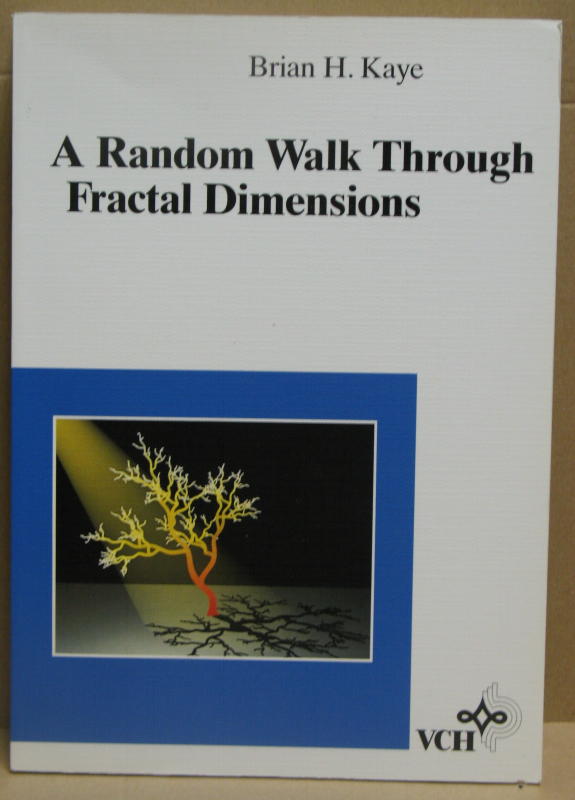
1989ref. 35078Weinheim, New York, etc., VCH Verlagsgesellschaft, 1989. Gr.8°; 421 pp.; [Englisch]; 1. Edition Orig.-Broschur geringe Gebrauchsspuren / good
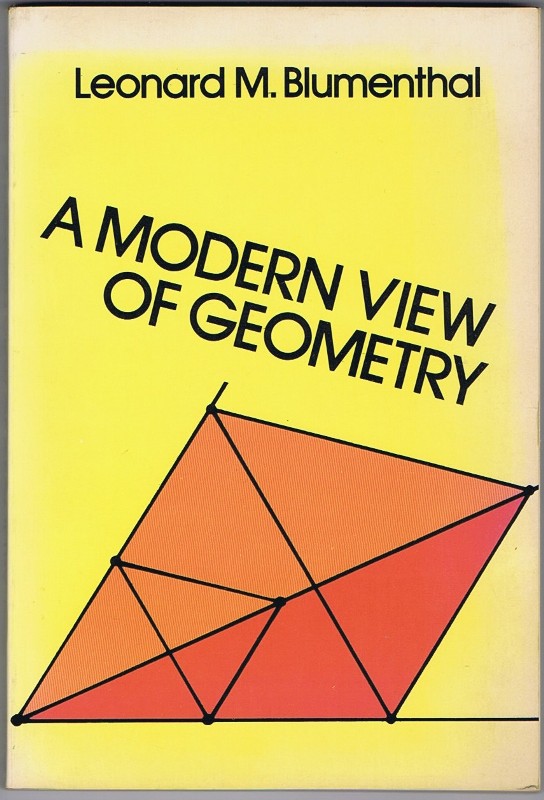
1980ref. 20587New York, Dover Publications, 1980. 8°, XII, 191 S. mit Index, 8 Bl. mit Verlagsanzeigen, kartoniert. This Dover edition, first published in 1980, is an unabridged and corrected republication of the work originally published in 1961 by W. H. Freeman and Company. Name auf Vorsatz. Einband lichtrandig.
1999ref. 296377Cambridge University Press, 1999. VIII,135 Seiten. Originalbroschur.
1835ref. 57591No place 1835. old sheep and marbled boards. Binding rubbed; tight and sound. 8vo. The owner's dated signature appears inside the front cover. hardcover
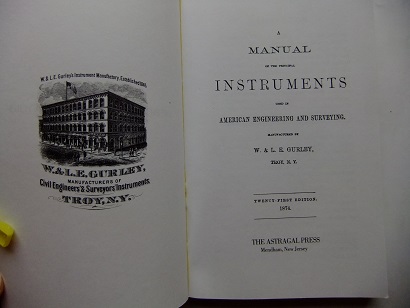
1993ref. 128688Mendham. Ney Jersey. The Astragal Press. 1993. (4), 217, (8) pages. With a lot of illustrations. Original softcover binding. 22x14 cm
1963ref. 91857CBNew York, Dover, (1963). 8°. XVIII, 451 S. mit zahlr. Formeln u. Diagrammen im Text. Illustr. OKart. (Dover books on advanced mathematics).
1947451pp VG/none reprint of 1940 edition, owner inscription on pastedown, some light waving on upper margin of preliminary pages, otherwise a very good copy, with clean and bright boards. The standard work on the subject. Scarce even in this reprint edition.
1983A. V. Bitsadze, D. F. Kalinichgenko A collection of problems on the equations of mathematical physics. , Mir Publishers 1983, Sovraccoperta plastificata con segni d'uso ai margini. Copertina in piena pelle. Tagli con fioriture. Buono (Good) . Copertina rigida 334
1950Very Good English Original b/w photography on a cardboard. Some cracked on photo. A good copy. Oblong: 31 x 82 cm. According to the Harvard archives and the program of that congress, there are around 650 mathematicians and scientists who attend to this congress worldwide including also Turkey. Nazim Terzioglu, (1912-1976), was one of the first mathematicians in Turkish academia. After his early career, upon completion of his education in Germany, Terzioglu began to work as an assistant of Mathematical Mechanics and Advanced Geometry in the Institute of Mathematics of the Faculty of Science of Istanbul University in 1937. He became associate professor in 1942 and the following year, he was appointed to professorship in the newly established Institute of Mathematics of the Faculty of Science of Ankara University (1943). After spending two years in this faculty, he returned to Istanbul University as a professor (1944). He worked as the Dean of the Faculty of Science in 1950-1952. During the same period, Terzioglu established some of the scientific institutions for which Turkey had felt the major need until those years. These are the Institute for Geophysics of Istanbul University, the Institute for Hydrobiology in Istanbul Baltalimani and the Cosmic Ray Institute which Terzioglu founded at Uludag, Bursa in cooperation with Prof. Dr. Adnan Sokullu and Prof. Dr. Sait Akpinar. After his deanship in the Faculty of Science, he became the Chairman of the Analysis Division of the Institute of Mathematics in the same faculty (1953).
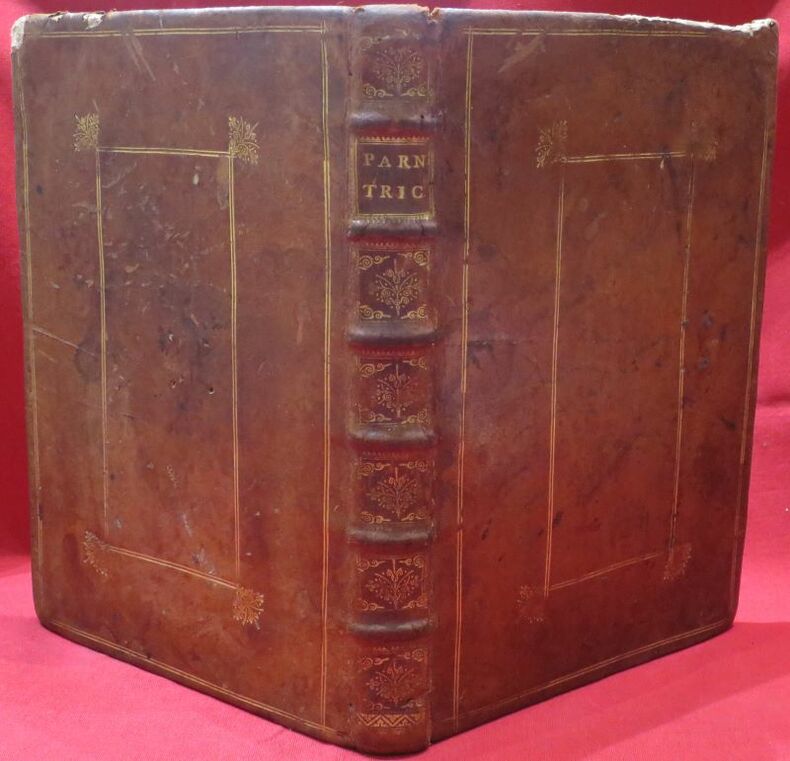
ref. 109902Turin Augustae Taurinorum [Turin], Ex Typographia Caroli Janelli, 1657, 1 volume in-folio de 300x210x35 mm environ, 1f.blanc, 9ff. (faux-titre, frontispice gravé, titre, epitre, lectori, Epigramma, Index), 376 pages, 1f.blanc, pleine basane fauve, dos à nerfs portant titres dorés, orné de caissons à motifs dorés, double encadrement des plats de filets dorés avec fleurons à chaque angle, contreplats marbrés avec une ex-libris sur le premier et traces d'étiquettes arrachées, un titre-frontispice de Giovenale Boetto, tranches mouchetées de rouge. Frottements épidermures et petits accrocs sur le cuir avec des manques de matière sur coins et coupes, rousseurs fortes par endroits et pages brunies, des mouillures dans les marges, des pages tachées. Texte en latin orné de belles lettrines de bandeaux, culs-de-lampe, et de figures dans le texte.
18742 vol. in-folio relié demi-chagrin noir, plats de percaline bordeaux avec mention au plat sup. "Ecole Polytechnique 1874-1875 ou 1875-1876 - P. J. Gaillac", 44 ff. et 33 ff. (en grand nombre de dessins et de lavis sont en double page) Rare et beau recueil de dessins et de lavis réalisés par P. J. Gaillac durant ses études à l'Ecole Polytechnique. On trouve dans le premier recueil des dessins d'architecture (soubassement du Palais de la Chancellerie à Rome), de beaux lavis techniques (Théorie du Lavis des volumes, Tore en saillie, tore en creux, tores composés), des dessins du Cours de géométrie descriptive (Exercices d'ombres, Projections côtées, Perspective, Perspective linéaire, Ombres linéaires d'un tore Ombre du piédouche, Vis à filet triangulaire) des dessins du Cours de stéréotomie (Croupe biaise, Limon d'escalier en courbe rampante, Coupe des Pierres avec descente biaise, Arche biaise, Voûte sphérique, Berceau coudé, Escalier suspendu), et une dizaine de dessins d'art. Dans le second recueil, on peut découvrir des dessins techniques réalisés dans le cadre des Cours de mécanique et de machines (Engrenages, Engrenages coniques) dont quelques belles aquarelles (Boulons, Pivot et Crapaudine, Meule, Palier graisseur), des dessins d'architecture (les différents ordres, un beau lavis intitulé Projet de Bibliothèque, lavis de Corps de garde, Projet de restaurant, de mairie, de gare), ou des oeuvres réalisées dans le cadre des cours de dessin ou librement (d'après l'antique, un écorché, et se termine avec trois beau lavis de militaires (un cuirassier, un artilleur et un fantassin). Bon état (dos et mors frottés, 1 f. faible, bel état intérieur) pour ce beau et rare témoignage des études à l'Ecole Polytechnique au lendemain de la défaite de 1870. Français
1874ref. 158772 vol. in-folio relié demi-chagrin noir, plats de percaline bordeaux avec mention au plat sup. "Ecole Polytechnique 1874-1875 ou 1875-1876 - P. J. Gaillac", 44 ff. et 33 ff. (en grand nombre de dessins et de lavis sont en double page)
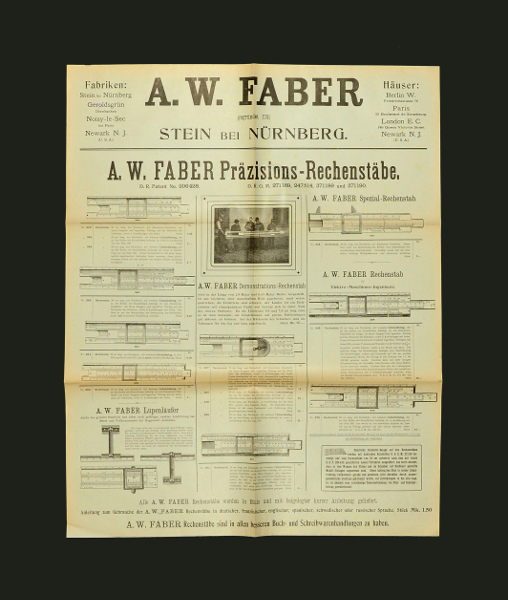
1900ref. 44631Stein bei Nürnberg, A. W. Faber, o. J. (um 1900). Illustr. Orig.-Plakat (70 x 55,5 cm).
1985ref. 148499Nördlingen. Greno Verlag. 1985. 110 Seiten. Originalbroschur. 30x22 cm
2005ref. 1211088Berlin ; Heidelberg ; New York : Springer, 2005. XIII, 629 S. : Ill., graph. Darst. ; 24 cm gebundener Originalpappband
2005Erste Auflage. Sehr sauber und frisch erhalten, keinerlei Einträge. Das leider kopiergeschützte Inhaltsverzeichnis hier d-nb.info/973330449/04 . Verlagsprosa: Schon lange bevor die Schrift entwickelt wurde, hat der Mensch geometrische Strukturen wahrgenommen und systematisch verwendet. So entstehen beim Weben und Flechten einfache zweidimensionale Muster und ohne dreidimensionale Körper wie Quader, Würfel oder Pyramide ist keine Bautätigkeit denkbar. Das vorliegende Buch gibt einen faszinierenden Überblick über die geometrischen Vorstellungen und Erkenntnisse der Menschen von der Urgesellschaft bis hin zu den komplexen mathematischen wie auch künstlerischen Ideen des 20. Jahrhunderts. Neben vielen Abbildungen wird jede Epoche mit einer Tabelle zeit- und kulturgeschichtlicher Daten eingeleitet und mit einer tabellarischen Darstellung der wesentlichen Inhalte der Geometrie dieser Zeit abgeschlossen. Aufgaben am Ende jeden Kapitels laden den Leser ein, sich an den Problemen der alten Meister selber zu versuchen. Ein Buch für alle, die der Lebendigkeit und Entwicklung der Geometrie als erste "Anwendungswissenschaft" nachspüren wollen. ISBN 9783540224716
1923ref. 17973Leipzig/Berlin, Verlag B.G. Teubner, 1920/1923. gr. 8°, 370 S., 362 S., Band 1 mit 289 Figuren im Text und 3 Tafeln, Band 2 mit 328 Figuren im Text, Bezahlung per PayPal möglich, we accept PayPal, Einband ger. beschabt und ger. bestoßen, altersbedingte Bräunungen, sonst min. Gebr.sp., Halbleinen
1683-1688-1687, 3 volumi in uno, in 12°, rilegatura coeva in pelle, tit. e decorazioni in oro al dorso che è diviso da 5 nervi , tagli colorati, p. (24), 163, (5); (24), 240; (12), 58, (2), numerose incisioni nel testo e complessivamente 9 tavole ripiegate f.t. Ex libris nobiliare al 1° piatto, ordinata collazione dei volumi a matita al risguardo. Qualche leggera brunitura, qualità della carta
1996Kline Morris 1: Dall'antichità al Settecento. Torino, Einaudi 1996, Copertina cartonata, lievemente sporca. Tagli e pagine sporchi di polvere e ingialliti.Collana:"Biblioteca Studio 33". Buono (Good) . 751 8806137549
1797ref. 88RARE FIRST EDITION OF LORENZO MASCHERONI's TREATISE ABOUT THE USE OF THE COMPASS IN GEOMETRY UNTRIMMED AND UNCUT COPY IN ORIGINAL PAPER WRAPPER Mascheroni Lorenzo. La geometria del compasso di Lorenzo Mascheroni. Pavia : presso gli eredi di Pietro Galeazzi anno V della Repubblica francese 1797. 8to 223 x 130 mm original printer's wrappers; pp. 2 XVIII 264 14 leaves of folding plates woodcut decoration at title page friezes and headletters. The principle of economy in geometric constructions First edition of Mascheroni's most important work with a dedication in verse to Napoleon in which he proves that any geometrical construction of Euclidean geometry can be carried out by means of compasses alone admitting that a straight line is constructed once two of its points have been defined thus demonstrating how a certain principle of economics in geometric constructions proclaimed by all the great mathematicians of the past from Pappus to Descartes was regularly and violated by the use of two tools where only one was enough. His approach was to first demonstrate how to use the compass alone to bisect a given arc of a circle add and subtract two given segments find the fourth proportional given three segments find the point of intersection of two given lines and the points of intersection between a given line and a circle. At this point Mascheroni theoretically demonstrated how all constructions completed with ruler and compass can be considered as a composition of the elementary operations defined above and therefore obtained using only the compass. In the spirit of the Enlightenment this work is not meant to be just theoretical but is also designed to facilitate the construction of precision instruments. Although some authors such as the Danish G. Mohr had sought before Mascheroni the solution of certain geometrical problems by using the compass alone he was able to deal with the subject of the geometry of the compass with such depth and in such a general way to make his forerunner forgotten. Lorenzo Mascheroni 1750 - 1800 was an Italian mathematician scholar and academic who since 1778 taught physics and mathematics at the Bergamo seminary. His most important contributions concern mathematical analysis with studies related to integral calculus and natural logarithms construction science with its original studies on arc-breaking calculus and geometry with the demonstration that solvable problems with row and compasses can also be solved with just the compass. His name is also linked to the Euler-Mascheroni constant of which he calculated the first 32 decimal digits. The Euler – Mascheroni constant also called Euler's constant is a mathematical constant recurring in analysis and number theory usually denoted by the lowercase Greek letter gamma γ. It is defined as the limiting difference between the harmonic series and the natural logarithm. Napoleon whose passion for science and mathematics is known met Mascheroni in 1796 during the invasion northern Italy and was intrigued by his theories ion the use of the compasses becoming they say a great expert. "General we could expect from you everything but geometry lessons": with this sentence the mathematician Laplace and Lagrange welcomed Napoleon's explanations on Mascheroni's constructions whose book just a year after the Italian edition in 1798 was translated into French by Charette. Conditions: Light marks of use along the text small warmholes never touching the text in general very good copy printed on strong paper untrimmed and uncut in its original paper wrapper. References: RICCARDI P. "Biblioteca Matematica Italiana Milano 1952 vol. 1 134 9.1 "Pregiata e Rara". Pietro Galeazzi paperback