(Book of Common Prayer)Biblio.com
4.213 Ergebnisse
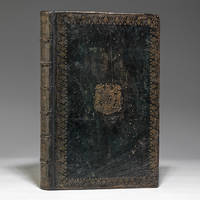
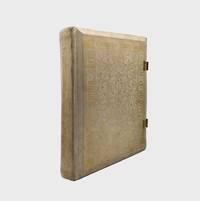
1893Best.-Nr. 254927New York: Printed for the Convention 1893. First edition according to the Standard of 1892. 28 566 2 pp. Title printed in red and black with floriated borders by Bertram Grosvenor Goodhue title in black letter. 1 vols. Folio. Original heavily gilt decorated vellum over boards with brass fore-clasps t.e.g. others untrimmed ribbon marker. Binding a bit dust soiled with bruises to foretips and small chip from lower corner of front pastedown front inner hinge cracked but webbing sound some occasional dust and finger smudging to the margins of the early leaves bookplate and small label on front pastedown some bleed-through on the title from the array of original ink signatures on the verso otherwise about very good. First edition according to the Standard of 1892. 28 566 2 pp. Title printed in red and black with floriated borders by Bertram Grosvenor Goodhue title in black letter. 1 vols. Folio. Copy #12 of the limited issue of the revised Book of Common Prayer overseen by D.B. Updike and signed in ink on the verso of the title of many of the principals associated with the revision approved at the 1892 General Convention including financier J.P. Morgan who helped fund the edition's publication. The limited edition was prepared in two forms one being this form intended for distribution to each diocese and jurisdiction within the Church with original signatures on the verso of the title and with a variant title all in black letter without border. The standard limited edition of 500 copies on handmade paper has the signatures of the principals in printed facsimile and a foliated border around the title resembling those around the main text and the central "Laudate Dominum" device and the two lines: "Together with the Psalter or Psalms of David." Updike comments at length on this project in his introduction to NOTES ON THE MERRYMOUNT PRESS and about his role in the attempted rescue of an ill-conceived attempt to produce a decorated edition from the plates of the 1892 printing: "The best things about the book were the cover and charming end-papers which Goodhue designed for it. Sad to relate the edition had an immediate and resounding success! We were congratulated and we blushed. Our shame was taken for modesty and we were congratulated more! While the book is indeed a strange one it is by no means so strange as the designs originally made for it" see pp. 9-10. Nonetheless the experience was an important prelude to the production in 1928 of Updike's own edition widely regarded as his finest work. Laid into this copy is a photocopy of the 4pp. leaflet ON THE DECORATIONS OF THE LIMITED EDITION OF THE STANDARD PRAYER BOOK OF MDCCCXCII. Griffths 1893; Updike Notes on the Merrymouth Press & Its Work p. 9; John Clyde Osborn Catalogue of Work of The De Vinne Press Exhibited at the Grolier Club p. 15 Printed for the Convention unknown
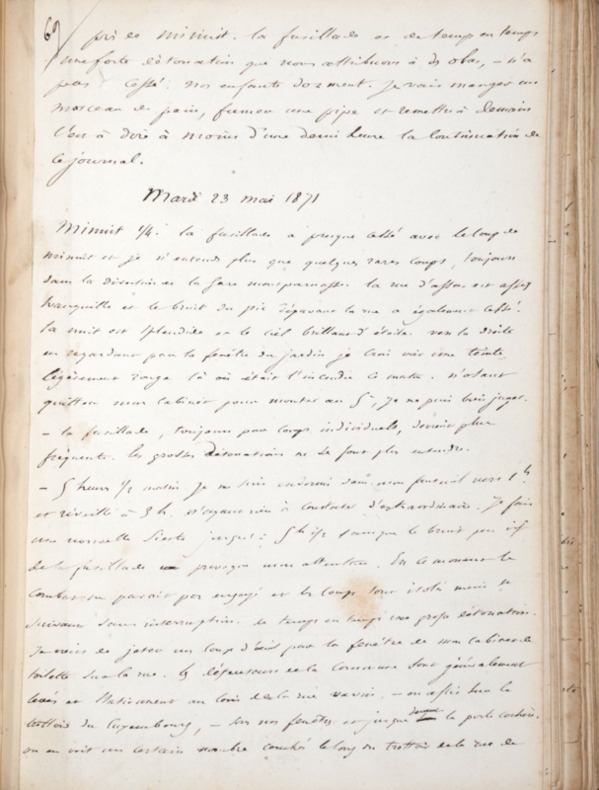
1871Best.-Nr. 41289Paris, , 1871. In-8 manuscrit en belle page (15 x 21 cm) de (2)-131 ff. montés sur onglet à 30 lignes par page, demi-chagrin vert, dos à nerfs, titre doré (reliure de l’époque).
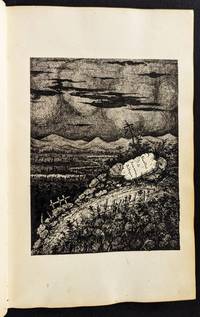
Best.-Nr. 11588vo. 186x 119 mm. 7 ¼ x 4 ½ inches. 1-14 1 15-19 21-24 1 25-29 1 30-36 1 37-90; folios 74 and 83-90 blank except for page numbers and 4 lines on fol. 85 verso; plus 18 blank leaves at the end followed by 1 leaves containing 3 index pages and 1 final blank leaf. Manuscript section tiles in outline capitals on separate leaves included in foliation. Complete the gap between folios 19 and 21 is a foliation error. Ruled borders throughout. Text in brown ink in a flowing cursive hand varying lines numerous insertions and deletions. The manuscript on wove paper is illustrated with 20 pen-and-ink drawings of which 7 full-page on rectos with verso blank the first five not included in the foliation and 13 half-page or smaller plus 2 small ornaments. Bound in black straight-grain morocco covers gilt paneled central panel with arabesque tooling at corners smooth spine with gilt title cartouche lettered “Bluettes” from which extend triple gilt fillets terminating in ornaments at head and tail gilt edges with moiré satin endleaves; binding a bit rubbed with corners bumped. A manuscript of poems and short prose pieces all in a romantic vein illustrated with quite accomplished pen-and-ink drawings presumably by the author whose name and the date of the manuscript are supplied on the verso of the front free endpaper: “Le Baron Achille de Cholet / Officier á l’Etat-Major / 1836”. In the first poem Aux Dames the poet calls himself a “novice Ecolier” implying youthfulness and the date of 1836 on the front fly leaf is probably at the time of writing although some of the many corrections and deletions may have been added later. The titles of the other poems or groups of poems are : Le Rin Le Déserteur L’Isolement L’Impiété Un Croix sur la Montagne La Mère du Prisonnier L’Avenir / á Melle Francine d’Hurbal Rheyms Séparation L’Enfant perdu L’Adieu au Plaisir La Campagne / á Mr le Vicomte Alfred de R. . . Le Cloches du Soir La Neige Les Pauvres and Le Jour des Rois . . . These stolid sentimental poems and prose impressions reflect the prevailing Romanticism of the period as do the far more skillfully executed pen-and-ink drawings that illustrate them. Somber or dreamlike with dark cross-hatching contrasting with lighter areas the drawings show a dark tunnel under a rocky mountainside a soldier in a garret or prison a cloaked barefoot man an emblematic trophy with musical instruments and weaponry a raven perched on ruined tombstones and columns a domestic scene of father and daughter a women on her knees the façade of Reims Cathedral surrounded by swirling clouds architectural details of cathedrals several surrounded by decaying facades and vignettes of crumbling chateaux pastoral churches and snow-covered gatehouses all of which reflect the vogue for l’ancienne France and the “pittoresque” as notably popularized by Nodier and Taylor in their Voyage pittoresque et romantiques dans l’Ancienne France 23 volumes 1820-1878. Achille de Cholet was descended from an ancient Anjou noble family according to his obituary in 1888 in the Bulletin héraldique de France vol. 7 235-6. He became an officer in the Légion d’honneur and was well known for his important topographic researches in the south of France. A few of the pieces in the manuscript are dedicated to aristocrats mainly female. It seems likely that the Baron shared his family’s Royalist views: his father had died in exile and his brother whose first name is not given in the obituary was an “ardent champion of the Royalists press” and author of a book title Madame en Vendée relating the attempted coup in 1832 of the duchesse de Berry mother of the Prentender the Comte de Chambord which was pursued and effectively banned by the tribunals indeed the work appears not be recorded in OCLC or other online OPACs. Thanks to Nina Musinsky for this description. . unknown
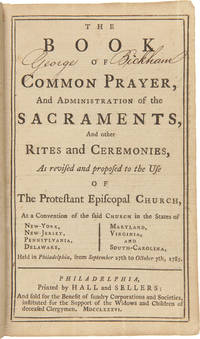
1786Best.-Nr. 34053Philadelphia: Printed by Hall and Sellers 1786. The Suppressed Original Episcopal Book of Common Prayer The American Protestant Episcopal Church was founded after the American Revolution as an adaptation of the Church of England in the new United States. The church was founded at a convention in Philadelphia in 1785 at which it was agreed to create a separate prayer book. The present title is the result and it caused great controversy upon its publication. Among the ill-considered revisions were "changes and omissions of such drastic nature as among other things the deletion of the Nicene and Athanasian Creeds. The Proposed Book proved unwelcome to clergy and laity even its suggestion of a prayer for the Fourth of July being taken exception to. Its use was brief and not general" Page. "This edition contains the alterations which were intended to adapt the Book of Common Prayer of the Church of England to the changed political conditions of this country; and is the result of a convention held in Philadelphia in 1785 presided over by the Reverend William White. The proposed Prayer Book met with much criticism and opposition in the church owing to its radical changes and was never adopted" - Evans. Rare. 12mo. Contemporary calf original endpapers. Binding crackled chipped at spine ends boards detached. A few leaves trimmed close four leaves with edge wear resulting in minor loss to a few letters. Leaf Gg3 a bit rumpled with a closed horizontal tear. Withal a good copy in unsophisticated condition with the contemporary ownership signature of "George Bickham" on the front free endpaper titlepage and contents page. In a gilt morocco solander case spine richly gilt. EVANS 19940. PAGE THE BOOK OF COMMON PRAYER 51. GRIFFITHS 1786 9. BRITTON & LOWENS AMERICAN SACRED MUSIC IMPRINTS 409. ESTC W29995. hardcover
1754Best.-Nr. 1216301754. BOOK OF COMMON PRAYER. The Book of Common PrayerÉ Cambridge: Printed by Joseph Bentham printer to the University by whom they are soldÉ and by Benj. DodÉ in London 1760. Tall folio 10-1/2 by 16-1/2 inches full contemporary dark green morocco rebacked with elaborately gilt-decorated spine laid down with crowned monogram of George II in compartments covers with elaborately gilt-tooled borders and gilt centerpiece featuring the arms of King George II raised bands later marbled endpapers evidence of silk ties. $7500.Splendid folio Cambridge edition of the Book of Common Prayer in a beautiful armorial George II binding with broad gilt-tooled borders elaborate royal cypher in spine panels and splendid gilt centerpiece on each cover featuring the arms of King George II and text hand-ruled in red throughout.Born of Thomas Cranmer's desire for liturgical texts upon which all of Europe's Protestant English-speaking churches could agree the Book of Common Prayer first issued in 1549 with its magisterial liturgical language is ""as a source of spiritual inspirationÉ for most Englishmen second only to the Bible"" PMM 75. This finely printed Cambridge editionÑset in large type with wide margins and hand-ruled in red throughoutÑboasts an impressive royal binding bearing the gilt monogram and crown device of King George II in the spine compartments and his gilt embossed armorial design on both boards within an ornate floral border. Griffiths 1754:1. Owner ink signature.Some faint foxing a very few leaves with light edge-wear. Expert restoration to lovely royal binding. hardcover
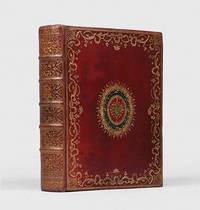
1769Best.-Nr. 160645Oxford: Printed by T. Wright and W. Gill Printers to the University and sold by R. Baldwin and S. Crowder in London; and by W. Jackson in Oxford 1769. Extra-illustrated with a complete suite of engravings A handsome binding made for the Bible trade in contemporary red morocco. This style is sometimes called "Chippendale" acknowledging the contemporary trend towards the use of decorations on bookbindings resembling those popular in other forms of decorative art. This copy has been extra-illustrated with a complete suite of 59 engraved plates The Liturgy of the Church of England London printed by Edward Ryland 1755. The designs are by Samuel Wale 1721-1786 one of the most prolific book illustrators of the 18th century this suite being mentioned in Wale's biography in ODNB though not listed in ESTC. Among the engravers was the eldest of the copperplate printer Edward Ryland's seven sons William Wynne Ryland 1733-1783 a highly skilled engraver who was hanged for issuing two forged bills drawn on the East India Company. Provenance: John William Beaumont Pease Lord Wardington 1936-2019 bookplate; Sotheby's Wardington Library of English Bibles 12 July 2006 lot 126. Large quarto 275 x 210 mm. Extra-illustrated with a suite of 59 plates including title engraved by François Ravenet Charles Grignion Louis Gérard Scotin Walker and William Wynne Ryland after Samuel Wale. Contemporary red morocco spine gilt all over within six compartments between raised bands sides richly decorated in gilt with wide border of rococo scrollwork flowers and insects enclosing a central green morocco onlay enclosing the Sacred Monogram "J.H.S." surrounded by an oval red morocco onlay tooled with stars and dots within an oval onlay of blue morocco tooled with cherubs' heads stars dots and swags the whole surrounded by a gilt gloriole gilt turn-ins marbled endpapers gilt edges. Bookplate of Jeremy & Penny Martin. Small areas of rubbing to joints sig. A4 with marginal tears at upper inner corner and outer edge neatly closed I4 with closed tear at foot entering 10 lines of text but without loss a few minor blemishes still very good overall. ESTC T81296. hardcover
1723Best.-Nr. 1197771723. BOOK OF COMMON PRAYER. The Book of Common Prayer and Administration of the Sacraments. London: John BaskettÉ and the Assigns of Thomas Newcomb and Henry Hills 1723. Tall folio 10-1/2 by 16 inches contemporary full mottled calf expertly rebacked with original spine neatly laid down corners and spine panels with gilt device of the crown of King George I raised bands renewed endpapers all edges gilt. $8250.Beautiful early 18th-century tall folio edition of the venerable Book of Common PrayerÑ the treasury of ritual prayer and Scripture that has indelibly shaped the piety and literature of the English-speaking worldÑwith fine engraved frontispiece handsome in nicely restored contemporary calf featuring the gilt device of King George I in the corners and spine panels.Born of Thomas Cranmer's desire for liturgical texts upon which all of Europe's Protestant English-speaking churches could agree the beautiful and dignified language of the Book of Common Prayer first issued in 1549 has considerably influenced not only ecclesiastical practice but also literature in English. ""The language of the Prayer Book is now part of the whole languageÉ and as a source of spiritual inspiration it is for most Englishmen second only to the Bible"" PMM 75. This 1723 London edition is handsomely bound in full mottled calf with King George I's gilt monogram cipher in each corner of the boards as well as in each spine panel. Ornamented with fine engraved frontispiece dated 1710 decorative headpieces and woodcut initials. Griffiths 1723:1. A few ink corrections and marginal annotations.A few short wormtraces; text clean. Evidence of cloth ties corners expertly restored. A very handsome volume. hardcover
Best.-Nr. 106783London: printed by John Baskett and by the assigns of Thomas Newcomb and Henry Hills 1715. Folio 380 23 3 pp. unpaginated text ends on Aaa4 as per ESTC. Engraved frontispiece by Loggan after Caspars. Title-page printed in red and black ruled in red throughout. Contemporary red morocco covers tooled in gilt with a wide scrolled border central gilt block of the arms of the Duke of Chandos backstrip richly gilt gilt edges a lovely binding of the period in the style of Mearne skillfully restored at head and foot and along joints. Armorial bookplate of John van Hatten. § Lovely prayer book bound for James Brydges 1st Duke of Chandos 1674-1744. It once rested on an embroidered cushion in the Duke and Duchess's private pew in his magnificent chapel at Cannons described by the architect Gibbs as "the finest in England." The centerpiece of the elaborately-tooled binding is the Duke's gilt arms supported by two otters beneath a ducal coronet. Four other bindings with the block are recorded by the British Armorial Bindings database. Full description and provenance available on request. ESTC T81463. printed by John Baskett unknown books
1879Best.-Nr. 10407Londres, Imp. Delatre, Howland st. 23, 1879. 1 vol. in-folio de 1 titre, 19 planches et 1 table gravés, maroquin rouge, dos lisse orné, large roulette dorée d'encadrement sur les plats, titre frappé au centre (reliure anglaise de l'époque).
1715Best.-Nr. 1067831715. London: printed by John Baskett and by the assigns of Thomas Newcomb and Henry Hills 1715. Folio 380 23 3 pp. unpaginated text ends on Aaa4 as per ESTC. Engraved frontispiece by Loggan after Caspars. Title-page printed in red and black ruled in red throughout. Contemporary red morocco covers tooled in gilt with a wide scrolled border central gilt block of the arms of the Duke of Chandos backstrip richly gilt gilt edges a lovely binding of the period in the style of Mearne skillfully restored at head and foot and along joints. Armorial bookplate of John van Hatten. § Lovely prayer book bound for James Brydges 1st Duke of Chandos 1674-1744. It once rested on an embroidered cushion in the Duke and Duchess's private pew in his magnificent chapel at Cannons described by the architect Gibbs as "the finest in England." The centerpiece of the elaborately-tooled binding is the Duke's gilt arms supported by two otters beneath a ducal coronet. Four other bindings with the block are recorded by the British Armorial Bindings database. Full description and provenance available on request. ESTC T81463. unknown
Best.-Nr. TM 767MEDIEVAL SERMON MANUSCRIPT IN A FIFTEENTH-CENTURY CHAINED BINDING CHAIN INTACT decorated manuscript on parchment in Latin Austria Vienna or Southern Germany c. 1275-1300. 182 x 127 mm. 190 folios complete written in a rapid Gothic hand with cursive influence in two columns of thirty-two to thirty-seven lines justification 141-143 x 96-100 mm. parchment ruled in brown ink quire signatures guide notes for rubrication red rubrics capitals and names of cited authorities stroked in red rhymed phrases underlined in red red paraphs two- to three-line plain red initials two-line red initial with pen flourishing in red f. 131v occasional scribal corrections and marginalia. BINDING: Fifteenth-century blind-tooled and -stamped red calf with eight engraved and bossed cornerpieces intact fore-edge clasp and chain hasp with intact chain with two manuscript fragments serving as front flyleaf and lower pastedown. Chained libraries were a late medieval solution to the problem of providing access to needed books in an institution while at the same time preventing theft and we can assume many late medieval volumes were once chained. Most however have been rebound or survive without the chain and other metalwork and intact chained bindings such as this one are uncommon. TEXT: This extensive collection includes more than one hundred sermons from the Sermones de sanctis et de communi sanctorum of the early Franciscan writer Conrad of Saxony d. 1279 together with his very popular text the Speculum beatae Mariae virginis all copied not long after their composition. This is however not simply a copy of Conrad's sermon cycle since some of his sermons are omitted and six sermons by contemporary Dominican authors Martinus Polonus Aldobrandinus de Calvacantibus and Antonius Azaro de Parma as well as eight sermons by unidentified authors were also included. It seems likely this is an example of a re-working of Conrad's texts for a Dominican audience who would have prized it as a preaching aid and for its pronounced Marian focus. Marginal annotations attest to the early use of these sermons most likely by preachers. PROVENANCE: Written in Southern Germany or Austria at the end of the thirteenth century as suggested by evidence of spelling script and decoration. Belonged to the Dominican house attached to the Church of St. Maria Rotunda in Vienna as indicated by two fifteenth-century inscriptions; here it was probably part of the house's chained library. Belonged to a Dominican convent at KosiÄe in present-day Slovakia as indicated by a sixteenth-century inscription. Belonged to Maurice Burrus 1882-1959 Alsatian philatelist; his ex libris on the front pastedown. CONDITION: Slight rust stains and corrosion in the outer margins of ff. 184-188 margins trimmed away overall in good condition. Full description and photographs available TM 767. books
PARIS, Lib. Législative - A. WITTERSHEIM & CIE/Lib. Germer-Baillière -1872 - couverture bleue imprimée - Grand in-4 - Texte sur 3 colonnes - 590 pages - exemplaire non coupé, très frais
PARIS, P.U.F. - Fondée en 1878 par Gabriel Monod, publiée avec le concours du CNRS et de la 6e section de l'Ecole des Hautes Etudes.- Revue historique N° 603, juillet-septembre 1997 - In-8, 15,5 x 24 cm - Broché - 219 Pages - Très frais, comme neuf - Envoi rapide et soigné La Revue historique, est une revue d’histoire française créée en 1876 par le protestant Gabriel Monod et le catholique Gustave Fagniez. Cette nouvelle revue s'inscrit en réaction contre La Revue des Questions historiques créée dix ans plus tôt et qui traduisait la pensée d'une droite ultramontaine et légitimiste. La Revue historique ne se réclame d'aucune religion, d'aucun parti, d'aucune doctrine Éditée à Paris par les Presses universitaires de France